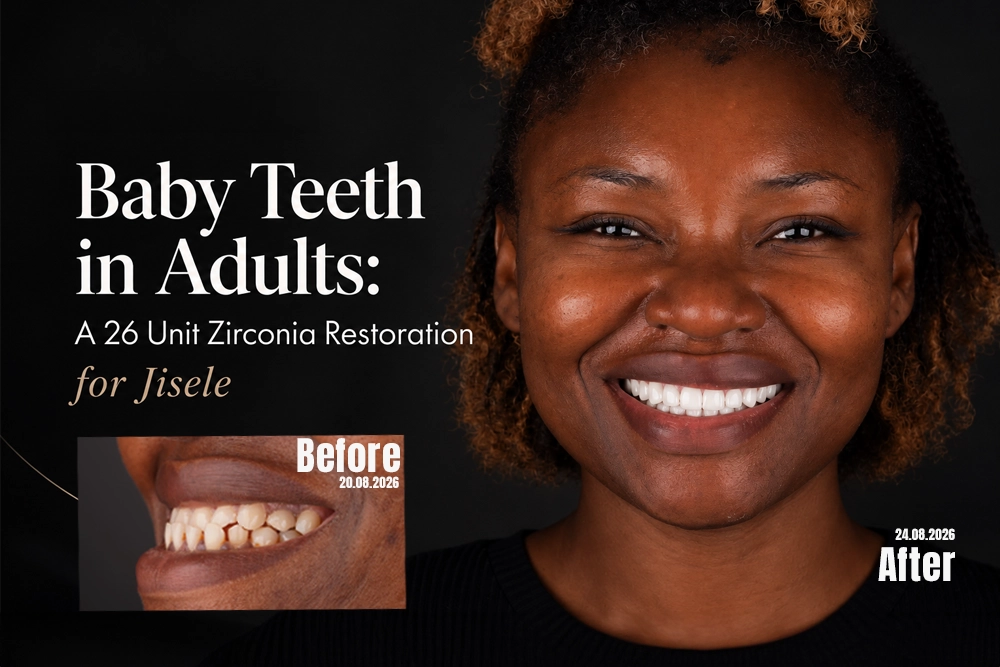
Baby teeth in adults are more common than most people expect and they rarely arrive alone as a clinical problem. Jisele, a French speaking patient treated at International Plus, still had three primary teeth in place when she came to the clinic, alongside teeth that needed endodontic and restorative work before anything could be built over them. Six teeth were removed at the first appointment and 26 zirconia units were delivered six days later. This case study follows that sequence.
Key Takeaways
- The challenge: Three primary teeth retained into adulthood inside an arch that also needed root canal treatment and fillings before any crown could be planned.
- The solution: A single treatment plan that removed six teeth first, then rebuilt both arches as one designed set rather than tooth by tooth.
- The technique: Face scanning and a mock-up approved before preparation with 26 monolithic zirconia units in shade OM3 and the clinic’s Plus 5 smile design style.
- The outcome: Definitive restorations delivered on 26 August 2026 and a night guard fitted the same day.
What Retained Baby Teeth Mean in an Adult Mouth
A retained baby tooth is a primary tooth that never fell out. Around 25% of people keep at least one longer than expected. The usual reason is tooth agenesis, the absence of a permanent successor beneath the primary tooth.
Studies show that agenesis is distributed unevenly between the upper and lower jaws (Al-Abdallah M, et al., 2015). Where no successor forms, the primary tooth then stays in service for decades. A systematic review of adult hypodontia patients reports reasonable survival of retained deciduous teeth across roughly two decades (Laverty DP, et al., 2018).
Jisele reached adulthood with 3 teeth of this kind still in place. Primary teeth are smaller than permanent teeth, which is visible in any full adult dentition and in the way individual teeth are named. For example, a narrower tooth leaves space around the neighbours and changes how the arch meets.
Jisele’s Starting Point and Treatment Plan
Jisele came to International Plus as a French speaking patient concerned about how the teeth met on closing. A treatment plan is the written sequence which fixes what happens first and the sequence here was set before any preparation began.
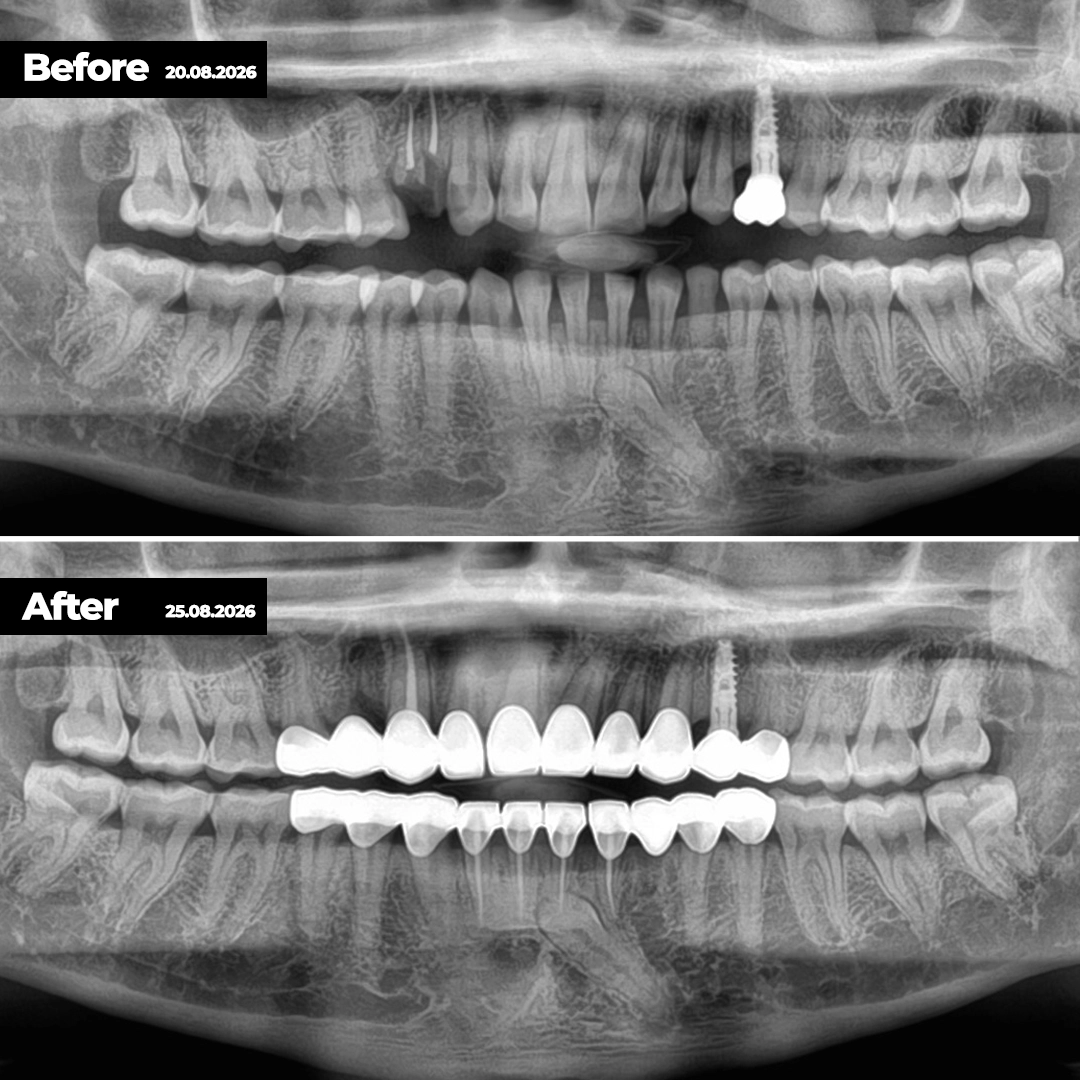
Records taken at the first appointment included photographs and a face scan. Clinical assessment identified 3 teeth needing root canal treatment and 3 teeth needing fillings, work which decides whether a tooth can carry a restoration at all. Then 6 teeth were scheduled for extraction and 3 were the retained primary teeth.
Our clinic plans such arches as a single unit rather than site by site. For example, a mock-up built from the face scan was approved before preparation, which is the working principle behind digital smile design. Treatment ran across 2 appointments 6 days apart in August 2026. Complex plans are reviewed by the clinic’s multidisciplinary Diagnostic Council rather than by one clinician working alone.
| First appointment | 20 August 2026, six extractions including three retained primary teeth |
| Second appointment | 26 August 2026, definitive restorations delivered |
| Zirconia units | 26 in total across both arches |
| Endodontic work | 3 root canal treatments |
| Restorative work | 3 fillings on natural abutments |
| Shade and design | OM3 with the Plus 5 smile design style |
| Digital records | Face scan plus an approved mock-up before preparation |
| Appliance | Night guard fitted at delivery |
Why the Extraction Stage Came First
Extraction is the removal of a tooth from its socket and in this plan 6 teeth were removed at the first appointment. 3 teeth were the retained primary ones and 3 teeth could no longer carry a restoration.
Removing a retained primary tooth changes the space the tooth occupied. Primary teeth are narrower than permanent teeth so neighbouring teeth drift over years to close around the smaller crown. The gap left behind therefore does not match the gap a permanent tooth would leave.
Follow-up research has compared orthodontic space closure against implants and tooth supported bridges in severe hypodontia. Studies show no single answer suits every arch (Hvaring CL, et al., 2016). In practice our clinic settles the final arch shape first, then designs what sits above. Preparation of the remaining abutments ran alongside since a tooth treated through endodontics is structurally different from an untreated one as our root canal before crown case sets out. Healing follows the standard tooth extraction aftercare protocol.
Rebuilding Both Arches With 26 Zirconia Units
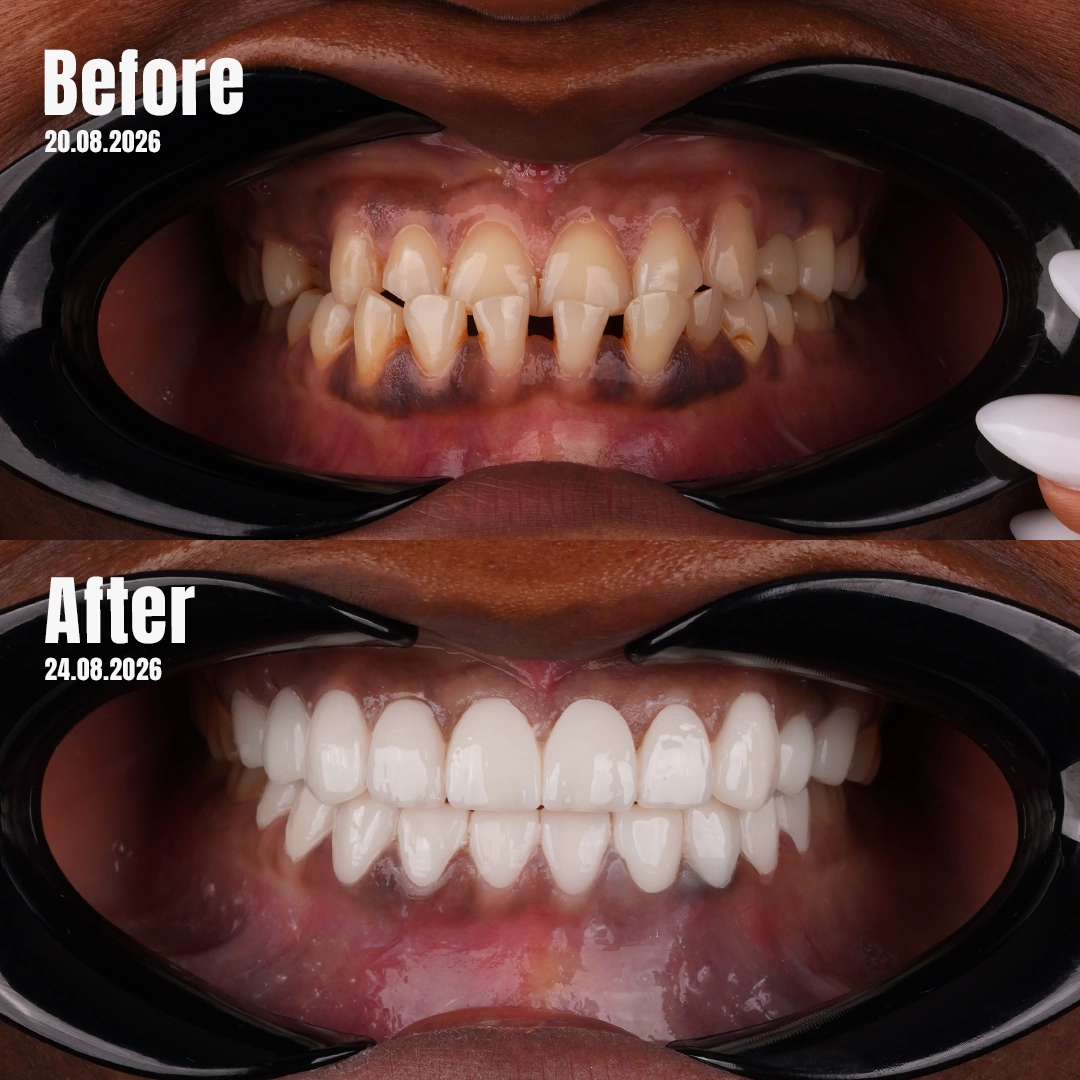
The restorative phase delivered 26 monolithic zirconia units across both arches in shade OM3. A unit is a single crown or one element of a bridge so 26 units means 26 separate restorations designed together as one set.
Design followed the clinic’s Plus 5 smile design style. Both arches were planned together because a rebuild spread across the upper and lower jaw must meet itself when the patient closes. Working arch by arch would have made that impossible to verify.
Restorations were then milled in the clinic’s on-site digital laboratory, the same route used for every dental crowns case and documented in our zirconium crown rehabilitation case. Definitive units were delivered 6 days after the extractions rather than across an international shipping cycle. Jisele’s whole treatment ran inside one stay in Istanbul. Our clinic has used the same on-site route since 2014.
Why Monolithic Zirconia Was the Material Choice
Monolithic zirconia is a ceramic milled from a single block rather than layered with surface porcelain. No veneering layer exists to chip away from the core.
Studies show consistent clinical performance for this material class. A systematic review and meta-analysis examined monolithic CAD/CAM tooth supported zirconia restorations (Leitao CIMB, et al., 2022). A separate review compared survival and complication rates for zirconia-ceramic against metal-ceramic single crowns (Pjetursson BE, et al., 2018).
Material choice then followed the span of the work. 26 units carry chewing load across the whole mouth, which is a different mechanical problem from a single crown placed beside untouched neighbours. Strength therefore outranked the marginal translucency advantage a layered ceramic would have offered. For example, our clinic selects material per arch rather than applying one ceramic across every case. Readers weighing the same decision will find our guide to what a dental crown is useful.
The Result and What Jisele Left With
Jisele left Istanbul with 26 zirconia units delivered and a night guard fitted the same day. An occlusal splint is a removable appliance worn during sleep and reviews of splint types set out where the appliance helps (Albagieh H, et al., 2023). Here the guard protects a large volume of new restorative work.
A written record of the materials and shade used went with her so a dentist in her own country can service the work without guesswork. Before and after photographs were taken with consent on file. Patients researching baby teeth in adults often arrive with alignment concerns rather than structural ones and may find our article on crooked teeth a closer starting point.
This is one patient’s recorded outcome and individual results may vary. International Plus has treated more than 200,000 patients from over 140 countries since 2014. The clinic holds a rating of 4.8 out of 5 across 5,504 reviews but no clinic can promise an identical result because every arch starts from a different place.
Book a consultation with International Plus if a baby tooth never fell out and you want to know whether treatment is needed.
Frequently Asked Questions
Is it normal to still have baby teeth as an adult?
Baby teeth in adults are more common than most people assume. Around 25 percent of people keep a primary tooth longer than expected, usually because no permanent successor formed beneath it. Many of these teeth stay functional for years. A dentist assesses the root and the surrounding bone before deciding whether anything needs to be done.
Do retained baby teeth always have to be removed?
No. If the tooth is well aligned and the root and supporting bone are sound, it can be left in place or modified restoratively. Extraction is considered when the tooth causes problems when it has resorbed significantly or when it sits below the level of the neighbouring teeth.
What replaces a baby tooth once it is extracted?
That depends on the gap and the teeth around it. Options include closing the space, a tooth supported restoration or an implant placed once the site has healed. In Jisele’s case the space was addressed within a 26 unit restorative plan covering both arches rather than by replacing each site separately.
How long did this treatment take?
Six teeth were extracted on 20 August 2026 and the definitive zirconia units were delivered on 26 August 2026. The on-site laboratory made that interval possible. Treatment length varies by case and depends on how much endodontic and restorative preparation the remaining teeth require.
Why was a night guard fitted at the end?
A night guard protects new restorations from the forces generated during sleep. With 26 units delivered at once, the appliance guards a large volume of restorative work. It is fitted at delivery rather than later so that protection starts on the first night after treatment. A guard is not specific to baby teeth in adults and follows the volume of restorative work instead.
Reviewed by Dr. Celal Aktay
References
- Laverty DP, et al. Eur J Prosthodont Restor Dent. 2018. PMID: 29461745
- Parise Gré C, et al. J Prosthodont. 2019. PMID: 28398648
- Al-Abdallah M, et al. Am J Orthod Dentofacial Orthop. 2015. PMID: 26522039
- Hvaring CL, et al. Am J Orthod Dentofacial Orthop. 2016. PMID: 27692419
- Leitão CIMB, et al. J Prosthodont Res. 2022. PMID: 34615842
- Pjetursson BE, et al. Clin Oral Implants Res. 2018. PMID: 30328190
- Albagieh H, et al. Saudi Dent J. 2023. PMC9931504
Follow us on Social Media
internationalplusofficial
internationalplus
internationalplusdental
This content is written, reviewed, and approved by the International Plus Medical Review Board to ensure clinical accuracy and adherence to strict editorial standards. All medical information is regularly monitored, audited and updated in light of the latest scientific advancements.
However the information provided here is for general informational purposes only and cannot be used for self diagnosis or making individual health interpretations. Results of medical treatments depend on individual anatomy and the unique healing process of each patient. This information should not replace a personal consultation with a qualified healthcare professional. To understand the best options for your specific needs and to receive a personalized treatment plan, we invite you to book a free consultation with the expert medical team at International Plus.
Dr. Celal Aktay delivers thorough, skillfully performed dental care with an emphasis on lasting results and patient satisfaction for travelers visiting InternationalPlus Istanbul. His systematic approach to case review ensures complete treatment planning that tackles every dimension of oral health rather than isolated issues.