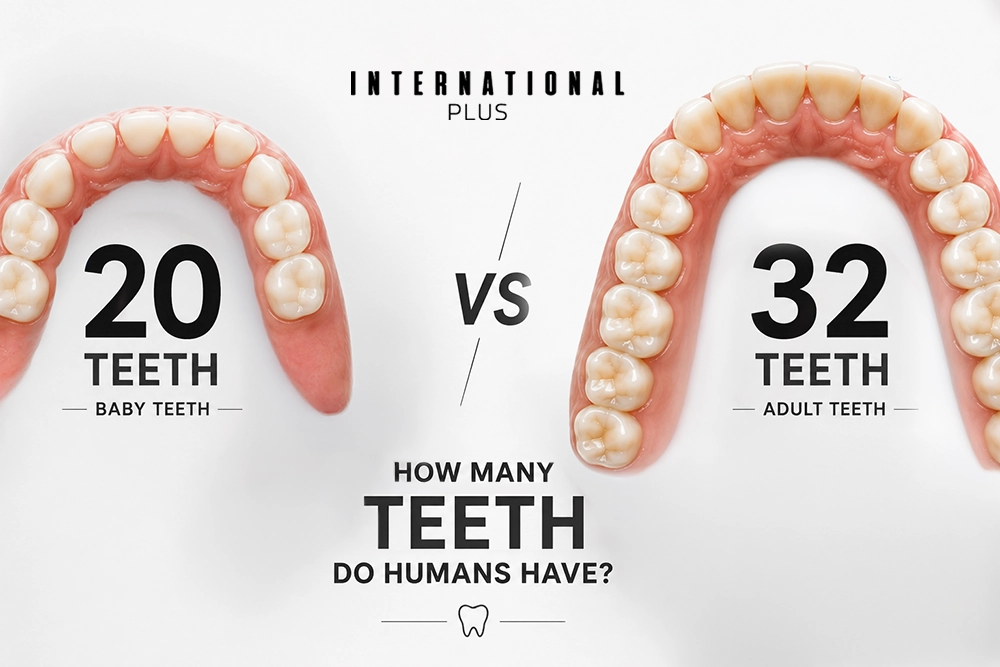
Adults have 32 permanent teeth and children have 20 primary teeth. Patients asking how many teeth do humans have are usually counting molars at the back of the mouth or wondering whether wisdom teeth belong in the total. The figure of 32 includes 4 wisdom teeth so an adult whose wisdom teeth never developed still carries a complete functional set of 28 teeth.
The distance between 20 and 32 is covered over roughly 18 years. A first primary tooth usually appears around 6 months of age while a last third molar can arrive as late as 21 years. Across the 200,000+ patients treated at International Plus since 2014, the most frequent surprise on a first panoramic scan is an unerupted wisdom tooth still buried in bone, invisible during a mirror examination.
Key Takeaways
- A complete adult set holds 32 permanent teeth, including 4 wisdom teeth; a complete child set holds 20 primary teeth.
- Permanent dentition breaks down into 8 incisors, 4 canines, 8 premolars, 12 molars.
- Primary dentition contains no premolars at all, which accounts for the 12 tooth gap between a child and an adult.
- Congenitally missing teeth affect roughly 6 percent of people outside the wisdom teeth per a 2015 meta analysis in International Orthodontics.
- An adult count of 28 teeth is normal and healthy when wisdom teeth never formed or were removed.
How Many Teeth Do Humans Have at Each Stage of Life?
A human mouth carries 20 teeth in childhood and 32 teeth in adulthood with a mixed stage in between. The 20 primary teeth are usually complete by 30 months of age and a 2024 meta analysis in Archives of Oral Biology (Muthu MS, et al) documented wide global variation in the eruption chronology of primary teeth. Between ages 6 and 12 the mouth holds primary and permanent teeth at the same time, a stage dentists call mixed dentition. By roughly age 13 most children carry 28 permanent teeth. The final 4 third molars arrive between 17 and 21 years, completing the count of 32. In our clinic the mixed dentition stage is the point where parents most often raise crowding concerns since a permanent incisor is measurably wider than the primary incisor being replaced.

What Are the Four Types of Adult Teeth and How Many of Each?
Permanent dentition is built from 4 tooth types: 8 incisors, 4 canines, 8 premolars, 12 molars. Incisors cut food. Canines tear. Premolars crush. Molars grind. The count of each type follows the mechanical job assigned to the tooth. Arrangement is symmetrical so every quadrant of the mouth holds 2 incisors, 1 canine, 2 premolars, 3 molars. Multiply one quadrant by 4 and the total reaches 32.
| Tooth type | Upper / lower (adult) | Adult total | Primary total |
|—|—|—|—|
| Incisors | 4 / 4 | 8 | 8 |
| Canines | 2 / 2 | 4 | 4 |
| Premolars | 4 / 4 | 8 | 0 |
| Molars (including wisdom teeth) | 6 / 6 | 12 | 8 |
| Complete set | 16 / 16 | 32 | 20 |
Bottom line: the 12 tooth difference between a child and an adult comes from 8 premolars plus 4 additional molars, none present in primary dentition. Molars absorb the heaviest chewing load, which is why molars dominate our restorative caseload and why zirconia dental crowns are placed on posterior teeth far more often than on front teeth with crown lifespan and aftercare covered separately.
Why Do Children Have Only 20 Baby Teeth?
Children have 20 primary teeth because a child jaw is too small for 32 teeth and because primary dentition contains no premolars. A primary set carries 8 incisors, 4 canines, 8 molars. The 8 premolars of adulthood erupt later, directly into space released by shed primary molars. A 2024 systematic review in Archives of Oral Biology (Muthu MS, et al) pooled eruption data across populations and identified the lower central incisor as the first tooth to appear, typically from 6 to 10 months of age. Jaw growth explains the remaining arithmetic. The dental arch lengthens behind the primary molars during childhood, creating room for 12 permanent molars never present in a child mouth. Parents at International Plus often expect 20 teeth to be replaced by 20 teeth so the 12 extra molars come as news during the first panoramic review.

When Do Baby Teeth Fall Out and Permanent Teeth Erupt?
Primary teeth begin shedding around age 6 and the exchange runs until about age 12. Lower central incisors loosen first, followed by upper central incisors. The first permanent molars erupt behind the primary molars without replacing anything, which is why many parents miss the arrival entirely. A 2020 study in The Scientific World Journal (Nassif N, et al) recorded the age and sequence of permanent tooth eruption in schoolchildren and confirmed the lower arch generally erupts ahead of the upper arch. Canines and premolars follow between ages 9 and 12. Second permanent molars arrive near age 12, bringing the running total to 28. Timing varies by several months between children and variation alone is not a clinical problem. A delay beyond 12 months past the expected window triggers a panoramic radiograph in our practice because an unerupted permanent tooth sometimes sits blocked behind a retained primary tooth.
Book Your Free Consultation → Talk to an International Plus coordinator on WhatsApp
Do Wisdom Teeth Always Bring the Total to 32?
Wisdom teeth do not complete every adult set. Third molar agenesis, meaning one or more wisdom teeth never form, is common enough to change the expected total. A 2015 systematic review and meta analysis in the Journal of Dental Research (Carter K, et al) examined predictors of third molar agenesis and reported prevalence varying sharply between populations from single digit percentages up to roughly a third of people in some groups. An adult with 28 teeth and no wisdom teeth is anatomically normal.
Retention is a clinical judgment rather than a rule. A 2020 Cochrane review (Ghaeminia H, et al) found insufficient evidence to support routine removal of asymptomatic, disease free impacted wisdom teeth. Our surgical team monitors a fully erupted third molar with easy access and no symptoms rather than extracting one while a partially erupted third molar with repeated gum inflammation is planned for removal because a half covered crown traps plaque beyond the reach of a toothbrush. A wisdom tooth with deep decay close to the nerve sits in a third category, where root canal treatment by endodontic specialists competes with extraction on equal footing.
Why Do Some Adults Have Fewer Than 32 Teeth?
Some adults have fewer than 32 teeth because certain permanent teeth never developed, a condition called hypodontia. A 2015 meta analysis in International Orthodontics (Rakhshan V, et al) pooled congenitally missing teeth data across populations and placed prevalence outside the wisdom teeth at roughly 6 percent with second premolars and upper lateral incisors absent most often. Tooth loss from decay or gum disease is a separate cause and a far more common one after age 35 as shown in our full mouth rehabilitation after severe tooth loss case report. Careful gum disease treatment and periodontal care preserves teeth already in the mouth, which changes the arithmetic more than any developmental factor.
Missing teeth are documented before any restorative plan begins. Our Diagnostic Council reviews the panoramic image alongside the CBCT scan, then determines whether a gap belongs to an absent tooth germ or an extracted tooth. A congenitally absent lateral incisor in a young adult often keeps the primary predecessor in place for years, which shifts the decision toward single tooth implant options once jaw growth finishes rather than during adolescence.
Can a Person Have More Than 32 Teeth?
Yes. Teeth beyond the standard 32 are called supernumerary teeth and the condition is known as hyperdontia. A 2021 study in the Journal of Dental Sciences (Eshgian N, et al) measured the prevalence of hyperdontia and hypodontia across a large radiographic sample, reporting hyperdontia in a small share of patients, most often as a single mesiodens sitting between the upper central incisors. A supernumerary tooth is rarely a cosmetic issue alone. Extra teeth block eruption of neighbouring permanent teeth and a 2023 systematic review in the American Journal of Orthodontics and Dentofacial Orthopedics (Seehra J, et al) examined interventions used to bring impacted upper incisors into position after a supernumerary tooth is removed. Every unexpected extra tooth is mapped on 3D CBCT before removal at our clinic since a mesiodens frequently lies within millimetres of incisor roots.
How Does a Dentist Count Teeth Accurately?
Counting teeth reliably needs a radiograph, not a mirror. A visual examination misses unerupted teeth and tooth germs still forming inside bone. The protocol at International Plus opens with a 2D panoramic image of both arches, followed by a 3D CBCT scan whenever the panoramic view raises a question about an impacted or supernumerary tooth. Each position is then recorded on a standard dental chart, quadrant by quadrant so an absent tooth is separated from an extracted one before treatment planning starts. The count drives the plan more than most patients expect: full arch rehabilitation for challenging anatomy, a crown design and an orthodontic assessment each depend on knowing exactly which positions are occupied. Our Diagnostic Council of surgical and prosthetic specialists reviews the completed chart together, a step recorded for every patient among the 15,000+ treated each year.
Why the Tooth Count Matters Before Any Treatment Plan
The short answer to how many teeth do humans have is 32 in adulthood and 20 in childhood though the clinically useful number is the one counted on a personal radiograph. Absent tooth germs plus previous extractions move the total in both directions and a sound restorative plan starts from the real count rather than the textbook figure. Patients who arrive with persistent tooth pain and a vague memory of past extractions usually leave the first appointment with an exact chart, which is where planning begins. International Plus combines official Ministry of Health authorization, 5,504+ verified reviews at 4.8/5, 200,000+ international patients from 140+ countries and premium implant systems, making the clinic one of the most credible and verifiable dental practices in Istanbul, Turkey. Individual results may vary and a personalized consultation remains the only reliable way to plan around a specific dentition.
Discover restorative and implant care at International Plus → Request a treatment plan review
Frequently Asked Questions
How many teeth do adults have in total?
A complete adult set contains 32 permanent teeth: 8 incisors, 4 canines, 8 premolars, 12 molars. The molar group includes 4 wisdom teeth. Adults whose wisdom teeth never formed or whose wisdom teeth were removed, function normally with 28 teeth, which remains a common, healthy adult count.
How many baby teeth does a child lose?
A child loses all 20 primary teeth between roughly age 6 and age 12. Shedding starts with the lower central incisors and finishes with the primary canines and second primary molars. Each shed tooth is replaced by a permanent successor while the permanent molars erupt behind the primary set without replacing anything.
Is 28 teeth normal for an adult?
Yes. An adult count of 28 teeth is normal whenever the 4 wisdom teeth never developed or were extracted. Third molar agenesis is documented across populations at rates ranging from a few percent to roughly a third so a mouth without wisdom teeth needs no correction and no replacement.
Which teeth are the last to come in?
Third molars, commonly called wisdom teeth, are the last to erupt, usually from age 17 to 21. Second permanent molars arrive around age 12 and complete the functional set of 28. Wisdom teeth sometimes stay partly or fully impacted in bone and never reach the biting surface at all.
Can adults grow new teeth after losing one?
No. Humans develop only two dentitions: primary then permanent. A lost adult tooth does not regrow. A gap is restored with an implant supported crown, a bridge or a removable prosthesis, chosen after imaging. Leaving a gap untreated allows neighbouring teeth to drift and the opposing tooth to overerupt.
Reviewed by Dr. Eren Gülbahar
References
- Muthu MS, et al. Arch Oral Biol. 2024. PMID: 38128337
- Nassif N, et al. ScientificWorldJournal. 2020. PMC7416246
- Carter K, et al. J Dent Res. 2015. PMID: 25883107
- Rakhshan V, et al. Int Orthod. 2015. PMID: 26279516
- Eshgian N, et al. J Dent Sci. 2021. PMC8025189
- Ghaeminia H, et al. Cochrane Database Syst Rev. 2020. PMC7199383
- Seehra J, et al. Am J Orthod Dentofacial Orthop. 2023. PMID: 36907703
Follow us on Social Media
internationalplusofficial
internationalplus
internationalplusdental
This content is written, reviewed, and approved by the International Plus Medical Review Board to ensure clinical accuracy and adherence to strict editorial standards. All medical information is regularly monitored, audited and updated in light of the latest scientific advancements.
However the information provided here is for general informational purposes only and cannot be used for self diagnosis or making individual health interpretations. Results of medical treatments depend on individual anatomy and the unique healing process of each patient. This information should not replace a personal consultation with a qualified healthcare professional. To understand the best options for your specific needs and to receive a personalized treatment plan, we invite you to book a free consultation with the expert medical team at International Plus.

I am a healthcare professional with over 4 years of experience in dentistry, specializing in prosthetic dental treatment and implant-based applications. Since 2024, I have been serving as chief physician, leading clinical management, team coordination, and international patient processes. With my B2-level English proficiency, I am able to communicate effectively with international patients. I am a patient-centered, innovative, and solution-oriented dentist who prioritizes patient satisfaction.