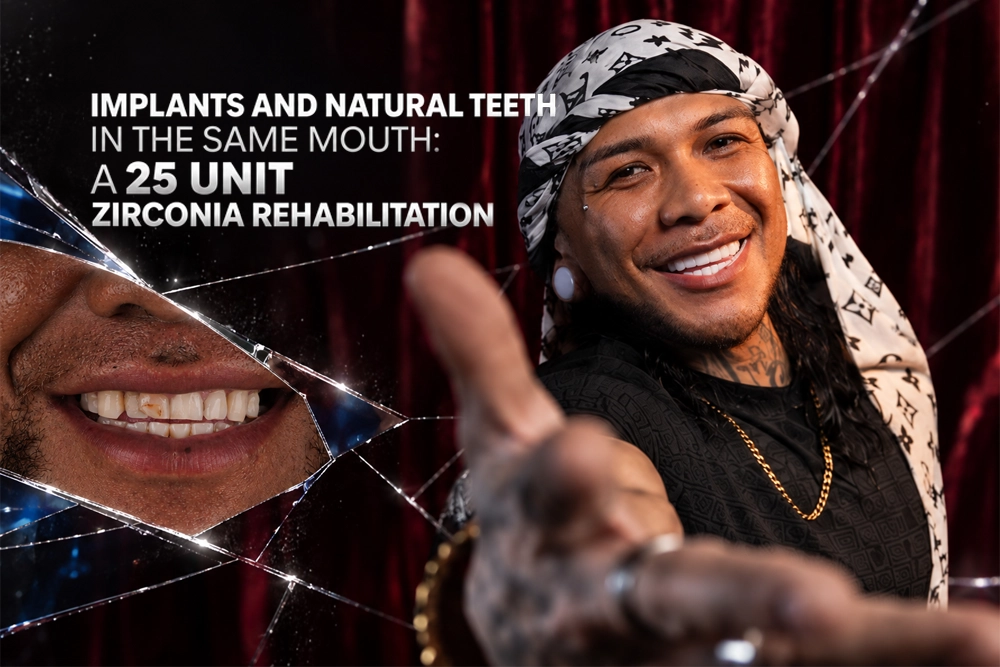
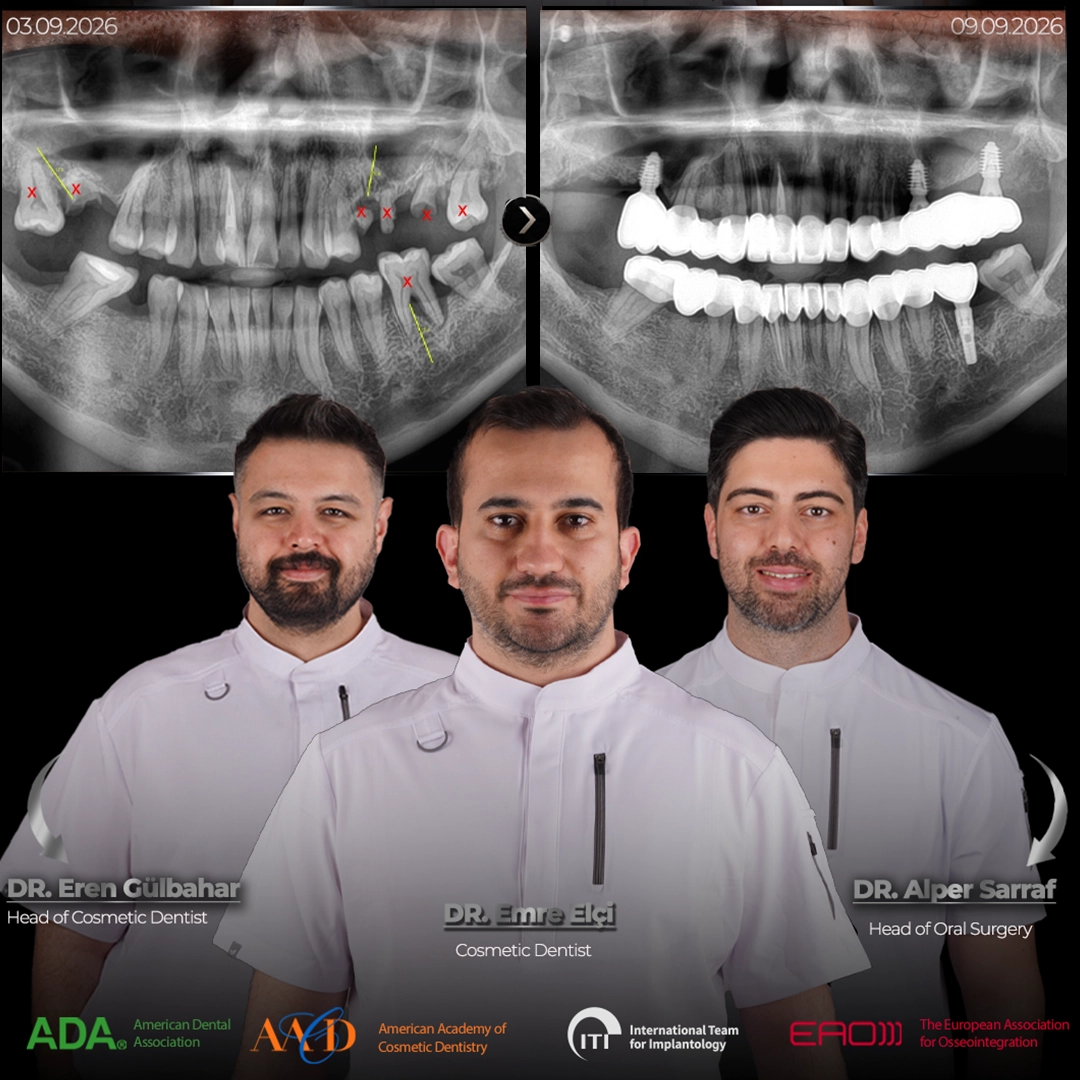
Restoring implants and natural teeth in the same mouth is a different problem from restoring either one alone. Jaroslav was treated at International Plus with Megagen implants placed alongside his remaining teeth, then rebuilt with 25 zirconia units including a bridge. Three root canal treatments and three fillings prepared the natural abutments before any crown was made and a night guard finished the plan. This case study follows the sequence and explains why the two support types were handled separately.
Key Takeaways
- The challenge: A rehabilitation carried across two different foundations, Megagen implants on one side of the plan and prepared natural teeth on the other.
- The solution: Endodontic and restorative preparation of the natural abutments first, then a 25 unit zirconia design agreed as one set.
- The technique: Face scanning with shade OM2 and the clinic’s Plus 1 smile design style with restorations milled in the on-site laboratory.
- The outcome: Twenty five zirconia units delivered on 10 September 2026, protected by a night guard fitted as part of the plan.
Why Mixing Implants and Natural Teeth Needs a Different Plan
An abutment is whatever carries a crown and Jaroslav’s 25 unit design rested on 2 different kinds. A natural tooth sits in a socket on a periodontal ligament that allows a fraction of a millimetre of movement under load. An implant is fused directly to bone and does not move at all.
That difference governs the design. First the support type is established for each site, then the restoration above it is planned. Clinical evidence on material and abutment selection for implant supported work in partially edentulous patients has been reviewed specifically because the decision differs from full arch planning (Strasding M, et al., 2024). Where implants and teeth serve one patient, each support type is assessed on its own terms before the restorations are designed together.
Connecting a rigid implant and a mobile tooth inside a single span raises mechanical questions so the clinic keeps the two support types separate within the prosthetic design wherever the anatomy allows it.
Jaroslav’s Starting Point and Treatment Plan

Jaroslav came to International Plus as an English speaking patient needing a rehabilitation that combined implant replacement with restoration of the teeth he still had. Photographic records were taken at the first appointment and a face scan was recorded as part of the digital workup.
| Record | Detail |
|—|—|
| First appointment | 27 February 2026, surgical phase, Megagen implants |
| Prosthetic phase | 10 September 2026, definitive restorations delivered |
| Zirconia units | 25 in total, including a bridge |
| Endodontic work | 3 root canal treatments, type 1 protocol |
| Restorative work | 3 fillings on natural abutments |
| Shade and design | OM2, Plus 1 smile design style |
| Appliance | Night guard fitted at delivery |
A staged plan is one carried out in separate phases with a healing interval between them rather than in a single visit. First the implants were placed. Then after healing, the natural abutments were prepared and the 25 units delivered.
Case planning at International Plus runs through a multidisciplinary Diagnostic Council, where surgical, endodontic and prosthetic judgement are applied to one file before the sequence is fixed.
The Interval Between Surgery and the Final Teeth
Roughly six months separated Jaroslav’s surgical appointment from the delivery of his definitive teeth. The clinic’s standard interval is around three months where bone volume is adequate, extending where the surgical site needs longer.
Osseointegration is the process by which bone cells attach directly to the implant surface and form a structural bond. How long that takes has been studied directly, including whether shorter periods are sufficient (Cassetta M, et al., 2020) and patient perception of these timing concepts has been reviewed separately (Gotfredsen K, et al., 2021).
Waiting longer delays the finished result, which patients rarely welcome but the interval was extended for Jaroslav because loading an implant before integration is complete risks losing the fixture entirely. Long term follow up of sandblasted implant surfaces supports the value of that patience (Monsalve-Guil L, et al., 2024).
Preparing the Natural Abutments First
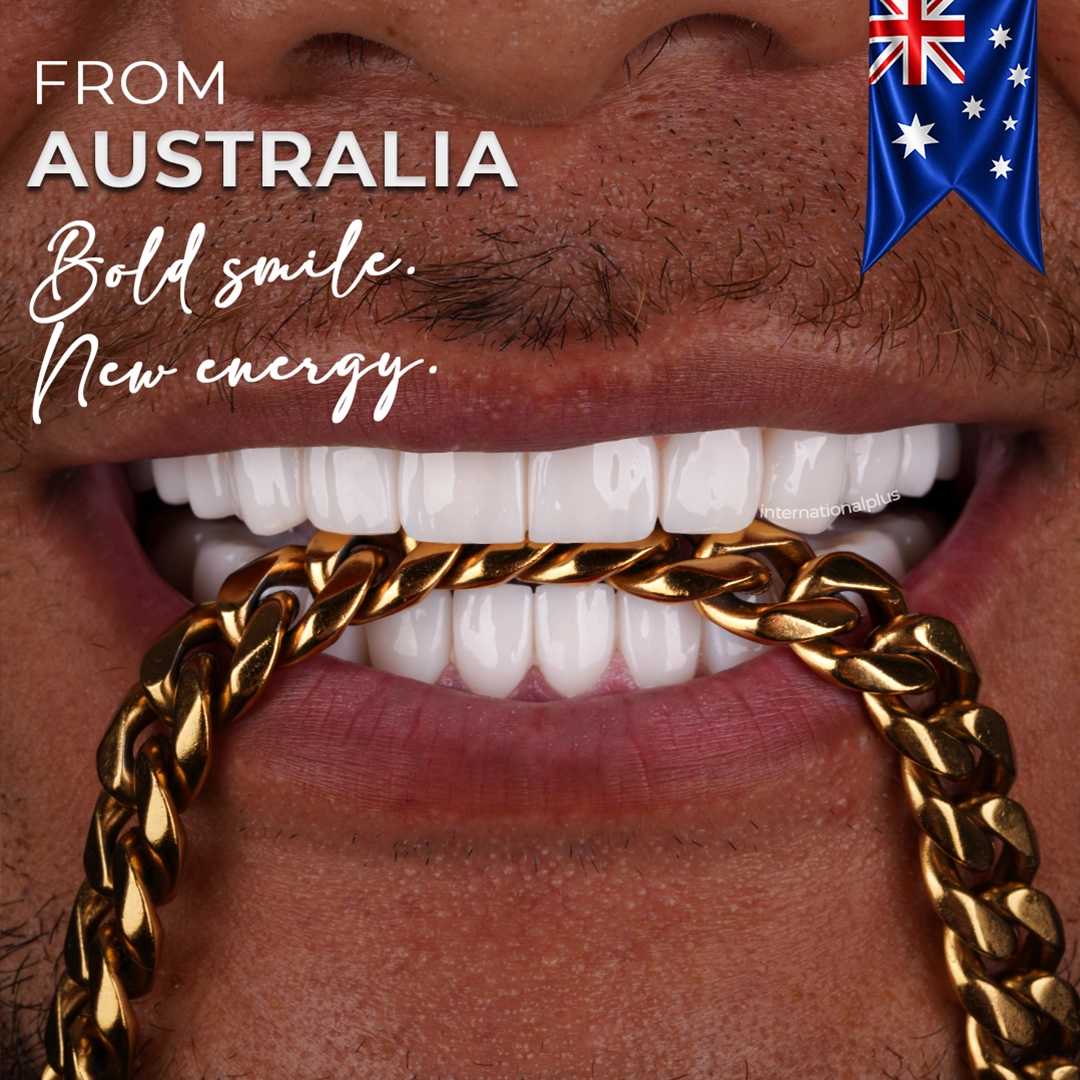
Endodontic preparation is the treatment of the nerve space inside a tooth before that tooth is covered. Three root canal treatments and 3 fillings were carried out on Jaroslav’s natural abutments before the definitive crowns were made. That order is a structural rule inside the plan rather than a scheduling convenience.
A crown seals a tooth completely so a tooth needing endodontic treatment after cementation has to be reached through the finished restoration. Reviews of the restoration of root filled teeth identify the structure remaining after access as the dominant factor in long term outcome (Bhuva B, et al., 2021), which is why pulp status is settled before preparation rather than afterwards.
For Jaroslav this meant the natural abutments entered the prosthetic phase already treated and sealed. International Plus has documented the same principle in a multidisciplinary rehabilitation combining surgery with endodontics and the protocols are set out under endodontics.
Twenty Five Zirconia Units, Including a Bridge
The prosthetic design covered 25 units in monolithic zirconia, recorded on the treatment card as six and seven units in the upper quadrants and six in each lower quadrant with a bridge among them.
A bridge spans a gap by connecting to abutments on either side, which is how a missing tooth is replaced without placing a fixture in that particular site. Combining bridge spans with single units across one arch means the load path has to be worked out across the whole design rather than tooth by tooth.
Shade OM2 was selected and the case followed the clinic’s Plus 1 smile design style. Units were milled in the on-site laboratory so contour could be refined during the stay. Comparable work appears in a complete digital full mouth implant rehabilitation and in a case combining implants with zirconium restorations.
Outcome and What Jaroslav Experienced
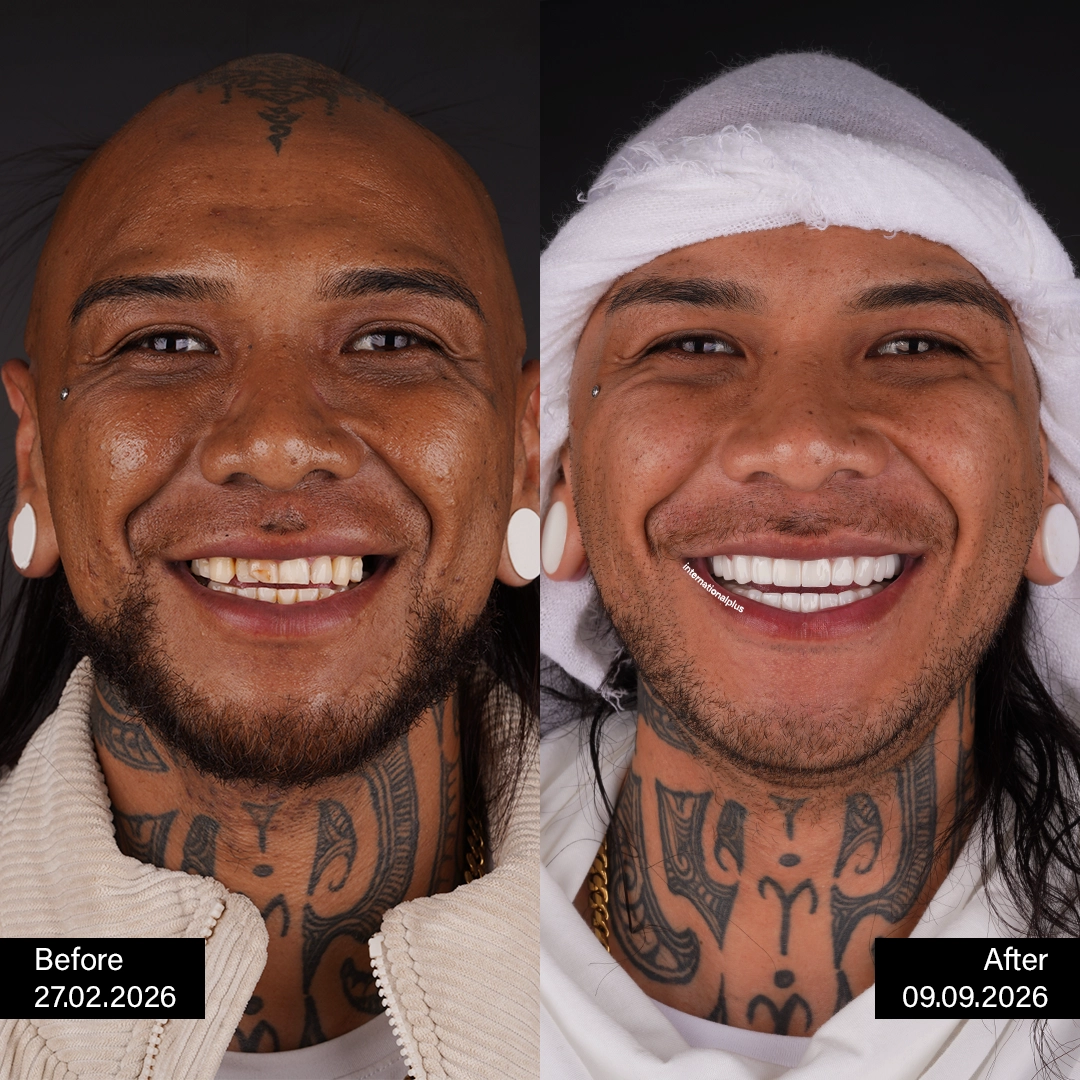
A mixed support rehabilitation is one in which some units sit on implants and others on prepared natural teeth. Jaroslav’s treatment finished on 10 September 2026 with 25 monolithic zirconia units delivered in shade OM2, the natural abutments restored after endodontic preparation and a night guard fitted before departure.
This outcome reflects Jaroslav’s own bone volume, the restorability of his remaining teeth and the healing his implants achieved so individual results may vary. International Plus reports treating more than 200,000 patients from over 140 countries since 2014 and holds a public rating of 4.8 out of 5 across 5,504 verified Google reviews though no published record replaces an individual examination.
Related cases include an advanced full mouth rehabilitation with sinus lift and zirconia and a rehabilitation complicated by severe bruxism and tooth loss. Planning at this scale begins with the records described under dental implant documentation.
Book a consultation with International Plus to have your remaining teeth and your implant sites assessed together rather than separately.
Frequently Asked Questions
Can implants and natural teeth be restored together?
Yes and it is common where some teeth are still sound. Each support type is assessed separately first because a natural tooth moves slightly under load on its periodontal ligament while an implant is fused to bone and does not. The prosthetic design accounts for that difference.
Why were the root canals done before the crowns?
Because a definitive crown seals the tooth completely. Treating a canal afterwards means drilling an access hole through the new restoration, which is repairable but compromises a unit built as one sealed piece. Settling pulp status first protects both the tooth and the crown above it.
Why did the treatment take around six months?
The interval covers osseointegration, the period during which bone attaches to the implant surface. The clinic’s standard is roughly three months where bone volume is adequate, extended where a site needs longer. Loading an implant before integration is complete risks losing the fixture.
What is the difference between a crown and a bridge here?
A crown covers one prepared tooth or sits on one implant. A bridge spans a gap by connecting to abutments on either side, replacing a missing tooth without placing a fixture in that site. Jaroslav’s 25 unit design combined both across the arches.
Why is a night guard included in a plan like this?
Grinding force that once wore natural enamel meets ceramic after a rehabilitation of this size. A night guard is a removable appliance worn during sleep that separates the arches so the appliance absorbs that force rather than the restorations or the implant connections.
Reviewed by Dr. Emre Colak
References
- Strasding M, et al. Clin Oral Implants Res. 2024. PMID: 38864592
- Cassetta M, et al. Int J Oral Maxillofac Surg. 2020. PMID: 31735528
- Gotfredsen K, et al. Clin Oral Implants Res. 2021. PMID: 34642992
- Monsalve-Guil L, et al. Br J Oral Maxillofac Surg. 2024. PMID: 38278652
- Bhuva B, et al. Int Endod J. 2021. PMID: 33128279
- Leitao CIMB, et al. J Prosthodont Res. 2022. PMID: 34615842
- Duong HY, et al. Periodontol 2000. 2022. PMC9304161
Follow us on Social Media
internationalplusofficial
internationalplus
internationalplusdental
This content is written, reviewed, and approved by the International Plus Medical Review Board to ensure clinical accuracy and adherence to strict editorial standards. All medical information is regularly monitored, audited and updated in light of the latest scientific advancements.
However the information provided here is for general informational purposes only and cannot be used for self diagnosis or making individual health interpretations. Results of medical treatments depend on individual anatomy and the unique healing process of each patient. This information should not replace a personal consultation with a qualified healthcare professional. To understand the best options for your specific needs and to receive a personalized treatment plan, we invite you to book a free consultation with the expert medical team at International Plus.

Dr. Emre Çolak concentrates on advanced implant surgery and modern regenerative treatments, delivering refined solutions to patients abroad in need of complex dental restoration.