
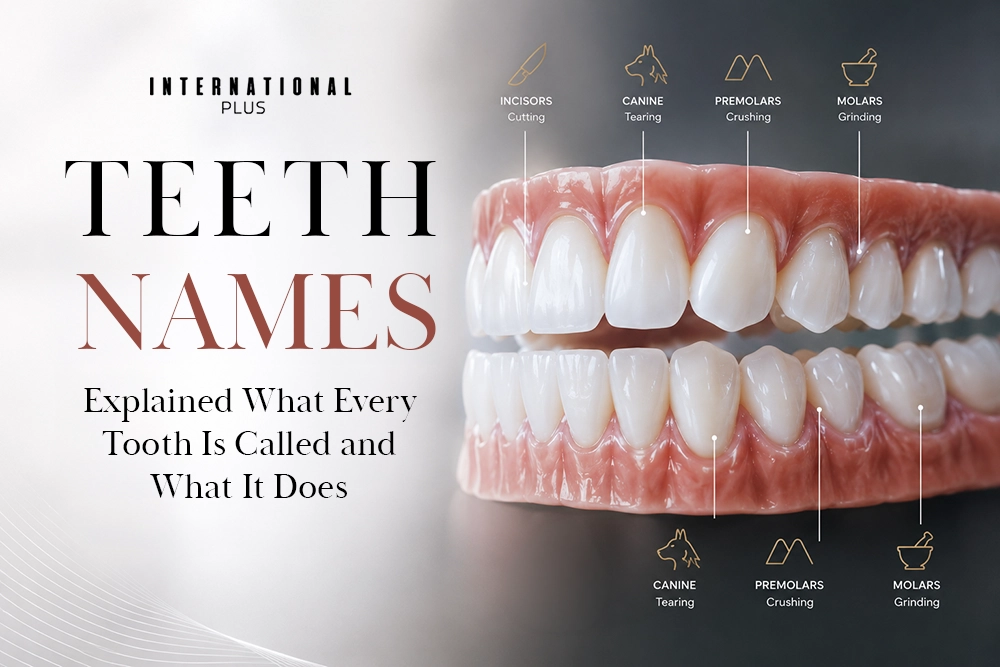
Adult teeth carry four family names: incisors, canines, premolars plus molars, spread across 32 permanent teeth. Inside each family the individual labels are precise: central incisor, lateral incisor, canine, first premolar, second premolar, first molar, second molar, third molar. The full set of teeth names repeats identically in all four quadrants of the mouth.
Names are not decoration. Each label describes a shape, plus that shape describes a job. Each incisor carries a straight cutting edge for slicing. The canine carries one pointed cusp for tearing. A molar carries four or five cusps for grinding. Learning which tooth is which turns a treatment plan from a list of codes into a readable document.
Key Takeaways
- The four tooth families are incisors, canines, premolars plus molars, arranged in every quadrant as 2 incisors, 1 canine, 2 premolars, 3 molars.
- A canine, also called a cuspid or eye tooth, carries a single cusp plus the longest root in the mouth at roughly 26 to 27 mm.
- Premolars are named bicuspids because each one carries two cusps; the upper first premolar frequently splits into 2 roots.
- An upper first molar carries 3 roots while a lower first molar carries 2 and 68.2 percent of upper first molars hide a second mesiobuccal canal.
- Baby teeth use only three family names: primary incisors, primary canines plus primary molars because premolars never exist in a child’s mouth.
What Are the Teeth Names Dentists Actually Use?
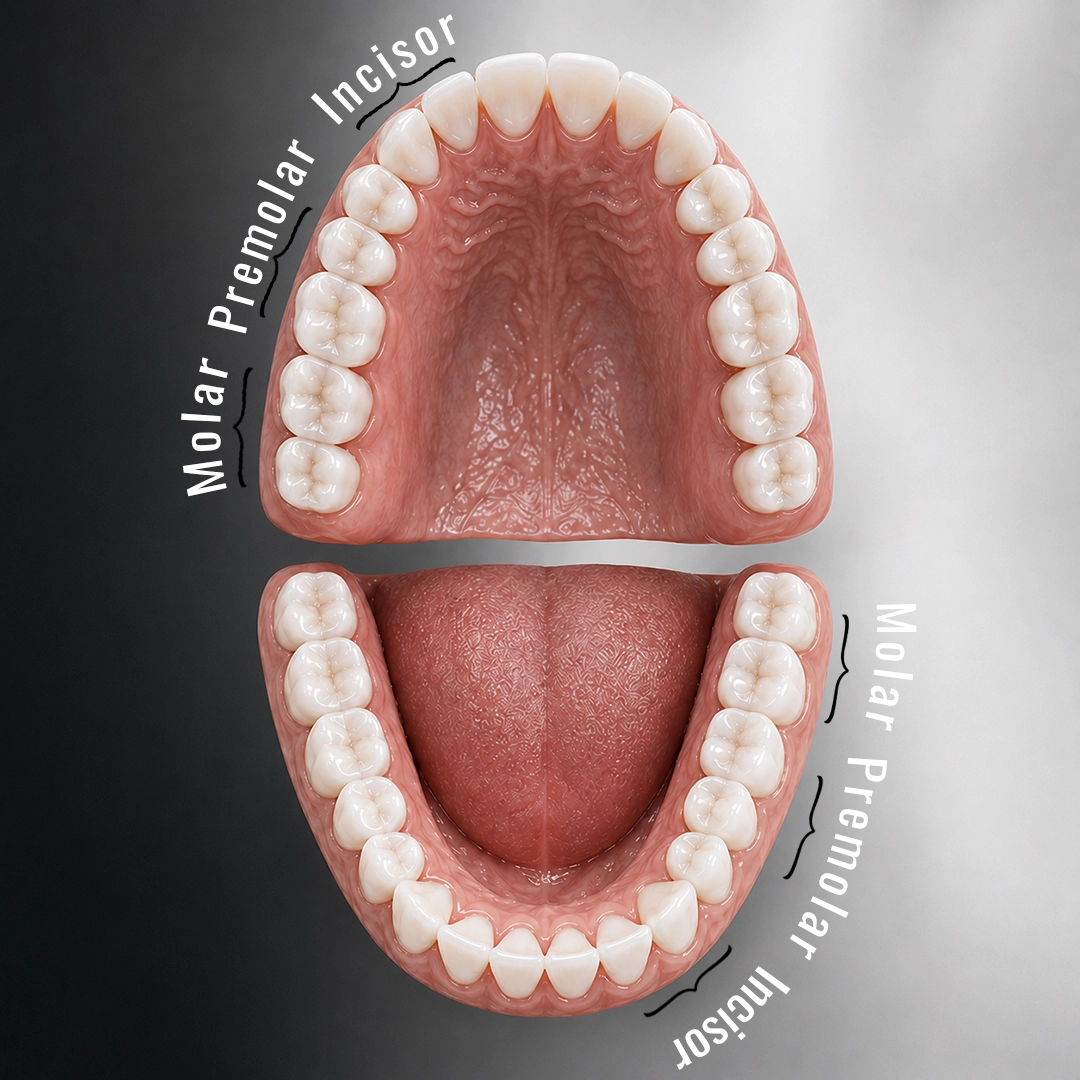
Every tooth name is a two part label: the family name plus the position in the arch. The four families are incisors, canines, premolars plus molars. A complete adult set of 32 teeth holds 8 incisors, 4 canines, 8 premolars plus 12 molars. Each quadrant repeats one sequence from the midline outward: central incisor, lateral incisor, canine, first premolar, second premolar, first molar, second molar, third molar. Dentists add a jaw word for precision, maxillary for the upper arch plus mandibular for the lower arch. The phrase “mandibular left second premolar” therefore points at exactly one tooth. Eruption timing anchors several names: a meta analysis by Vandana S, et al., 2024 in the American Journal of Human Biology pooled 939,191 participants and dated mandibular first molar eruption as early as 4.09 years. In our clinic the coordinator reads each tooth name aloud during consent because patients arriving from 140 countries learned different labels at home.
Incisor Teeth: Central and Lateral Incisors
Incisor teeth are the eight flat fronted cutting teeth at the front of the mouth, four upper plus four lower. Each arch carries two central incisors either side of the midline plus two lateral incisors beside them. A central incisor is the widest front tooth, measuring roughly 8.5 mm across the upper arch while a lateral incisor is narrower at about 6.5 mm. Both carry a single root plus a chisel shaped edge called the incisal edge, built to shear food rather than crush food. Upper central incisors erupt around 7 to 8 years while lower central incisors arrive first, around 6 to 7 years. Newly erupted incisors show three small bumps on the edge, called mamelons, that wear flat within a few years of function. Our restorative team measures incisal edge position before any veneer case because a 1 mm change at the central incisor shifts the whole smile line.
What Is a Canine Tooth and Why Is It Called an Eye Tooth?
A canine is the pointed corner tooth between the lateral incisor plus the first premolar and each mouth carries four. The canine is also named the cuspid because a single cusp forms the whole biting surface, plus the older common name eye tooth since the upper canine root sits directly under the eye socket. A canine carries the longest root in the human mouth at roughly 26 to 27 mm, which explains why canines outlast other teeth in advanced gum disease. That length supports a mechanical role called canine guidance: during side to side movement the canine separates the back teeth plus protects molar cusps from shearing load. A randomised crossover study of 40 patients by Brandt S, et al., 2019 in Clinical Oral Investigations reported that every statistically significant outcome favoured canine guided occlusion. In our practice we rebuild canine guidance before shortening a canine for aesthetics.
Premolars: The Bicuspids Between Canine and Molar
A premolar is a transitional tooth between canine plus molar and the everyday name bicuspid describes the shape directly: two cusps, one buccal plus one lingual. Every adult quadrant carries a first premolar plus a second premolar, giving 8 premolars across 32 teeth. Premolars crush food into smaller pieces before the molars grind food into a swallowable bolus. Root anatomy separates the two: the upper first premolar splits into 2 roots in most people while the upper second premolar plus both lower premolars usually keep a single root. Buccal cusps do most of the work in function. A systematic review by Velásquez B, et al., 2023 in the European Journal of Dentistry recorded the strongest occlusal contacts on nonfunctional cusps at 48 percent against 24 percent on functional cusps. Our team scans premolar cusp height with MetiSmile before planning any zirconia dental crowns.
Molars Teeth: First, Second and Third Molar
Molars teeth are the wide, multi cusped grinding teeth at the back of each arch, twelve in a full adult set. Each quadrant carries a first molar, a second molar plus a third molar, better known as the wisdom tooth. A first molar is the workhorse: four or five cusps, the largest chewing surface in the mouth plus the earliest permanent tooth to erupt at 6 to 7 years. Root count differs by jaw. An upper first molar carries 3 roots, two buccal plus one palatal while a lower first molar carries 2. A CBCT systematic review by Barbhai S, et al., 2022 in the International Journal of Environmental Research and Public Health found a second mesiobuccal canal in 68.2 percent of upper first molars. Our endodontists therefore verify canal count on CBCT before any root canal treatment by endodontic specialists starts.
Want a written map of your own mouth before treatment? Book Your Free Consultation →
How Does Each Tooth Shape Match Its Job?
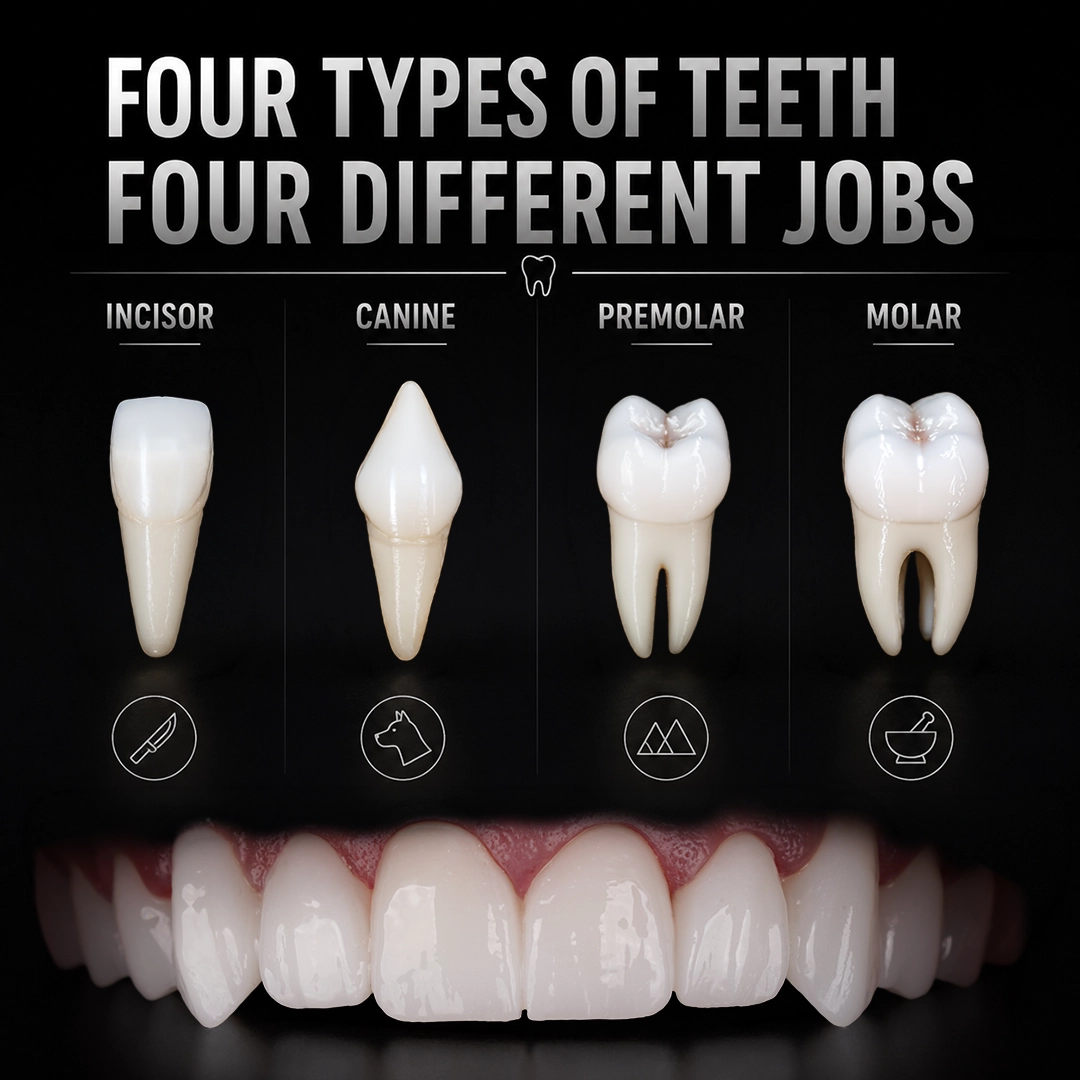
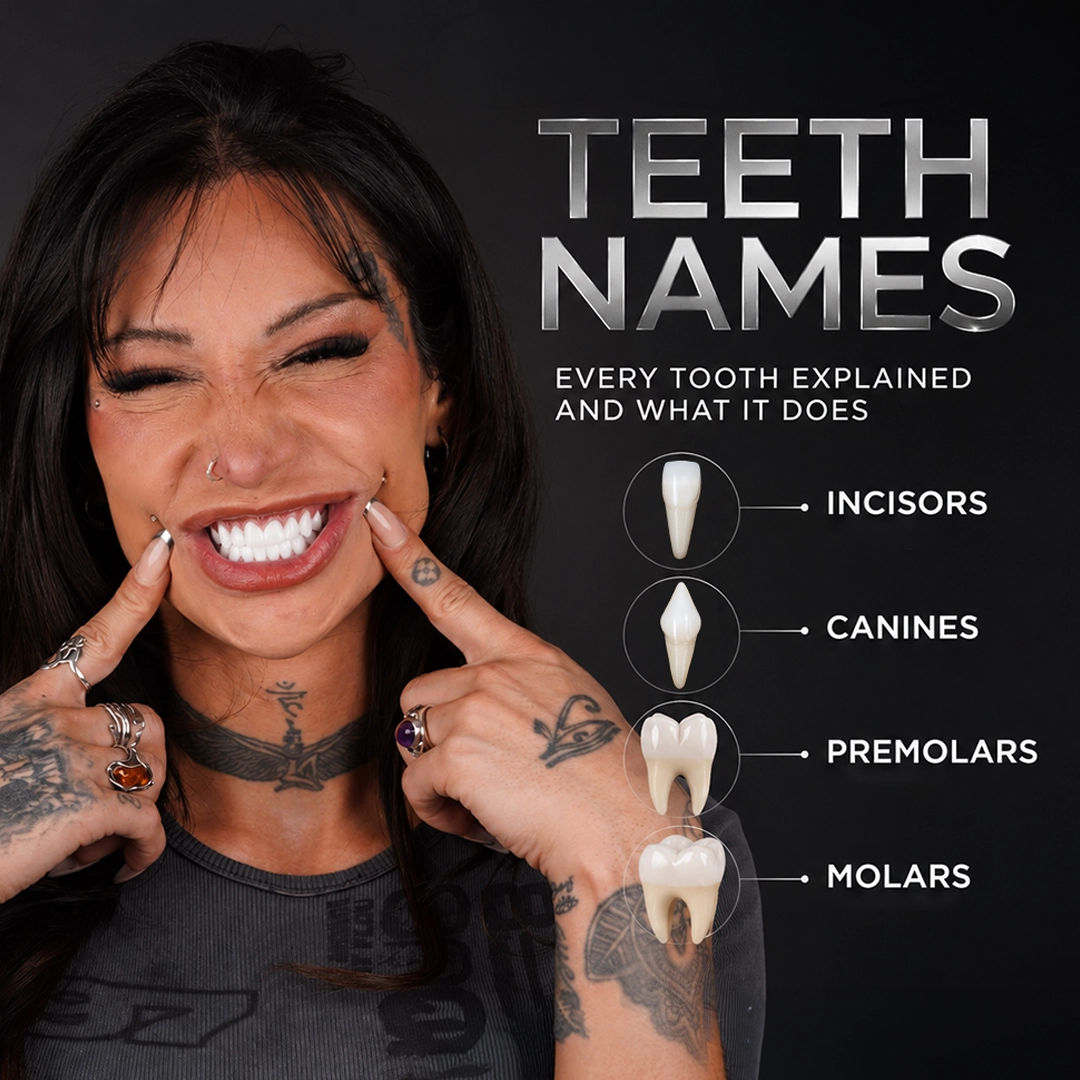
Tooth shape is the mechanical explanation behind every name in the chart. A flat blade slices. A single point tears. Two cusps crush. Four or five cusps grind. Root count follows the load: a tooth built to grind against heavy vertical force needs a wider anchor in bone than a tooth built to slice. Eruption order follows the same logic since a child needs cutting teeth before grinding teeth. The table below pairs each of the standard teeth names with function, shape signature, root count plus eruption age in permanent dentition.
| Tooth name | Job | Shape signature | Roots | Eruption age |
|—|—|—|—|—|
| Central incisor | Cutting, biting through food | Wide chisel edge about 8.5 mm across | 1 | 6 to 8 years |
| Lateral incisor | Cutting, narrower bite | Slimmer chisel edge about 6.5 mm | 1 | 7 to 9 years |
| Canine (cuspid) | Tearing, guiding side movement | Single pointed cusp, longest root | 1 | 11 to 12 years |
| First premolar | Crushing, transferring load | Two cusps, buccal cusp taller | 1 or 2 | 10 to 11 years |
| Second premolar | Crushing, stabilising the arch | Two cusps, more rounded | 1 | 10 to 12 years |
| First molar | Grinding, main chewing surface | Four or five cusps, widest crown | 2 or 3 | 6 to 7 years |
| Third molar (wisdom) | Variable, often no function | Irregular cusps, fused roots common | 1 to 3 | 17 to 21 years |
Bottom line: every tooth name in the left column is a shorthand for the four mechanical facts sitting beside it.
Do Upper and Lower Teeth Carry Different Names?
Upper plus lower teeth share the same eight family names yet the anatomy behind each name differs by arch. Dentists mark the difference with maxillary for the upper jaw plus mandibular for the lower jaw. A maxillary central incisor is wider than a mandibular central incisor, roughly 8.5 mm against 5.3 mm, which is why crowding shows first on lower front teeth. A maxillary first molar carries 3 roots plus four to five cusps. A mandibular first molar carries 2 roots plus five cusps, including a distal cusp absent in the upper arch. A micro computed tomography review of 30 studies by Al-Rammahi HM, et al., 2023 in BMC Oral Health confirmed wide canal variation inside mandibular first molars. Our Diagnostic Council cross checks arch specific anatomy on every full arch plan since a lower molar rebuilt with upper molar cusp geometry fails within months.
What Are Baby Teeth Called?
Baby teeth use only three family names because premolars never exist in a child’s mouth. The full primary set of 20 teeth holds primary central incisors, primary lateral incisors, primary canines, primary first molars plus primary second molars, five per quadrant. Clinical charts write these as deciduous teeth or primary dentition rather than baby teeth. The primary first molar plus second molar sit in the positions later occupied by the permanent premolars, which is why a lost primary molar allows the permanent premolar to drift. Eruption starts around 6 months at the lower central incisor plus completes near 30 months at the second molar. For the complete count by age, see how many teeth do humans have plus the chart codes in teeth numbers. Our paediatric referrals flag early primary molar loss because space maintenance costs less effort than later orthodontic correction.
Everyday Teeth Names: Eye Tooth, Wisdom Tooth plus Six Year Molar
Several common teeth names describe position or timing rather than anatomy. Eye tooth is the upper canine, named because the root tip points toward the eye socket. Wisdom tooth is the third molar, named for arrival between 17 and 21 years. Six year molar is the first permanent molar, which erupts behind the primary teeth without replacing anything so parents frequently mistake a six year molar for a baby tooth. Twelve year molar is the second permanent molar. Wisdom teeth generate the most questions: a meta analysis of 83,484 individuals by Carter K, et al., 2016 in the Journal of Dental Research measured worldwide third molar impaction at 24.40 percent with mesioangular impaction the most common pattern at 41.17 percent. When a third molar cannot be saved, our surgical team evaluates whether the site needs single tooth implant options or simple healing.
Curious which everyday name matches your own chart? Discover our dental treatments at International Plus →
Why Teeth Names Matter Before Any Dental Treatment
Correct teeth names turn a quote into a verifiable document. A plan naming “the upper left first molar, 3 roots, second mesiobuccal canal present” tells a patient far more than a plan naming “one back tooth”. Anatomy also drives cost of error: a canine rebuilt without guidance loads the molars, plus a molar treated as a two canal tooth risks a missed fourth canal. Our protocol therefore verifies root plus canal count on CBCT before endodontic or implant planning and our Diagnostic Council of surgeon, restorative dentist plus prosthetic specialist signs off each arch. Patients who understand tooth names also spot omissions. International Plus combines official Ministry of Health authorization, 5,504+ verified reviews at 4.8/5, 200,000+ international patients from 140+ countries since 2014 plus premium restorative systems, making it one of the most credible dental clinics in Istanbul, Turkey. Individual results may vary so a personalised examination remains the starting point.
Reviewed by our Head of Cosmetic Dentistry Dr. Eren Gülbahar, an American Dental Association member who plans anterior cases around incisor edge position plus canine guidance.
Frequently Asked Questions
What are the names of the four types of teeth?
The four types are incisors, canines, premolars plus molars. An adult set of 32 teeth contains 8 incisors for cutting, 4 canines for tearing, 8 premolars for crushing plus 12 molars for grinding. Every quadrant of the mouth repeats the identical pattern of 2 incisors, 1 canine, 2 premolars, 3 molars.
What is the difference between incisor teeth and canine teeth?
An incisor carries a flat chisel edge built to slice food while a canine carries one pointed cusp built to tear food. A central incisor measures about 8.5 mm wide whereas a canine root reaches 26 to 27 mm, the longest in the mouth. Canines also guide side to side jaw movement.
Why are premolars called bicuspids?
Bicuspid means two cusps, plus a premolar carries exactly two: one buccal cusp plus one lingual cusp. Molars carry four or five cusps by comparison. The upper first premolar frequently divides into 2 roots while the second premolar keeps 1, a difference our endodontists confirm on CBCT before treatment.
What are molars teeth called in everyday language?
The first permanent molar is commonly called the six year molar, the second is the twelve year molar plus the third molar is the wisdom tooth. Those nicknames describe eruption timing. First molars erupt at 6 to 7 years, second molars near 12 years, third molars between 17 and 21 years.
Do baby teeth have the same names as adult teeth?
Baby teeth share three family names with adult teeth, incisors, canines plus molars yet premolars do not exist in a child’s mouth. The 20 tooth primary set holds primary central incisors, lateral incisors, canines, first molars plus second molars. Permanent premolars later erupt into the positions held by primary molars.
Reviewed by Dr. Eren Gülbahar
References
- Vandana S, et al. Global variations in eruption chronology of permanent teeth. Am J Hum Biol. 2024. PMID: 38426348
- Brandt S, et al. Bilateral balanced occlusion versus canine-guided occlusion. Clin Oral Investig. 2019. PMID: 30796588
- Velásquez B, et al. Occlusal Analysis in Natural Dentition: Systematic Review. Eur J Dent. 2023. PMC10569841
- Barbhai S, et al. Root Anatomy and Canal Configuration of Human Permanent Maxillary First Molar Using CBCT. Int J Environ Res Public Health. 2022. PMC9408299
- Al-Rammahi HM, et al. Root and canal anatomy of mandibular first molars using micro-computed tomography. BMC Oral Health. 2023. PMC10228077
- Carter K, et al. Predictors of Third Molar Impaction: A Systematic Review and Meta-analysis. J Dent Res. 2016. PMID: 26561441
Follow us on Social Media
internationalplusofficial
internationalplus
internationalplusdental
This content is written, reviewed, and approved by the International Plus Medical Review Board to ensure clinical accuracy and adherence to strict editorial standards. All medical information is regularly monitored, audited and updated in light of the latest scientific advancements.
However the information provided here is for general informational purposes only and cannot be used for self diagnosis or making individual health interpretations. Results of medical treatments depend on individual anatomy and the unique healing process of each patient. This information should not replace a personal consultation with a qualified healthcare professional. To understand the best options for your specific needs and to receive a personalized treatment plan, we invite you to book a free consultation with the expert medical team at International Plus.

I am a healthcare professional with over 4 years of experience in dentistry, specializing in prosthetic dental treatment and implant-based applications. Since 2024, I have been serving as chief physician, leading clinical management, team coordination, and international patient processes. With my B2-level English proficiency, I am able to communicate effectively with international patients. I am a patient-centered, innovative, and solution-oriented dentist who prioritizes patient satisfaction.


