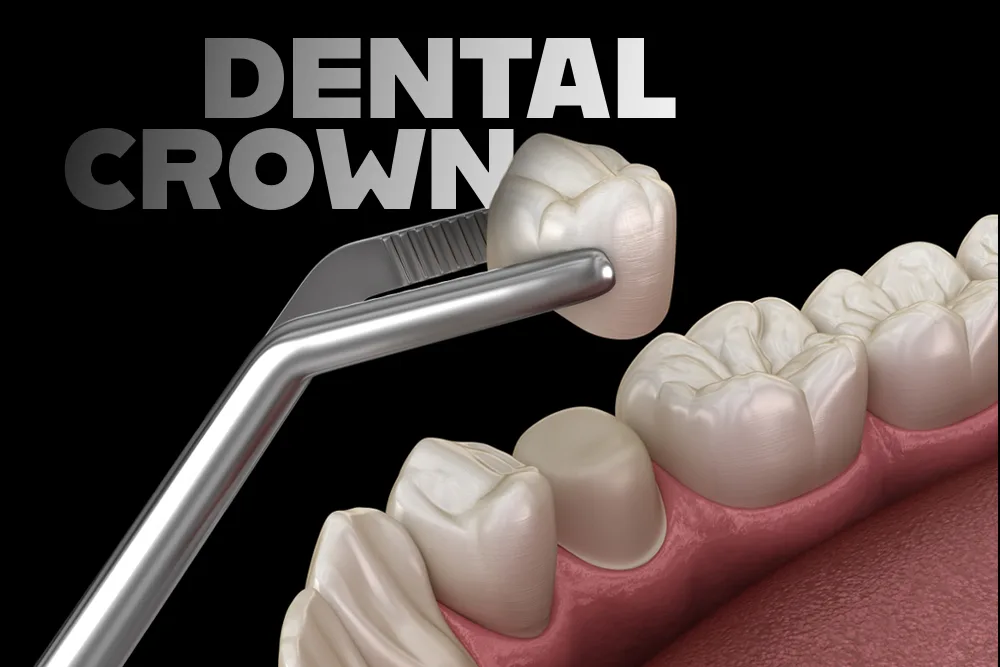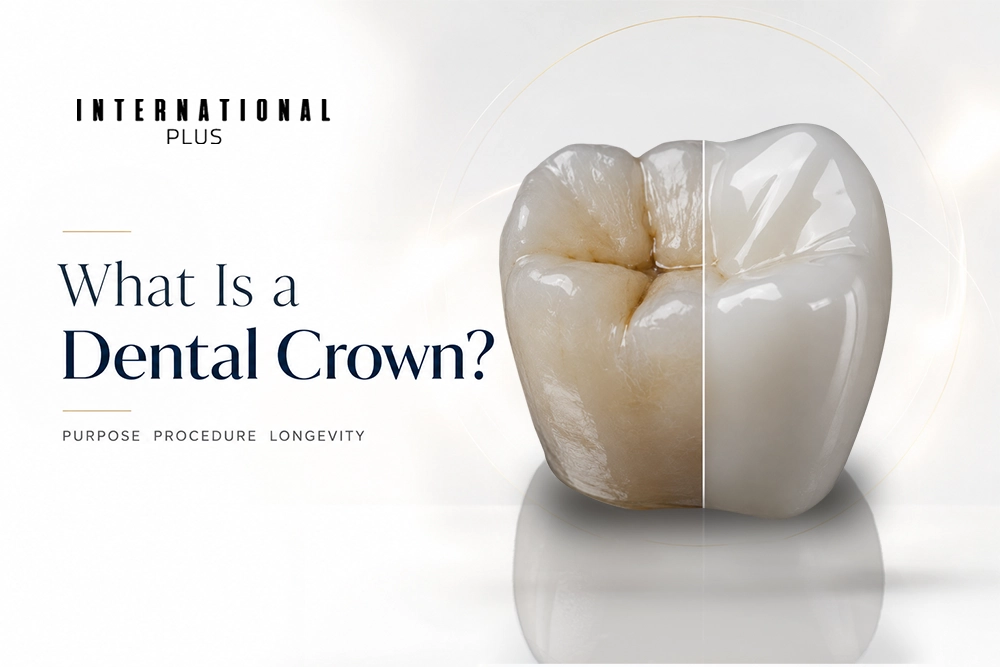
A dental crown is a custom made cap that fully covers a prepared tooth and restores its bite function and outer shape. Crowns are milled from zirconia or pressed ceramic in a dental laboratory then cemented over what remains of the natural tooth. Patients who ask what is a dental crown usually reach the question after a fracture, a deep cavity or a root canal at the point where a filling can no longer hold the tooth together.
The difference between those two treatments matters more than the terminology. A filling replaces missing tooth material from the inside. A crown wraps the tooth from the outside and shifts chewing load away from weakened walls. A 2018 systematic review in Clinical Oral Implants Research by Pjetursson and colleagues reported five year survival above 95 percent for zirconia ceramic single crowns, which is why full coverage remains the standard answer for a structurally compromised molar in our Istanbul clinic.
Key Takeaways
- A crown covers the entire visible tooth while a filling only replaces missing material inside it.
- Zirconia ceramic single crowns showed survival above 95 percent at five years in a 2018 systematic review of clinical trials.
- Most crowns are completed in two visits with a temporary crown protecting the prepared tooth in between.
- Root canal treated molars benefit measurably from cuspal coverage since a treated tooth loses much of its internal support.
- A crown protects tooth structure but does not protect against decay at the margin so the gum line still needs daily attention.
Why Would a Tooth Need a Crown?
A tooth needs a crown when so much natural structure has been lost that the remaining walls can no longer survive normal chewing forces. The usual triggers are a fractured cusp, a cavity wider than half the biting surface, heavy wear from grinding or a molar recently finished with root canal treatment. Cracked molars form a separate category. A 2024 meta analysis in the Journal of Dentistry (Zhang S, et al) pooled outcomes across cracked tooth studies and placed full coverage restoration at the centre of keeping a cracked molar functional.
Our team works from a structural threshold rather than a cosmetic one. Every candidate tooth is documented with CBCT imaging and an intraoral scan, then reviewed by our Diagnostic Council before preparation begins. Preparing a tooth removes 1 to 2 millimetres of enamel and dentine around the whole circumference and the removed structure never grows back. Full coverage suits a molar that has lost over 50% of its coronal volume. The same preparation is the wrong answer for a small occlusal cavity in an otherwise sound tooth because preparation sacrifices healthy enamel to solve a problem a bonded filling already handles. In practice, teeth with early damage are restored conservatively and reviewed at 6 months.

What Is a Dental Crown Made Of and Does the Material Matter?
Answering what is a dental crown in material terms means choosing between zirconia, lithium disilicate ceramic or metal ceramic. Modern practice leans heavily toward ceramics. A 2015 review in Dental Materials by Sailer and colleagues compared all ceramic with metal ceramic single crowns and documented comparable survival for anterior ceramic restorations while a 2022 systematic review in the Journal of Prosthodontic Research by Leitão and colleagues examined monolithic CAD CAM zirconia and found strong medium term clinical performance. Zirconia used in our in house laboratory reaches roughly 1200 MPa flexural strength, which is what allows a thin restoration to carry molar loads.
Material choice follows position in the mouth rather than preference. In our practice we use monolithic zirconia for posterior molars and layered ceramic for front teeth because a molar is judged on fracture resistance under vertical load while an incisor is judged on translucency at the incisal edge. Metal ceramic still has a role where an existing metal framework must be matched. Patients comparing options for front teeth often find the boundary between crowns and thinner restorations useful, which is covered in our guide to dental crowns vs veneers.
How Is a Dental Crown Fitted, Step by Step?
Most crowns are fitted across two appointments, separated by the laboratory production time. The first visit covers examination, tooth preparation, then digital scanning. The second covers try in and cementation. Between the two, a temporary crown protects the prepared tooth and keeps the neighbouring teeth from drifting into the space.
- Assessment and imaging: panoramic radiography plus 3D CBCT where the root or bone needs checking, followed by the Diagnostic Council review.
- Tooth preparation: the dentist reduces the tooth by 1 to 2 millimetres under local anaesthesia, creating room for the crown thickness.
- Digital scanning: a TRIOS 5 intraoral scanner captures the preparation, the opposing arch plus the bite, replacing conventional impression material.
- Temporary crown: a printed provisional restoration is cemented so the patient can eat and speak normally.
- Laboratory production: the crown is milled on a five axis Redon unit then sintered between 1500 and 1800 degrees Celsius before glazing.
- Fit and cementation: contacts, bite alignment plus shade are verified before the crown is bonded or cemented in place.
Patients travelling to Istanbul for treatment usually complete both stages inside a single trip of 5 days because our clinic runs the laboratory on site rather than offsite. Turnaround measured across 2 visits is the practical reason a 2022 Journal of Prosthodontic Research review (Leitao CIMB, et al) matters here: milled monolithic zirconia needs no third appointment for veneering ceramic. Cases where shade matching across several front teeth is critical are planned with digital smile design preview technology before any preparation begins, a workflow described in detail in our International Plus digital smile article.
Book Your Free Consultation → Send your dental photos on WhatsApp

Does a Root Canal Treated Tooth Always Need a Crown?
A root canal treated tooth needs a crown when it is a molar or premolar carrying chewing load and often does not when it is an intact front tooth with a small access cavity. The reason is mechanical rather than biological. Removing the pulp and shaping the canals leaves less internal dentine so the remaining walls flex further under load and crack more readily. A 2022 review in Dental Materials by Mario and colleagues examined indirect bonded restorations and concluded that cuspal coverage improves the clinical prognosis of endodontically treated posterior teeth. A 2020 systematic review in the Journal of Prosthetic Dentistry by Govare and colleagues reported comparable outcomes for endocrowns, a single piece restoration anchored in the pulp chamber.
Our clinic applies a straightforward rule after root canal treatment by endodontic specialists: posterior teeth receive coverage, anterior teeth are assessed individually. An upper central incisor with intact walls and no discolouration is usually restored with a bonded composite and monitored since a crown there would remove sound enamel for no mechanical gain.
Crown, Filling or Veneer: Which Restoration Fits Which Problem?
The right restoration depends on how much tooth structure is missing and where the tooth sits in the arch. A filling rebuilds from the inside. A veneer resurfaces the front face. Only a crown surrounds the whole tooth. Our team sorts these cases at the planning stage using one measure: the proportion of sound tooth wall still standing once decay or fracture has been cleared.
| Clinical situation | Restoration usually chosen | Reason |
|—|—|—|
| Small cavity, most of the tooth intact | Composite filling | Preserves enamel, no full circumference preparation needed |
| Large cavity or lost cusp on a molar | Full coverage crown | Chewing load is transferred off the weakened walls |
| Molar with a confirmed crack line | Full coverage crown | Coverage holds the segments together under function |
| Discoloured or slightly uneven front tooth, healthy structure | Veneer | Only the visible surface is resurfaced |
| Front tooth with a large old restoration | Crown | Too little enamel remains to bond a veneer reliably |
Bottom line: the amount of remaining tooth structure decides the restoration, not the cosmetic goal. For example, a discoloured upper incisor with intact enamel is a veneer case while the same incisor carrying an old restoration across 70% of the surface is a crown case. A 2015 Dental Materials review (Sailer I, et al) found ceramic performs predictably in both roles when enough sound structure supports the bond. Patients weighing durability against appearance for front teeth often read our comparison of how long veneers last alongside this table.
How Long Does a Dental Crown Last?
A well fitted ceramic crown commonly serves 10 to 15 years and many last considerably longer when the bite is balanced and hygiene is consistent. Clinical evidence supports the upper end of that range: the 2018 Clinical Oral Implants Research review reported five year survival above 95 percent for zirconia ceramic single crowns with the most frequent complications being ceramic chipping and loss of retention rather than outright failure. Longevity depends less on the ceramic than on what surrounds the crown. Recurrent decay at the margin, untreated gum inflammation, plus unmanaged grinding account for most of the replacements we see in follow up appointments.
Grinding deserves particular attention. Patients with bruxism place forces on a crown that no ceramic is designed to absorb indefinitely, which is why our protocol pairs full mouth restorations with a custom night guard. That combination is documented in the full mouth rehabilitation of a severe bruxism and tooth loss case and in a 28 unit zirconia bruxism reconstruction treated by our team. Individual results may vary and the same crown design behaves differently in two patients with different bite patterns.
Discover restorative dental care at International Plus → See our dental treatments
Living With a Crown: What Changes and What Does Not
A crowned tooth is cleaned exactly like a natural tooth with one addition: the margin where ceramic meets tooth needs deliberate attention. Ceramic itself cannot decay but the tooth structure underneath the crown can and the margin at the gum line is where that process starts. Interdental brushes or floss around every crowned tooth once daily is the single habit that separates crowns lasting five years from crowns lasting fifteen.
Sensitivity to cold in the first two weeks after cementation is common and settles as the tooth adapts. Persistent discomfort on biting usually indicates a high contact rather than a failing crown and a two minute occlusal adjustment resolves it. Patients treated at our clinic receive a follow up review at six months with panoramic imaging where the tooth had prior root canal treatment. Long term crown work across a full arch is illustrated in a couple treated with full mouth zirconia crowns and in a case combining gold and zirconia restorations.
Making a Confident Decision About a Crown
Understanding what is a dental crown answers the mechanical question. Deciding whether one particular tooth needs a crown is a clinical judgement built on imaging and an examination. The right treatment for a tooth that has lost structural integrity is full coverage. Crowning a tooth that only looks imperfect is the wrong call. Any dentist recommending full coverage should be able to show the fracture line, the cavity extent or the post endodontic wall thickness behind the recommendation, ideally using CBCT imaging. Published survival above 95% at 5 years, reported in the 2018 Clinical Oral Implants Research review (Pjetursson BE, et al), applies to crowns planned and maintained properly. Costs vary depending on individual clinical needs and a personalised consultation remains the only way to establish what a specific tooth requires.
Our clinic combines official Ministry of Health authorization, 4.8 out of 5 across 5,504 reviews, more than 200,000 patients from 140+ countries since 2014 and an in house laboratory producing zirconia dental crowns under one roof that makes crown planning and production verifiable at every step. Patient coordination runs in 21 languages for international cases.
Learn more about crown treatment planning → Message our coordination team
Frequently Asked Questions
What is a dental crown used for?
A dental crown is used to cover and protect a tooth that has lost significant structure through fracture, decay, wear or root canal treatment. The crown restores chewing function and shape while transferring biting force away from weakened walls. Crowns also cover dental implants and anchor fixed bridges.
Does getting a dental crown hurt?
Tooth preparation is carried out under local anaesthesia so the appointment itself is not painful. Mild sensitivity to cold and pressure for one to two weeks afterwards is normal while the tooth adapts to the new restoration. Persistent pain on biting should be checked as it usually signals a bite contact needing adjustment.
How long does a dental crown last?
Ceramic crowns commonly last 10 to 15 years and zirconia crowns showed survival above 95 percent at five years in a 2018 systematic review. Lifespan depends on hygiene at the crown margin, bite balance, plus grinding habits rather than on the ceramic itself. Regular checkups extend that range considerably.
Can a tooth with a crown still get a cavity?
Yes. The ceramic cannot decay but the natural tooth structure beneath and around the crown can. Decay typically begins at the margin where the crown meets the tooth at the gum line. Daily flossing or interdental brushing around every crowned tooth is the most effective preventive step.
Is a dental crown the same thing as a cap?
Cap is the everyday word patients use for a crown and both terms describe the same restoration. A patient asking what is a dental crown and a patient asking about a cap are describing the same treatment. Dentists prefer crown since cap is sometimes confused with veneers, which cover only the front surface of a tooth.
Reviewed by Dr. Eren Gülbahar
References
- Pjetursson BE, et al. Clin Oral Implants Res. 2018. PMID: 30328190
- Sailer I, et al. Dent Mater. 2015. PMID: 25842099
- Leitão CIMB, et al. J Prosthodont Res. 2022. PMID: 34615842
- Mario D, et al. Dent Mater. 2022. PMID: 35835608
- Govare N, et al. J Prosthet Dent. 2020. PMID: 31353111
- Zhang S, et al. J Dent. 2024. PMID: 38272437
- Kakka A, et al. Clin Exp Dent Res. 2022. PMC9562569
Follow us on Social Media
internationalplusofficial
internationalplus
internationalplusdental
This content is written, reviewed, and approved by the International Plus Medical Review Board to ensure clinical accuracy and adherence to strict editorial standards. All medical information is regularly monitored, audited and updated in light of the latest scientific advancements.
However the information provided here is for general informational purposes only and cannot be used for self diagnosis or making individual health interpretations. Results of medical treatments depend on individual anatomy and the unique healing process of each patient. This information should not replace a personal consultation with a qualified healthcare professional. To understand the best options for your specific needs and to receive a personalized treatment plan, we invite you to book a free consultation with the expert medical team at International Plus.

I am a healthcare professional with over 4 years of experience in dentistry, specializing in prosthetic dental treatment and implant-based applications. Since 2024, I have been serving as chief physician, leading clinical management, team coordination, and international patient processes. With my B2-level English proficiency, I am able to communicate effectively with international patients. I am a patient-centered, innovative, and solution-oriented dentist who prioritizes patient satisfaction.