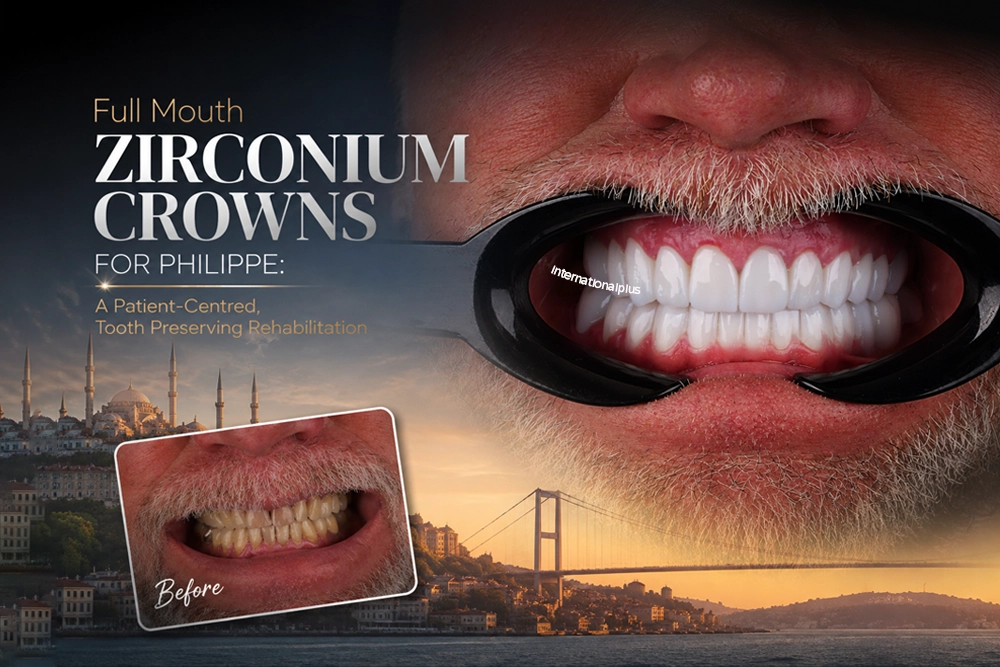
Not every full mouth rehabilitation has to remove healthy teeth. For Philippe from France, an international patient who came to International Plus, one request guided the whole plan: keep as much of his own dentition as possible. This case study follows a patient-centred, tooth preserving route built around full mouth zirconium crowns, where conservative fillings and root canals saved natural teeth and an implant was placed only where one was genuinely needed. International Plus has treated more than 200,000 patients from 140+ countries since 2014.
Key Takeaways
- The challenge: Rebuild a worn, damaged dentition without defaulting to extractions, honouring a patient who wanted to preserve his own teeth rather than replace them.
- The solution: A restorative-led plan of about 6 composite fillings, 6 root canal treatments and roughly 24 monolithic zirconium crown units with an implant placed only where a tooth could not be saved.
- Technical highlights: Shared decision-making, CBCT-guided prognosis, microscope assisted endodontics, screw retained units for retrievability, shade 0M2 and a night guard for parafunctional protection.
- The outcome: A fixed, natural looking result built largely on Philippe’s own teeth. Individual results may vary.
Philippe’s Story: A Rebuild That Kept His Own Teeth
A tooth preserving full mouth rehabilitation is a plan that restores the whole mouth while keeping as many natural teeth as the prognosis allows. That definition framed the case from the first consultation. Philippe from France, a French speaking international patient, wanted a durable, fixed result without surrendering teeth that could still serve for years, and planned the whole rehabilitation end to end before travelling to Istanbul. Our restorative team treated this preference as a clinical input, not a footnote. Unlike a full arch rehabilitation rebuilt entirely on implants, such as a screw retained zirconia bridge on a milled bar, many of Philippe’s teeth were still worth keeping. Clinical evidence backs the instinct: preserving a viable natural tooth is widely preferred over extraction when the prognosis allows (Yu X, et al., 2022). In practice, that single priority shaped every decision our clinic made across the plan.

Diagnosis and Treatment Plan: Prognosis Meets Patient Preference
Planning began with layered imaging because deciding which teeth to keep needs more than one view. Our team captured a 2D panoramic radiograph for an overview, a 3D CBCT scan, a cone beam tomography that maps bone volume and root anatomy in three dimensions and an intraoral scan. The Diagnostic Council, our multidisciplinary review of every complex plan, then graded each tooth’s prognosis before any treatment began. Where a case might otherwise be driven purely by clinical grading, here Philippe’s own wish to avoid implant supported coverage wherever possible was written into the roadmap, a shared decision-making approach that improves the quality of dental care (Ho JCY, et al., 2025). The Council drew a clear line: teeth with treatable decay or infection were routed to fillings and root canals and only teeth beyond repair were marked for extraction. This is the same diagnosis led thinking behind our comprehensive multidisciplinary rehabilitation work.
Saving the Teeth: Conservative Fillings and Root Canals
Conservative restoration was the first stage of the tooth preserving plan, the quiet tooth by tooth work that made preservation possible. First, roughly six teeth received conservative composite fillings, an adhesive restoration where decay is removed and the cavity is rebuilt with tooth coloured resin bonded to the remaining structure. Studies show modern adhesive composite restorations reach good longevity when placed with sound technique, which supported keeping these teeth rather than crowning or removing them (Josic U, et al., 2023). Then, where decay had reached the nerve, a further six teeth received root canal treatment, the removal of infected pulp followed by cleaning and sealing of the canal, carried out with magnification and rotary instruments for precise shaping. Endodontic treatment reaches high reported success when the canal system is thoroughly cleaned and sealed (Karamifar K, et al., 2020). For these preserved teeth, our team used microscope assisted root canal treatment to keep the natural roots anchored in the bone rather than trading them for surgery.

Restoring the Bite: Zirconium Crowns and a Single Implant
Once the foundation was stable, the prosthetic phase unified the mouth under one design. Our team first restored the dentition with roughly 24 monolithic zirconium crown units, cut from single high strength blocks so there is no layered porcelain to fracture first, which gives crowns strong long term survival (Leitão CIMB, et al., 2022). Most units sat over Philippe’s preserved teeth, while tooth 46, a lower first molar that could not be saved, was rebuilt as a single crown on one implant, the only surgery the plan required. That fixture, an internationally certified implant system, was placed with guided surgery, PRF (platelet rich fibrin drawn from Philippe’s own blood) and an insertion torque of 35 to 45 N/cm. A staged rather than immediate loading protocol was chosen because loading decisions turn on bone quality and stability at placement (Morton D, et al., 2018). Shape and shade were then previewed with digital smile design and a trial smile before the final zirconium dental crowns were milled in shade 0M2, some screw retained for retrievability.
| Element | What was done | Why |
| Diagnosis | Panoramic, CBCT, intraoral scan, Diagnostic Council review | Grade each tooth’s prognosis and record patient preference |
| Fillings | About 6 conservative composite restorations | Save teeth with treatable decay without crowning |
| Endodontics | About 6 root canal treatments, microscope assisted | Preserve viable teeth with infected pulp |
| Implant | One fixture at tooth 46, guided surgery, PRF | Replace the single unsalvageable molar |
| Crowns | Around 24 monolithic zirconium units, shade 0M2 | Unify natural teeth and the implant under one bite |
| Aftercare | Night guard | Manage parafunctional load on the new work |
The Result: A Fixed Smile Built on His Own Teeth
The result was a fixed, unified dentition that remained, by the patient’s own choice, mostly natural teeth, colour matched to shade 0M2. Only one site, a lower first molar at tooth 46, was restored through a single dental implant. Building durable restorations onto preserved natural teeth alongside a single implant reflects the broad, diagnosis led scope of a modern full mouth rehabilitation (Chen R, et al., 2024). To protect the work, our team delivered a night guard, a removable splint worn during sleep that absorbs the involuntary clenching and grinding which can overload newly restored teeth. This patient-centred set of full mouth zirconium crowns gave Philippe a more conservative reconstruction than a full clearance would have. Individual results may vary, and every plan depends on the prognosis of the specific teeth involved. Compared with a purely prognosis driven full mouth rehabilitation with implants and root canals, this case shows in practice how a patient’s own preference can steer a durable, tooth preserving result.

Frequently Asked Questions
What are full mouth zirconium crowns?
Full mouth zirconium crowns are a rehabilitation that restores the whole dentition with crowns milled from monolithic zirconia, a very strong ceramic. The crowns can sit on preserved natural teeth on root canal treated teeth or on implants where a tooth was lost. In Philippe’s case around 24 units in shade 0M2 unified natural teeth and a single implant into one bite.
Can I keep my natural teeth in a full mouth rehabilitation?
Often, yes. When a tooth has a sound root and treatable decay or infection, a filling or root canal treatment can preserve it instead of extraction. A tooth preserving full mouth plan keeps viable teeth and restores them with crowns while implants replace only teeth that cannot be saved, based on each tooth’s prognosis graded at diagnosis.
Why choose fillings and root canals over extractions and implants?
Preserving a viable natural tooth is more conservative than removing it because a tooth with good root and bone support can serve for years. Conservative fillings and root canals avoid unnecessary surgery and a natural root maintains the bone around it. Implants are then reserved for teeth that are genuinely beyond repair as with the single molar in this case.
Is shared decision-making part of the treatment plan?
Yes. The Diagnostic Council grades the clinical prognosis of every tooth, but the patient’s own priorities help shape the final roadmap. In this case, a wish to avoid implant supported coverage wherever possible was integrated into the plan, so the result balanced clinical judgement with what mattered to the patient. Timelines and outcomes depend on healing and the teeth involved.
Reviewed by Dr. Muhammed Kerem Işıkhan
References
- Yu X, et al. J Evid Based Dent Pract. 2022. PMID: 36162892
- Ho JCY, et al. Dent J (Basel). 2025. PMC11763373
- Josic U, et al. Dent Mater. 2023. PMID: 37827872
- Karamifar K, et al. Eur Endod J. 2020. PMC7398993
- Leitão CIMB, et al. J Prosthodont Res. 2022. PMID: 34615842
- Al-Maawi S, et al. Int J Implant Dent. 2021. PMC8684569
- Morton D, et al. Clin Oral Implants Res. 2018. PMID: 30328196
- Chen R, et al. BMC Oral Health. 2024. PMC11437823
Follow us on Social Media
internationalplusofficial
internationalplus
internationalplusdental
This content is written, reviewed, and approved by the International Plus Medical Review Board to ensure clinical accuracy and adherence to strict editorial standards. All medical information is regularly monitored, audited and updated in light of the latest scientific advancements.
However the information provided here is for general informational purposes only and cannot be used for self diagnosis or making individual health interpretations. Results of medical treatments depend on individual anatomy and the unique healing process of each patient. This information should not replace a personal consultation with a qualified healthcare professional. To understand the best options for your specific needs and to receive a personalized treatment plan, we invite you to book a free consultation with the expert medical team at International Plus.

Muhammed Kerem provides comprehensive dental care centered on practical solutions and exceptional patient outcomes for travelers seeking quality treatment in Istanbul.