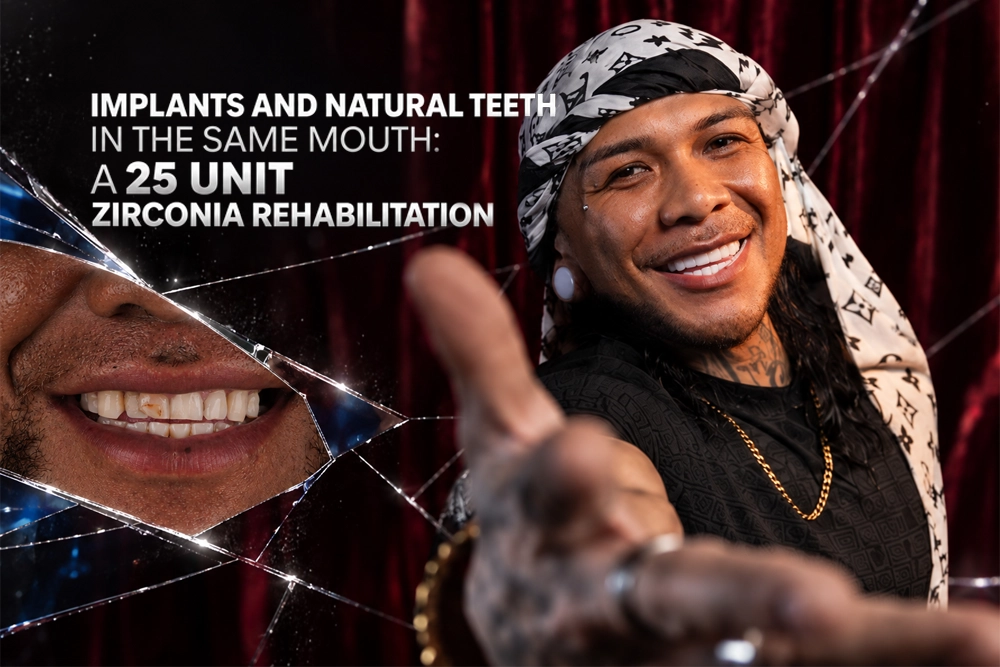
Wolfgang’s treatment record documents a mixed support rehabilitation rather than a purely implant borne one. The chart lists 24 zirconium units across both jaws on titanium bars, plus one post entry marking a root filled tooth rebuilt as an abutment. Between impression and cementation the team ran a two stage try in protocol, two plastic try in appointments on consecutive days. International Plus has treated 200,000+ patients from 140+ countries since 2014.
Key Takeaways
- The challenge: A 24 unit two jaw restoration combining bar supported implants with a natural root rebuilt by a post and core.
- The solution: Two consecutive plastic try in appointments, the first establishing vertical dimension and midline, the second verifying corrections before milling.
- Technical highlights: Post and core abutment rebuild, shade 0M2 from the in house PLUS laboratory, bar support in both jaws.
- The outcome: A fixed two arch restoration cemented on 26 July 2026 with night guards recorded for protection. Individual results may vary.
What Does Wolfgang’s Treatment Record Document?
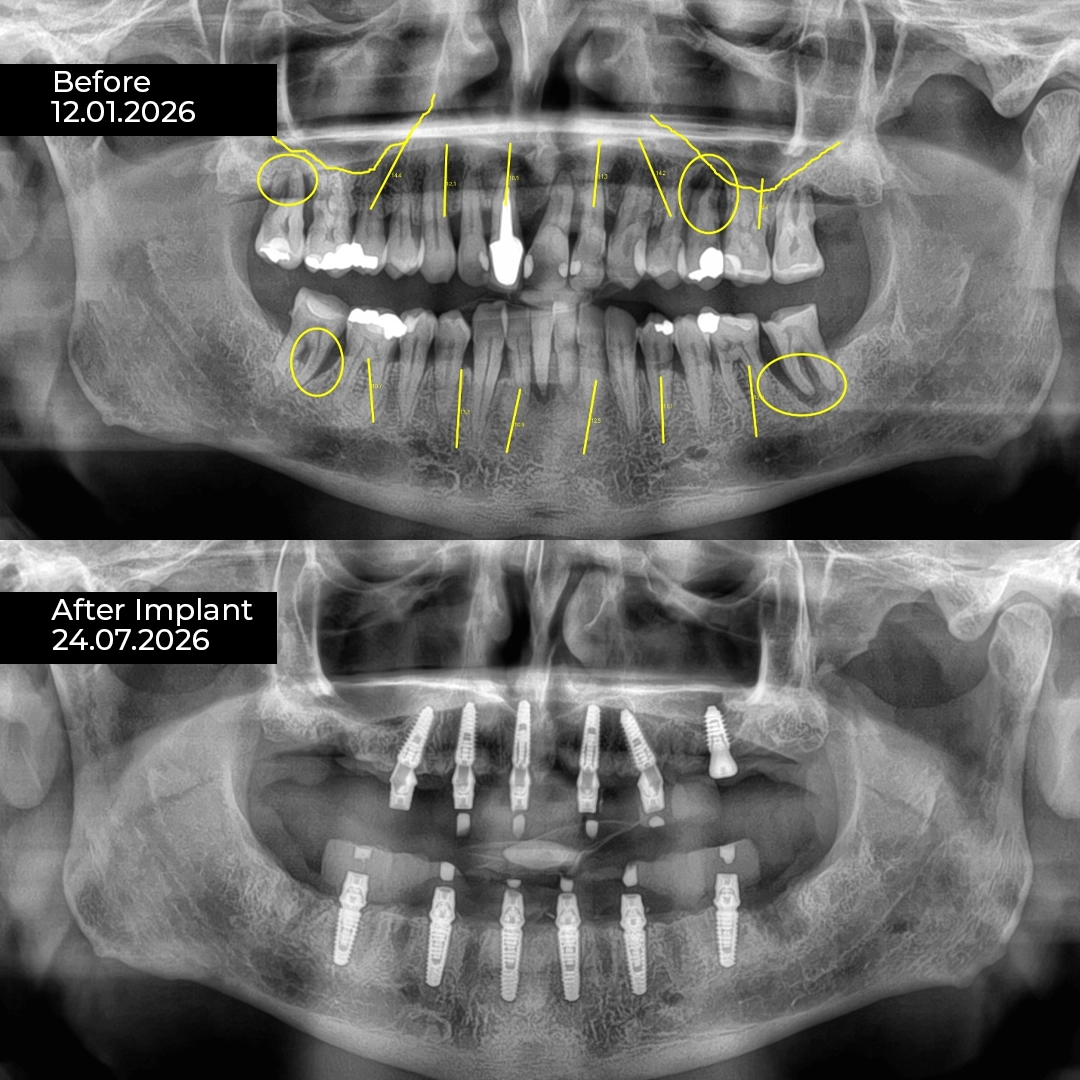
Wolfgang’s chart, dated 28 July 2026, records a seven day prosthetic sequence. The tooth grid covers six teeth per quadrant in both jaws, giving 24 units. Laboratory work is logged to the in house PLUS laboratory in shade 0M2. Post work is marked on the chart, together with a night guard entry recorded as two.
Two chart entries set the direction. The bar note, written for both jaws, places the restoration in splinted framework territory instead of conventional bridgework. The post note points elsewhere to a root canal treated tooth rebuilt so it can hold a crown. Our Diagnostic Council, the multidisciplinary review behind every two arch plan, fixed the order of preparation. Fixture counts are not legible in the archived chart so only confirmed data appears here.
Why Did This Case Use a Two Stage Try In Protocol?
A plastic try in is a rehearsal restoration in tooth coloured resin, seated in the mouth so the team can read fit and occlusion before the final ceramic is milled. Wolfgang’s log records two of them on 21 July 2026 and 22 July 2026, one day apart.
Each appointment carried a different job. The first try in establishes the working references: vertical dimension of occlusion, the height at which the jaws meet in contact, then midline and occlusal plane. Determining that height in a fully restored mouth relies on clinical judgement rather than one formula (Alhajj MN, et al., 2017). A randomised comparison of denture trial methods showed the trial stage itself carries the verification value (Inokoshi M, et al., 2012).
The second appointment tests the corrections rather than repeating the first. One try in is enough for a short span restoration but a 24 unit two jaw rehabilitation earns a second visit because every adjustment made at the first appointment shifts the reference the next measurement depends on. Appearance is deliberately not settled at the first try in.
What Is a Post and Core and Why Was One Recorded Here?
A post and core is a two part rebuild for a root canal treated tooth. Cement fixes the post inside the prepared canal, then a core is built over it, together recreating the shape a crown needs to grip. The prosthetic plan for Wolfgang includes exactly that rebuild.
Indication decides whether a post belongs in the plan. Evidence from a 2024 systematic review of endodontically treated teeth ties the justification to how little coronal tooth structure survives, not to the root filling (Alenezi AA, et al., 2024). Contrary to assumption, a post does not reinforce a root; its job is retention.
The ferrule governs how well that assembly resists fracture. A ferrule is the collar of sound tooth wall the crown grips below the core and testing ties fracture resistance to its height and even distribution (Zahran M, et al., 2021). A 2024 meta-analysis of glass fibre against metal posts tied post survival to the restorative situation, not to one material (Tsintsadze N, et al., 2024). Our team measures wall height before selecting a post and root canal treatment by endodontic specialists closes before the core as in our full mouth rehabilitation combining implants and endodontics.
Planning a full mouth restoration? Book your free consultation
How Do a Post and Core Abutment and a Bar Framework Share One Arch?
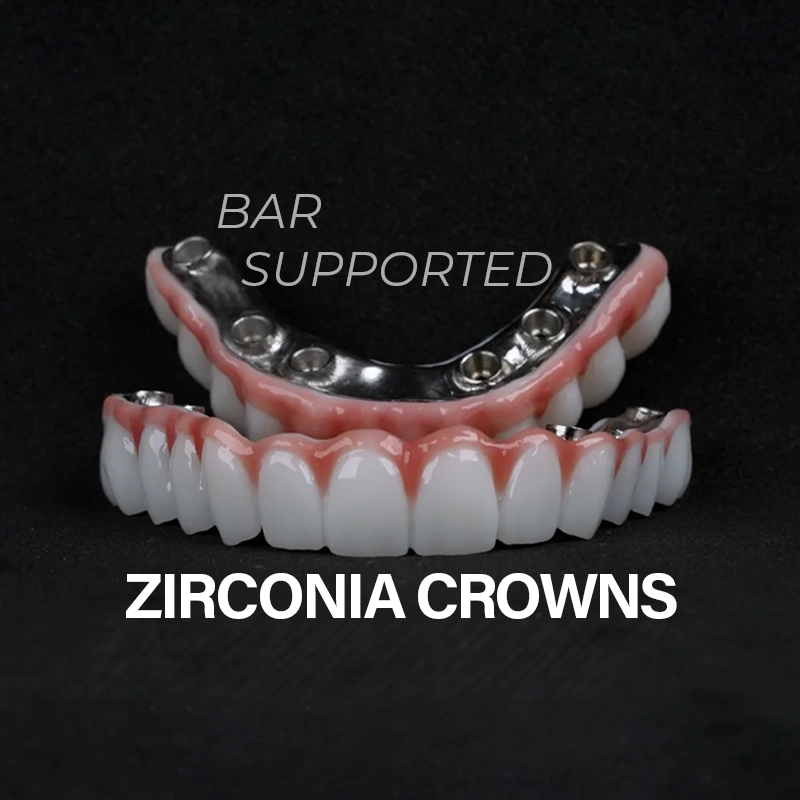
Mixed support means one arch carries implant borne units alongside tooth borne units. Wolfgang’s record combines titanium bar support with a natural root rebuilt by a post and core. Those two supports behave differently under bite force so the restoration has to be designed around that difference rather than in spite of it.
A tooth suspended by a periodontal ligament has physiological mobility. An osseointegrated implant has effectively none, which is why the bar exists: splinting a jaw of fixtures into a rigid framework spreads load along the arch instead of onto individual screws. Seven year data on bar retained superstructures in edentulous mandibles record that splinting behaviour (Ayna M, et al., 2018). Bar fabrication and passive fit checks are documented in our bar supported full arch zirconia rehabilitation with alveoloplasty.
Preserving a natural root buys proprioceptive feedback an implant cannot replace so our team keeps a restorable root where the ferrule allows, then shapes contacts so the bar segments absorb the heavier load. Wolfgang’s full ceramic crown restorations follow that scheme as in our tooth preserving full mouth zirconium crown rehabilitation.
What Did the Seven Day Delivery Sequence Look Like?
Wolfgang’s treatment log covers seven calendar days from the impression on 20 July 2026 to cementation on 26 July 2026. Four appointments sit inside that window: one impression visit, two plastic try in visits on consecutive days, then delivery of the 24 unit restoration.
| Date | Recorded step | Purpose |
|—|—|—|
| 20 July 2026 | Impression taken | Capture the prepared abutments and bar level positions |
| 21 July 2026 | First plastic try in | Establish vertical dimension, midline and occlusal plane |
| 22 July 2026 | Second plastic try in | Verify the corrections made after the first try in |
| 26 July 2026 | 24 unit bar supported zirconia cemented | Seat the definitive restoration in the upper and lower jaws |
Bottom line: three preparatory appointments across three days carried the case to one delivery visit four days later. Compressing a two jaw rehabilitation into a single week needs laboratory capacity on site so milling and sintering for 24 units ran in our own PLUS laboratory as in our complete digital full mouth implant rehabilitation protocol.
How Is a Rigid Two Arch Rehabilitation Protected During Sleep?
A night guard is a removable acrylic splint worn during sleep that takes clenching load onto a replaceable surface. Wolfgang’s chart records the night guard entry as two. Zirconia in both jaws removes the wear and flex natural enamel provides so nocturnal force travels down to the framework and to the post and core abutment beneath it.
Splint therapy is not automatic in every implant case. A systematic review of routine splint prescription for bruxers undergoing implant therapy found the evidence supports protection in identified parafunction rather than blanket prescription (Mesko ME, et al., 2014). Rigid two arch work changes that calculation since no opposing natural dentition absorbs overload. A guard moves night time force onto acrylic, the reasoning applied in our full mouth rehabilitation for severe bruxism and tooth loss.
What the Record Shows at Delivery
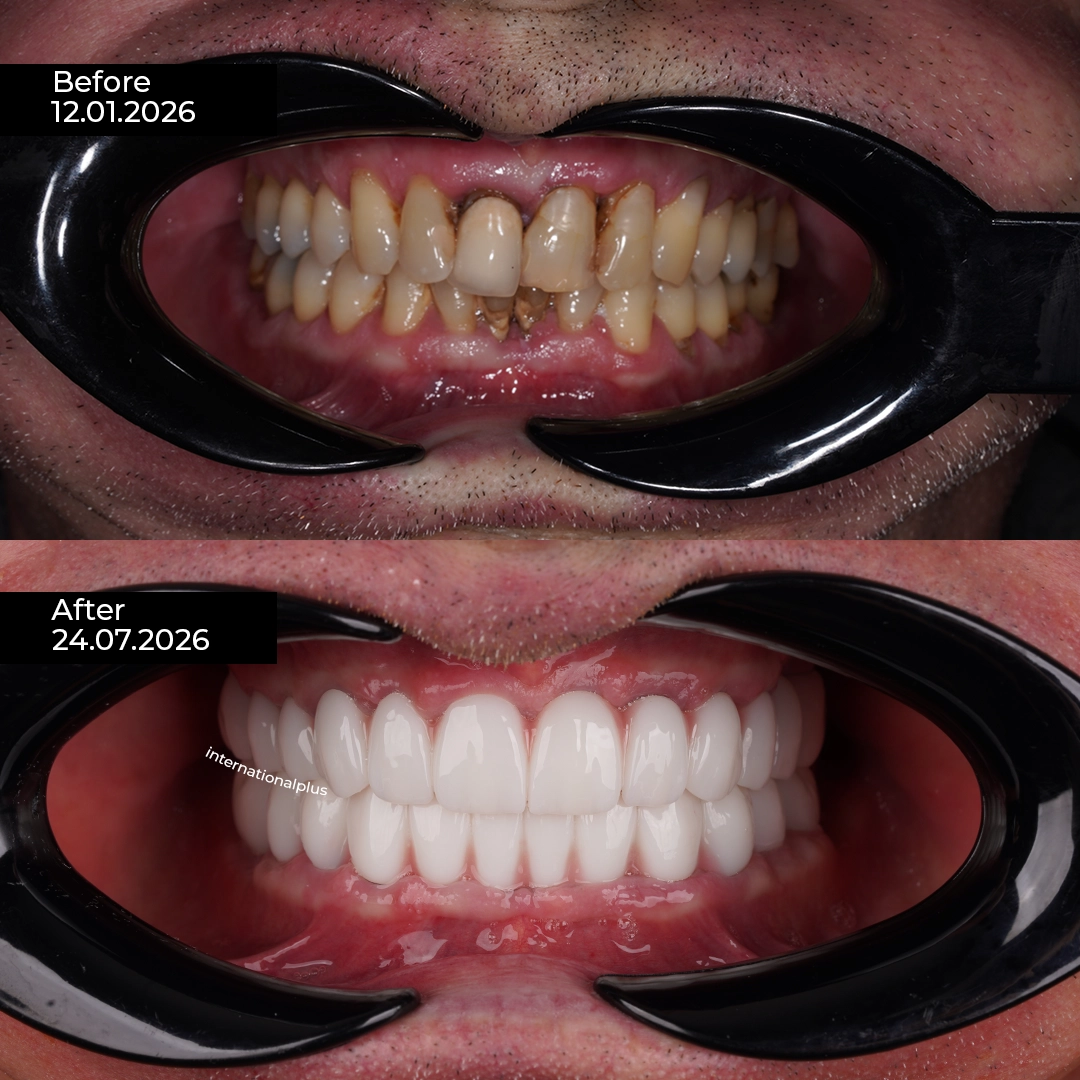
The treatment log closes on 26 July 2026 with a single entry: 24 units of bar supported zirconium cemented across the upper and lower jaws. Seven calendar days separate the first impression from that delivery and nothing beyond the recorded entries is claimed here.
Material choice sits on published outcome data. A 2024 systematic review of monolithic against veneered zirconia in complete arch implant prostheses concentrated mechanical complications in the veneering layer rather than the zirconia core (Martakoush-Saleh S, et al., 2024). What this two stage try in protocol adds is verification: the scheme carried by 24 monolithic units was read twice before one unit was milled. One patient under one set of findings is described here so individual results may vary.
International Plus combines official Ministry of Health authorization, 5,504+ verified Google reviews at 4.8/5 and more than 200,000 patients treated since 2014. Work built on this two stage try in protocol sits alongside our fixed Toronto bridge prosthesis and dental implant treatment in Istanbul cases, sharing the night guard protocol of our 27 unit screw retained zirconia rehabilitation.
Considering a fixed restoration for both jaws? Get a personalised treatment assessment
Frequently Asked Questions
What is a two stage try in protocol?
It is a prosthetic sequence using two try in appointments instead of one. The first seats a resin rehearsal restoration that establishes vertical dimension, midline and occlusal plane. The second verifies those corrections before the definitive ceramic is milled.
What is a post and core in dentistry?
A post and core rebuilds a root canal treated tooth that has lost most of its crown. Cement fixes the post into the prepared canal and a core is shaped over it, recreating the form a crown needs. The post retains the core rather than strengthening the root.
Can natural teeth and dental implants support the same restoration?
They can provided the design accounts for the difference between them. A natural root moves slightly within its periodontal ligament while an osseointegrated implant does not. Splinting implants with a bar and shaping contacts carefully lets both supports work inside one arch.
Why is a night guard recommended after full arch zirconia work?
Zirconia neither wears nor flexes the way natural enamel does so clenching during sleep concentrates load onto the framework and onto any rebuilt abutment. A removable splint moves that force onto acrylic which can be replaced without touching the fixed restoration.
Reviewed by Dr. Mehmet Yavuz
References
- Alhajj MN, et al. Determination of occlusal vertical dimension for complete dentures patients: an updated review. J Oral Rehabil. 2017. PMID 28600914
- Inokoshi M, et al. Evaluation of a complete denture trial method applying rapid prototyping. Dent Mater J. 2012. PMID 22277604
- Alenezi AA, et al. Clinical behavior and survival of endodontically treated teeth with or without post placement: a systematic review and meta-analysis. J Oral Sci. 2024. PMID 39231718
- Zahran M, et al. Effect of ferrule height and distribution on the fracture resistance of endodontically treated premolars. Niger J Clin Pract. 2021. PMID 33851671
- Tsintsadze N, et al. Comparing survival rates of endodontically treated teeth restored either with glass-fiber-reinforced or metal posts: a systematic review and meta-analyses. J Prosthet Dent. 2024. PMID 35430048
- Ayna M, et al. A comparative study on 7-year results of All on four immediate-function concept for completely edentulous mandibles: metal-ceramic vs bar-retained superstructures. Odontology. 2018. PMID 28321585
- Martakoush-Saleh S, et al. Evaluating the clinical behavior of veneered zirconia in comparison with monolithic zirconia complete arch implant-supported prostheses: a systematic review and meta-analysis. J Prosthet Dent. 2024. PMID 37696747
- Mesko ME, et al. Should occlusal splints be a routine prescription for diagnosed bruxers undergoing implant therapy? Int J Prosthodont. 2014. PMID 24905259
Follow us on Social Media
internationalplusofficial
internationalplus
internationalplusdental
This content is written, reviewed, and approved by the International Plus Medical Review Board to ensure clinical accuracy and adherence to strict editorial standards. All medical information is regularly monitored, audited and updated in light of the latest scientific advancements.
However the information provided here is for general informational purposes only and cannot be used for self diagnosis or making individual health interpretations. Results of medical treatments depend on individual anatomy and the unique healing process of each patient. This information should not replace a personal consultation with a qualified healthcare professional. To understand the best options for your specific needs and to receive a personalized treatment plan, we invite you to book a free consultation with the expert medical team at International Plus.

Dr. Mehmet Yavuz specializes in premium ceramic restorations, building beautiful, natural looking smiles through skilled Emax crown work and laminate veneer artistry for patients abroad. His mastery of both high translucency zirconium systems and delicate Emax materials lets him choose the ideal restoration for each patient’s unique needs and aesthetic wishes. Travelers seek him out specifically for his attention to detail in color matching, shape design and smile aesthetics that enhance rather than overpower natural facial features. His thorough case analysis and digital smile planning secure predictable results, giving patients confidence in their outcomes before any procedure begins. Mindful of the worries visitors carry about complex aesthetic work overseas, he provides full consultations with realistic expectations and detailed timelines. Patient reviews steadily highlight his artistic skill, professional approach and gift for creating smile transformations that look truly natural. Fluent in English and experienced in coordinating multi visit cosmetic cases, he delivers exceptional results with warm, patient centered care.