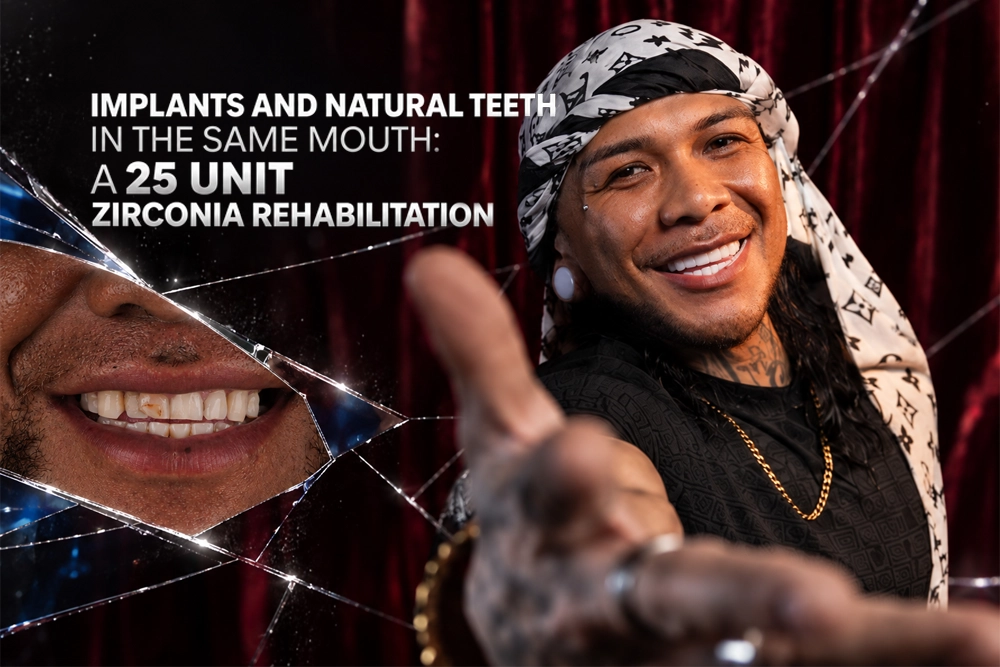
Monserrat’s treatment record describes a demanding situation in implant prosthetics: both jaws restored on implants, both splinted by titanium bars, each carrying a fixed zirconia superstructure. The chart also marks alveoloplasty in the surgical session, meaning the bone ridge had to be reshaped before prosthetic work could begin. This case study follows that bar supported full arch zirconia plan as the documentation records it. International Plus has treated more than 200,000 patients from 140+ countries since 2014.
Key Takeaways
- The challenge: Both jaws required implant supported fixed teeth and the surgical record shows the alveolar ridge needed reshaping by alveoloplasty first.
- The solution: Titanium bars in both jaws, splinting the implants of each arch into one rigid framework beneath the zirconia.
- Technical highlights: Ridge preparation by alveoloplasty, passive fit verification on both bars plus 24 zirconia units in shade 0M1 with a Plus 5 tooth form.
- The outcome: A fixed two arch rehabilitation delivered with a night guard. Individual results may vary.
What Does Monserrat’s Treatment Record Document?
Monserrat’s chart, dated August 2026, records a two session rehabilitation. The first session covers implant surgery with alveoloplasty marked on the surgical form. The second delivers titanium bars in both jaws carrying zirconium crowns on implants. The tooth grid totals 24 units, six per quadrant in shade 0M1 with Plus 5 tooth form.
Alveoloplasty is a bone reshaping step and its presence on the surgical form changes the prosthetic sequence. The bar entry, marked for both jaws, moves the case out of conventional bridge territory into a splinted framework design. Our clinic routes every two arch plan through the Diagnostic Council before surgery.
The implant system and the fixture count are not legible in the archived chart so the case study reports only what the clinical data confirms.

Why Was Alveoloplasty Performed Before Implant Placement?
Alveoloplasty is the surgical reshaping of the alveolar ridge, the bone crest that once held the natural teeth to remove sharp edges and irregular height. In Monserrat’s surgery the step preceded implant placement because a fixed prosthesis needs a level foundation before fixture positions are planned.
Ridge irregularity is not a cosmetic detail. An uneven crest forces the prosthesis to compensate with bulk.
Controlled clinical studies show piezosurgery and bur alveoloplasty produce comparable ridge form with the piezoelectric technique linked to less postoperative swelling (Gangwani KD, et al., 2018) and repeated later (Pandey V, et al., 2022). Our surgical team measures bone reduction from the CBCT scan since over reduction costs implant length no later stage recovers. Ridge preparation adds surgical time yet removes problems that surface at try in as in our same day bar supported implant case.
Bar Supported or Direct Screw Retained: Which Design Suits a Long Arch?
A bar supported rehabilitation is a design in which a milled titanium framework sits over the implants and carries the zirconia superstructure rather than each fixture carrying the prosthesis directly. Monserrat’s record marks bar work in both jaws, turning each arch into one splinted unit.
| Design | How load is carried | Where it fits best |
|—|—|—|
| Titanium bar supported | Bar splints every fixture, then spreads bite force along the framework | Long spans, corrected ridges, two arch rehabilitations |
| Direct screw retained bridge | Zirconia seats straight onto multi unit abutments | Near parallel implants, fewer components |
Bottom line: the bar costs one component and one laboratory stage, then returns rigidity plus angulation correction.
A direct screw retained bridge works well for arches with near parallel implants but a bar earns its extra laboratory stage here because splinting corrects angulation and spreads load a long zirconia span would carry alone. Bar frameworks also demand more vertical restorative space, a requirement set out in clinical data for implant prostheses (Carpentieri J, et al., 2019). Where angulation planned with CBCT is favourable, our team prefers the simpler screw retained zirconia bridge on a milled bar or an All on 4 full arch restoration.
Planning a full arch rehabilitation? Book your free consultation

How Is Passive Fit Verified on a Titanium Bar?
Passive fit is a seating condition in which the framework rests on every implant without generating stress once the retaining screws are tightened. Verification comes before the zirconia is milled because a bar that seats unevenly transfers permanent strain into bone and screws.
Framework misfit is measured in microns and cannot be judged by feel. Clinical studies of screw retained prostheses describe passive fit as an ideal laboratory work approaches rather than perfectly achieves (Buzayan MM, et al., 2014). Modelling shows how uneven seating redistributes stress across implant retained prostheses (Tonin BSH, et al., 2021).
Our team verifies each bar separately, first with a one screw test and then with a digital seating check inside the in house PLUS laboratory, the workflow set out in our complete digital full mouth implant rehabilitation protocol. Monserrat’s arches were checked one at a time since a bar strained on one side stays silent under the superstructure.
How Is Occlusion Managed When Both Arches Are Rehabilitated?
Restoring both jaws at once removes the reference a single arch case keeps because no untouched opposing dentition remains to copy. Vertical dimension, midline and occlusal plane must all be established by the clinical team rather than inherited. A two arch plan is therefore delivered as one unit.
Long term clinical studies of implant supported jaw rehabilitations track exactly the load relationships at work here (Lopes A, et al., 2017). Two rigid zirconia arches lose the shock absorption periodontal ligaments provide so contact scheme and vertical dimension carry more weight than in a single arch plan. Monserrat’s rehabilitation used the Plus 5 tooth form so occlusal contacts land evenly across 24 units.
Contrary to a common assumption, treating both jaws together is easier to balance than staging the arches because our team controls both halves of the occlusion at once as in our full arch rehabilitation for challenging anatomy.

The 24 Unit Zirconia Superstructure
Monserrat’s final restoration is recorded as 24 zirconium crown units on implants, six per quadrant across both arches in shade 0M1. Zirconia carries the superstructure because the material resists the fracture and chipping that layered ceramics show over long spans.
Retrospective clinical data support the material decision. A review of 2,039 complete arch zirconia prostheses reported high survival with mechanical complications concentrated in veneering rather than in the zirconia core (Bidra AS, et al., 2018). A series of 115 edentulous jaws tied outcomes to prosthetic space as much as to the ceramic (Al-Tarawneh S, et al., 2023).
Milling and glazing were completed with Redon equipment in our in house PLUS laboratory before the units were seated on the verified bars. Shade 0M1 is a bright low chroma tone and against the Plus 5 form it gives a uniform arch as in Suzy’s Toronto bridge transformation.
Why Is a Night Guard Part of the Protocol?
A night guard is a removable occlusal splint worn during sleep and it closed Monserrat’s treatment sequence. Two opposing zirconia arches cannot wear or flex the way enamel does so nocturnal clenching concentrates force on the bars and the retaining screws beneath the restoration.
Parafunctional load is a recognised risk factor in implant rehabilitation and clinical studies of implants in patients with bruxing habits recommend protective splinting alongside careful occlusal design (Lobbezoo F, et al., 2006). A splint does not stop clenching, it moves force onto a sacrificial surface easier to replace than a framework. Our clinic delivers the night guard with every rigid two arch rehabilitation, a policy shaped by cases such as our full mouth rehabilitation for severe bruxism.
The Result and What This Case Records
Monserrat finished treatment with a fixed bar supported full arch zirconia rehabilitation in both jaws, 24 units in total, protected by a night guard. The documented order makes the case instructive: ridge correction first, framework verification second, superstructure last. Every plan is built around one person’s anatomy so individual results may vary.
Verifiable standards sit behind that outcome. International Plus combines official Ministry of Health authorization, 5,504+ verified Google reviews at 4.8/5 and more than 200,000 international patients treated since 2014. A case like this sits within our dental implant treatment in Istanbul and fixed Toronto bridge prosthesis work, planned before travel.
Considering a fixed solution for both jaws? Get a personalised treatment assessment
Frequently Asked Questions
What is a bar supported full arch zirconia restoration?
It is a fixed set of teeth in which a milled titanium bar is attached to the implants of one jaw, splinting them into one rigid framework. A zirconia superstructure is fixed onto that bar so chewing force spreads along the arch.
Why is alveoloplasty performed before implant placement?
Alveoloplasty reshapes the alveolar bone crest to remove sharp edges and uneven height. A fixed full arch prosthesis needs a level foundation so correcting ridge form first lets the team place implants where the replacement teeth belong.
How is passive fit of a titanium bar checked?
Passive fit is verified before the final teeth are made. Our prosthetic team seats the bar, tightens a single screw and checks whether the opposite end lifts. A bar that seats unevenly is remade because misfit stresses bone and screws.
Why deliver a night guard with a zirconia rehabilitation?
Zirconia does not wear or flex like natural enamel so grinding during sleep concentrates force on the framework and on the supporting bone. A night guard is a removable splint that absorbs that load onto a replaceable surface after rigid full arch work.
Reviewed by Dr. Şehrazat Artış
References
- Gangwani KD, et al. Piezosurgery Versus Conventional Method Alveoloplasty. Ann Maxillofac Surg. 2018. PMC6327828
- Pandey V, et al. Piezosurgery Versus Conventional Method Alveoloplasty: A Comparative Study. J Maxillofac Oral Surg. 2022. PMC9474792
- Carpentieri J, et al. Hierarchy of restorative space required for different types of dental implant prostheses. J Am Dent Assoc. 2019. PMID 31352966
- Buzayan MM, et al. Passive Fit in Screw Retained Multi-unit Implant Prosthesis: A Review of the Literature. J Indian Prosthodont Soc. 2014. PMC3935037
- Tonin BSH, et al. Evaluation of misfit and stress distribution in implant-retained prosthesis obtained by different methods. Braz Dent J. 2021. PMID 34877979
- Bidra AS, et al. Survival of 2039 complete arch fixed implant-supported zirconia prostheses: A retrospective study. J Prosthet Dent. 2018. PMID 28689903
- Al-Tarawneh S, et al. Zirconia full arch implant prostheses: survival and prosthetic space dimensions with 115 edentulous jaws. Int J Oral Maxillofac Implants. 2023. PMID 37083903
- Lobbezoo F, et al. Dental implants in patients with bruxing habits. J Oral Rehabil. 2006. PMID 16457676
Follow us on Social Media
internationalplusofficial
internationalplus
internationalplusdental
This content is written, reviewed, and approved by the International Plus Medical Review Board to ensure clinical accuracy and adherence to strict editorial standards. All medical information is regularly monitored, audited and updated in light of the latest scientific advancements.
However the information provided here is for general informational purposes only and cannot be used for self diagnosis or making individual health interpretations. Results of medical treatments depend on individual anatomy and the unique healing process of each patient. This information should not replace a personal consultation with a qualified healthcare professional. To understand the best options for your specific needs and to receive a personalized treatment plan, we invite you to book a free consultation with the expert medical team at International Plus.

Dr. Alper Çağlayan Sarraf directs the oral surgery unit at InternationalPlus Istanbul, focusing on demanding cases that draw patients from every corner of the world.