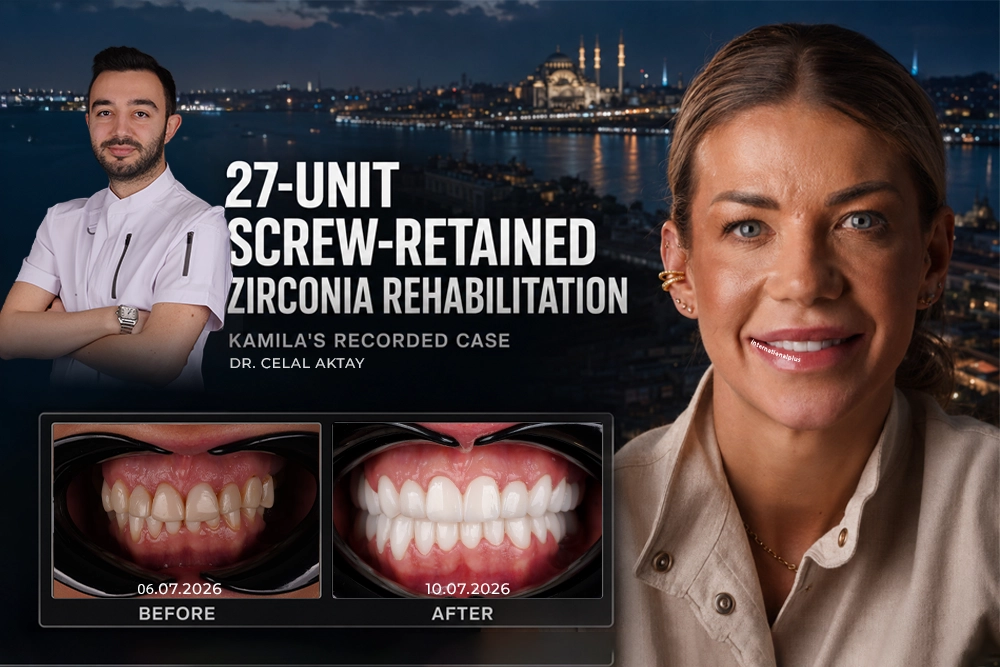
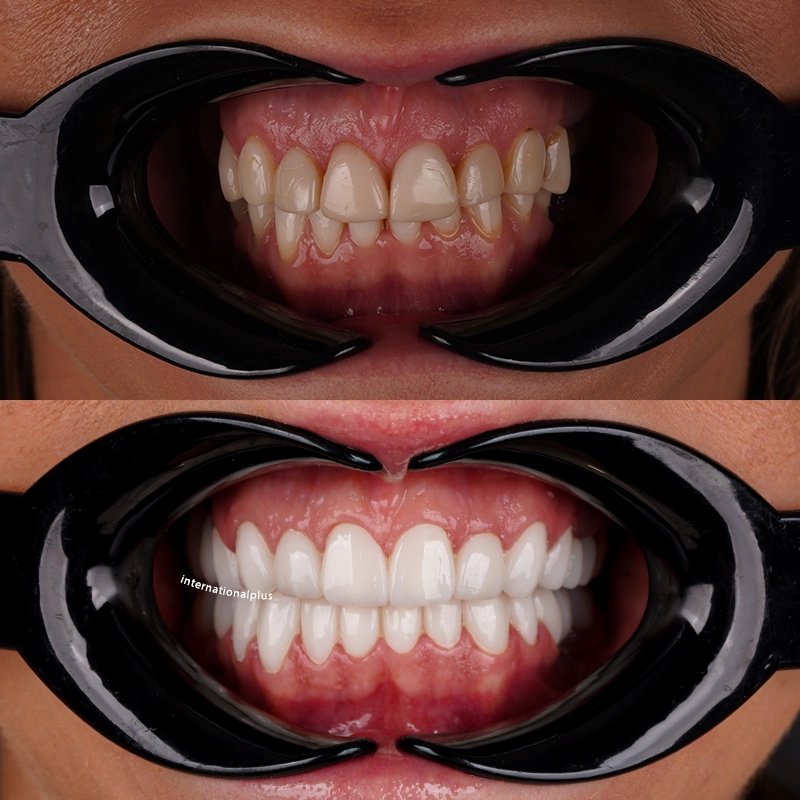
Kamila’s treatment record documents a prosthetic case rather than a surgical one. The chart lists two premolars lost to a cyst, an upper arch to be restored from 7 to 7 with a lower arch from 6 to 7. Two root canals plus two fillings were also pending. What the prosthetic team built from those findings was a screw retained zirconia rehabilitation of 27 units, two of them held by screws on implants. This case study follows the sequencing across five recorded working days at a clinic treating patients from 140+ countries.
Key Takeaways
- The challenge: A 27 unit restoration combining tooth supported zirconium crowns with implant borne units, plus two premolar spaces lost to a cyst.
- The solution: Two screw retained units within a 27 unit zirconia restoration, upper arch 7 to 7 plus lower arch 6 to 7, extendable later on request.
- Technical highlights: A type 3 root canal on tooth 27 closed before delivery, SHINING 3D digital impressions, shade 0M2 in the PLUS 2 tooth form.
- The outcome: A fixed restoration seated on the fifth recorded day with a night guard for occlusal protection. Individual results may vary.
What Did the Clinical Record Show Before Treatment?
Kamila’s chart recorded four findings. Two premolars were absent after a cyst. The upper arch was to be restored from 7 to 7 with the lower arch from 6 to 7. Two root canal treatments plus two fillings were still pending. Examination took place on 6 July 2026, one day before preparation began.
The arithmetic is exact. Unit count in prosthetics is the number of crowns spanning an arch: 14 units upper when restored 7 to 7, then 13 units lower when restored 6 to 7, giving 27 units. Two units were screw retained on implants checked during the preparation visit. Every other unit was a zirconium crown seated on a prepared natural tooth. Our Diagnostic Council, the multidisciplinary review signing off each full mouth plan, fixed the order in which endodontics preceded prosthetics.
Why Was This Screw Retained Zirconia Rehabilitation Not Cemented?
A screw retained restoration is a crown held to its implant by a screw passing through the biting surface rather than by cement. Two of Kamila’s 27 units were built that way. A cemented crown cannot be removed intact. Residual cement below the gum line is also a documented trigger of peri implant inflammation.
Retrievability drove the choice. Clinical evidence comparing the two retention modes reports fewer biological complications for screw retained work (Wittneben JG, et al., 2014). A 2015 maintenance review found screw retained reconstructions were repaired rather than replaced (Ma S, et al., 2015). Screw retention works well for implant borne units in a long span restoration but a cemented crown remains the better option where implant angulation would drive the screw channel through a visible facial surface because that access hole cannot be corrected after delivery. Our team applied the same reasoning to a screw retained zirconia bridge on a milled bar.
Why Is Endodontic Treatment Sequenced Before the Final Crowns?
Root canal treatment belongs before the definitive crown. Kamila’s record lists two root canal treatments plus two fillings. The completion log dates a type 3 root canal on tooth 27, the upper left second molar to 10 July 2026, the same appointment at which the 27 unit restoration was seated.
Sequence protects the ceramic. A tooth crowned before its canal system is cleaned must later be reopened through the finished restoration, damaging the crown while breaking the coronal seal. Research on root filled teeth shows survival depends heavily on the quality of the definitive coronal restoration placed over the endodontic work (Mannocci F, et al., 2022). In our practice the full ceramic crown becomes the permanent seal only once endodontics is closed. Kamila’s case ran root canal treatment by endodontic specialists inside the prosthetic timeline, mirroring our full mouth rehabilitation combining implants and root canals.
How Were the Cyst Related Premolar Spaces Restored?
Two premolars were missing from Kamila’s arches, recorded on the chart as lost because of a cyst. Enucleation of a jaw cyst leaves a bone cavity that fills over months while often altering the ridge contour left behind. Those spaces were therefore restored inside the fixed 27 unit design instead of being reopened surgically.
Clinical studies of enucleation with guided bone regeneration in odontogenic jaw cysts document ossification proceeding over months with defect size influencing how completely a site fills (Cao YT, et al., 2022). Because a healed cyst site can leave a flatter ridge than adjacent bone, our prosthetic team shaped the units bridging those spaces to rest against tissue without pressing into it. Kamila’s lower arch was restored 6 to 7 rather than 7 to 7. The chart notes the final lower molars can be added later on request.
How Were the Impressions Taken and the Zirconia Built?
Preparation was completed on 7 July 2026 alongside implant checks with the first plastic try in the next day. A SHINING 3D scanner captured both arches directly. Digital capture removes the tray distortion of conventional impressions while sending the case to our in house laboratory as a file.
A 2025 systematic review of complete arch digital implant impressions confirms that scanning strategy affects accuracy across the span (Pozzi A, et al., 2025) with scan path plus operator handling as established variables (Revilla-Leon M, et al., 2023). The plastic try in on 8 July 2026 then tested that digital plan in the mouth: margin fit first, then occlusal contact, then tooth form. Zirconia suits this span because long ceramic arches need adequate prosthetic space plus a material tolerating the load (AlTarawneh S, et al., 2021). Final zirconia dental crowns were milled in shade 0M2 using the PLUS 2 tooth form, the route shown in our complete digital full mouth implant rehabilitation.
| Date | Recorded step | Purpose |
|—|—|—|
| 6 July 2026 | Examination | Fix the restorative plan |
| 7 July 2026 | Preparation, implant checks, SHINING 3D scan | Create crown space, capture both arches |
| 8 July 2026 | First plastic try in | Verify fit before milling |
| 10 July 2026 | Type 3 root canal on tooth 27, filling work | Close endodontics first |
| 10 July 2026 | 27 unit restoration plus night guard delivered | Seat and protect the final work |
Bottom line: five appointments carried the case from examination to a seated restoration.
Why Did a Night Guard Complete the Case?
A night guard is a removable acrylic splint worn during sleep that absorbs clenching force before it reaches the restoration. Kamila’s chart marked one as part of the plan and the guard was handed over with the 27 units. Zirconia does not wear or flex the way enamel does.
Rigidity is exactly why occlusal protection is standard here. A 2026 systematic review of implant supported prostheses in patients with parafunctional habits lists occlusal splints among the strategies reducing mechanical complications (Chawki I, et al., 2026). Screws share one force path with the ceramic plus the prepared abutment teeth beneath it. A splint spreads night time load across a wider surface instead of concentrating it on a few contacts. Our full mouth rehabilitation for severe bruxism and tooth loss case applies the same logic to a heavier load.
Considering a full mouth restoration? Book your free consultation
What the Record Shows at Delivery
The treatment log closes on 10 July 2026 with three entries: endodontic work completed, 27 units delivered with two screw retained, a night guard issued. Preparation through definitive seating falls inside five recorded working days between 6 July 2026 and 10 July 2026.
Nothing further is claimed here. This screw retained zirconia rehabilitation describes one patient under one specific set of findings so individual results may vary. The record does show a repeatable order of work: findings first, then endodontics, then digital capture, then protection. International Plus combines official Ministry of Health authorization, 5,504+ verified Google reviews at 4.8/5 and more than 200,000 international patients treated since 2014. Implant borne work sits within our single tooth implant options while tooth supported cases follow our tooth preserving full mouth zirconium crown rehabilitation.
Frequently Asked Questions
What is a screw retained zirconia crown?
A screw retained zirconia crown is a ceramic restoration fixed to an implant by a screw passing through the crown. No cement is used at the implant interface so the crown can be unscrewed for maintenance then reseated. The screw channel is sealed with composite.
Why is root canal treatment completed before the final crowns?
Sealing the root canal system before the definitive crown protects both the tooth and the restoration. If endodontic treatment becomes necessary afterwards, the dentist must drill through the finished crown, weakening the ceramic while breaking the coronal seal that keeps bacteria out.
Can teeth lost to a jaw cyst be replaced with a fixed restoration?
Often yes though the plan depends on how much bone remains after the cyst was removed. A healed cyst site can leave a flatter ridge than surrounding bone. The restoration can bridge that space within a fixed design or implants can be considered once the site has ossified.
How long does a full mouth zirconia restoration take?
Treatment length varies with how much preparatory work is needed. A case limited to preparation, digital impressions, a try in and delivery can be completed inside a single treatment week as this record shows. Cases involving extractions, bone grafting or implant placement need healing intervals of several months between the surgical and prosthetic stages.
Why is a night guard recommended after full mouth crowns?
Zirconia is far harder than natural enamel and does not flex under load in the same way. Clenching during sleep therefore concentrates force onto the crowns, the screws, the prepared teeth beneath them. After a screw retained zirconia rehabilitation, a night guard spreads that load across a wider surface.
Reviewed by Dr. Celal Aktay
References
- Wittneben JG, et al. Clinical performance of screw versus cement retained fixed implant-supported reconstructions: a systematic review. Int J Oral Maxillofac Implants. 2014. PMID 24660192
- Ma S, et al. Screw versus cement retained implant prostheses: a systematic review of prosthodontic maintenance and complications. Int J Prosthodont. 2015. PMID 25822297
- Mannocci F, et al. Present status and future directions: The restoration of root filled teeth. Int Endod J. 2022. PMC9796050
- Cao YT, et al. Enucleation combined with guided bone regeneration in small and medium-sized odontogenic jaw cysts. World J Clin Cases. 2022. PMC8968821
- Pozzi A, et al. Photogrammetry versus intraoral scanning in complete-arch digital implant impression: a systematic review and meta-analysis. Clin Implant Dent Relat Res. 2025. PMC12144927
- Revilla-Leon M, et al. Intraoral digital implant scans: parameters to improve accuracy. J Prosthodont. 2023. PMID 37586762
- AlTarawneh S, et al. Zirconia full arch implant prostheses: survival, complications and prosthetic space dimensions. Int J Oral Implantol (Berl). 2021. PMID 34006068
- Chawki I, et al. Particularities of the implant-supported prosthesis in patients with bruxism: systematic review of the literature. Pan Afr Med J. 2026. PMC13331755
Follow us on Social Media
internationalplusofficial
internationalplus
internationalplusdental
This content is written, reviewed, and approved by the International Plus Medical Review Board to ensure clinical accuracy and adherence to strict editorial standards. All medical information is regularly monitored, audited and updated in light of the latest scientific advancements.
However the information provided here is for general informational purposes only and cannot be used for self diagnosis or making individual health interpretations. Results of medical treatments depend on individual anatomy and the unique healing process of each patient. This information should not replace a personal consultation with a qualified healthcare professional. To understand the best options for your specific needs and to receive a personalized treatment plan, we invite you to book a free consultation with the expert medical team at International Plus.

Dr. Alper Çağlayan Sarraf directs the oral surgery unit at InternationalPlus Istanbul, focusing on demanding cases that draw patients from every corner of the world.