Wiktoria’s treatment card documents a restorative case with the decision written into it. The laminate line is marked for 20 units in porcelain and directly beneath it an E-max crown line carries the same 20 units with the word “or” beside it. What the team delivered was a porcelain laminate veneer rehabilitation across both arches, completed in four appointments between 16 and 21 July 2026 at a clinic serving 140+ countries.
Key Takeaways
- The challenge: Twenty teeth, ten per arch from second premolar to second premolar with two material routes recorded on one card.
- The solution: 20 porcelain laminate veneers instead of 20 E-max crowns, chosen for a preparation envelope that keeps the bond on enamel.
- Technical highlights: Plastic try in on 17 July then dentin try in on 20 July before adhesive bonding on 21 July 2026.
- Medical planning: A penicillin allergy was recorded on the card and carried into pharmacological decisions by the clinician.
- The outcome: All 20 veneers bonded at the fourth appointment with a night guard impression the same day. Individual results may vary.
What Did the Treatment Card Show Before Preparation?
Wiktoria’s card records one aesthetic plan holding two material options. The laminate line is marked for 20 units in porcelain with the tooth grid filled 5 to 5 in the upper arch and 5 to 5 in the lower arch. A night guard is ticked inside the same plan.
The arithmetic is direct. A 5 to 5 span covers ten teeth per arch from the right second premolar across to the left, giving ten upper units plus ten lower units. One further entry sits in the medical history field, written with double exclamation marks: a penicillin allergy. Our Diagnostic Council, the multidisciplinary review that signs off restorative plans, reads that field before any preparation date is set.
Why Were Porcelain Laminate Veneers Chosen Over E-max Crowns?
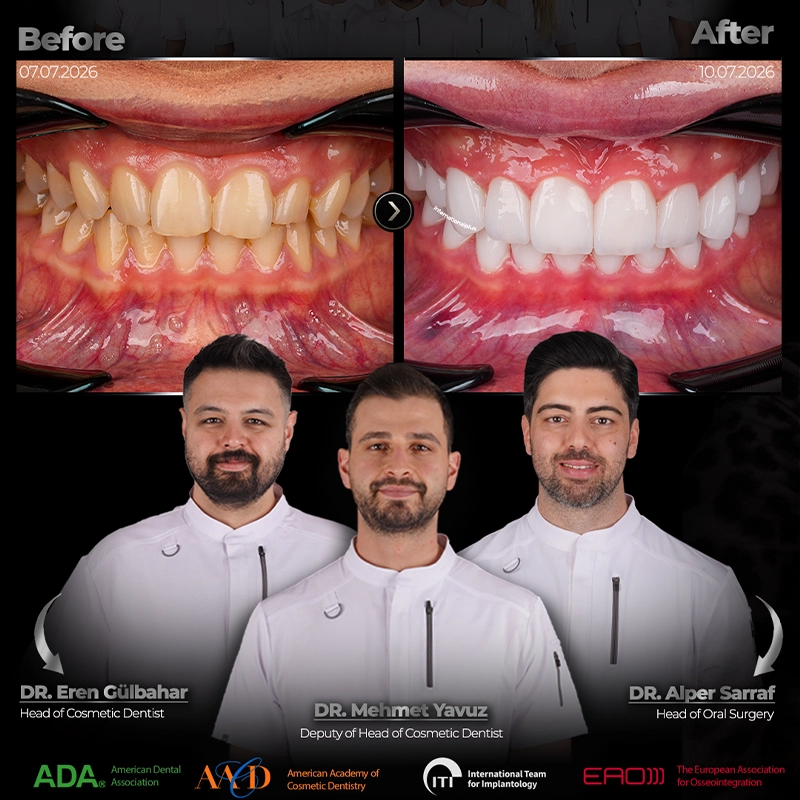
A porcelain laminate veneer rehabilitation removes far less tooth structure than a crown rehabilitation of the same span. Laminates are thin ceramic shells bonded to the facial surface while a crown encircles the entire tooth. Wiktoria’s card weighed both routes across the same 20 teeth before the laminate line was confirmed.
Preparation depth is the measurable difference. A full coverage preparation reduces every axial wall; a laminate preparation stays inside the facial enamel. That distinction is not cosmetic because enamel is a stable, highly mineralised bonding substrate and dentin is not. Outcome data grouped by preparation design shows that design and material together drive the result rather than the ceramic alone (Alothman Y, et al., 2018) while a systematic review of laminate veneers bonded to different substrates found survival and bond performance both favour enamel supported margins (Alqutaibi AY, et al., 2025). A 2025 meta analysis reports high survival for ceramic laminate veneers over multi year follow up (Klein P, et al., 2025) and an earlier review named debonding rather than bulk failure as the dominant complication (Alenezi A, et al., 2021).
Laminate veneers work well where the facial enamel is largely intact but a full ceramic crown remains the better option once a tooth has lost substantial coronal structure because a bonded shell cannot retain itself without sound enamel beneath it. In our practice the remaining enamel decides this, not the shade target so heavily restored teeth are carried by full ceramic crown restorations instead as our 28 unit zirconia smile makeover record shows. Patients weighing the two routes can compare dental crowns versus veneers and how long veneers last.
How Was the Recorded Drug Allergy Handled in Planning?
Wiktoria’s card carries a penicillin allergy entry written with double exclamation marks in the medical history field. That entry is part of the clinical record and governs pharmacological decisions for the case. No antibiotic name or dose appears in this report because drug selection after an allergy entry belongs to the treating clinician.
Documenting the allergy is the clinically meaningful act. Allergy guidance for dental practitioners emphasises that a reported drug allergy must be captured and evaluated rather than assumed since an unverified label changes prescribing decisions for years (Ramsey A, et al., 2019). Veneer work is restorative rather than surgical so pharmacological exposure is limited by the treatment design itself: the log records preparation, two try in stages then bonding with no extraction anywhere. Our Diagnostic Council still reads that field before a preparation date is booked because the entry must be visible to every clinician touching the case. The same discipline shaped another allergy aware full mouth zirconia plan in our archive.
How Were the 20 Veneers Verified and Bonded?
Two try in appointments sit between preparation and bonding in this record. The plastic try in on 17 July 2026 tested form and arch alignment in a machinable polymer. The dentin try in on 20 July 2026 checked the ceramic core before glaze and final shade were committed. Neither stage was optional here.
Staged verification is a documented method, not an extra visit. Work on the full mouth mock up describes it as a dynamic diagnostic approach that tests function and appearance before definitive restorations are made (Fabbri G, et al., 2018). The polymer stage tests whether preparation left the ceramist enough room across 20 units; the dentin stage tests whether the core shade reads correctly under translucency.
| Date | Recorded step | What it verified |
|—|—|—|
| 16 July 2026 | Tooth preparation, 20 teeth | Enamel level reduction and ceramic space |
| 17 July 2026 | Plastic try in | Form and arch alignment |
| 20 July 2026 | Dentin try in | Core shade and ceramic thickness |
| 21 July 2026 | 20 veneers bonded, night guard impression | Final seating plus occlusal protection |
Bonding followed on 21 July 2026. A laminate holds no mechanical retention of its own so the adhesive interface is the restoration itself. A 2023 review catalogues the risk factors that surface during veneer cementation from isolation failure through to seating sequence errors (Assaf A, et al., 2023). Our team seats laminates in defined groups rather than one continuous run, checking each group against the midline before the next is loaded with field isolation held throughout. Cases planned through our digital smile design preview technology arrive with contour already agreed.
Considering a veneer rehabilitation? Book your free consultation
Why Did a Night Guard Complete the Plan?
The card marks a night guard inside the treatment plan and the impression for it was taken on 21 July 2026 at the same appointment as bonding. A night guard is a removable acrylic splint worn during sleep. Its purpose here is to keep clenching force away from 20 freshly bonded ceramic margins.
Sleep bruxism guidance for adults lists occlusal splints among the recognised approaches with protection of the dentition as the aim (Minakuchi H, et al., 2022). Ordering the splint on delivery day matters for laminate work since porcelain laminates are a fraction of a millimetre thick and carry no bulk to absorb an unplanned lateral excursion. The same logic runs through heavier work such as our full mouth reconstruction for severe bruxism record. Here the splint has a second job: guarding the enamel deliberately left intact around each preparation.
What the Record Shows at Delivery
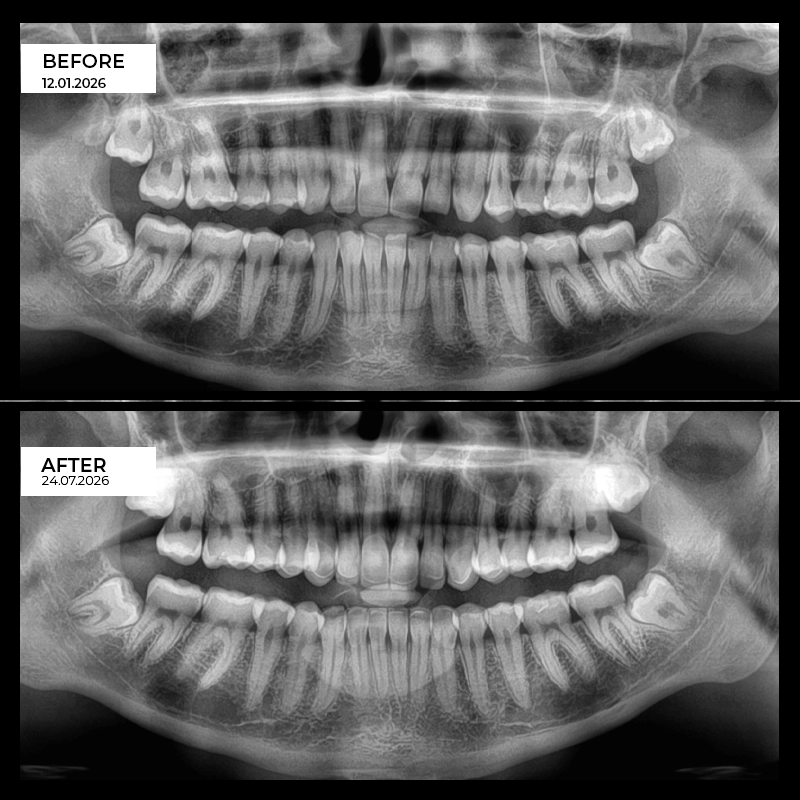
The treatment log closes on 21 July 2026 with two entries: 20 laminate veneers cemented and a night guard impression taken. Preparation on 16 July 2026 through bonded delivery on 21 July 2026 spans six calendar days across four recorded appointments. Nothing beyond those entries is claimed here.
This porcelain laminate veneer rehabilitation describes one patient under one set of card findings so individual results may vary. The record does show a repeatable order of work: material decision first, then enamel level preparation, then two verification stages, then bonding with occlusal protection ordered the same day. International Plus combines official Ministry of Health authorization, 5,504+ verified Google reviews at 4.8/5 and more than 200,000 international patients treated since 2014 with an in house laboratory milling ceramic inside the clinic building. Patients researching a full arch change often begin with a complete Hollywood Smile makeover, then narrow the plan tooth by tooth as our 27 unit screw retained zirconia case records.
Weighing a porcelain laminate veneer rehabilitation against a crown plan? Discover restorative planning at International Plus
Frequently Asked Questions
What is a porcelain laminate veneer?
A porcelain laminate veneer is a thin ceramic shell bonded to the facial surface of a tooth. It replaces enamel rather than replacing the tooth. Retention comes entirely from the adhesive bond so the quality of the remaining enamel surface determines how the restoration performs over time.
How is a laminate veneer different from an E-max crown?
A laminate veneer covers the facial surface and a narrow incisal edge while a crown encircles the whole tooth. The crown route removes more tooth structure but restores teeth that have already lost significant substance. Both options were marked on this patient’s card before the laminate route was selected.
Why are there two try in appointments before veneers are bonded?
Each stage checks something different. The plastic try in verifies form and arch alignment in a polymer that can still be adjusted freely. The dentin try in checks core shade and ceramic thickness before glaze and surface characterisation are committed. Correcting either variable after bonding is far harder.
Why is a night guard recommended after porcelain veneers?
Porcelain laminates are very thin at the facial surface and rely on their bond to the tooth. Night time clenching concentrates force on the bonded margins. A splint spreads that load across a wider surface during sleep and also protects the natural enamel left intact around the preparations.
Can a veneer plan proceed when a drug allergy is recorded?
Yes. A recorded allergy is entered in the medical history and taken into account when any medication decision is made. Specific drug choices are made by the treating clinician against the individual record. Veneer work is restorative rather than surgical, which limits pharmacological exposure by design.
Reviewed by Dr. Mehmet Yavuz
References
- Alothman Y, et al. The Success of Dental Veneers According to Preparation Design and Material Type. Open Access Maced J Med Sci. 2018. PMC6311473
- Alqutaibi AY, et al. Survival rate and bond strength of laminate veneers bonded to different tooth substrates: a systematic review. J Prosthodont. 2025. PMID 39207840
- Klein P, et al. Survival and Complication Rates of Ceramic Laminate Veneers: A Systematic Review and Meta-Analysis. J Esthet Restor Dent. 2025. PMC12076113
- Alenezi A, et al. Long term Survival and Complication Rates of Porcelain Laminate Veneers in Clinical Studies: A Systematic Review. J Clin Med. 2021. PMC7961608
- Ramsey A, et al. Allergy topics for dental practitioners. Gen Dent. 2019. PMID 31355763
- Fabbri G, et al. The full mouth mock-up: a dynamic diagnostic approach to test function and esthetics in complex rehabilitations. Int J Esthet Dent. 2018. PMID 30302437
- Assaf A, et al. Risk Factors with Porcelain Laminate Veneers Experienced during Cementation: A Review. Materials (Basel). 2023. PMC10381715
- Minakuchi H, et al. Managements of sleep bruxism in adult: A systematic review. Jpn Dent Sci Rev. 2022. PMC8958360
Follow us on Social Media
internationalplusofficial
internationalplus
internationalplusdental
This content is written, reviewed, and approved by the International Plus Medical Review Board to ensure clinical accuracy and adherence to strict editorial standards. All medical information is regularly monitored, audited and updated in light of the latest scientific advancements.
However the information provided here is for general informational purposes only and cannot be used for self diagnosis or making individual health interpretations. Results of medical treatments depend on individual anatomy and the unique healing process of each patient. This information should not replace a personal consultation with a qualified healthcare professional. To understand the best options for your specific needs and to receive a personalized treatment plan, we invite you to book a free consultation with the expert medical team at International Plus.

Dr. Mehmet Yavuz specializes in premium ceramic restorations, building beautiful, natural looking smiles through skilled Emax crown work and laminate veneer artistry for patients abroad. His mastery of both high translucency zirconium systems and delicate Emax materials lets him choose the ideal restoration for each patient’s unique needs and aesthetic wishes. Travelers seek him out specifically for his attention to detail in color matching, shape design and smile aesthetics that enhance rather than overpower natural facial features. His thorough case analysis and digital smile planning secure predictable results, giving patients confidence in their outcomes before any procedure begins. Mindful of the worries visitors carry about complex aesthetic work overseas, he provides full consultations with realistic expectations and detailed timelines. Patient reviews steadily highlight his artistic skill, professional approach and gift for creating smile transformations that look truly natural. Fluent in English and experienced in coordinating multi visit cosmetic cases, he delivers exceptional results with warm, patient centered care.