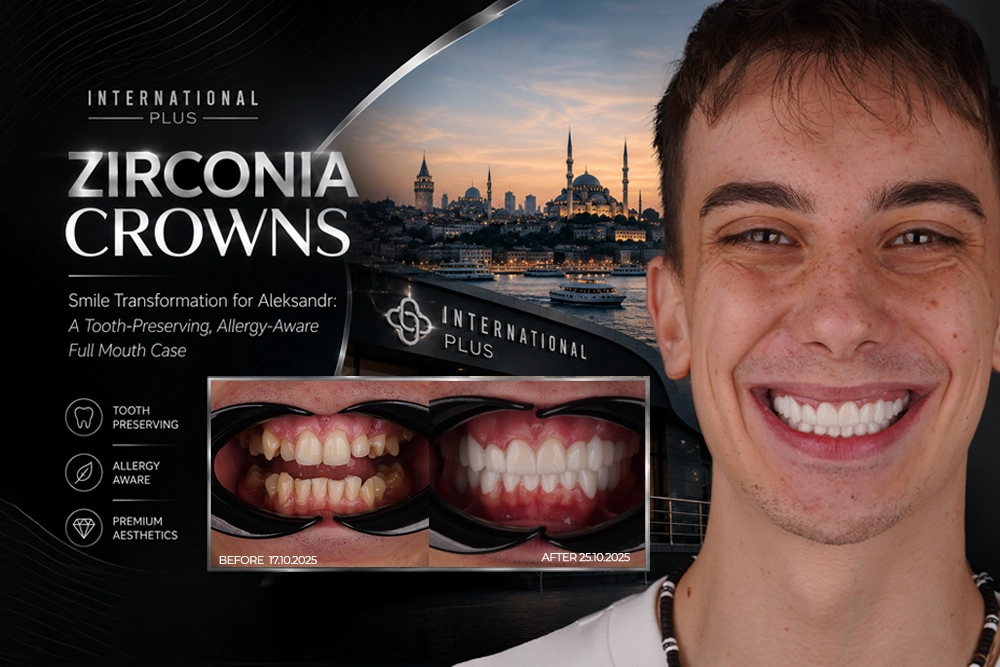
A zirconia crowns smile transformation rebuilds the whole visible dentition with high strength ceramic crowns rather than replacing teeth. For Aleksandr, a Russian speaking international patient and a young adult, that distinction mattered: he wanted a durable, natural smile early in life while keeping every one of his own teeth. Our restorative and cosmetic team planned around two constraints, preserving the natural dentition and respecting a documented penicillin allergy, then delivered 24 monolithic zirconia crowns with no extraction or implant. This case study follows that plan at International Plus, which has treated 200,000+ patients from 140+ countries since 2014.
Key Takeaways
- The challenge: Give a young adult a durable, natural looking full mouth restoration without removing healthy teeth while planning every clinical step around a known penicillin allergy.
- The solution: A tooth-preserving plan of a few conservative fillings, three root canal treatments, three gingivectomy sites and roughly 24 monolithic zirconia crown units in a light natural shade with no implants or extractions.
- Technical highlights: An allergy-aware medication and infection-control protocol, minimally invasive preparation, digital intraoral impressions, a PMMA trial smile for staged approval and a night guard for parafunctional protection.
- The outcome: A fixed, natural smile built entirely on Aleksandr’s own teeth. Individual results may vary.
Aleksandr’s Story: A Long-Term Smile, Built Early
A tooth-preserving rehabilitation is a full mouth plan that keeps as many natural teeth as the prognosis allows. Aleksandr, a young adult, came to our clinic wanting to settle his smile once and thoughtfully rather than patch it over the years. He disliked the colour and shape of his teeth and the way his gum line sat unevenly, but he was clear that he did not want to lose the teeth he still had. For a patient this early in adult life, that instinct is well founded because a natural tooth with a sound root can serve for decades. Our team treated his preference as a clinical starting point, not an afterthought. Unlike a patient-centred rehabilitation where a single unsalvageable tooth still needs an implant as in our full mouth zirconium crowns case for Philippe, every one of Aleksandr’s teeth was judged worth keeping. Aleksandr also carried one detail that reshaped the whole roadmap: a documented penicillin allergy.

Diagnosis and Treatment Plan: Allergy-Aware From the First Step
An allergy-aware protocol is a treatment plan that avoids a drug the patient reacts to and substitutes a safe alternative. That principle shaped this roadmap from the first appointment. Diagnosis used a 2D panoramic radiograph for an overview and an intraoral scan, a digital camera pass that captures the mouth as a 3D model without physical moulds, with 3D cone beam imaging available where a tooth needed closer assessment. The Diagnostic Council, our multidisciplinary review of every complex case, then graded each tooth and confirmed that root canals and crowns, not extractions, could rebuild the mouth. The penicillin allergy was written into the plan through a full medical history, an alternative medication and infection-control strategy and coordinated care so that no step relied on a drug he could not tolerate. Clinical evidence confirms that reviewing a reported penicillin allergy and planning around it is an important part of safe dental care (Accarino JJO, et al., 2023).
Saving the Teeth: Root Canals, Fillings and Minimally Invasive Prep
Preserving the dentition depended on careful tooth-by-tooth work before any crown was designed. First, a few teeth with decay received conservative fillings and three teeth needed root canal treatment, the removal of infected or damaged pulp followed by cleaning and sealing of the canal. These three canals were not equal: they spanned three difficulty levels from a straightforward case to a more demanding anatomy and each was managed accordingly with magnification and rotary shaping. Thorough cleaning and sealing is what gives endodontic treatment its high reported success (Karamifar K, et al., 2020), which is why these teeth could stay anchored in the bone rather than being removed. Where teeth were then prepared for crowns, our team used minimally invasive preparation, removing only the enamel and dentine strictly required so that healthy tooth structure is conserved (Politano G, et al., 2018). This quiet stage is what made a no-extraction result possible, and the root canal work in particular kept his own roots doing their job.

Designing the Smile: Gingivectomy, Digital Impressions and 24 Zirconia Crowns
The aesthetic phase unified the mouth under one design once the foundation was stable. Three gingivectomy sites were treated first; gingivectomy is a minor procedure that reshapes and evens the gum line so tooth lengths look balanced, a well documented step in aesthetic cases (Qali M, et al., 2024). Shape and shade were then planned with our “Plus 1” digital smile design approach and previewed as a PMMA trial smile, a set of provisional teeth in the planned form that let Aleksandr see and approve the design in stages before anything final was made (Garcia PP, et al., 2018). Digital intraoral impressions then captured the prepared teeth precisely. Finally, roughly 24 zirconia crowns were milled in our in-house lab from single high strength monolithic zirconia blocks, cut from one piece so there is no layered porcelain to chip first, which gives strong documented long term survival (Leitão CIMB, et al., 2022). All 24 units sat over Aleksandr’s own preserved teeth in a light natural shade rather than an obviously artificial white.
| Stage | Focus | What was done |
|—|—|—|
| Diagnosis | Planning | Panoramic and intraoral scan, Diagnostic Council review, allergy-aware protocol set |
| Foundation | Endodontic and restorative | A few conservative fillings and three root canals across three difficulty levels |
| Preparation | Conservative prep | Minimally invasive preparation of the teeth receiving crowns |
| Gum contouring | Aesthetic | Three gingivectomy sites to even the gum line |
| Trial smile | Staged approval | Digital impressions and a PMMA provisional approved before milling |
| Final restorations | Prosthetic | Around 24 monolithic zirconia crowns in a light natural shade |
| Aftercare | Protection | Night guard to manage parafunctional load |
Considering a smile transformation? You can ask our clinical team for an assessment directly on WhatsApp.
The Result: A Natural Smile Kept Entirely on His Own Teeth
Aleksandr finished with a fixed, unified smile in a light natural shade, built on 24 crowns and not one implant or extraction. Because he is a young adult who will carry this work for a long time, our team delivered a night guard, a removable splint worn during sleep that absorbs the involuntary clenching and grinding which can overload restored teeth; occlusal splints are a recognised way to protect against that parafunctional load (Albagieh H, et al., 2023). Where a broader smile makeover such as Ahmad’s camouflaged crowding across 28 units, Aleksandr’s case is defined by two things: a medically individualised, allergy-aware protocol and a strictly tooth-preserving result achieved early in life. Individual results may vary and every plan depends on the prognosis of the specific teeth involved. This outcome reflects the standard behind International Plus: official Ministry of Health authorization and 5,504+ verified reviews at 4.8/5.
Discover cosmetic dentistry at International Plus → Book your free consultation

Frequently Asked Questions
What is a zirconia crowns smile transformation?
A zirconia crowns smile transformation restores the visible dentition with crowns milled from monolithic zirconia, a very strong ceramic. The crowns can sit on preserved natural teeth on root canal treated teeth or on implants where a tooth was lost. In Aleksandr’s case, around 24 units in a light natural shade rebuilt the smile entirely on his own teeth with no implants or extractions.
Can a full mouth restoration keep all of the natural teeth?
Often, yes. When teeth have sound roots and treatable decay or infection, fillings and root canal treatment can preserve them instead of extraction and crowns then restore the shape and shade. Whether every tooth can be kept depends on each tooth’s prognosis, which is graded at diagnosis before any treatment begins.
How is dental treatment planned around a penicillin allergy?
A reported penicillin allergy is reviewed as part of the medical history and the team plans an alternative medication and infection-control strategy that avoids the drug the patient cannot tolerate. Care is coordinated so no step depends on it. This is general, allergy-aware planning; the specific medications used are always decided by the treating clinicians for the individual patient.
Why is a night guard used after a smile transformation?
A night guard is a removable splint worn during sleep that absorbs involuntary clenching and grinding. Because this parafunctional load can overload newly restored teeth over time, a night guard helps protect the crowns, which is especially relevant for a younger patient expected to wear the restorations for many years.
Reviewed by Dr. Eren Gülbahar
References
- Accarino JJO, et al. Ann Allergy Asthma Immunol. 2023. PMID: 37557950
- Karamifar K, et al. Eur Endod J. 2020. PMC7398993
- Politano G, et al. J Adhes Dent. 2018. PMID: 30564796
- Qali M, et al. Cureus. 2024. PMC11614317
- Garcia PP, et al. J Conserv Dent. 2018. PMC6080190
- Leitão CIMB, et al. J Prosthodont Res. 2022. PMID: 34615842
- Albagieh H, et al. Saudi Dent J. 2023. PMC9931504
Follow us on Social Media
internationalplusofficial
internationalplus
internationalplusdental
This content is written, reviewed, and approved by the International Plus Medical Review Board to ensure clinical accuracy and adherence to strict editorial standards. All medical information is regularly monitored, audited and updated in light of the latest scientific advancements.
However the information provided here is for general informational purposes only and cannot be used for self diagnosis or making individual health interpretations. Results of medical treatments depend on individual anatomy and the unique healing process of each patient. This information should not replace a personal consultation with a qualified healthcare professional. To understand the best options for your specific needs and to receive a personalized treatment plan, we invite you to book a free consultation with the expert medical team at International Plus.

I am a healthcare professional with over 4 years of experience in dentistry, specializing in prosthetic dental treatment and implant-based applications. Since 2024, I have been serving as chief physician, leading clinical management, team coordination, and international patient processes. With my B2-level English proficiency, I am able to communicate effectively with international patients. I am a patient-centered, innovative, and solution-oriented dentist who prioritizes patient satisfaction.