Rebuilding a complete set of teeth on implants asks far more of a prosthesis than any single crown ever will. For Constant, an international patient who came to International Plus seeking a permanent alternative to a failing dentition, the plan centred on a full arch, screw retained implant supported zirconia bridge built over a milled titanium bar. This case study follows the clinical reasoning behind that choice from CBCT planning and Nucleoss implant placement to a monolithic zirconia framework and a night guard that protects the finished work. International Plus has treated more than 200,000 patients from 140+ countries since 2014.
Key Takeaways
- The challenge: A full arch rehabilitation where the final teeth had to carry heavy chewing and grinding loads across many years without fracturing or loosening.
- The solution: A staged protocol placing roughly six implants per arch, then a screw retained monolithic zirconia bridge of about 25 units on a milled bar.
- Technical highlights: CBCT guided surgery, PRF, an insertion torque target of 35 to 45 N/cm for primary stability and a screw retained design chosen for retrievability.
- The outcome: A fixed, natural looking arch delivered with a night guard to manage parafunctional load. Individual results may vary.
Constant’s Story: Seeking a Fixed, Lasting Result
A full arch rehabilitation is the replacement of every tooth in a jaw on dental implants, in Constant’s case on roughly 6 fixtures per arch. Constant wanted that result fixed in place rather than removable, and planned end to end before travelling as an English speaking international patient. Longevity, not a quick fix, framed every decision our clinical team made. Every choice, from implant number to prosthetic material, followed from that single demand for durability.
That priority carried real engineering weight. A full arch prosthesis absorbs the combined force of every bite across 12 or more replacement teeth, so the design had to spread those loads safely while staying serviceable for years. Weighing strength against serviceability, the team chose a rigid, retrievable construction over the simplest possible restoration. This case study records how that reasoning became a screw retained result.

Diagnosis and Treatment Plan
Planning began with imaging: a 2D panoramic radiograph for an overview and a 3D CBCT scan, a cone beam tomography that maps bone volume and vital structures in three dimensions. The Diagnostic Council, our multidisciplinary review of every full arch plan before surgery, assessed available bone height and density arch by arch. The plan set roughly six implants per arch, recorded as 6 and 6 to 7 in Constant’s chart, as the foundation for a fixed bridge.
The Council chose a staged protocol over immediate loading. Loading decisions in full arch cases turn on bone quality and the stability reached at placement, and a delayed approach lets bone integrate before carrying a final prosthesis (Morton D, et al., 2018). Where teeth remained, atraumatic extraction preserved the surrounding bone, and a CBCT derived surgical guide directed implant angulation for a prosthetically driven result. The roadmap was explicit: surgery first, a healing interval, then the final teeth.
Placing the Implants: Guided Surgery, PRF and Primary Stability
The surgical phase used guided surgery, where a surgical guide printed from the CBCT positions each implant along the planned path. Nucleoss implants were placed to an insertion torque target of 35 to 45 N/cm, the rotational force that measures how firmly an implant grips bone at placement. Adequate insertion torque is a recognised marker of primary stability, the mechanical firmness that must be present before biological healing takes over (Greenstein G, et al., 2017).
To support healing, the team applied PRF, platelet rich fibrin concentrated from Constant’s own blood to release growth factors at the surgical site. PRF has shown benefit in promoting soft and hard tissue healing of extraction and implant sites (Al-Maawi S, et al., 2021). Over roughly six months, the implants underwent osseointegration, the process where living bone fuses directly to the implant surface and converts initial mechanical grip into lasting biological anchorage. The implants healed quietly under the gum while Constant waited for the arch to become load ready, the biology we detail in our overview of osseointegration in All on 4 and All on 6 systems.

Why a Screw Retained Design on a Milled Bar
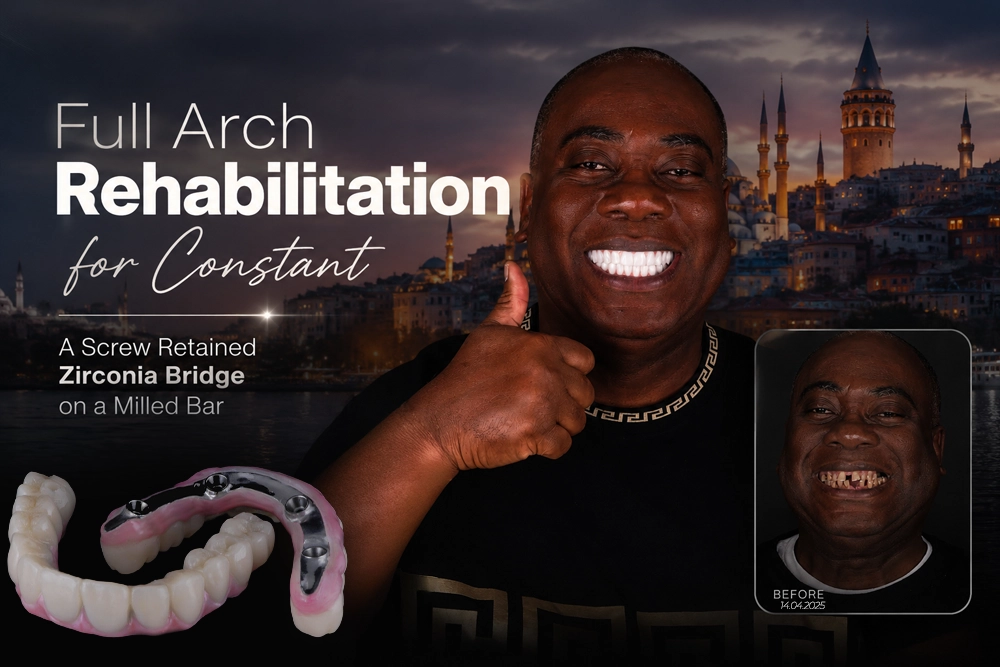
Once integration was confirmed, the restorative phase produced the definitive implant supported zirconia bridge on a milled titanium bar. A milled bar is a Toronto type framework that splints every implant of an arch into one rigid unit, distributing occlusal load instead of concentrating it on a single fixture. The restoration was screw retained rather than cemented, meaning it is fixed by screws that pass through the bridge into the bar.
That choice was deliberate. Screw retention keeps the prosthesis retrievable, so it can be removed for maintenance or repair without destroying it, and it avoids the residual cement that can drive peri-implant inflammation (Wittneben JG, et al., 2014). The trade off is real: screw retained work demands precise implant angulation and more laboratory time than a cemented bridge, yet it lowers the long term maintenance burden for full arch cases (Ma S, et al., 2015). For a load bearing arch, the team judged serviceability worth that cost.
The Zirconia Bridge and the Digital Workflow
The bridge itself was milled from monolithic zirconia in shade 0M2, about 25 units spanning the arch. Monolithic zirconia is cut from a single high strength block with no layered porcelain, which removes the weakest failure point of veneered restorations and gives full arch prostheses strong survival with low fracture rates (Papaspyridakos P, et al., 2025). Long span zirconia arches also demand adequate prosthetic space, which the bar design and planning accounted for (AlTarawneh S, et al., 2021).
Fabrication ran through our in house digital laboratory. An intraoral TRIOS scan captured both arches, the monolithic zirconia was milled and sintered to shade 0M2, and staged try ins confirmed fit and appearance before final delivery. Building strength and serviceability together, this workflow echoes our fixed Toronto bridge prosthesis work, Suzy’s Toronto bridge transformation and other full mouth zirconia rehabilitations with sinus lift that we publish.
| Stage | What was done | Purpose |
| Diagnosis | Panoramic, CBCT, Diagnostic Council review | Map bone, plan implant number and position |
| Surgery | Guided placement of Nucleoss implants, PRF, atraumatic extraction | Achieve primary stability and preserve bone |
| Healing (~6 months) | Osseointegration under the gum | Convert mechanical grip to biological anchorage |
| Restoration | Milled bar, screw retained monolithic zirconia bridge (~25 units, shade 0M2) | Deliver the definitive fixed arch |
| Aftercare | Night guard delivery, maintenance schedule | Manage parafunctional load, protect the result |

Managing Parafunctional Load with a Night Guard
The final step addressed a real long term risk: parafunction, the involuntary clenching or grinding (bruxism) that loads teeth well beyond normal chewing. Because a rigid full arch bridge does not flex or wear like natural enamel, that excess force concentrates on the implants and the zirconia. Constant was therefore delivered a night guard, a removable occlusal splint worn during sleep to absorb and redistribute those forces.
This is standard protective protocol in demanding full arch cases. Managing occlusal overload with a splint is a recognised strategy for reducing mechanical complications in implant supported rehabilitations (Shafiee E, et al., 2025). For Constant, the guard is a small nightly habit that helps protect a large investment, the same reasoning behind our full mouth rehabilitation for severe bruxism and tooth loss.
The Result: A Fixed Arch Built to Last
Constant finished treatment with a fixed, screw retained implant supported zirconia bridge that restored full function and a natural appearance through a fully digital full mouth implant workflow. The milled bar spreads bite force across every implant. The screw retained design keeps the prosthesis serviceable, and the night guard protects against parafunctional wear. We build each plan around one person’s anatomy and goals, so individual results may vary.
This is the standard behind the outcome. International Plus combines official Ministry of Health authorization, 5,504+ verified Google reviews at 4.8/5 and more than 200,000 international patients treated since 2014. For international patients like Constant, a full arch case sits within our broader dental implant treatment in Istanbul and All on 4 full arch restoration, planned in full before travel.
Considering a fixed full arch solution? Book your free consultation
Frequently Asked Questions
What is a screw retained implant supported zirconia bridge?
It is a fixed set of teeth milled from monolithic zirconia and held to the implants by screws rather than cement. The screws pass through the bridge into the implants or a bar so the prosthesis is retrievable for maintenance. This makes servicing simpler and avoids the residual cement that can irritate the tissue around implants.
Why place the zirconia bridge on a milled bar?
A milled bar is a rigid framework that splints all the implants in an arch into one unit. It distributes chewing forces evenly across every implant instead of loading any single one, which supports the long span zirconia and adds durability. For full arch cases, this combination balances strength with a retrievable, serviceable design.
How many implants are needed for a full arch zirconia bridge?
It depends on bone volume and the load expected but a full arch fixed bridge is commonly supported by around six implants per jaw as in Constant’s plan. The exact number is decided from CBCT imaging and a multidisciplinary review of the available bone volume before any surgery is scheduled.
Why was a night guard part of the treatment?
A rigid zirconia arch does not flex or wear like natural teeth so grinding or clenching concentrates force on the implants and the bridge. A night guard is a removable splint worn during sleep that absorbs and spreads that load. It is a protective measure that helps reduce mechanical wear on a full arch restoration over time.
Reviewed by Dr. Melek Şentürk
References
- Morton D, et al. Dental implant loading protocols in partially and fully edentulous patients. Clin Oral Implants Res. 2018. PMID 30328196
- Greenstein G, et al. Implant Insertion Torque: Its Role in Achieving Primary Stability of Restorable Dental Implants. Compend Contin Educ Dent. 2017. PMID 28156122
- Al-Maawi S, et al. Efficacy of platelet-rich fibrin in promoting the healing of extraction sockets: a systematic review. Int J Implant Dent. 2021. PMC8684569
- Papaspyridakos P, et al. Full arch implant-supported monolithic zirconia fixed dental prostheses: An updated systematic review. J Prosthodont. 2025. PMID 39136214
- Wittneben JG, et al. Clinical performance of screw versus cement retained fixed implant-supported reconstructions: a systematic review. Int J Oral Maxillofac Implants. 2014. PMID 24660192
- Ma S, et al. Screw versus cement retained implant prostheses: a systematic review of prosthodontic maintenance and complications. Int J Prosthodont. 2015. PMID 25822297
- AlTarawneh S, et al. Zirconia full arch implant prostheses: survival, complications and prosthetic space dimensions. Int J Oral Implantol (Berl). 2021. PMID 34006068
- Shafiee E, et al. Bruxism in implant-supported rehabilitations: a narrative review of clinical complications and management strategies. BMC Oral Health. 2025. PMC12512445
Follow us on Social Media
internationalplusofficial
internationalplus
internationalplusdental
This content is written, reviewed, and approved by the International Plus Medical Review Board to ensure clinical accuracy and adherence to strict editorial standards. All medical information is regularly monitored, audited and updated in light of the latest scientific advancements.
However the information provided here is for general informational purposes only and cannot be used for self diagnosis or making individual health interpretations. Results of medical treatments depend on individual anatomy and the unique healing process of each patient. This information should not replace a personal consultation with a qualified healthcare professional. To understand the best options for your specific needs and to receive a personalized treatment plan, we invite you to book a free consultation with the expert medical team at International Plus.

Dt. Melek Şentürk brings advanced surgical expertise to complex cases many general dentists turn away, specializing in subperiosteal implants and full mouth rehabilitations for patients abroad with severe bone loss.