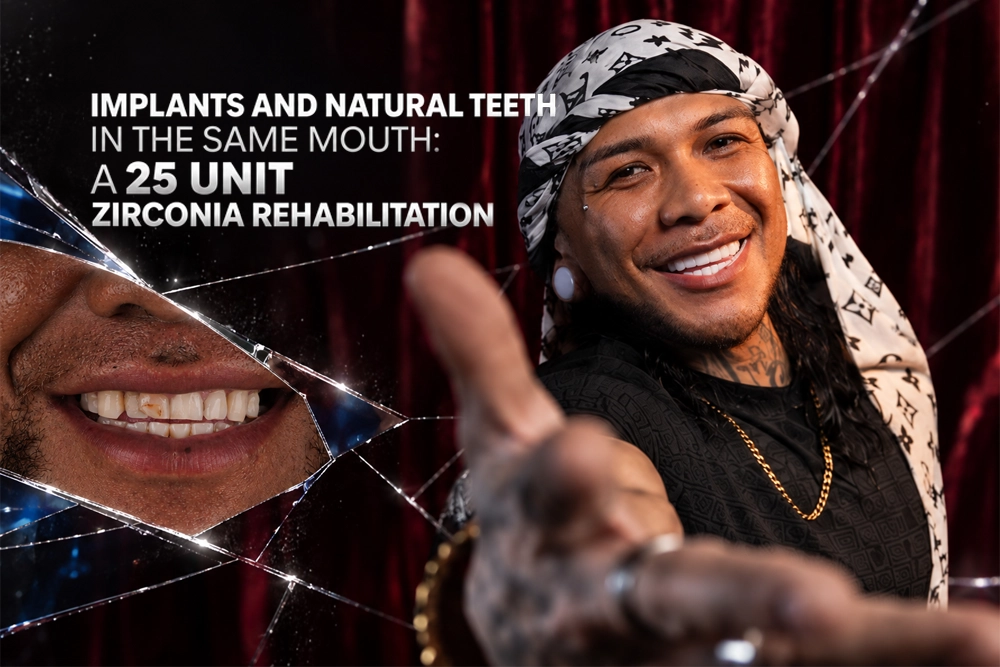
When a 52 year old patient from Romania arrived at International Plus Istanbul, she carried burdens familiar to anyone who has relied on removable dentures for extended periods: the constant awareness of prosthetics that shift during eating, the self consciousness when speaking in social situations, and the aesthetic dissatisfaction that comes from seeing artificial-appearing teeth every time she smiled. Her upper jaw, completely edentulous for years, depended on a complete removable denture that never quite stayed in place. Her lower jaw, while retaining five natural teeth, required a partial removable denture to restore missing posterior teeth, creating a patchwork of natural and artificial structures that functioned inadequately and appeared unnatural. The daily frustration of managing two separate removable prosthetics, the anxiety about denture movement, and the aesthetic compromises these conventional solutions imposed had diminished her quality of life incrementally yet profoundly. Her case would demonstrate how modern implant dentistry addresses not just tooth loss but the complex anatomical challenges that years of bone resorption create, delivering fixed stability even when long inter-implant distances and significant bone defects complicate treatment planning.
The Dual Denture Challenge: Compounding Frustrations Across Both Arches
Patients requiring removable prosthetics in both upper and lower jaws face compounded challenges compared to single arch denture wearers. Each prosthetic presents its own retention difficulties, movement patterns, and maintenance requirements. The interaction between upper and lower dentures during function creates additional complexity: occlusal relationships must accommodate the movement inherent to removable prosthetics, vertical dimension becomes difficult to establish precisely, and the cumulative effect of two shifting prosthetics amplifies functional limitations. Research on patient satisfaction with dual denture configurations demonstrates that quality of life impacts correlate strongly with the number of removable prosthetics required, with dual denture wearers reporting significantly greater dissatisfaction than single denture users.
Our patient’s upper complete denture faced the classic challenges complete dentures present: insufficient retention due to progressive bone resorption, pressure sores developing where irregular ridge anatomy creates force concentration, and the constant awareness of a foreign object that never becomes truly comfortable. The lower partial denture added different frustrations: clasps gripping the remaining five natural teeth created aesthetic concerns and gradual tooth mobility, the partial framework rocked during function creating sore spots, and the combination of natural teeth and denture base created hygiene challenges that conventional cleaning methods struggled to address adequately.
The five remaining lower natural teeth, while technically present, exhibited poor long term prognosis. Comprehensive periodontal and structural evaluation revealed that these teeth, compromised by progressive disease and serving as partial denture abutments, would likely fail within years. Retaining them would commit the patient to ongoing maintenance, progressive loosening, and eventual extraction requiring denture modification or replacement. The treatment plan reflected decisive intervention: extract the compromised teeth, place six implants in each jaw, and deliver fixed full arch prosthetics eliminating removable dentures entirely.

Complex Anatomical Challenges: Long Inter-Implant Distances and Bone Defects
Initial diagnostic evaluation using panoramic radiography and volumetric CBCT imaging revealed anatomical conditions that would significantly influence treatment planning. The upper jaw displayed severe bone loss characteristic of long term edentulism: vertical resorption reducing ridge height substantially, horizontal resorption narrowing the alveolar ridge, and localized bone defects creating irregular contours that complicated implant positioning. The lower jaw, while less severely affected than the maxilla, showed substantial bone loss in posterior regions where teeth had been absent for extended periods.
These anatomical limitations created specific treatment challenges. First, the severe maxillary bone loss required sinus lift procedures to establish adequate bone height for implant placement in posterior regions. Without augmentation, implants in the posterior maxilla would lack the vertical bone engagement necessary for long term stability. Second, the pattern of bone loss and bone defects dictated implant positions that would create relatively long inter-implant distances, the span between adjacent implants, in both arches. Studies on prosthetic design considerations with long inter-implant distances demonstrate that these spans create unique biomechanical demands requiring framework designs that provide adequate rigidity while permitting slight flexibility accommodating functional forces.
Third, the combination of bone defects and long inter-implant distances would challenge soft tissue aesthetics and support. When implants occupy widely separated positions and underlying bone displays irregular contours, the gingival architecture surrounding prosthetic teeth requires careful design to appear natural and provide appropriate support. Inadequate soft tissue planning creates restorations with visible gaps beneath prosthetic teeth, unnatural gingival contours, or aesthetic compromises that undermine otherwise technically successful treatment.
The treatment plan addressed these challenges through coordinated surgical and prosthodontic strategies. Sinus augmentation would restore adequate maxillary bone volume. Strategic implant positioning would maximize engagement with available bone while accepting the long inter-implant distances that anatomy dictated. The prosthodontic framework design would employ titanium bar construction using the Toronto protocol, a design specifically engineered to provide rigid yet flexible support across widely spaced implants while enabling gingival contouring that optimizes soft tissue aesthetics despite underlying anatomical limitations.
Surgical Phase: Extraction, Augmentation, and Strategic Implant Placement
The surgical intervention began with atraumatic extraction of the five remaining lower teeth. Despite their compromised condition, controlled extraction techniques minimized surgical trauma while ensuring complete removal of all tooth structure and infected tissues. Each extraction site was thoroughly debrided, preparing clean healing environment for subsequent implant integration.
Following extraction completion, attention turned to maxillary sinus lift procedures addressing the inadequate posterior bone height. Using lateral window approach, the sinus membrane was carefully elevated and the created space filled with bone graft material establishing vertical dimension necessary for implant placement. The augmentation procedures, while adding surgical complexity and healing requirements, enabled implant positioning in anatomically sound locations rather than forcing implants into inadequate bone through compromised angulations or insufficient engagement.
Twelve dental implants, six in each jaw, were then positioned according to pre surgical three dimensional planning. The implant distribution reflected careful biomechanical analysis: positioning was optimized to engage the best available bone while accepting that anatomical limitations would create relatively long spans between adjacent implants. All twelve implants achieved adequate primary stability, the immediate mechanical engagement with surrounding bone that predicts successful osseointegration and determines loading protocol possibilities.
The surgical sites were closed with appropriate suturing techniques, and the patient entered the healing phase that would permit both implant integration and maturation of the augmented bone in the maxillary sinus regions. Rather than attempting immediate loading, which the combination of bone augmentation and challenging anatomy would complicate, the treatment plan employed conservative six month healing permitting complete biological maturation before prosthodontic loading.

Six Month Healing and Advanced Digital Planning
The six month osseointegration period served multiple biological purposes. Most fundamentally, it permitted direct bone to implant contact to develop, the structural integration that provides long term implant stability. Additionally, the interval allowed the grafted bone in the maxillary sinus regions to consolidate and remodel, transitioning from graft material to mature bone capable of supporting functional loads. The extended timeline, while requiring patient patience, reflected appropriate clinical judgment prioritizing long term success over accelerated treatment.
At six months post surgery, clinical examination and radiographic assessment confirmed successful osseointegration of all twelve implants. Stability testing demonstrated solid integration, and radiographs showed appropriate bone levels surrounding implant surfaces with no signs of complications. The stage was set for definitive prosthodontic procedures.
The prosthodontic phase employed International Plus Istanbul’s advanced digital workflow integrating multiple technologies. Specialized scan bodies attached to the implant positions enabled the Shining intraoral scanner to capture precise three dimensional data of implant locations and orientations. Simultaneously, the iCam iMetric photogrammetric system recorded facial proportions, lip dynamics, and smile characteristics that would inform aesthetic design decisions. Research on integrated digital workflows for complex full arch cases demonstrates that combining intraoral scanning with facial photogrammetry supports aesthetic outcomes superior to designs based solely on intraoral technical requirements.
Multi-unit abutments were connected to all twelve implants, establishing standardized prosthetic platforms for the titanium bar frameworks that would support the final restorations. The framework design required particular sophistication given the long inter-implant distances and underlying bone irregularities. The Toronto protocol, employing precision milled titanium bars, provided the rigid yet slightly flexible foundation necessary to distribute forces appropriately across widely spaced implants while permitting gingival contouring that would optimize soft tissue support and aesthetics despite the challenging underlying anatomy.
The frameworks incorporated strategic features addressing the case-specific challenges: reinforcement in regions spanning long inter-implant distances, contours designed to support optimal gingival architecture even where underlying bone proved inadequate, and precise passive fit ensuring stress-free engagement with all twelve implant abutments. This level of design sophistication requires both advanced planning software and experienced prosthodontic judgment recognizing how framework geometry influences long term outcomes.
Premium Fabrication and Soft Tissue Optimization
The definitive prosthetics were fabricated from zirconia blocks, specifically Azir brand zirconia, combining exceptional mechanical strength exceeding 1,000 MPa with optical properties permitting natural appearing aesthetics. The restorations comprised 26 individual prosthetic units restoring complete function and aesthetics across both arches. The shade selection, OM1 tone, provided bright yet natural appearance appropriate for the patient’s preferences and facial characteristics.
Particular attention addressed soft tissue aesthetics and support, the aspect of treatment most challenged by the long inter-implant distances and bone defects. When prosthetic teeth must span substantial distances between supporting implants, the gingival architecture requires careful design to appear natural rather than creating obvious gaps or unnatural contours. The Toronto protocol framework design enabled gingival contouring that created appropriate tissue support and emergence profiles even where underlying bone proved inadequate, a capability that simpler framework designs cannot achieve.
The fabrication employed International Plus Istanbul’s in house Redon precision milling systems, creating both titanium frameworks and overlying zirconia prosthetics from digital design files. This manufacturing precision ensures the passive framework fit essential for long term implant health while permitting the complex gingival contouring that challenging anatomy demands.
Following fabrication completion, the restorations underwent comprehensive clinical verification. Frameworks were tested for passive fit across all twelve implants, confirming stress free engagement. Occlusal relationships were refined, ensuring balanced force distribution. Aesthetic appearance was evaluated with patient input, confirming satisfaction with both tooth appearance and gingival aesthetics. Upon approval, the prosthetics were secured using appropriate torque values, and access screw holes were sealed with composite materials.
Transformation: From Dual Denture Frustration to Fixed Stability
For our patient, the transformation proved profound. The elimination of both upper and lower removable dentures ended years of constant awareness about prosthetic movement, anxiety during eating and speaking, and self consciousness about artificial appearance. The fixed nature of her implant supported restorations restored capabilities she had not experienced since losing her natural teeth: eating without concern about denture shifting, speaking without fear of prosthetic movement, and smiling with confidence rather than self consciousness.
The aesthetic improvements extended beyond simply eliminating removable dentures. The OM1 shade zirconia restorations created natural appearing smiles free from the tell-tale signs of conventional dentures. The careful attention to soft tissue aesthetics, enabled by sophisticated Toronto protocol framework design, created gingival architecture that appeared balanced and natural despite the challenging underlying anatomy. The comprehensive rehabilitation of both arches simultaneously established harmonious occlusion and facial proportions that treating only one arch cannot achieve.
Frequently Asked Questions
What challenges do long inter-implant distances create?
Long inter-implant distances, the spans between adjacent implants, create biomechanical demands that framework design must address. Prosthetic structures spanning substantial distances experience greater deflection under functional loads compared to shorter spans, potentially creating stress on supporting implants. Titanium bar frameworks using the Toronto protocol provide the rigidity necessary to minimize deflection while permitting slight flexibility that accommodates functional forces. Research demonstrates that properly designed frameworks achieve long term success even with relatively long inter-implant distances when appropriate engineering principles guide design.
How does the Toronto protocol address soft tissue aesthetics in compromised anatomy?
The Toronto protocol employs precision milled titanium bar frameworks that enable sophisticated gingival contouring independent of underlying bone architecture. When bone defects or irregular contours would compromise soft tissue support using simpler framework designs, Toronto protocol frameworks create the foundation for optimal gingival emergence profiles and tissue support. This capability proves particularly valuable in cases combining long inter-implant distances with bone irregularities, permitting natural appearing soft tissue aesthetics despite challenging anatomy.
Why use six month rather than three month osseointegration periods?
While three month osseointegration proves adequate in many cases, extended healing periods benefit treatments involving bone augmentation or compromised bone quality. The sinus lift procedures in this case required additional time for graft consolidation and remodeling beyond basic implant integration. Research on healing timelines suggests that conservative approaches prioritizing complete biological maturation support superior long term outcomes compared to accelerated protocols, particularly in anatomically complex cases.
What advantages does the iCam iMetric system provide for full arch cases?
The iCam iMetric photogrammetric system captures three dimensional facial data including proportions, lip dynamics, and smile characteristics informing prosthodontic design. This facial analysis enables design decisions considering how restorations integrate with facial features rather than designing based solely on intraoral technical requirements. The integration of facial photogrammetry with intraoral scanning creates comprehensive digital datasets supporting aesthetic outcomes superior to conventional planning methods.
Can patients with severe bone loss avoid extensive augmentation procedures?
Strategic implant positioning and sophisticated framework design often enable treatment with limited augmentation rather than extensive grafting. While this case required sinus lift procedures for the posterior maxilla, careful surgical planning avoided more extensive augmentation that theoretical anatomic ideals might suggest. The Toronto protocol framework design accommodated the resulting long inter-implant distances while achieving reliable long term outcomes, demonstrating that biomechanically sound planning can often achieve success with conservative augmentation approaches.
International Plus Istanbul: Advanced Solutions for Complex Anatomical Challenges
This case exemplifies International Plus Istanbul’s approach to anatomically complex full arch rehabilitation: strategic surgical planning achieving implant placement with conservative augmentation despite severe bone loss (sinus lift procedures enabling twelve implants, six per arch), extended healing appropriate for augmented bone maturation, sophisticated digital workflow integrating Shining scanning and iCam iMetric photogrammetry, and precision fabrication of titanium bar Toronto protocol frameworks supporting Azir zirconia prosthetics (26 units in OM1 shade) designed specifically to address long inter-implant distances and optimize soft tissue aesthetics despite challenging underlying anatomy.
This level of care requires infrastructure few facilities globally possess. Experienced surgical specialists execute complex cases in compromised anatomy. Advanced imaging including CBCT enables precise three dimensional planning. Digital design systems integrate intraoral and facial data supporting sophisticated framework engineering. In house Dental Art laboratory fabricates complex structures using Redon precision equipment. Multiple implant brands (Straumann, Nobel Biocare, Megagen, BEGO, Implant Swiss, Implance, Nucleoss) ensure optimal selection for each case.
Comprehensive patient services support international patients throughout treatment. VIP airport transfers, luxury accommodation, and 24/7 coordination eliminate logistical barriers. Having successfully treated over 200,000 patients from more than 140 countries, International Plus Istanbul combines surgical expertise, technological capability, and patient support delivering world class care regardless of anatomic complexity.
If you seek escape from removable denture frustration through fixed implant supported rehabilitation, even when bone loss creates anatomical challenges, contact International Plus Istanbul today.
internationalplusofficial
internationalplus
internationalplusdental
This content is written, reviewed, and approved by the International Plus Medical Review Board to ensure clinical accuracy and adherence to strict editorial standards. All medical information is regularly monitored, audited and updated in light of the latest scientific advancements.
However the information provided here is for general informational purposes only and cannot be used for self diagnosis or making individual health interpretations. Results of medical treatments depend on individual anatomy and the unique healing process of each patient. This information should not replace a personal consultation with a qualified healthcare professional. To understand the best options for your specific needs and to receive a personalized treatment plan, we invite you to book a free consultation with the expert medical team at International Plus.

Dt. Melek Şentürk brings advanced surgical expertise to complex cases many general dentists turn away, specializing in subperiosteal implants and full mouth rehabilitations for patients abroad with severe bone loss.