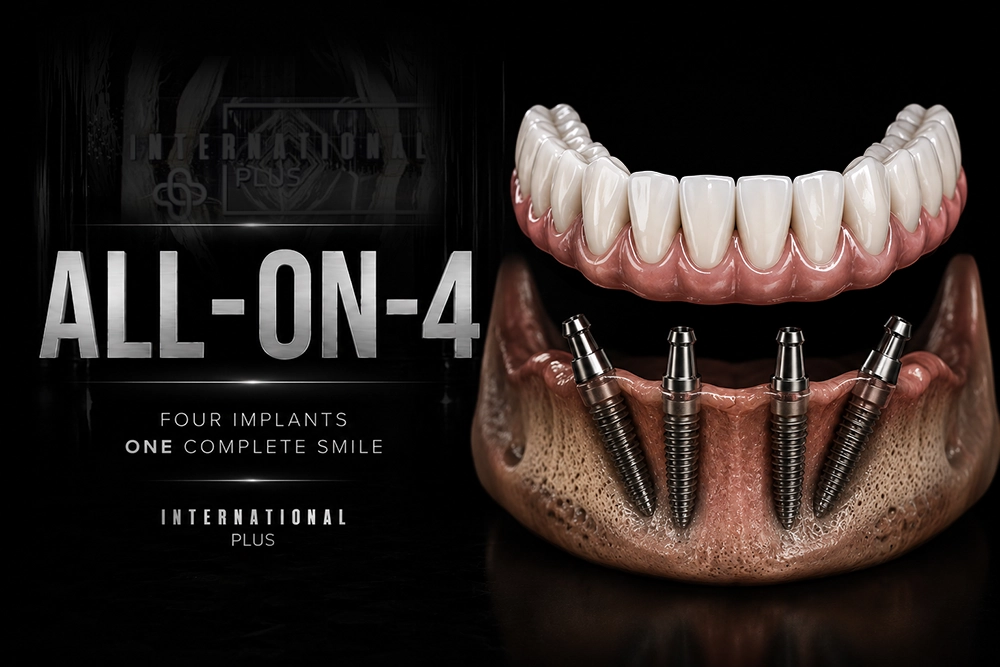
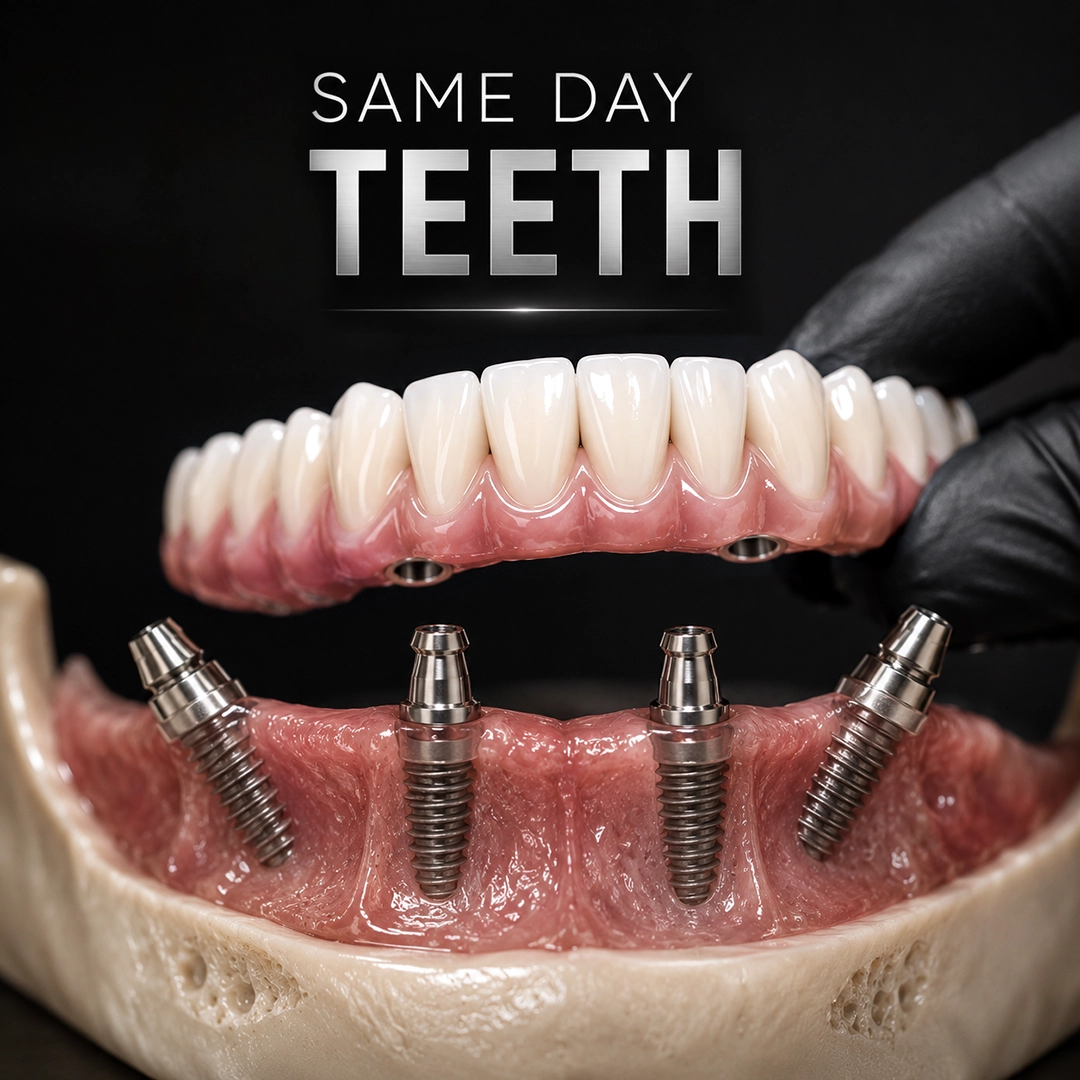
All on 4 dental implants are a full arch restoration technique that replaces an entire upper or lower set of teeth using only four titanium implants, two placed straight at the front and two angled at the back. This approach carries a fixed bridge of 10 to 14 teeth and often allows a same day provisional set. A 2017 systematic review by Soto-Penaloza and colleagues documented implant survival of roughly 98% over follow up periods reaching several years (Soto-Penaloza et al., 2017). This guide explains the biomechanics and candidacy behind the concept and how healing unfolds, written by the surgical team at International Plus in Istanbul.
Key Takeaways
- Four implants, one full arch: Two straight anterior implants and two tilted posterior implants support a fixed bridge of 10 to 14 teeth, documented at around 98% survival (Soto-Penaloza et al., 2017).
- Tilting is the key idea: Angling the back implants up to 45 degrees uses existing bone and avoids sinus lifting in most upper jaw cases (Chan et al., 2015).
- Same day teeth are conditional: Immediate loading needs strong primary stability so severe bruxism or very soft bone may require a staged plan.
- Best for full edentulism: All on 4 dental implants suit patients who are fully edentulous or facing loss of a whole arch, not single gaps.
What Are All on 4 Dental Implants?
All on 4 dental implants are a treatment concept that restores a complete arch of teeth on four implants rather than one implant per missing tooth. The four implants act as anchors for a single fixed prosthesis so a patient with no upper teeth can receive a bridge of 10 to 14 units supported entirely by these four posts. The concept was developed to give edentulous patients fixed teeth without extensive grafting.
Full arch rehabilitation on four implants has strong clinical backing. A 2015 review by Chan and Oh confirmed that the tilted four implant design has become a predictable option for the edentulous jaw (Chan et al., 2015). At International Plus, every case begins with a 3D CBCT scan reviewed by our Diagnostic Council, a multidisciplinary team of surgical and prosthetic specialists who confirm that four implants can safely carry the planned bridge. Individual results vary so candidacy is always confirmed on scan data, not assumption. Patients weighing full arch options can also compare our All on 4 full arch restoration service page.
How Do Four Implants Support a Full Arch?
Four implants support a full arch because their position and angle spread bite force across the jaw rather than concentrating it. Two implants are placed straight in the dense anterior region and two are tilted up to 45 degrees in the posterior region where bone is often thinner. Tilting the back implants lengthens the bone contact and moves support further back, which shortens the unsupported cantilever at the rear of the bridge.
This biomechanical arrangement is what makes the concept work with so few implants. A 2016 prospective study by Najafi and colleagues confirmed that tilted posterior implants perform comparably to axial implants in full arch cases, with survival above 97% (Najafi et al., 2016). Contrary to a common assumption, adding more implants does not automatically make a full arch stronger since poor angulation or overloaded bone can undermine a six implant design just as easily as a four implant one. Our team plans each implant angle with guided surgery from the CBCT data so that the tilted posterior implants engage the strongest available bone. For patients with severe posterior bone loss where tilting is not enough, zygomatic implant surgery for severe bone loss becomes the alternative anchoring route.
Same Day Teeth: How Immediate Loading Works
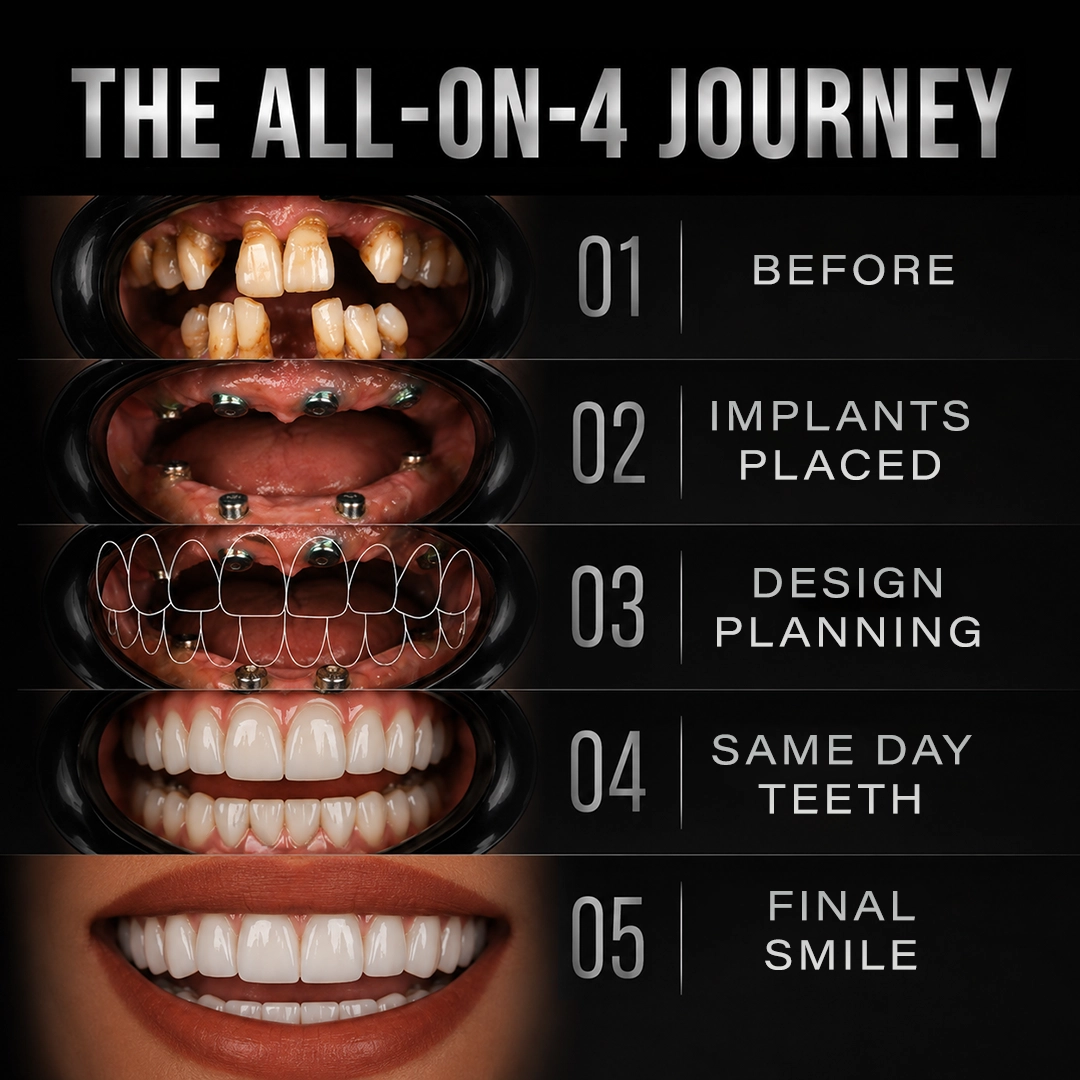
Immediate loading means fitting a fixed provisional bridge onto the four implants on the same day they are placed so the patient leaves with teeth rather than a bare gum. This is possible when the implants achieve strong primary stability, typically an insertion torque of at least 45 N/cm, which lets the arch tolerate light function while the bone heals underneath.
Same day teeth are one of the concept’s defining benefits but immediate loading is not universal. A 2016 study by Najafi and colleagues found that both immediate and delayed loading produced high success in All on 4 cases with loading protocol chosen by clinical condition (Najafi et al., 2016). Same day loading suits patients with adequate bone density and stable fixation but severe bruxism cases often need a staged approach because immediate load stresses can compromise the implant before the bone matures. At International Plus, the same day bridge is a PMMA provisional printed in house on an Asiga 3D printer, giving immediate function while the final prosthesis is crafted. You can ask our team about your own timeline directly on WhatsApp.
Who Is a Candidate for All on 4 Dental Implants?
Candidates for All on 4 dental implants are patients who have lost or expect to lose an entire arch of teeth and want a fixed alternative to removable dentures. The concept suits full edentulism, failing dentitions with widespread decay or gum disease and moderate bone loss that still leaves enough anterior bone to anchor the implants. Good general health and controlled healing conditions matter as much as bone volume.
Honest candidacy assessment protects long term results. A 2025 retrospective study by Chen and colleagues identified smoking, uncontrolled diabetes and heavy bruxism as risk factors for full arch implant failure (Chen et al., 2025), which is why these conditions are addressed before surgery rather than ignored. Our team favours a staged healing protocol over immediate loading when a patient’s bite force or bone quality raises the risk of micromovement even when the four implants achieve acceptable torque. Patients who are not candidates are told directly and alternatives such as grafting, a sinus lift procedure or zygomatic anchoring are discussed. This kind of frank planning is covered further in our guide to what to consider when getting a dental implant.
All on 4 vs All on 6 vs Traditional Implants
The main difference between these options is how many implants carry the restoration and how much bone each demands. All on 4 uses four implants for a full arch, All on 6 uses six for extra load distribution in the upper jaw and traditional single implants replace teeth individually. A 2026 systematic review and meta-analysis by Shao and colleagues found that both All on 4 and All on 6 achieve implant survival above 97% for the edentulous jaw (Shao et al., 2026). Our team bases the choice on upper jaw bone density from the CBCT scan, so four implants suit firmer bone while six spread the load where the posterior maxilla is soft.
| Feature | All on 4 | All on 6 | Traditional implants |
|—|—|—|—|
| Implants per arch | 4 | 6 | 1 per tooth (up to 8+) |
| Best indication | Full edentulism, moderate bone loss | Full arch with softer upper bone | One or few missing teeth |
| Bone requirement | Lower, tilting avoids grafting | Moderate, more posterior bone | Adequate bone at each site |
| Same day fixed teeth | Often yes | Often yes | Usually staged |
Bottom line: All on 4 dental implants restore a whole arch with the fewest implants while All on 6 adds support for softer bone and traditional implants remain best for isolated gaps. The osseointegration behaviour of these designs is compared in depth in our guide to osseointegration in All on 4 and All on 6 systems.
The Healing and Osseointegration Timeline
Healing after four implant surgery follows a predictable path with soft tissue closing in one to two weeks and osseointegration, the fusion of implant and bone, maturing over roughly three to six months. The same day provisional carries the patient through this period and the final zirconia bridge is fitted once the bone has integrated. A 2023 retrospective study by Yang and colleagues reported low marginal bone loss and implant survival near 98% around All on 4 implants over one to four years of follow up (Yang et al., 2023).
Recovery discipline shapes the outcome. Standard integration is around three months when bone quality is good, extending toward six months if grafting or a sinus lift was needed. During this window the provisional bridge is kept clean and hard foods are limited, a routine detailed in our dental implant aftercare guide and our advice on what to eat after implant surgery. The gradual return of full function is mapped stage by stage in our dental implant healing stages guide. Our team selects the implant system by arch, often a Megagen AnyRidge in softer upper bone to match primary stability to the healing plan.
How Do You Care for All on 4 Dental Implants?
Caring for All on 4 dental implants centres on cleaning under the fixed bridge since the prosthesis sits slightly above the gum and traps plaque if neglected. Daily brushing, a water flosser and interproximal brushes reach the area beneath the arch and professional maintenance visits every six months protect the surrounding bone. A 2012 evidence review by Duello confirmed that structured maintenance lowers peri-implant disease risk in full arch cases (Duello et al., 2012).
Long term care is straightforward but non negotiable. The fixed bridge is not removable by the patient so cleaning tools that reach under it matter more than they do for natural teeth. Night guards are advised for patients who grind because occlusal overload is a leading mechanical cause of late full arch complications. Many International Plus patients travel for treatment and full arch care is a common reason people research dental implant options in Turkey before committing to a plan. Our broader dental implant treatment in Istanbul pathway covers this follow up in detail and the wider journey is described in our patient journey guide.
International Plus combines official Ministry of Health authorization, 5,504+ verified reviews at 4.8/5, more than 200,000 international patients from 140+ countries and premium implant systems, making All on 4 dental implants planning here both credible and verifiable. Every full arch case is led by a cadaver trained full mouth surgeon and confirmed by the Diagnostic Council before treatment begins.
Discover full arch treatment at International Plus → Book your free consultation
Frequently Asked Questions
How long do All on 4 dental implants last?
With good hygiene and regular maintenance the four implants can last decades. Studies document around 98% implant survival over follow up periods reaching several years (Soto-Penaloza et al., 2017). The fixed bridge itself may be renewed sooner than the implants. Individual results vary with bone quality and personal care habits.
Are All on 4 dental implants painful?
Surgery is performed under local anesthesia or sedation so the procedure itself is not painful. Mild swelling and discomfort in the first few days are normal and controlled with prescribed pain relief. Most patients describe recovery as more manageable than expected though individual healing varies.
Can you get same day teeth with All on 4?
Often yes. When the four implants reach strong primary stability, usually at least 45 N/cm of insertion torque, a fixed provisional bridge can be fitted the same day. Patients with very soft bone or severe grinding may instead follow a staged plan for safer healing.
Is All on 4 better than All on 6?
Neither is universally better. All on 4 restores a full arch with fewer implants and less grafting while All on 6 adds load distribution for softer upper jaw bone. A 2026 meta-analysis found both achieve high survival (Shao et al., 2026) so the choice depends on your bone and bite.
Who should not get All on 4 dental implants?
Patients with insufficient bone for anchoring, uncontrolled diabetes, heavy smoking or untreated severe bruxism may not be suitable candidates without additional steps. A 2025 study linked these factors to higher full arch failure risk (Chen et al., 2025). A CBCT based assessment determines suitability honestly.
Reviewed by Dr. Alper Çağlayan Sarraf
References
- Soto-Penaloza D, et al. The All on four treatment concept: Systematic review. J Clin Exp Dent. 2017. PMC5347302
- Chan MH, et al. Contemporary “All on 4” concept. Dent Clin North Am. 2015. PMID 25835803
- Najafi H, et al. Effects of Immediate and Delayed Loading on the Outcomes of All on 4 Treatment: A Prospective Study. J Dent (Tehran). 2016. PMC5318498
- Yang Q, et al. Implant survival rate and marginal bone loss with the All on 4 immediate-loading strategy: A clinical retrospective study. J Prosthet Dent. 2023. PMID 35168818
- Shao WH, et al. All on 4 and All on 6 implant-supported fixed prostheses for the edentulous jaw: a systematic review and meta-analysis. Int J Oral Maxillofac Surg. 2026. PMID 42031576
- Duello GV, et al. An evidence-based protocol for immediate rehabilitation of the edentulous patient. J Evid Based Dent Pract. 2012. PMID 23040347
Follow us on Social Media
internationalplusofficial
internationalplus
internationalplusdental
This content is written, reviewed, and approved by the International Plus Medical Review Board to ensure clinical accuracy and adherence to strict editorial standards. All medical information is regularly monitored, audited and updated in light of the latest scientific advancements.
However the information provided here is for general informational purposes only and cannot be used for self diagnosis or making individual health interpretations. Results of medical treatments depend on individual anatomy and the unique healing process of each patient. This information should not replace a personal consultation with a qualified healthcare professional. To understand the best options for your specific needs and to receive a personalized treatment plan, we invite you to book a free consultation with the expert medical team at International Plus.

Dr. Alper Çağlayan Sarraf directs the oral surgery unit at InternationalPlus Istanbul, focusing on demanding cases that draw patients from every corner of the world.