Getting a dental implant is one of the most reliable and long-lasting decisions you can make for your oral health. Yet for many patients, the weeks and months between surgical placement and the attachment of a permanent crown can feel uncertain. What is actually happening inside your jaw? What should you feel, what should you avoid and when can you eat normally again? Understanding the dental implant healing process in detail transforms what might feel like a passive waiting period into an active, informed partnership between you and your clinical team. At International Plus Dental Clinic in Istanbul, our structured recovery timeline and personalised aftercare protocols are designed to optimise every phase of healing, minimise discomfort and give you the confidence to know exactly where you are in your journey at every stage.
The Dental Implant Healing Timeline: A Step-by-Step Overview
The implant stages from surgery to a fully functional permanent tooth span a period of three to eight months for most patients, with the exact timeline shaped by individual biology, the anatomical location of the implant and whether any preparatory procedures such as bone grafting or sinus lifting were required alongside the implant placement itself.
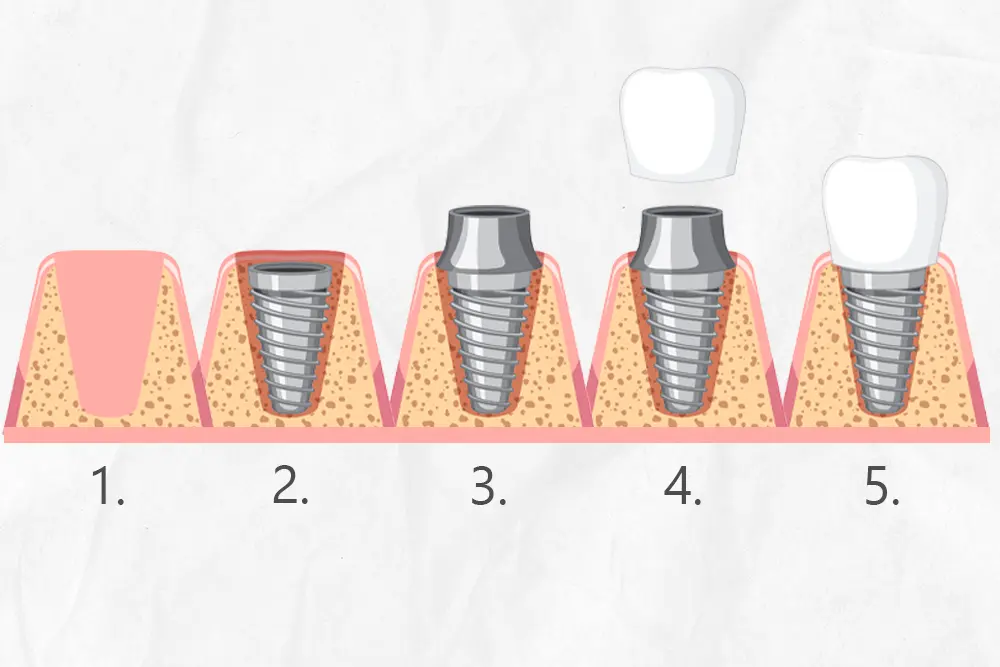
A helpful way to think about the overall sequence is in four broad phases: the immediate recovery phase covering the first seven to ten days, the soft tissue consolidation phase covering weeks two through four, the osseointegration phase covering months one through five and the restorative phase in which the abutment and permanent crown are placed. Each phase has its own biological logic and its own set of clinical requirements. Understanding them does not change how long they take but it does help patients comply with aftercare instructions more effectively and recognise whether what they are experiencing is a normal part of healing or something that warrants clinical attention. At International Plus, our patient liaison team is available throughout every phase to answer questions and provide reassurance as your recovery progresses.
Explore Our Dental Implant Protocols at International Plus →
Immediate Post-Operative Care: The First 24 Hours
The first 24 hours following implant surgery are the most biologically critical of the entire healing journey. The surgical wound begins forming a blood clot almost immediately after placement and this clot is the biological foundation upon which all subsequent tissue repair depends. Protecting it is the single most important aftercare for dental implants action you can take in the immediate post-operative period.
Post-op instructions during these first hours are specific and evidence-based. Avoid rinsing, spitting forcefully or using a straw, as the suction and pressure these activities generate can dislodge the forming clot and expose the underlying bone. Keep the head elevated above the level of the heart, including during sleep, to reduce the accumulation of fluids in the surgical area. Apply an ice pack wrapped in a cloth to the outer jaw in cycles of 20 minutes on and 20 minutes off during the first day to manage initial swelling. Take the prescribed analgesic and antibiotic medications on the schedule your International Plus team has provided, not only when discomfort prompts you to.
Managing dental pain in the first 24 hours is typically straightforward with modern pharmaceutical protocols. Most patients at International Plus describe the post-operative sensation as a dull ache rather than sharp pain, and find that it is well controlled by the prescribed regimen. If you experience pain that intensifies rather than diminishes after the first 24 to 48 hours, contact our team without delay, as this pattern warrants clinical review.
The First Week: Soft Tissue Recovery and Oral Hygiene
During the first week following surgery, the focus of biological activity shifts from clot formation to active gum healing and the initial closure of soft tissue around the implant site. The gum tissue, which appeared red and swollen immediately after surgery, begins to consolidate and reduce in inflammation as the days progress. By days four to five, most patients notice a meaningful reduction in swelling and discomfort. By day seven to ten, the gum tissue is visibly more settled and, for patients who received sutures, this is typically when those sutures are removed or have dissolved.
Swelling after dental surgery is a normal and expected part of the healing response, not a sign of a problem. It peaks between 48 and 72 hours after the procedure and then gradually subsides over the following days. Bruising around the jaw and lower cheek area is also common and resolves at the same pace. If swelling or pain increases after day four rather than decreasing, this is a clinical signal that should be reported to the International Plus team immediately.
Dental hygiene for implants during the first week requires a modified approach. Direct brushing of the surgical site should be avoided entirely for the first few days. From day two, gentle rinsing with a dilute antiseptic mouthwash recommended by your International Plus team is introduced to manage bacterial load in the area without mechanical disruption. Your normal brushing and interdental cleaning routine continues around all non-surgical areas of the mouth. Our team provides each patient with a written hygiene protocol tailored to the specific location and design of their implant case, so you always know exactly what is and is not appropriate at each stage of the first week.
The Science of Osseointegration: The Critical Healing Phase
Osseointegration is the biological process by which living bone tissue grows in direct contact with the titanium implant surface and forms a structural bond that is capable of bearing functional loading forces indefinitely. The term was introduced by Professor Per-Ingvar Brånemark following his pioneering research in the 1960s and it remains the defining biological criterion by which dental implant success rate is measured.
The osseointegration process unfolds across three distinct biological stages. In the first stage, woven bone forms adjacent to the implant surface through both contact osteogenesis (bone cells migrating directly from the implant surface) and distance osteogenesis (bone forming from the surrounding native bone and advancing toward the implant). By approximately day 28, new bone tissue is histologically demonstrable around the implant body. In the second stage, which continues through the first three months, this initial woven bone is replaced and reinforced by more mature lamellar bone that adapts structurally to the mechanical environment at the implant site. The third stage, which extends through months three to six, is one of continuous bone remodelling in which the peri-implant bone adjusts its density and trabecular architecture in response to the loading forces transmitted through the implant (PMC9213185).
Understanding that bone integration is an active, ongoing biological process helps patients appreciate why this phase takes the time it does. Accelerating it is not clinically possible through any intervention, but it can be optimised. At International Plus, PRF (Platelet-Rich Fibrin) is routinely incorporated into the surgical protocol where clinically appropriate. PRF is prepared from the patient’s own blood, processed chairside in a centrifuge before the surgical procedure begins. The resulting fibrin membrane is applied at the implant site to provide a concentrated local delivery of growth factors including PDGF, TGF-beta and IGF-1, which accelerate vascular ingrowth and stimulate osteoblast activity. A systematic review published in PubMed confirmed that PRF application significantly improved wound healing and soft tissue recovery after oral surgical procedures and was associated with measurable improvements in early implant stability (PubMed: 27672729).
Nutritional Guide: What to Eat During Implant Recovery
Diet after dental implants is one of the most common sources of patient questions and one of the areas where following guidance precisely makes a genuine difference to healing speed and outcome. Dietary choices affect healing through two mechanisms: the physical protection of the surgical site from pressure and trauma and the nutritional substrate available for tissue repair and bone formation.
For the first 72 hours following surgery, nutrition should come exclusively from cool, soft foods that require no chewing near the implant site. Yoghurt, smoothies, cold soups, blended vegetables and chilled protein shakes are appropriate. Avoid anything hot during this phase, as heat increases blood flow to the surgical area and can exacerbate bleeding and swelling.
Soft food recipes that work well through the first two weeks include mashed sweet potato with butter, well-cooked pasta or rice, scrambled eggs, fish poached or steamed to tenderness, cold blended fruit drinks without seeds and Greek yoghurt with honey. The objective is to nourish healing tissues with protein, vitamin C and calcium-rich foods while placing no mechanical demand on the implant site. From week two onward, foods can gradually be reintroduced based on comfort. By week four, most patients are eating a near-normal diet with the exception of very hard or crunchy items.
Avoiding hard foods such as raw carrots, crusty bread, nuts and hard confectionery should continue until osseointegration is confirmed by the clinical team. These foods generate biting forces that, if applied to a healing implant before adequate bone bonding has occurred, can introduce micro-motion at the implant-bone interface and disrupt the osseointegration process. Alcohol should be minimised during the healing period as it impairs immune function and bone metabolism. Patients receiving bone grafting in addition to implant placement should follow extended dietary restrictions as advised by their International Plus surgeon.
Managing Pain and Discomfort with Modern Medicine
Pain management after implant surgery at International Plus is structured around contemporary multi-modal analgesic principles, which combine different classes of medication to address pain through complementary mechanisms and reduce the total dose required of any single drug. This approach produces superior comfort outcomes compared to single-drug protocols.
The standard post-operative medication plan includes a non-steroidal anti-inflammatory drug (NSAID) such as ibuprofen to manage inflammatory pain and reduce swelling, a short course of antibiotics to protect the surgical site during the most infection-susceptible window and, where the procedure complexity warrants it, a short-acting corticosteroid administered intraoperatively to blunt the initial inflammatory cascade and significantly reduce post-operative swelling.
Dental anaesthesia recovery typically takes two to four hours following local anaesthesia injection, after which the first analgesic dose should be taken prophylactically rather than waiting for pain to fully emerge. During healing comfort management, patients should never exceed the prescribed dosage of any medication and should report any unexpected symptom including fever, persistent bleeding or increasing rather than decreasing pain to the International Plus team before making any changes to their medication regimen.
Book Your Free Consultation at International Plus →
Factors Influencing Your Healing Speed and Success
Several patient-specific factors can either support or impede the dental implant healing process. Being aware of these factors before surgery allows patients and the clinical team to put strategies in place to mitigate their effects.
Smoking and dental implants is the most extensively documented lifestyle factor in peri-implant healing research. Cigarette smoke contains vasoconstrictive compounds that reduce blood flow to healing tissues and carbon monoxide that displaces oxygen in the blood. Nicotine directly inhibits osteoblast activity at the cellular level. Patients who smoke have clinically demonstrated higher rates of peri-implant bone loss and implant failure compared to non-smokers. At International Plus, we strongly recommend cessation for at least two weeks before surgery and for the full duration of the osseointegration phase. Where full cessation is not possible, a significant reduction in the frequency of smoking is still beneficial.
Diabetes and healing is another critical variable. Patients with well-controlled type 2 diabetes (HbA1c within accepted clinical limits) undergo osseointegration at a pace comparable to non-diabetic patients when care is managed appropriately. Poorly controlled hyperglycaemia, however, impairs neutrophil function, reduces collagen synthesis and prolongs the inflammatory phase of wound healing. Our Diagnostic Council reviews blood parameters for all diabetic patients before surgical planning is confirmed.
Bone density at the implant site is one of the primary determinants of initial implant stability and osseointegration speed. Dense cortical bone in the anterior mandible provides rapid mechanical stability, while the more cancellous bone of the posterior maxilla integrates more slowly. Where bone density is borderline, International Plus surgeons adjust the implant surface selection, torque protocols and loading timeline accordingly. Individual results vary and a personalised consultation is the appropriate starting point for any patient with concerns about their specific healing prospects.
Digital Planning: How Technology Speeds Up Healing
One of the most consequential factors in guided implant surgery benefits for healing speed is the precision with which the implant is placed. When an implant is positioned using freehand technique without three-dimensional guidance, the surgeon estimates the correct trajectory and depth based on two-dimensional radiographs and clinical landmarks. When an implant is placed using a 3D dental imaging derived surgical guide, the position, angulation and depth are predetermined with sub-millimetre accuracy before any incision is made.
This precision dentistry approach reduces healing time in two significant ways. First, guided placement minimises the volume of bone and soft tissue disturbed during surgery. The corticotomy is made at the precise required location without the exploratory movement that increases tissue trauma in freehand cases. Less trauma means less post-operative swelling, faster soft tissue closure and a shorter initial recovery phase. Second, accurate implant positioning ensures optimal load distribution during osseointegration, reducing the mechanical stress at the bone-implant interface during the most biologically sensitive period of healing.
At International Plus, every single implant case is planned using CBCT tomography data integrated into our digital planning software before surgery begins. The surgical guide is fabricated in our in-house laboratory and its fit is verified at the pre-operative consultation. Patients treated under this guided protocol consistently report shorter and more comfortable recoveries than those who have previously received freehand implants at other facilities.
Second Stage Surgery: Abutment Placement
Once osseointegration has been confirmed through clinical and radiographic assessment, typically at the three to six month mark depending on the case, a minor outpatient procedure is performed to expose the healed implant and place the implant abutment. This component is the precision-machined connection piece that links the implant body to the final crown.
In cases where a healing cap was placed at the time of initial surgery to keep the gum tissue clear of the implant head, this second stage is minimally invasive, often requiring only a local anaesthetic and a small soft tissue incision to access the implant. A healing abutment or temporary abutment is then placed and left for two to four weeks to allow the gum tissue to mature into its final contoured shape around the emergence profile. This tissue shaping is not a cosmetic afterthought. It is a clinical step that determines the aesthetic appearance and biological health of the gumline around the permanent crown.
The final restoration phase begins once the peri-implant gum tissue has stabilised around the abutment profile. An impression or digital scan of the abutment and surrounding teeth is taken and sent to the International Plus in-house laboratory for crown fabrication. Our laboratory uses Redon five-axis milling and Aidite and Ivoclar zirconia materials to produce crowns with tolerances measured in microns, ensuring that the final restoration fits with precision and matches the adjacent teeth in both shade and morphology.
The Final Reveal: Attaching the Permanent Crown
The attachment of the permanent tooth replacement crown is the culminating moment of a treatment process that may have spanned three to eight months from the day of your initial surgery. At International Plus, this moment is the product of multiple layers of precision: the accurate digital planning of the surgical placement, the optimised biological environment created during healing, the expert craftsmanship of the in-house laboratory and the aesthetic crown fitting skill of our cosmetic dentistry team.
The crown is either cemented onto the abutment or secured with a small titanium screw, depending on the case design. Both methods produce a restoration that is fixed, stable and indistinguishable from a natural tooth in function and appearance. The occlusal contact between the new crown and the opposing teeth is carefully checked and refined to ensure balanced load distribution that protects the osseointegrated implant for decades of service.
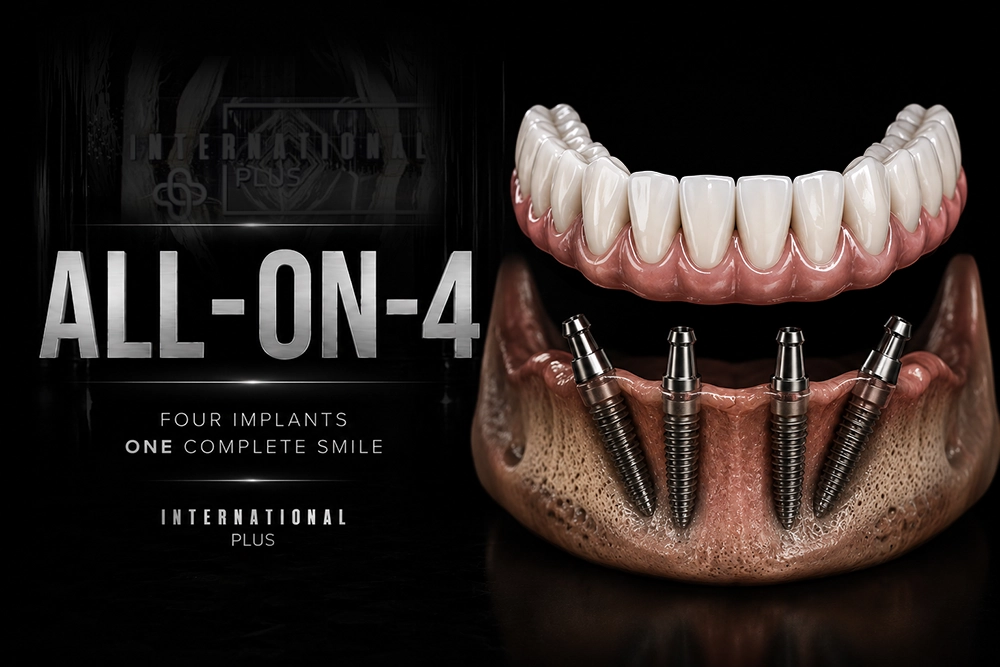
Smile makeover results from a single implant to a full-arch rehabilitation share the same fundamental achievement: a functional, permanent tooth that preserves jaw bone, restores natural bite force and provides the confidence that comes from a complete, stable smile. At International Plus, we accompany every patient from the day of consultation through to this final moment and beyond, with scheduled follow-up appointments to monitor the long-term health of the implant and the surrounding bone.
Discover Full-Arch Implant Solutions at International Plus →
Frequently Asked Questions
How long does it take for a dental implant to heal completely?
Soft tissue around the implant site heals within one to two weeks. The complete osseointegration of the implant with the jawbone, which is the biological process that determines the long-term success of the treatment, typically takes three to six months. Cases involving bone grafting or sinus augmentation may require a longer healing period before implant placement or before the final crown can be fitted.
Can I smoke during the dental implant healing stages?
Smoking significantly impairs the dental implant healing process by restricting blood flow to healing tissues and directly inhibiting bone-forming cells at the implant surface. At International Plus, we strongly advise against smoking for at least two weeks before surgery and throughout the entire osseointegration phase. Smoking during this period meaningfully increases the risk of peri-implant complications and implant failure.
When can I return to work after implant surgery?
Most patients return to their daily routines within 24 to 48 hours of surgery, depending on the complexity of the procedure and their individual level of post-operative comfort. Office and administrative work is generally fine by the second day. Physically demanding occupations or activities involving significant exertion should be deferred for seven to ten days to avoid elevating blood pressure at the healing site.
Is it normal to have swelling after the first week?
Swelling typically peaks between 48 and 72 hours after surgery and progressively subsides over the following days. By day seven, most patients have minimal residual puffiness. If swelling persists beyond the first week without improving or if it increases after day four, please contact the International Plus team immediately as this warrants clinical assessment.
What happens if my body rejects the implant during healing?
True immunological rejection of titanium is extremely rare because titanium is a biologically inert material that does not trigger an adaptive immune response. Failed osseointegration, where the implant does not form a stable bone bond, occurs in fewer than 2% of cases in modern guided implant protocols. At International Plus, our 3D dental imaging planning, premium implant system selection and PRF-enhanced healing protocols reduce this risk to the lowest clinically achievable level. In the rare event that an implant does not integrate successfully, it is removed and the site is allowed to heal before a new implant is placed.
Scientific References
Gaviria L, et al. Contemporary concepts in osseointegration of dental implants: a review. J Korean Assoc Oral Maxillofac Surg. 2022. PMC9213185.
Albrektsson T, Johansson C. Osseointegration: an update. Eur Spine J. 2001. PMC3602536.
Miron RJ, et al. Platelet-rich fibrin in implant dentistry in combination with new bone regenerative technique in elderly patients. Clin Oral Implants Res. 2016. PubMed: 27689517.
Zhao JH, et al. Platelet-rich fibrin and soft tissue wound healing: a systematic review. J Oral Maxillofac Surg. 2016. PubMed: 27672729.
Darriba IL, et al. Immediate loading of four implants with a fixed prosthesis in the edentulous maxilla and mandible. J Clin Periodontol. 2023. PMC6530943.
Reviewed by Dr. Alper Çağlayan Sarraf, Head of Oral Surgery, International Plus Dental Clinic, Istanbul. PhD Candidate in Oral and Maxillofacial Surgery, Istanbul Aydın University. Certified: ITI, Megagen, Zygoma Cadaver Training, EACMFS, Soft Tissue Surgery. 2,500+ international patients treated.
Follow us on Social Media
internationalplusofficial
internationalplus
internationalplusdental
This content is written, reviewed, and approved by the International Plus Medical Review Board to ensure clinical accuracy and adherence to strict editorial standards. All medical information is regularly monitored, audited and updated in light of the latest scientific advancements.
However the information provided here is for general informational purposes only and cannot be used for self diagnosis or making individual health interpretations. Results of medical treatments depend on individual anatomy and the unique healing process of each patient. This information should not replace a personal consultation with a qualified healthcare professional. To understand the best options for your specific needs and to receive a personalized treatment plan, we invite you to book a free consultation with the expert medical team at International Plus.

Dr. Alper Çağlayan Sarraf directs the oral surgery unit at InternationalPlus Istanbul, focusing on demanding cases that draw patients from every corner of the world.