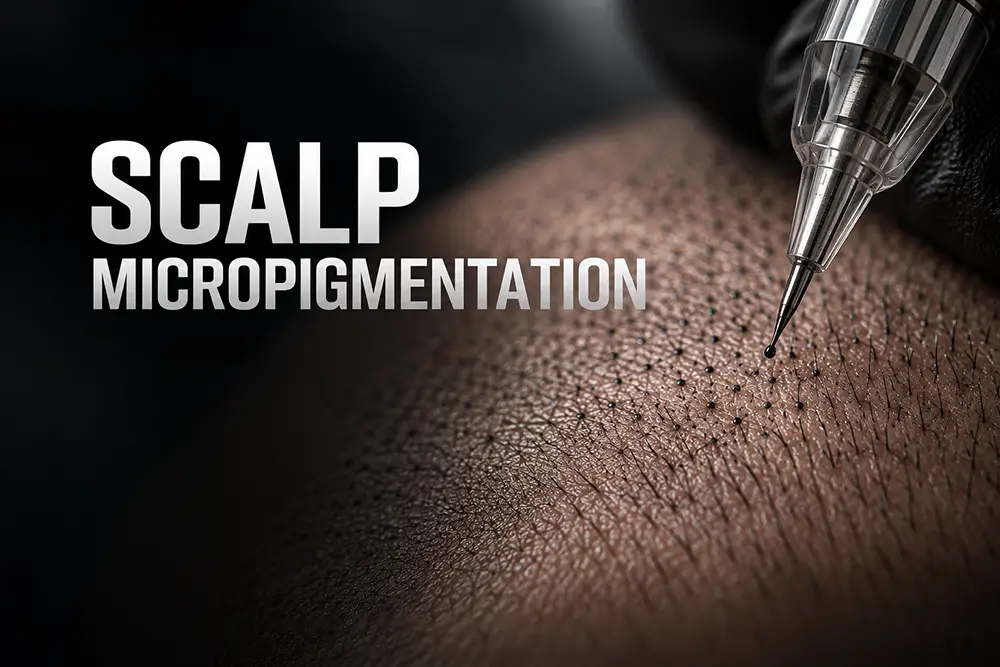

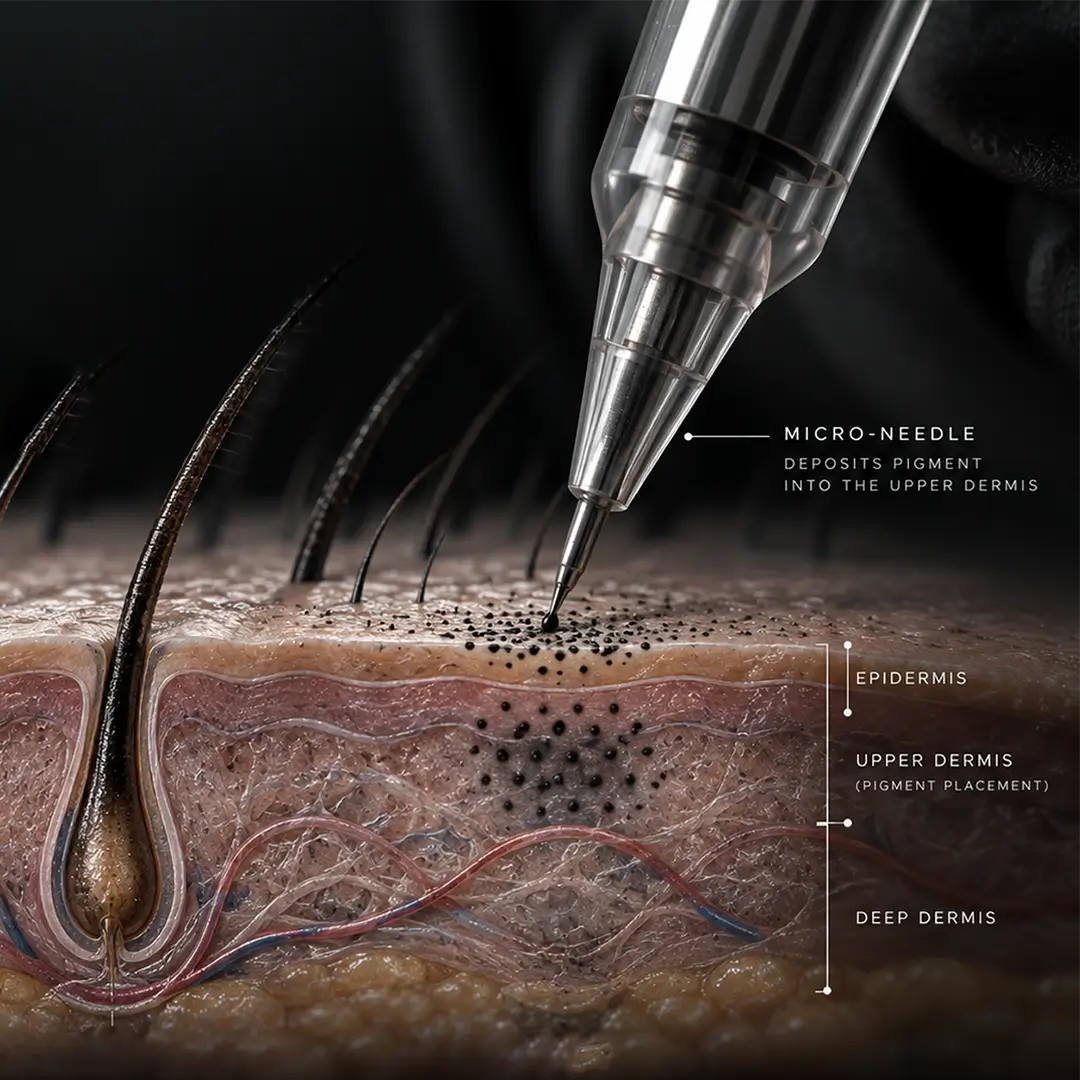
Scalp micropigmentation deposits pigment into the upper dermis in dot patterns that read as shaved stubble or as added density between existing hairs. No follicle is created and no hair grows. The result is an optical effect, which is exactly why the technique succeeds for some patients and disappoints others. This International Plus guide covers pigment behaviour, session structure, candidacy, plus the sequencing question that matters most when surgery is also on the table.
Key Takeaways
- Scalp micropigmentation is a cosmetic tattooing technique so the treatment adds visual density without adding a single hair.
- Most plans run 2 to 3 sessions spaced roughly two weeks apart, allowing pigment settling to be judged before more is added.
- Pigment fades and can shift in tone over years, which makes carbon-based pigment selection and needle depth the two decisions that govern long term appearance.
- SMP camouflages donor area scars and low-density zones and it pairs well with surgery rather than competing with it.
- Correction is possible through laser removal though correction is slower and less predictable than the original application.
What Is Scalp Micropigmentation?
Scalp micropigmentation is a cosmetic tattooing procedure in which micro-droplets of pigment are placed into the upper dermis to imitate the appearance of hair follicles emerging from the skin. Practitioners use fine needles and grayscale pigment. The finished pattern creates either a closely shaved look or the impression of thicker hair across a thinning area.
Distinguishing SMP from body tattooing prevents most misunderstandings. Needle depth is shallower, pigment is diluted differently, dot size is deliberately irregular so the pattern avoids a printed appearance. Dhurat and colleagues documented standardisation of the SMP procedure in the Journal of Cutaneous and Aesthetic Surgery (2017), reporting that outcome quality tracked directly with technical control rather than with device brand. A 2025 case series by Liu and colleagues in the Journal of Cosmetic Dermatology described ten patients treated for localised alopecia with detailed technical analysis. Our hair unit treats SMP as a camouflage discipline, not as a hair loss treatment.
How Does the Scalp Micropigmentation Procedure Work?
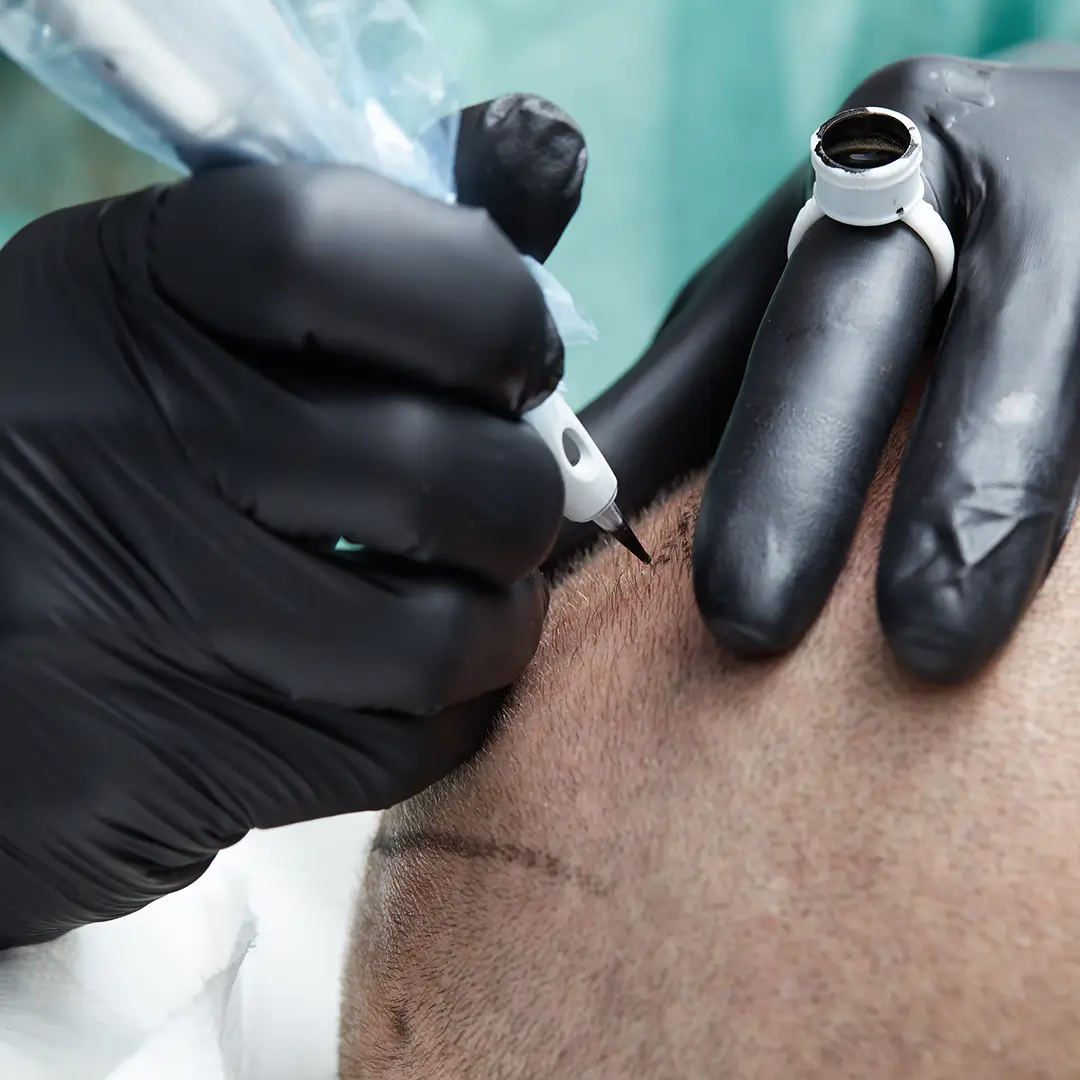
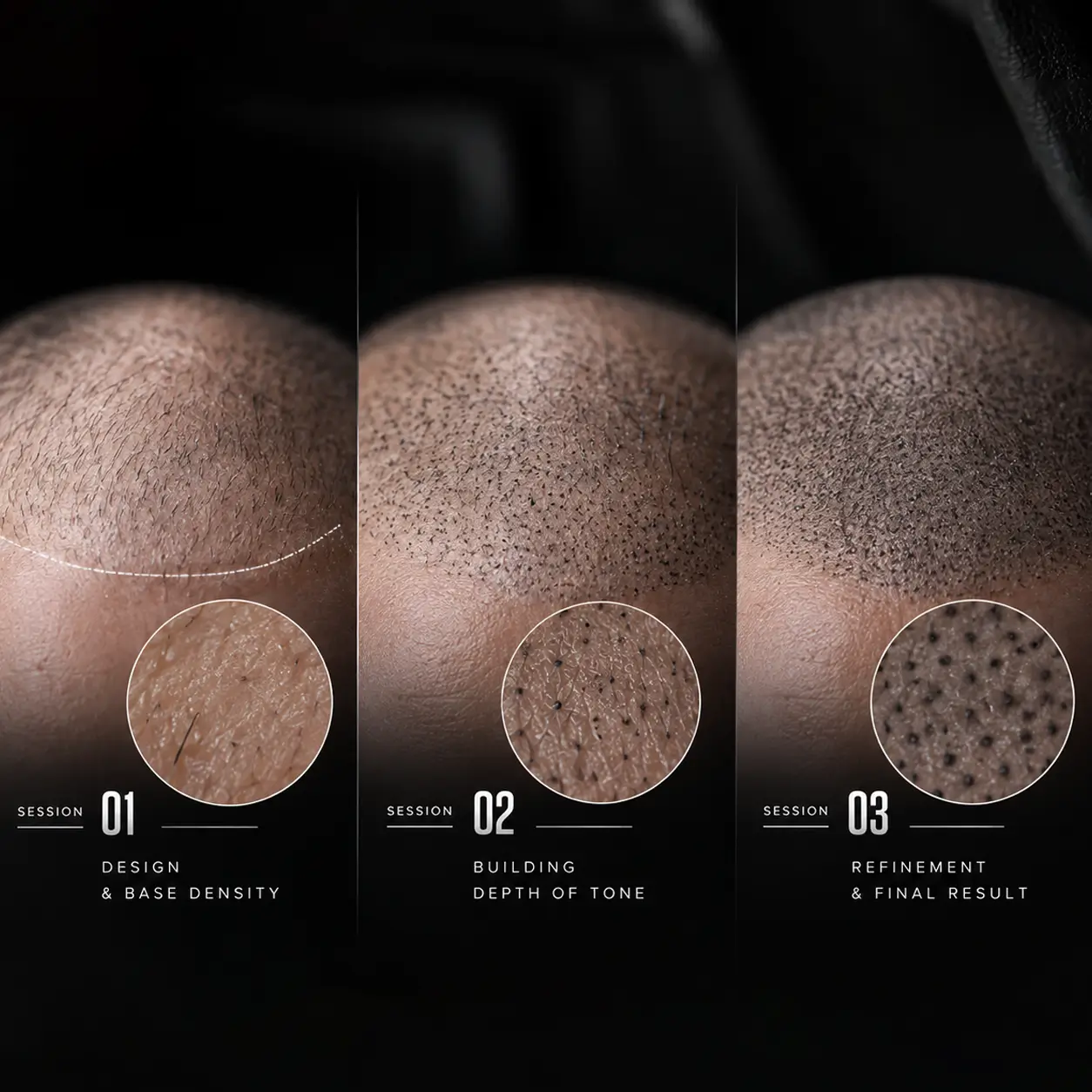
A standard course runs across 2 to 3 sessions of roughly two to four hours each, spaced ten to fourteen days apart. Topical anaesthetic reduces discomfort. The first session establishes hairline design and base density, later sessions build depth of tone once the practitioner sees how the skin has retained pigment.
Staged application exists for a technical reason. Pigment always looks darker on the treatment day, then softens as the skin heals over the following week. Building tone gradually prevents the heavy, flat appearance that gives poor work away. Our practitioners photograph each zone under fixed lighting before every session so retention can be measured rather than estimated. Hairline design deserves its own consultation because a frontal hairline drawn too low or too sharp ages badly on a face that continues to change. Patients weighing surgical options often review our regrowth timeline documentation during the same visit.
Which Pigment Is Used and Why Does the Colour Shift?
Reputable SMP work uses carbon-based grayscale pigment rather than coloured tattoo ink because carbon particles resist the colour drift that turns older tattoos blue or green. Pigment sits in the upper dermis where immune clearance is faster than in deeper tattoo layers. Fading is therefore expected and it is planned for.
Pigment chemistry is the least discussed variable in SMP marketing. Research by Hauri and Hohl in Current Problems in Dermatology (2015) examined photostability and breakdown products of pigments used in tattoo inks, showing that light exposure alters some formulations over time. Sun exposure across an unprotected scalp accelerates that process considerably. Rare adverse pigment reactions are documented too: Abtahi-Naeini and colleagues reported delayed pigmented macules following cosmetic micropigmentation in the Nigerian Postgraduate Medical Journal (2019). Our protocol records batch and dilution for every case so a touch-up years later can match the original tone.
| Planning decision | Practical options | What the choice changes |
| Pigment type | Carbon-based grayscale, coloured ink | Carbon resists the blue or green drift seen in older tattoos |
| Needle depth | Upper dermis, deeper placement | Deeper placement causes blurred dots that spread over time |
| Dot pattern | Irregular scatter, uniform grid | Irregular scatter reads as natural stubble under close inspection |
| Hairline style | Soft and broken, sharp and defined | Soft edges age better as the face changes |
| Session count | Staged over 2 to 3 visits, single long visit | Staged work allows retention to be measured before tone is deepened |
Each row above is agreed in writing before the first needle pass, never improvised during the session.
Is Scalp Micropigmentation for Women Different?
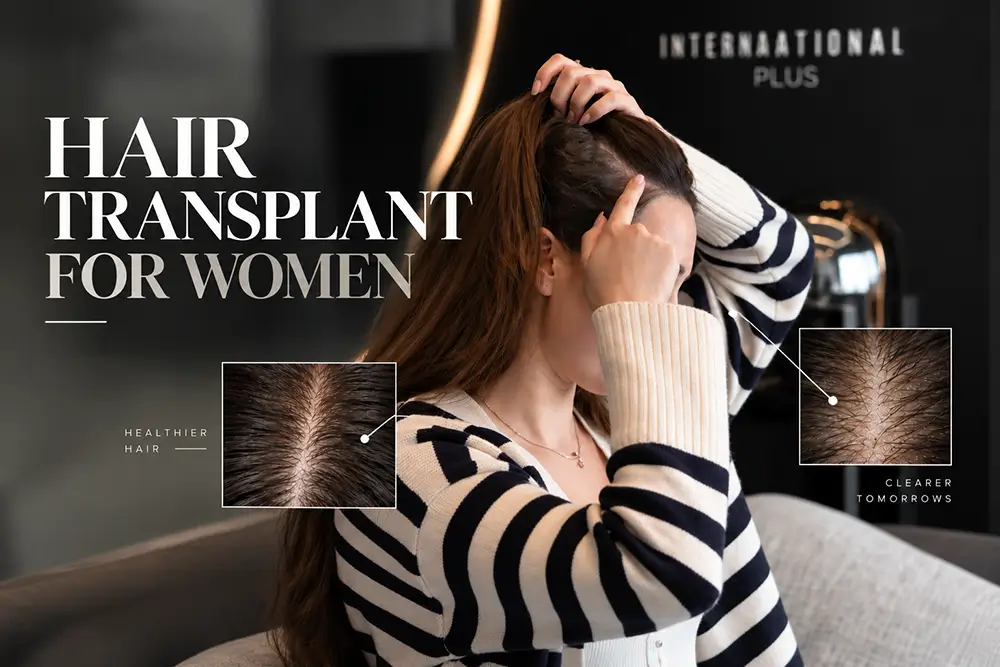
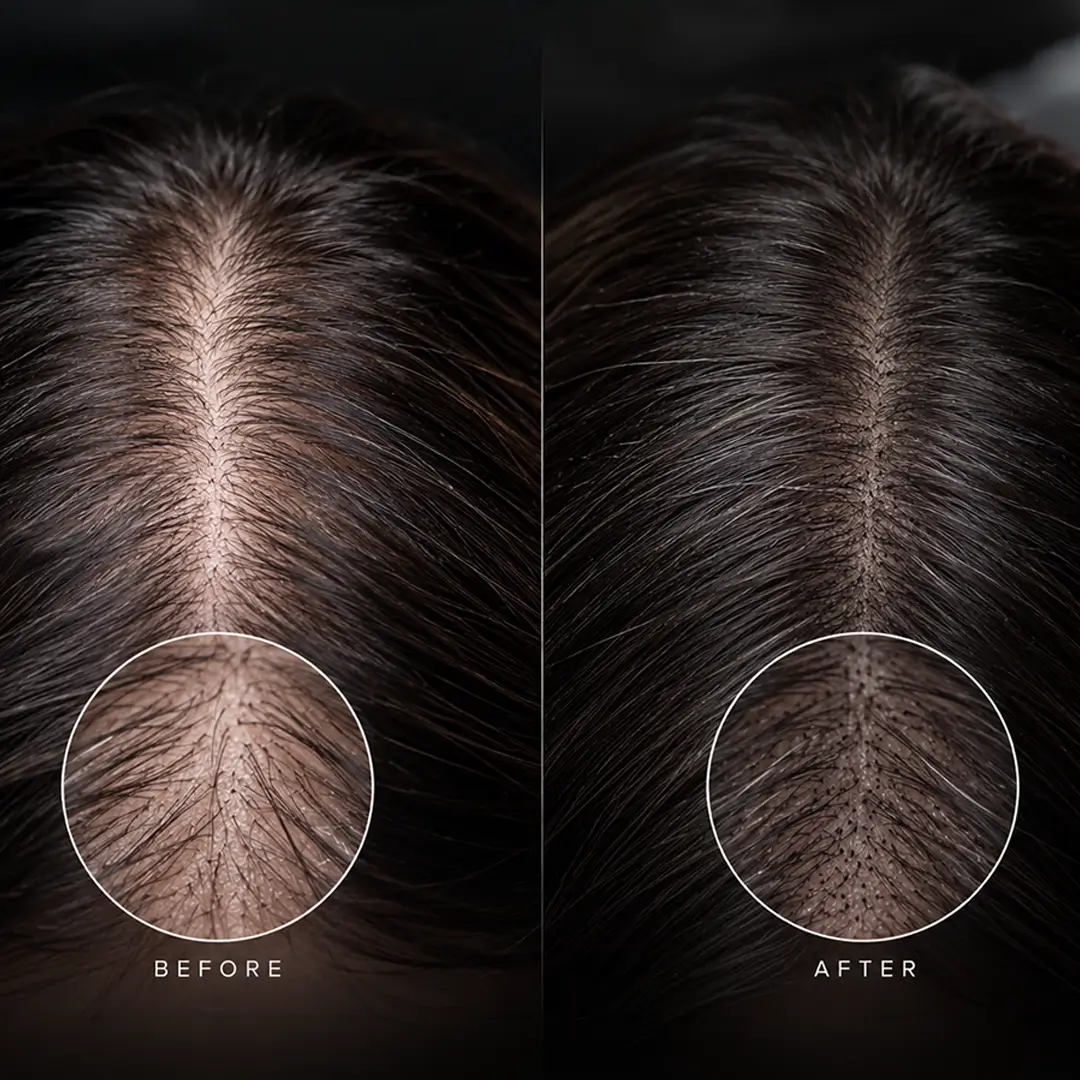
Female SMP usually aims at density illusion rather than a shaved look. Pigment is placed between existing hairs across a widened parting or a thinning crown, darkening the visible scalp so contrast with the hair drops. The technique suits diffuse thinning where hair still covers the area.
Contrast management drives the female result. Light skin with dark hair produces the strongest visible improvement since reducing scalp brightness immediately narrows the parting line. Very sparse coverage limits the effect because pigment alone cannot imitate volume when few hairs remain. Scalp micropigmentation suits a woman keeping her hair long but the same technique disappoints when thinning has advanced to visible skin across the crown because dots read as skin tone, not as strands. Candidacy for a surgical route instead is covered in our guide to hair transplant planning for women and diffuse female thinning is assessed at International Plus through the same female hair restoration pathway used before any surgical decision.
Should SMP Come Before or After a Hair Transplant?
Sequencing depends on the goal. SMP applied after transplant surgery adds background density between grafts and camouflages donor area scars, which is the most common combined plan. SMP applied first can bridge the waiting months though pigment in a future recipient zone complicates surgical planning for the operating team.
Timing rules protect both results. Transplanted hair needs roughly twelve months before final density can be judged so pigment added earlier may end up unnecessary or badly matched. Scar camouflage is a different case since a linear strip scar or punch scarring in the donor zone is stable and can be treated sooner. Reconstructive literature supports the combined approach: Kolasinski and colleagues described an eight-year experience combining fat grafting, follicular unit excision and micropigmentation in the Journal of Clinical Medicine (2026). Our surgeons plan sequence at the first consultation for hair transplant surgery in Istanbul, where more than 200,000 patients from 140 countries have been treated since 2014. Patients comparing placement methods also read our implanter pen technique analysis and donor healing is covered in the donor zone recovery guide.
What Drives Scalp Micropigmentation Cost?
Cost of scalp micropigmentation follows treated surface area, session count, practitioner experience, plus whether the work is a full shaved-look build or a density blend across a small zone. A Norwood VI scalp requires far more passes than a crown patch. Published price lists rarely state which of these they assume.
Four variables deserve attention before any figure enters the conversation. Surface area comes first because pigment work is priced by the ground it covers. Practitioner hours follow since artistry cannot be rushed without visible cost to the result. Touch-up planning matters because maintenance every few years is part of the real total, not an optional extra. Correction risk completes the list, given that fixing poor work costs more than doing it once properly. Our coordinators issue a written scope naming zones and session count before payment is discussed, matching the transparency approach in our breakdown of what drives hair transplant pricing.
Can Scalp Micropigmentation Be Corrected or Removed?
Removal is possible with laser treatment, most commonly picosecond or Q-switched systems though the process needs several sessions and results are less predictable than the original application. Common complaints involve dots that spread, a hairline drawn too low or a tone that reads too dark against the skin.
Correction strategy depends on the fault. Tone that is merely too dark often softens acceptably as natural fading progresses over two to three years. Blurred or oversized dots require laser lightening before any new pigment is placed. Suh and colleagues reported picosecond laser protocols across a case series in the Journal of Cosmetic and Laser Therapy (2025), noting that pigment response varies by formulation and depth. Avoiding correction entirely remains the better plan. International Plus holds a 4.8/5 rating across 5,504 verified patient reviews, works under Turkish Ministry of Health authorisation and supports patients in 21 languages and individual results may vary. Non-surgical support such as our platelet-rich plasma protocol is often discussed in the same consultation.
Book a scalp consultation with our coordination team and receive a written opinion on whether pigment, surgery or a combined plan matches your hair loss pattern.
Frequently Asked Questions
How long does scalp micropigmentation last?
Most treated scalps hold a satisfactory appearance for roughly four to six years before a touch-up becomes worthwhile. Fading speed depends on sun exposure, skin type, pigment used and how deeply it was placed. Patients who use daily sun protection on the scalp generally stretch the interval considerably.
Does scalp micropigmentation hurt?
Discomfort is usually rated lower than a conventional tattoo because needle depth is shallower and each pass is brief. Topical numbing cream is applied beforehand. Sensitive zones include the temples and the area over the crown. Most patients describe a scratching sensation rather than sharp pain during a session.
Can scalp micropigmentation hide hair transplant scars?
Yes and scar camouflage is one of the strongest indications for the technique. Pigment placed into and around a strip scar or punch scarring reduces the brightness contrast that makes scars visible through short hair. Scar tissue holds pigment differently from normal skin so retention is tested in a small area first.
Is scalp micropigmentation safe?
The procedure is generally well tolerated when performed with sterile single-use needles by a trained practitioner. Reported problems include infection, allergic pigment reaction plus unsatisfactory aesthetic outcome. Patients with keloid tendency, active scalp inflammation or a bleeding disorder need a medical review beforehand. Pigment reactions remain uncommon but are documented in dermatology literature.
Will SMP work if I want to keep long hair?
Partially. Pigment darkens the visible scalp and reduces contrast, which helps a widened parting or a thinning crown look denser under normal lighting. The effect weakens when hair is styled back or when wet. SMP cannot add length, movement or volume so expectations need setting before the first session.
How soon after a hair transplant can SMP be done?
Most surgical teams wait around twelve months so transplanted density can be judged properly before pigment is added. Donor area scar camouflage is sometimes possible earlier, often from six months once healing is complete. A surgeon who performed the operation should confirm timing rather than the pigment practitioner alone.
Reviewed by Dr. Eren Gülbahar
References
- Dhurat RS, et al. J Cutan Aesthet Surg. 2017. PMC5782438
- Liu Q, et al. J Cosmet Dermatol. 2025. PMC12406178
- Hauri U, et al. Curr Probl Dermatol. 2015. PMID: 25833639
- Abtahi-Naeini B, et al. Niger Postgrad Med J. 2019. PMID: 31621666
- Kolasinski JR, et al. J Clin Med. 2026. PMID: 42652631
- Suh DH, et al. J Cosmet Laser Ther. 2025. PMID: 40137855
Follow us on Social Media
internationalplusofficial
internationalplus
internationalplusdental
This content is written, reviewed, and approved by the International Plus Medical Review Board to ensure clinical accuracy and adherence to strict editorial standards. All medical information is regularly monitored, audited and updated in light of the latest scientific advancements.
However the information provided here is for general informational purposes only and cannot be used for self diagnosis or making individual health interpretations. Results of medical treatments depend on individual anatomy and the unique healing process of each patient. This information should not replace a personal consultation with a qualified healthcare professional. To understand the best options for your specific needs and to receive a personalized treatment plan, we invite you to book a free consultation with the expert medical team at International Plus.

I am a healthcare professional with over 4 years of experience in dentistry, specializing in prosthetic dental treatment and implant-based applications. Since 2024, I have been serving as chief physician, leading clinical management, team coordination, and international patient processes. With my B2-level English proficiency, I am able to communicate effectively with international patients. I am a patient-centered, innovative, and solution-oriented dentist who prioritizes patient satisfaction.