
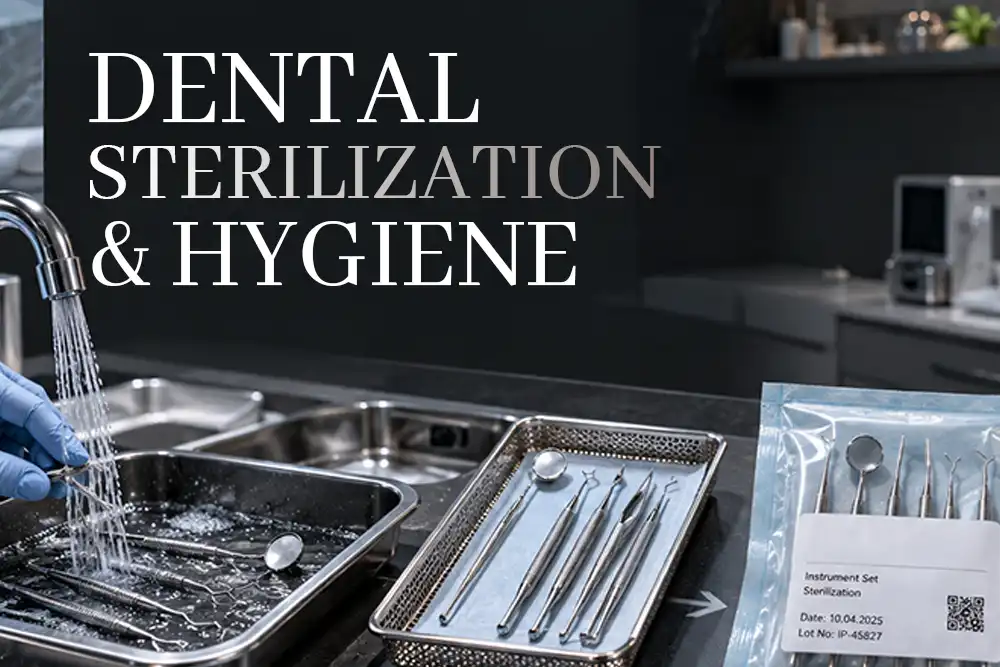

Dental sterilization is the part of treatment a patient never sees yet it decides whether the next person in the chair is safe. Patients travelling to Istanbul ask about it more than almost anything else. In a short video for the clinic, Gizem Aydin, co-owner of International Plus, walked through exactly what happens to an instrument between one patient and the next. This guide follows her account step by step and sets each step against the published evidence and the UK standard for dental decontamination.
Key Takeaways
- Every reusable instrument at International Plus passes through a fixed route: sorting in a dirty zone, machine washing, labelled packaging, then a double door autoclave that opens into a separate clean zone.
- Each sterilisation pouch is marked with the name of the person who processed it, the treatment room it belongs to, plus the date and time.
- Treatment rooms plus waiting areas are disinfected regularly along with devices with products approved by the Turkish Ministry of Health.
- Every patient is screened with tests for infectious diseases before treatment begins but the protection does not depend on that result because standard precautions apply to every patient regardless of status.
- Steam sterilisers failed less often than dry heat units in a large Canadian dataset though most recorded failures traced back to human error, which is why traceability labels matter.
What Is Dental Sterilization and Why Does It Matter?
Dental sterilization is the process that kills all microorganisms on a reusable instrument, including bacterial spores before the instrument is used on another patient. Cleaning removes visible debris and disinfection reduces germs on surfaces. Sterilisation is the final step that makes a reusable instrument safe to enter the mouth again.
Gizem Aydin opens the video with a simple principle: “In healthcare, hygiene is the most fundamental element of success.” The clinical record supports that view. According to a 2016 review in the Journal of the American Dental Association by Cleveland et al., only three reports of hepatitis B or hepatitis C transmission in US dental settings were published between 2003 and 2015 and the lapses identified included failure to heat sterilise handpieces between patients plus unsafe injection practices. In practice, transmission in dentistry is rare when the process is followed and becomes possible when a single step is skipped. The CDC baseline guideline by Kohn et al., published in 2003, covers sterilisation of patient care items, environmental infection control plus dental unit waterlines among its nine areas of recommendation. At International Plus, all equipment used in treatment is sterilised before and after every procedure in line with international health standards, which is the commitment the rest of this guide explains.
How Are Dental Instruments Sterilised at International Plus?
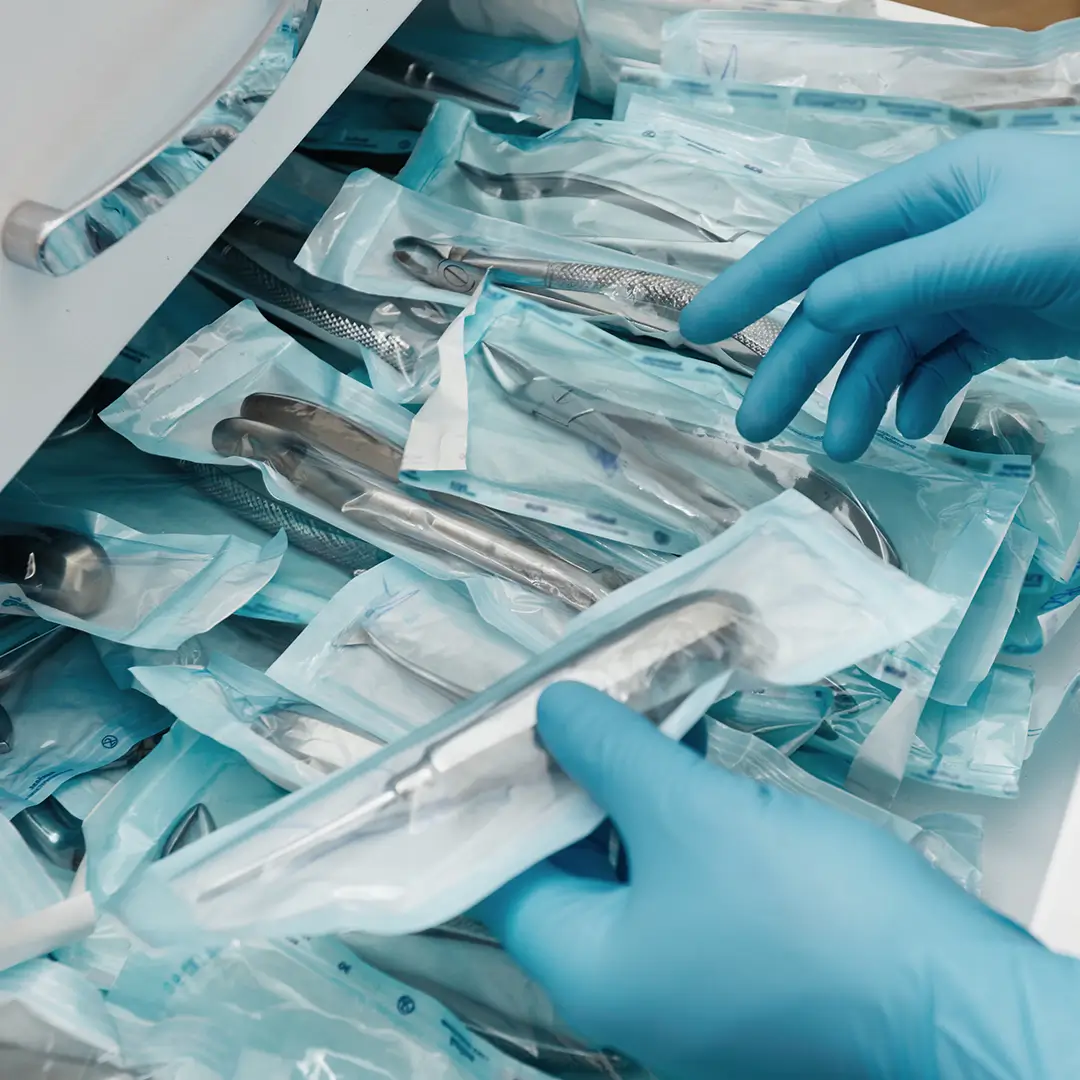
Dental instruments at International Plus are sterilised in five fixed stages that move in one direction from a dirty zone to a clean zone. The sterilisation area is divided in two, a dirty zone and a clean zone so sterile instruments are kept completely apart from used ones. The labelling stage records who processed each pack for which room and when.
| Stage | What happens | Why it matters |
| 1. Sorting (dirty zone) | Used instruments are separated | Used items stay in the dirty zone until washed |
| 2. Washing | Instruments go through a washing machine built to healthcare procedures | Debris left on metal shields microbes from steam |
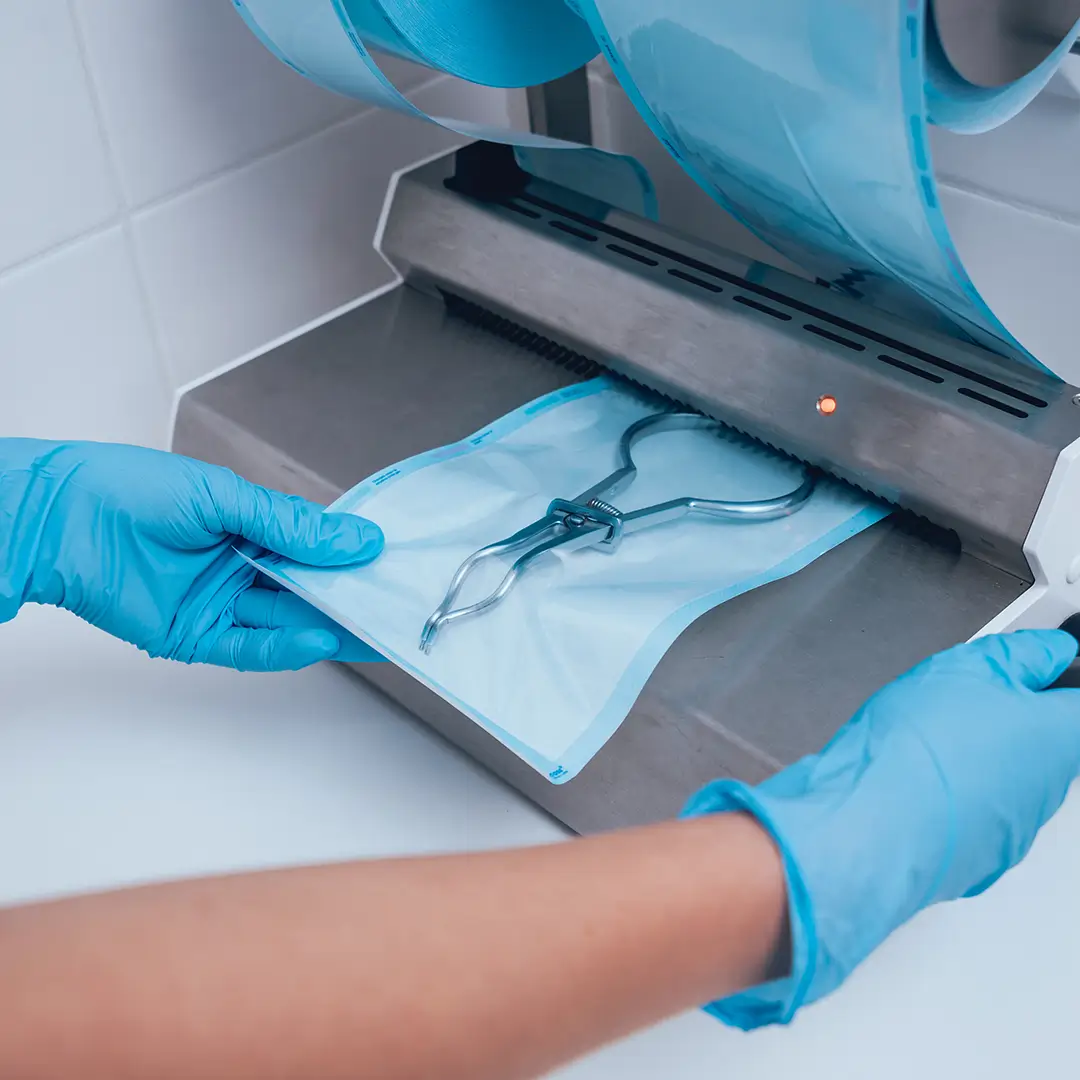
| 3. Packaging | Instruments receive special sterilisation packaging | Keeps the instrument sterile until it is opened |
| 4. Labelling | Name of the staff member plus room, date and time are marked on the pouch | Any pouch can be traced to a person plus a room and a time |
| 5. Double door autoclave | Reusable instruments enter from the dirty side and leave on the clean side | Sterile instruments stay separate from the dirty zone |
Bottom line: the route only runs one way and every pouch carries the information needed to trace it.
Machine washing is not a detail. Published in the British Dental Journal in 2011, a study by Vassey et al. measured residual protein on 1,304 instruments from 30 practices in South West England and found that manual washing combined with ultrasonic cleaning was significantly less effective than the other two methods while washer disinfectors reduced the variability. The same study found that a visual check did not predict how clean an instrument was. “After the separated instruments are washed in a washing machine that fully complies with health procedures, special packaging is carried out,” Gizem Aydin explains. The evidence favours machines here for consistency rather than speed.
Why Use a Double Door Autoclave?
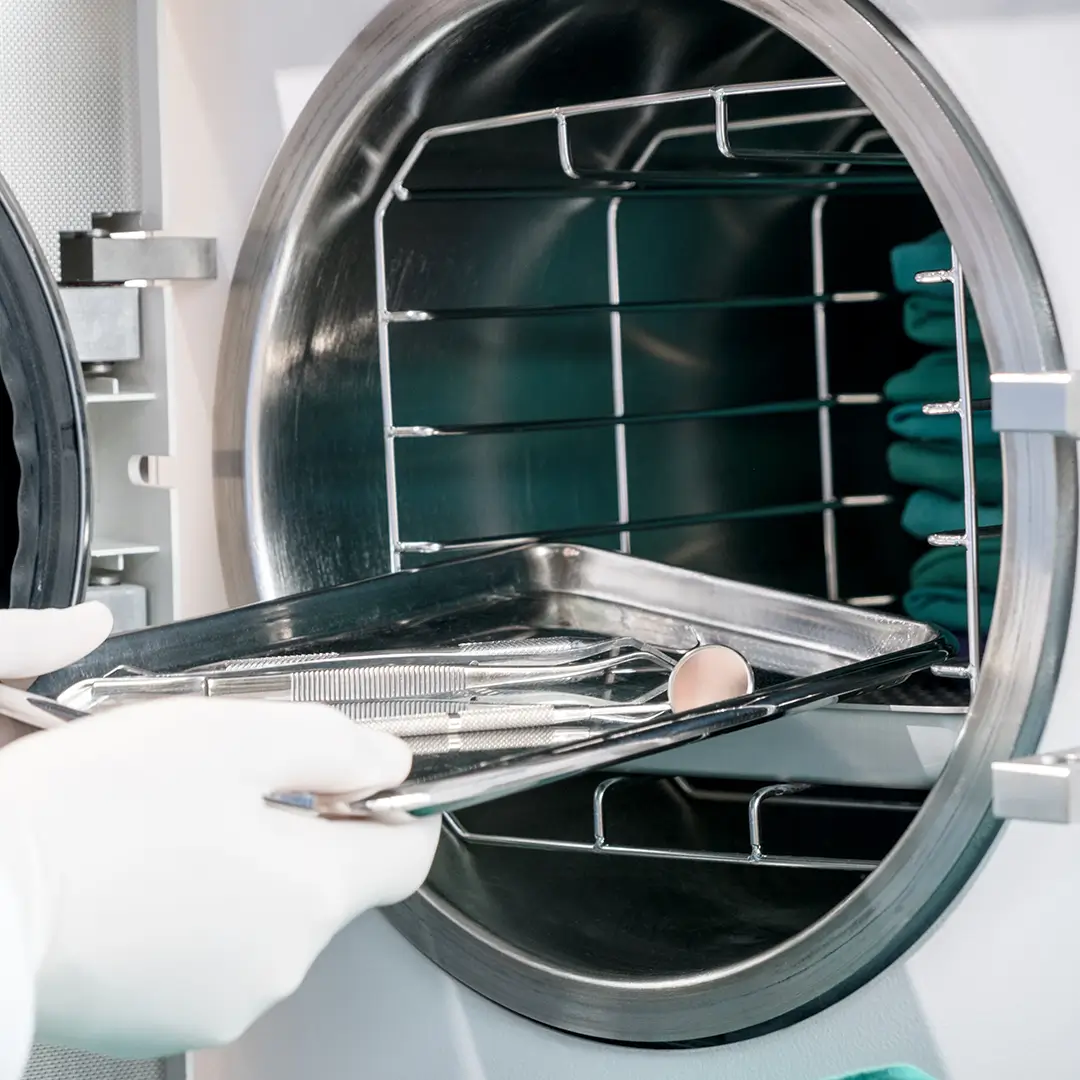
A double door autoclave is a steam steriliser with two doors on opposite walls: instruments are loaded from the dirty zone and unloaded into the clean zone. The design keeps sterile packs from travelling back through the area where used instruments are handled.
“The aim is for sterile instruments to exit into the clean area and stay completely separated from the dirty area,” Gizem Aydin says in the video. The UK decontamination standard for dental practices, HTM 01-05, describes the same principle as a workflow that runs “from dirty to clean through the successive processes” (gov.uk). Steam also performs well in large datasets. According to a 2024 retrospective study in BMC Oral Health by Vatanparast et al., which reviewed 198,771 biological indicator tests from 362 dental offices, steam sterilisers failed in 0.20% of tests compared with 1.30% for dry heat and 91.8% of all failures were attributed to human error. That figure shows why labelling every pouch with the name of the person who processed it matters: a process that depends on people needs to show which person handled each load. For example a label that names the staff member, the room plus the date and time lets any question about a pack be traced back to its source.
How Are Treatment Rooms Disinfected and What About Handpieces and Water Lines?
Treatment rooms and waiting areas at International Plus along with every device, are disinfected regularly using only effective disinfectants approved by the Turkish Ministry of Health. Rooms and fixed surfaces cannot go into an autoclave so disinfection is the route for rooms and devices while reusable instruments go through the full sterilisation route.
Handpieces deserve particular attention because their internal channels are narrow. A 2017 study in the Journal of Hospital Infection by Winter et al. tested handpiece lumens of 0.8 to 2.3 mm and found that non vacuum steam cycles produced significantly more sterilisation failures inside the channels while vacuum cycles achieved sterility in every biological indicator test. Research shows that the water inside a dental unit needs separate care as well. A 2020 narrative review in Pathogens by Spagnolo et al. explains that narrow tubing, standing water or suck back of saliva allows biofilm to form in dental unit waterlines and recommends combined measures rather than a single treatment. A patient can ask any clinic how handpieces are sterilised between patients and how unit water lines are maintained because instrument sterilisation does not cover the water inside the unit. Patients recovering after surgery can read how the same attention continues at home in our guide to dental implant aftercare in the first 30 days.
Book Your Free Consultation and ask our coordinators any question about our hygiene protocol before you travel.
Why Is Every Patient Screened Before Treatment?
Every patient at International Plus is screened with tests for infectious diseases before treatment begins. If a transmissible infection is present, the team can plan additional precautions in advance. Gizem Aydin describes the purpose plainly: the step lets the next patient sit in the dental chair with confidence.
Screening is an extra layer, not a replacement for routine protection. The CDC states that standard precautions “apply to all patient care, regardless of suspected or confirmed infection status” (CDC) so every instrument is sterilised the same way whatever the test shows. The reason both layers matter is that infection is often invisible. Data from the Saudi Medical Journal in 2018, reported by Al-Amad et al. show that among 372 dental patients tested after staff sharps or splash injuries over seven years, 3.8% were positive for hepatitis C antibodies and 2.2% for hepatitis B surface antigen and all of them had no symptoms. A patient’s history alone would not have revealed those infections. In practice, screening gives the clinical team information while standard precautions protect every patient regardless, which is the balance our clinic follows. “For us, every patient’s health and safety comes before everything,” Gizem Aydin says. Patients weighing safety in a wider sense can read our honest assessment of whether Turkey teeth are safe.
How Can You Check a Clinic’s Hygiene Before You Travel?
You can check a clinic’s hygiene by asking specific questions before you book and by watching what happens in the treatment room on the day. A clinic with a real protocol answers precisely and shows its sterilisation area without hesitation. Vague reassurance is the warning sign.
Ask these questions in order. First, are reusable instruments machine washed before sterilisation and is the sterilisation area divided into dirty and clean zones? Second, are instruments sealed in pouches marked with a date and are the pouches opened in front of you? Third, how is the autoclave checked? Is there a record of each cycle? Fourth, what disinfectants are used on surfaces? Are they approved by the national health authority? The same questions apply in the UK and in Turkey and our comparison of Turkey teeth versus a UK dentist covers the regulatory differences in more detail. For surgical treatment such as dental implant treatment in Istanbul, sterile handling extends to the surgical field itself and our guide on whether it is safe to have dental implants in Turkey explains the wider checks. Endodontic files used during root canal treatment by endodontic specialists are a good test question too because UK guidance treats them as single patient use.
International Plus has treated more than 200,000 patients from 140+ countries since 2014 and holds 5,504 verified reviews at 4.8 out of 5. The full picture of treatment in Istanbul is in our dental treatment in Turkey guide. This guide was reviewed for accuracy by Dr. Eren Gülbahar, Head of Cosmetic Dentistry at International Plus. Dr. Gülbahar is an American Dental Association member. Individual results vary. The article is educational and is not medical advice.
If you would like to know more about how dental sterilization works in our clinic before your visit, Contact our patient coordination team for a no obligation conversation.
Frequently Asked Questions
Are dental instruments sterilised between every patient?
Yes. Every reusable instrument at International Plus is sterilised before and after each procedure. Used instruments are sorted in a dirty zone and machine washed. Sealed in labelled pouches, the instruments are then processed in a double door autoclave that releases them into a separate clean zone, kept completely apart from the dirty area.
What is written on a sterilisation pouch?
Each sterilisation pouch at International Plus carries the name of the staff member who processed it plus the treatment room. The date and time are marked as well. This makes every pouch traceable to a person, a room plus a date and time so any question about a pack can be followed back to its source.
What is a double door autoclave?
A double door autoclave is a steam steriliser with a door on each side. Instruments are loaded from the dirty zone and removed on the clean side so sterile pouches never pass back through the area where used instruments are handled. The design enforces the one way, dirty to clean workflow that decontamination standards require.
Why are patients tested for infectious diseases before treatment?
Screening lets the clinical team know about a transmissible infection in advance and plan any additional precautions. Screening is an extra layer only. Standard precautions, including full sterilisation of every instrument, apply to every patient regardless of the result because many infections cause no symptoms and would not be revealed by a medical history.
Is it safe to get dental work in Turkey?
Safety depends on the individual clinic rather than the country. Ask whether instruments are machine washed before sealing in dated pouches, then sterilised in an autoclave with a recorded cycle and whether surface disinfectants are approved by the Ministry of Health. A clinic with a genuine dental sterilization protocol answers clearly and shows its sterilisation area.
Reviewed by Dr. Eren Gülbahar
References
- Cleveland JL, et al. J Am Dent Assoc. 2016. PMID: 27233680
- Kohn WG, et al. MMWR Recomm Rep. 2003. PMID: 14685139
- Vassey M, et al. Br Dent J. 2011. PMID: 21372833
- Vatanparast B, et al. BMC Oral Health. 2024. PMID: 39521967
- Winter S, et al. J Hosp Infect. 2017. PMID: 28903057
- Spagnolo AM, et al. Pathogens. 2020. PMID: 32823641
- Al-Amad SH, et al. Saudi Med J. 2018. PMID: 29738011
Follow us on Social Media
internationalplusofficial
internationalplus
internationalplusdental
This content is written, reviewed, and approved by the International Plus Medical Review Board to ensure clinical accuracy and adherence to strict editorial standards. All medical information is regularly monitored, audited and updated in light of the latest scientific advancements.
However the information provided here is for general informational purposes only and cannot be used for self diagnosis or making individual health interpretations. Results of medical treatments depend on individual anatomy and the unique healing process of each patient. This information should not replace a personal consultation with a qualified healthcare professional. To understand the best options for your specific needs and to receive a personalized treatment plan, we invite you to book a free consultation with the expert medical team at International Plus.

I am a healthcare professional with over 4 years of experience in dentistry, specializing in prosthetic dental treatment and implant-based applications. Since 2024, I have been serving as chief physician, leading clinical management, team coordination, and international patient processes. With my B2-level English proficiency, I am able to communicate effectively with international patients. I am a patient-centered, innovative, and solution-oriented dentist who prioritizes patient satisfaction.


