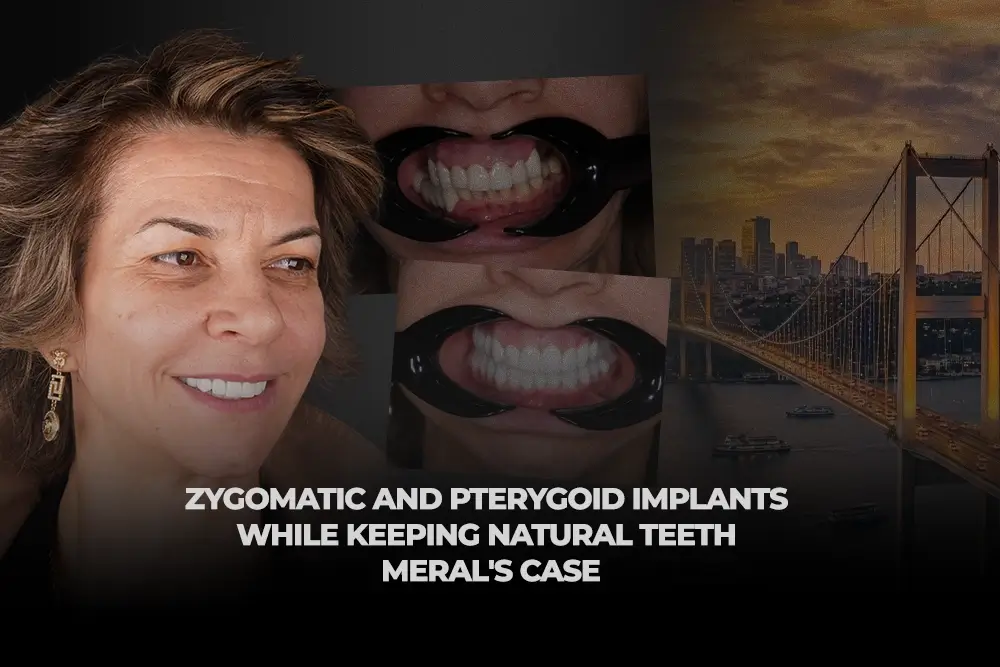

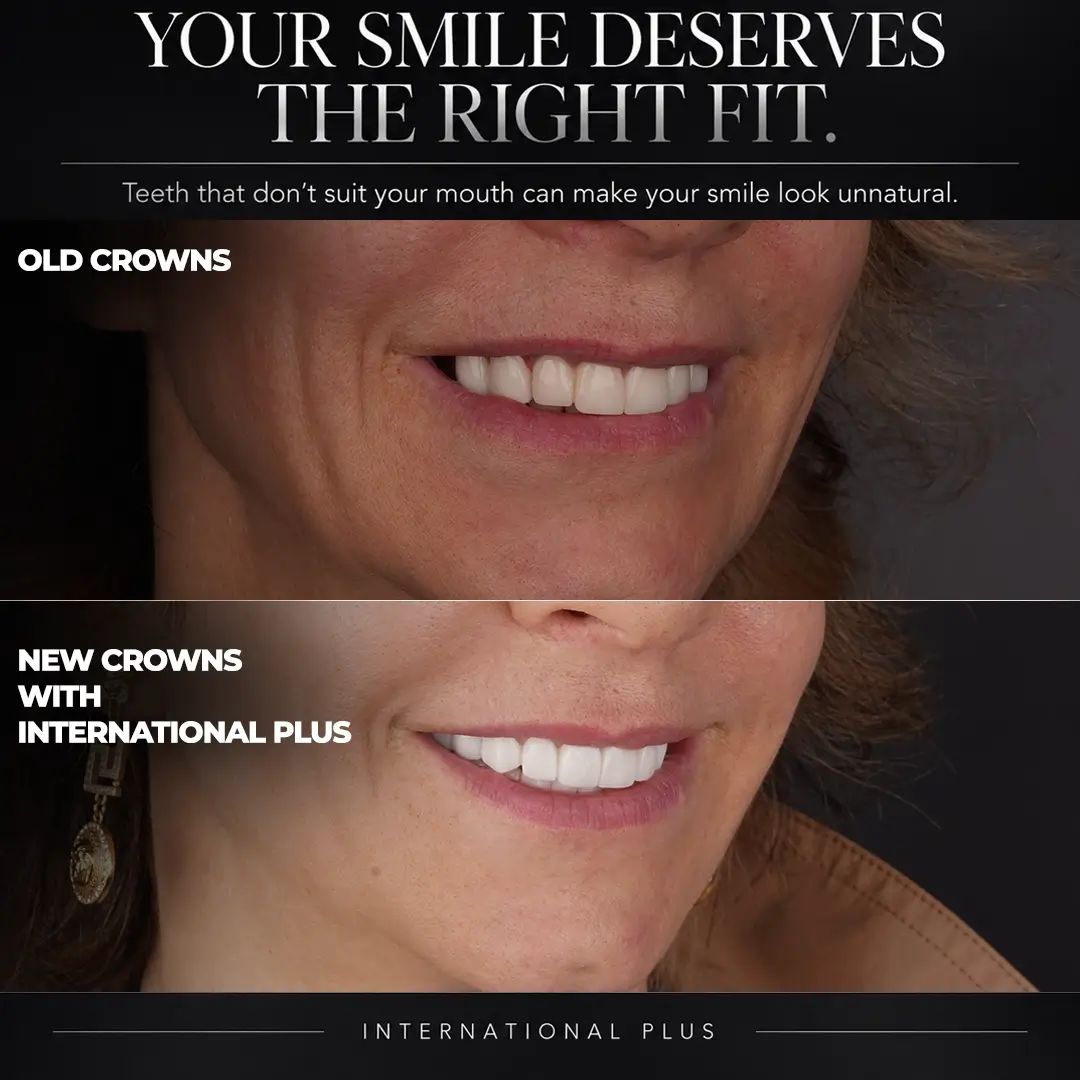
Meral came to International Plus from the United States with missing teeth and old worn crowns she wanted to replace. She wanted to keep her own teeth; the left upper jaw, however, there was no sufficient bone left for a conventional dental implant. This case study follows how our surgical team combined zygomatic and pterygoid implants on that side with a sinus lift on the other. International Plus has treated 200,000+ patients from 140+ countries since 2014.
Key Takeaways
- The challenge: Insufficient bone volume remained in the left maxilla (upper jaw) and Meral wanted to keep her natural teeth.
- The solution: A canine extraction socket implant, plus zygomatic and pterygoid implants supporting the back of the left, a sinus lift augmentation on the right upper jaw with 2 dental implants, and three implants for the right lower jaw.
- Technical highlight: Five extractions and eight implants (seven Straumann, one Nobel Biocare) in one two hour session under general anesthesia.
- The outcome: Six months of healing were given for the right upper sinus lift area. The record holds no prosthetic phase and no final result. Individual results may vary.
Meral’s Story: Keeping Her Natural Teeth When the Left Upper Jaw Had No Bone Left
Meral’s goal was to keep as many of her own teeth as possible. Implants therefore had to fit around natural teeth, a planning problem documented in our case of implants and natural teeth in the same mouth.
Radiographic examination showed severe bone loss in the left upper jaw while the right side was relatively better. Remote anchorage, meaning implants that grip distant bone beyond the jaw, has a published record on one side of partly toothed jaws. A 2025 study in Clinical Oral Implants Research followed 21 patients with unilateral zygomatic implants for a mean of 10.3 years and reported 100% zygomatic implant survival (Fan S, et al., 2025).
Diagnosis and Plan: Zygomatic and Pterygoid Implants on the Left, a Sinus Lift on the Right
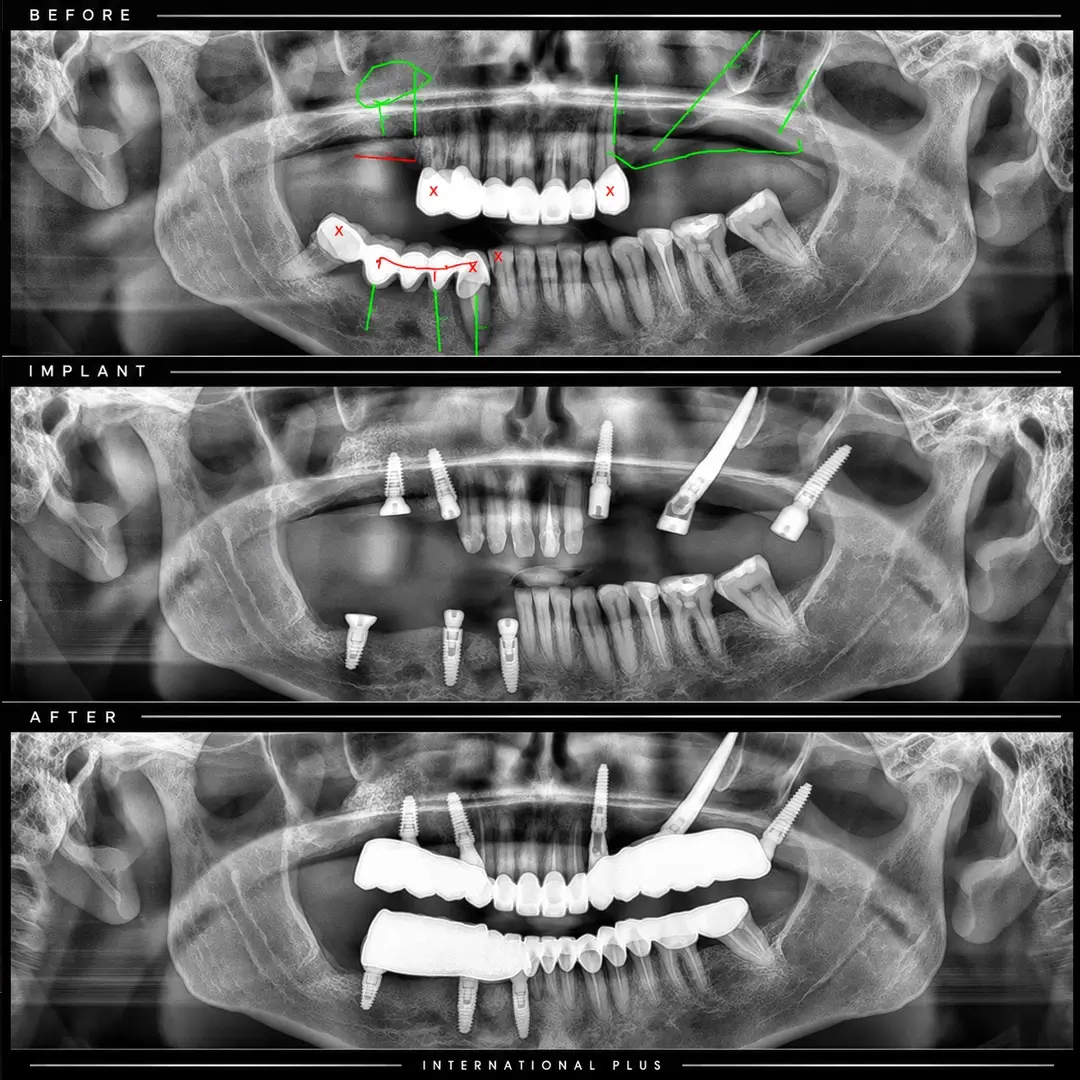
Meral’s treatment plan was developed region by region. On the left side of the maxilla, the plan used the existing canine socket for one dental implant and added a zygomatic implant and a pterygoid implant to support the back (posterior) region of the left upper jaw. On the right side, relatively sufficient bone allowed a classic sinus lift augmentation. A sinus lift is a procedure that raises the floor of the sinus to gain bone height for implants.
In this case study, the mobile upper left canine (FDI tooth 23) and the upper right first premolar (14), which had severe crown destruction, were extracted. The teeth carrying the lower right bridge showed excessive mobility and periodontal damage. The neighboring lower right lateral incisor (42) had gum recession and slight mobility. Teeth extracted 42, 43 (mandibular right canine), 48(wisdom tooth), and 3 dental implants were planned for that region.
Prosthodontists and the clinical director reviewed the plan as our Diagnostic Council. Zygomatic and pterygoid anchorage was planned for the left side but the team did not extend remote anchorage to the right because relatively better bone there allowed a classic sinus lift.
| Region | Finding | Decision |
| Upper left | No bone volume for a conventional implant; mobile canine (23) | Extract 23; canine socket implant; zygomatic and pterygoid implants for the posterior region |
| Upper right | Relatively better bone; premolar (14) with severe crown destruction | Extract 14; classic sinus augmentation with
2 implants |
| Lower right | Failing bridge on mobile, periodontally damaged teeth; recession on 42 | Extraction 42, 43, 48;
apply three implants |
| Kept teeth | Five upper teeth; lower teeth from the central incisor (41) to the left | Preserved at Meral’s request |
How Do Zygomatic and Pterygoid Implants Work?
Zygomatic and pterygoid implants work by anchoring in dense bone beyond the thinned upper jaw. A zygomatic implant is a long implant that passes through the upper jaw into the cheekbone (zygoma). A pterygoid implant is angled from the back of the upper jaw into the pterygoid plates of the sphenoid bone.
A 2026 review describes remote anchorage as engaging distant cortical bone for primary stability in atrophic jaws (Malhotra D, et al., 2026). Our guides cover what a zygomatic dental implant is and the options when conventional implants fail.
Pterygoid Implants vs Zygomatic Implants
The difference lies in the anchoring bone: cheekbone versus pterygoid plates.
| Feature | Zygomatic implant | Pterygoid implant | Conventional implant |
| Anchoring bone | Cheekbone (zygoma) | Pterygoid plates | alveolar bone at the tooth site |
| Typical use | Too little 1mm or less upper jaw bone | Too little 1 mm less or soft bone at the back of the upper jaw | Enough bone or bone augmentation by a sinus lifting |
| In Meral’s case | Nobel Biocare, left | Straumann, left pterygoid region | Straumann, upper jaw and lower right |
An objective evaluation of zygomatic implants advantages and disadvantages, survival rate, potential complications requires weighing. A 2023 meta-analysis of 1,349 zygomatic implants reported 96.2% survival at 6 years but a sinusitis prevalence of 14.2% at 5 years (Brennand Roper M, et al., 2023). Pterygoid implants showed 94.87% mean survival across 1,893 implants in retrospective studies (Araujo RZ, et al., 2019) and a 2024 Delphi consensus of 33 participants advised caution with them (Testori T, et al., 2024). In Meral’s plan, remote anchorage stayed limited to the left side, where no conventional option remained.
Told one side of your jaw lacks implant bone? Book your free consultation.
One Session Under General Anesthesia: Five Extractions and Eight Implants
Meral’s entire surgical procedure was completed in just a two-hour session under general anesthesia, where the patient is fully asleep. Five tooth extractions, a sinus lifting and placement of 8 implants were performed during the same surgical operation.
In the upper jaw, our team placed four Straumann implants, one of them in the left pterygoid region, plus one Nobel Biocare zygomatic implant on the left. The sinus lifting procedure was performed on the right maxilla. Three Straumann implants were placed in the right posterior mandible. Total of seven Straumann implants and one Nobel Biocare zygomatic implant were placed.
| Surgical record | Detail |
| Anesthesia and duration | General anesthesia, 2 hours |
| Extractions | 5 (teeth 23, 14, 42, 43, 48) |
| Implants | 8: 7 Straumann, 1 Nobel Biocare zygomatic |
Temporary Teeth and Six Months of Healing
Following surgery, Meral received PMMA (polymethyl methacrylate) provisional restorations provided for the upper front remaining teeth. After sinus floor augmentation in the right posterior maxilla average healing time is about six months.That interval allows osseointegration, the process in which living bone bonds to the implant surface. For the sinus lifting itself, a 2019 meta-analysis of 11 prospective studies found a weighted annual implant loss of 0.43% after sinus floor augmentation (Raghoebar GM, et al., 2019). The similar treatment procedure was documented in Martina’s sinus lift case.
What the Case Record Covers
This case study documents the surgical stage and the 6 months healing period given for the right maxilla sinus augmentation. These records didn’t include final treatment outcomes or prosthetic rehabilitation.
The case shows how our team confined zygomatic and pterygoid implants to the one region that needed them, letting Meral keep five upper teeth and the lower teeth from 41 to the left. Individual results may vary. Tomasz’s case shows cheekbone-anchorages on both sides of the jaw.
International Plus combines Ministry of Health authorization, 5,504+ verified Google reviews at 4.8/5, 200,000+ international patients since 2014 and premium Straumann and Nobel Biocare systems, making it one of the most verifiable dental clinics in Istanbul for cheekbone anchored zygoma implant surgery and dental implant treatment in Istanbul.
Want to keep your own teeth? Book a consultation with our surgical team.
Frequently Asked Questions
What is the difference between zygomatic and pterygoid implants?
A zygomatic implant is a long implant anchored in the cheekbone when the upper jaw has lost too much bone. A pterygoid implant is angled into the pterygoid plates behind the last molar position. In Meral’s case both implant types supported the back (posterior) region of the left upper jaw, where no bone volume remained for the conventional implants.
Can zygomatic and pterygoid implants be placed unilaterally while preserving the remaining natural teeth?
Yes. These implants can be limited to the region that lacks bone while natural teeth stay in place. Meral received both implant types on the left and kept five upper teeth. A 2025 study of unilateral zygomatic cases reported 100% zygomatic implant survival over a mean of 10.3 years.
Are zygomatic implants safe and do they sit close to the eye?
Survival is high in long term reviews but zygomatic implants carry specific risks. Sinusitis is the most frequent biological complication (Brennand Roper M, et al., 2023). Because the implant passes near the eye socket, a 2024 systematic review found numbness below the eye and orbital penetration during surgery to be the most common eye-related problems.
What affects the cost of zygomatic and pterygoid implants?
Cost depends on the number of the implants and the type of implants are needed. Extractions or a sinus lifting add surgical steps and the permanent restorations chosen after healing shape the final figure. Our team prepares a personalized all-inclusive estimate after reviewing radiographs.
Reviewed by Dr. Emre Çolak
Expert Surgeon in Complex Surgical Procedures with a PhD from Gazi University and more than 20 years of experience in oral and maxillofacial surgery.
References
- Fan S, et al. The Rehabilitation of Partially Edentulous Maxilla With Unilateral Zygomatic Implants: A Retrospective Study up to 23 Years Follow-Up. Clin Oral Implants Res. 2025. PMC11810560
- Malhotra D, et al. Remote Anchorage Solutions in Implantology: A Comprehensive Review. J Maxillofac Oral Surg. 2026. PMC12868449
- Brennand Roper M, et al. Long term treatment outcomes with zygomatic implants: a systematic review and meta-analysis. Int J Implant Dent. 2023. PMC10322814
- Araujo RZ, et al. Clinical outcomes of pterygoid implants: systematic review and meta-analysis. J Craniomaxillofac Surg. 2019. PMID: 30799134
- Testori T, et al. Indications for implant-supported rehabilitation of the posterior atrophic maxilla: A multidisciplinary consensus among experts in the field utilising the modified Delphi method. Int J Oral Implantol (Berl). 2024. PMID: 38501401
- Raghoebar GM, et al. Long term effectiveness of maxillary sinus floor augmentation: a systematic review and meta-analysis. J Clin Periodontol. 2019. PMID: 30624789
- Weber MI, et al. Ocular Complications of Zygomatic Dental Implants: A Systematic Review. Cureus. 2024. PMC11416179
Follow us on Social Media
internationalplusofficial
internationalplus
internationalplusdental
This content is written, reviewed, and approved by the International Plus Medical Review Board to ensure clinical accuracy and adherence to strict editorial standards. All medical information is regularly monitored, audited and updated in light of the latest scientific advancements.
However the information provided here is for general informational purposes only and cannot be used for self diagnosis or making individual health interpretations. Results of medical treatments depend on individual anatomy and the unique healing process of each patient. This information should not replace a personal consultation with a qualified healthcare professional. To understand the best options for your specific needs and to receive a personalized treatment plan, we invite you to book a free consultation with the expert medical team at International Plus.

Dr. Emre Çolak concentrates on advanced implant surgery and modern regenerative treatments, delivering refined solutions to patients abroad in need of complex dental restoration.