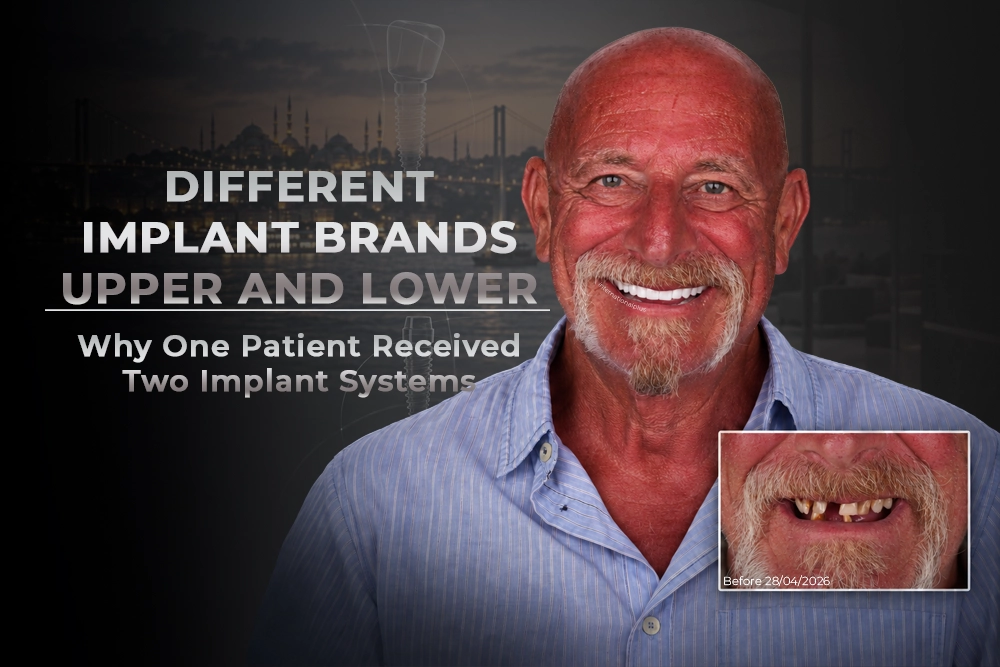
Using different implant brands upper and lower in the same mouth looks inconsistent until the two jaws are compared as engineering problems. Michael was treated at International Plus with Megagen implants in the upper jaw and BEGO implants in the lower, carrying a titanium bar and 24 zirconia units. This case study explains the reasoning behind that split, the prosthetic design built on top of it and the night guard that finished the treatment.
Key Takeaways
- The challenge: Fractured, infected upper teeth with severe mobility and extensive bone loss in two jaws whose bone behaves differently under drilling and under load.
- The solution: Megagen implants in the maxilla and BEGO implants in the mandible, selected per jaw rather than per patient.
- The technique: A titanium bar in each jaw carrying 24 zirconia units with the prosthetic phase recorded four months after the initial appointment.
- The outcome: A fixed, bar retained rehabilitation delivered in August 2026, protected by a night guard fitted as part of the plan.
Why an Implant Brand Is Chosen Per Jaw, Not Per Patient
Bone density is the measure of how much mineralised bone occupies a given volume of jaw and it differs sharply between the two jaws. The maxilla is typically softer and more porous while the mandible carries denser cortical bone and absorbs higher chewing forces.
Implant macrodesign is the shape of the fixture itself, meaning its thread depth, thread pitch and body taper. Clinical evidence shows macrodesign is a primary determinant of how firmly an implant sits at the moment of placement (Wang Y, et al., 2025) and a separate in vitro investigation reached the same conclusion about macro-design and preparation technique (Antonelli A, et al., 2023).
Selecting one system for the whole mouth is simpler to administer. First the surgical inventory shrinks, then the prosthetic components match across both jaws. A single system across both jaws works well in a straightforward case with even bone but it was not the right answer for Michael because the maxilla and the mandible presented different densities at the drill.
Michael’s Starting Point and Treatment Plan
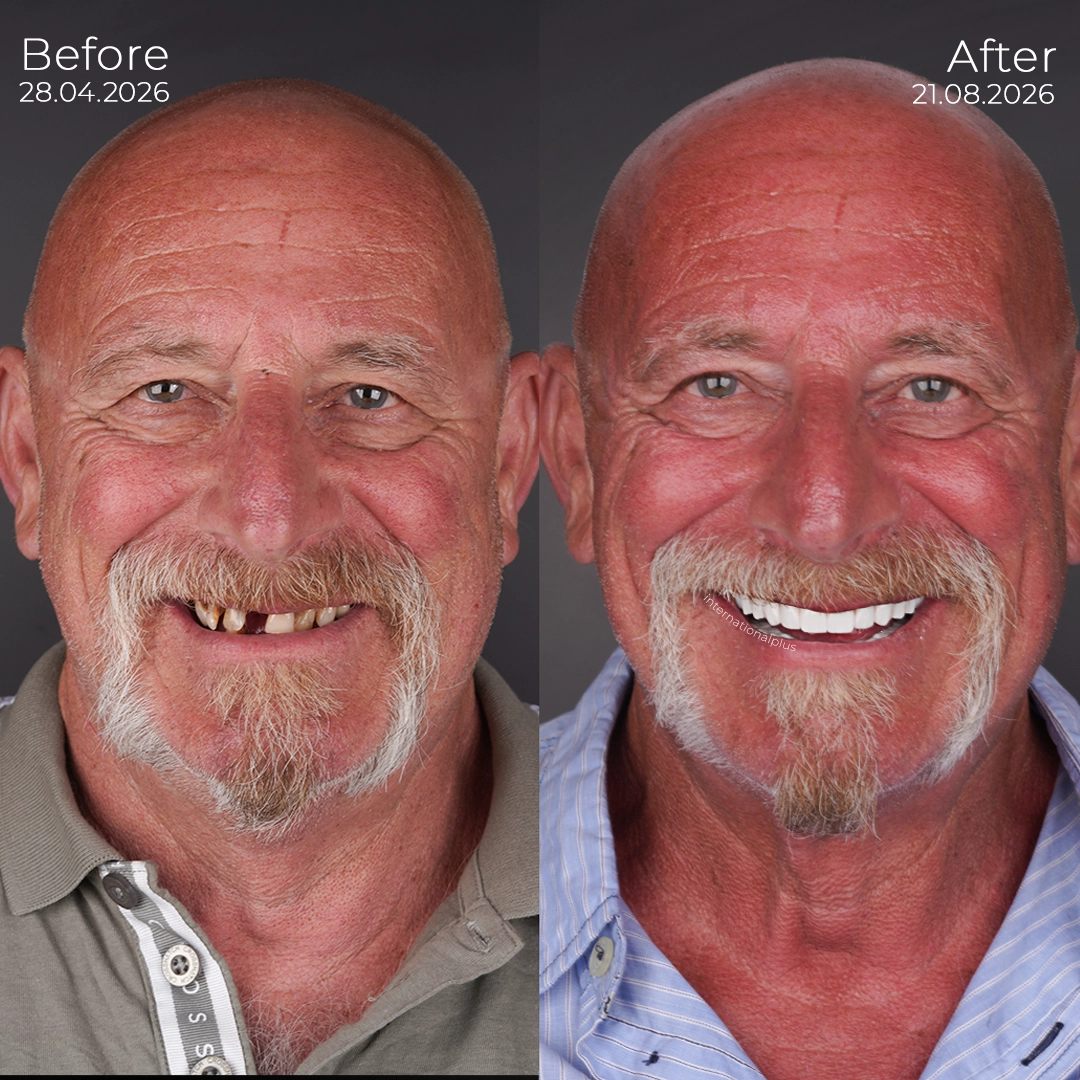
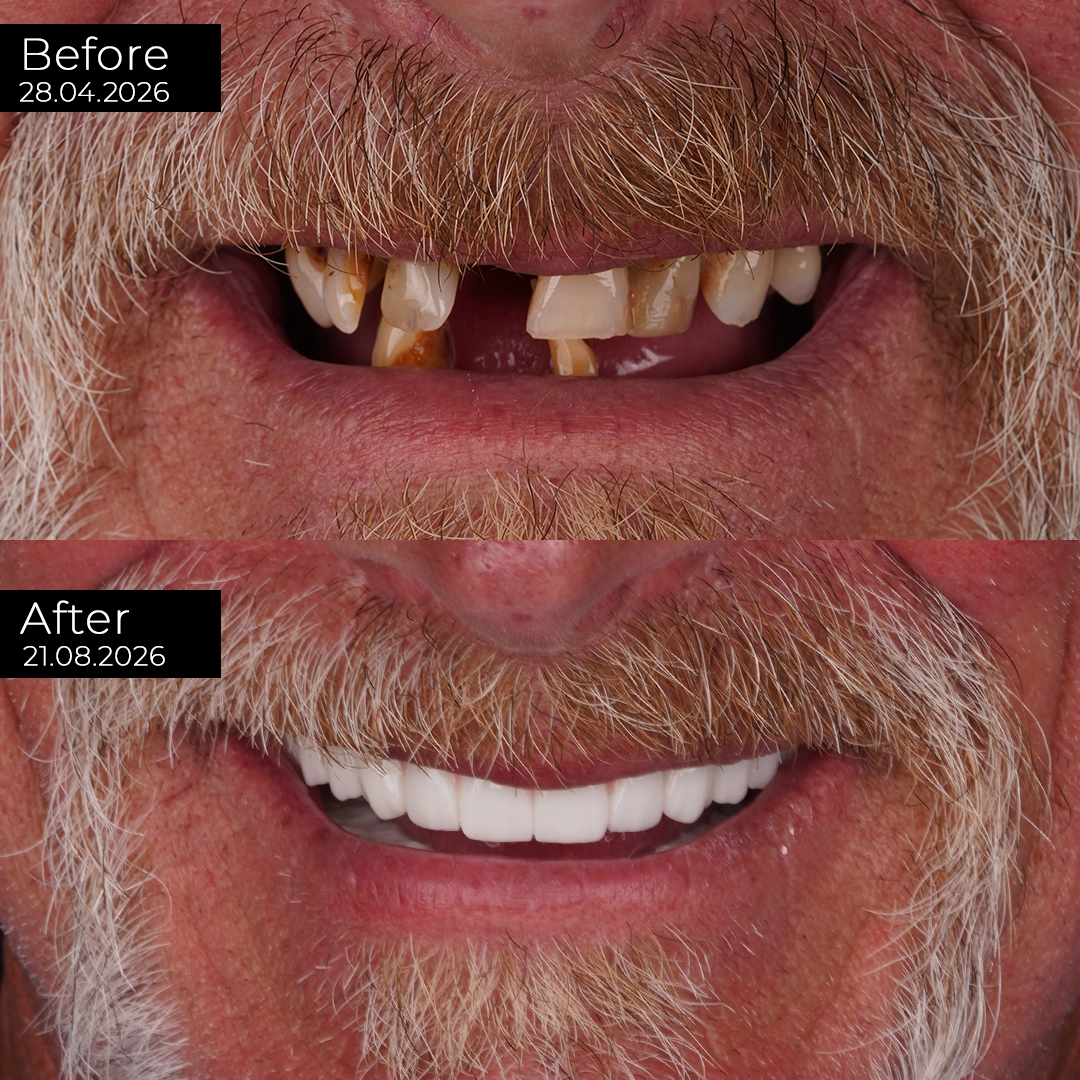
Michael arrived at International Plus with an upper jaw in advanced breakdown. The remaining teeth were fractured and infected, opening the mouth was uncomfortable and mobility was severe across the arch because the bone that should have anchored those teeth had largely been lost.
Bone loss at that level removes the option of saving the dentition so the plan moved directly to a fixed implant supported reconstruction. The treatment file records an initial appointment on 28 April 2026 and the prosthetic phase on 25 August 2026, roughly four months apart, which is the interval that allows implants to integrate with bone before load is applied.
The agreed design was bar retained in both jaws, carrying 24 zirconia units in total. Case planning at International Plus runs through a multidisciplinary Diagnostic Council, where surgical and prosthetic specialists review the same file before the implant system for each jaw is fixed.
Megagen in the Upper Jaw, BEGO in the Lower
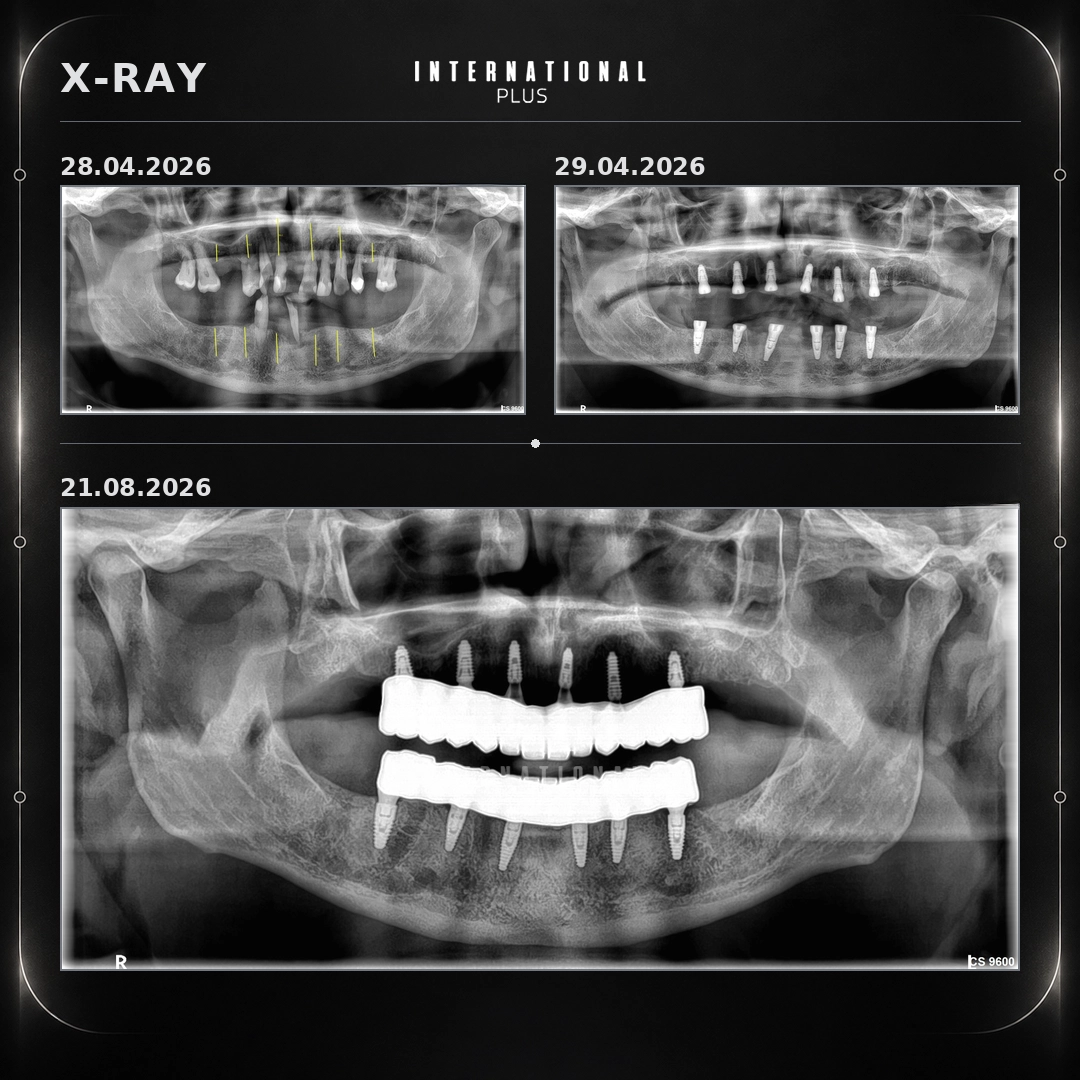
Primary stability is the mechanical grip an implant achieves at the moment of placement before any biological healing begins and in 2 jaws of the same patient that grip is rarely equal. The treatment card records Megagen implants in the maxilla and BEGO implants in the mandible.
| Jaw | Implant system | Clinical reasoning |
|—|—|—|
| Upper (maxilla) | Megagen | Lower bone density; aggressive thread geometry favours primary stability in softer bone |
| Lower (mandible) | BEGO | Denser cortical bone; higher occlusal load, where German manufactured tolerance consistency matters |
| Both | Titanium bar | Splints the implants so load is shared across the arch rather than per fixture |
First the upper jaw. Deep, multi-helix thread designs have been reviewed specifically for their behaviour in compromised bone (Lee KJ, et al., 2025) and Megagen fixtures sit in that design family. Then the lower jaw, where the governing problem is load rather than grip, restored with BEGO systems manufactured entirely in Germany and described in the clinic’s dental implant documentation.
Clinical evidence therefore points in two directions inside one mouth, which is why International Plus records the system used for each jaw separately in the patient file.
The Titanium Bar and the 24 Unit Zirconia Superstructure
A titanium bar is a milled framework screwed onto the implants that carries all 24 units as one connected structure. The bar solves a problem individual crowns cannot because splinting the implants distributes chewing force across the whole framework so a single fixture in a weaker site is not asked to carry a disproportionate share.
Bar designs demand vertical space and the restorative space required differs by prosthesis type (Carpentieri J, et al., 2019). Digital impressions were used to record the arches, an approach compared directly against conventional impressions for full arch screw retained work (Cappare P, et al., 2019).
Monolithic zirconia was milled for the 24 units in the clinic’s own laboratory, a construction whose clinical performance has been examined in meta-analysis (Leitao CIMB, et al., 2022). Related work appears in a bar supported rehabilitation for another patient and in a screw retained zirconia bridge case.
Shaping the Emergence Profile
The emergence profile is the shape a restoration takes as it rises out of the gum and it is where implant work most often gives itself away. A prosthesis that leaves the tissue as a flat, uniform ridge reads as a plate of teeth rather than as 24 separate ones.
The design used for Michael narrows towards the front instead, following the taper a natural tooth takes as it leaves the gingiva. That contour was built into the zirconia during design rather than adjusted at the chairside since a bar retained framework leaves little room to alter the tissue interface after delivery.
The result presents as zirconia above the gum line with a natural transition beneath it. Emergence contour is one of the few variables in a full arch case that changes appearance without changing function.
Protecting the Rehabilitation with a Night Guard
A night guard is a removable appliance worn during sleep that separates the upper and lower teeth so grinding force is absorbed by the appliance instead of the zirconia. Michael’s guard was recorded on the same treatment card as the definitive work rather than added later.
Occlusal splints are the standard conservative management for sleep bruxism and clinical evidence from systematic review supports their use in adults (Minakuchi H, et al., 2022). Grinding matters more after a full arch rehabilitation because the force that once wore natural enamel now meets ceramic bonded to a rigid metal framework. First the guard protects the ceramic surface, then it protects the screw joints that hold each bar in place.
International Plus has documented comparable bar work in a same day bar supported implant case and Megagen placement in a full mouth reconstruction with sinus lift.
Outcome and What Michael Experienced
A bar retained rehabilitation is a fixed reconstruction in which the visible teeth are carried by a framework rather than by the gum. Michael’s prosthetic phase was completed on 25 August 2026 with 24 monolithic zirconia units delivered on titanium bars in both jaws and the night guard recorded alongside them. After photography was taken for the clinical file, recording an emergence contour that tapers forward rather than sitting flat on the ridge.
This result reflects Michael’s own bone anatomy, the density of each jaw and the loading pattern of his bite so individual results may vary. International Plus reports treating more than 200,000 patients from over 140 countries since 2014 and holds a public rating of 4.8 out of 5 across 5,504 verified Google reviews yet no published record replaces an individual examination.
A comparable transition appears in a denture to fixed zirconia case with framework principles under Toronto dental bridge.
Book a consultation with International Plus to have the bone density of each jaw assessed before an implant system is selected.
Frequently Asked Questions
Can a dentist use different implant brands in the upper and lower jaw?
Yes. The two jaws differ in bone density and in the chewing forces they carry so a system that performs well in dense mandibular bone is not automatically the best choice for the softer maxilla. Selecting per jaw is a clinical decision rather than a supply compromise.
Is it safe to mix implant systems in one mouth?
Mixing systems within a single connected prosthesis would raise component compatibility problems. Placing one system in the upper jaw and another in the lower does not because each jaw carries its own separate framework with its own matched prosthetic parts throughout.
Why is the upper jaw treated differently from the lower?
The maxilla is generally softer and more porous while the mandible carries denser cortical bone and absorbs higher occlusal load. Implant thread geometry that grips well in soft bone is therefore useful in the upper jaw, where achieving stability at placement is harder.
What does a titanium bar do in a full arch case?
The bar is a rigid framework screwed onto the implants that carries the teeth as one connected unit. Splinting the fixtures spreads chewing force across the whole arch so no single implant in a weaker site carries a disproportionate share of the load.
Reviewed by Dr. Muhammed Kerem Isikhan
References
- Wang Y, et al. Int J Implant Dent. 2025. PMC12374932
- Antonelli A, et al. Dent J (Basel). 2023. PMC10605303
- Lee KJ, et al. J Korean Assoc Oral Maxillofac Surg. 2025. PMC12223436
- Carpentieri J, et al. J Am Dent Assoc. 2019. PMID: 31352966
- Cappare P, et al. Int J Environ Res Public Health. 2019. PMC6427545
- Leitao CIMB, et al. J Prosthodont Res. 2022. PMID: 34615842
- Minakuchi H, et al. Jpn Dent Sci Rev. 2022. PMC8958360
Follow us on Social Media
internationalplusofficial
internationalplus
internationalplusdental
This content is written, reviewed, and approved by the International Plus Medical Review Board to ensure clinical accuracy and adherence to strict editorial standards. All medical information is regularly monitored, audited and updated in light of the latest scientific advancements.
However the information provided here is for general informational purposes only and cannot be used for self diagnosis or making individual health interpretations. Results of medical treatments depend on individual anatomy and the unique healing process of each patient. This information should not replace a personal consultation with a qualified healthcare professional. To understand the best options for your specific needs and to receive a personalized treatment plan, we invite you to book a free consultation with the expert medical team at International Plus.

Muhammed Kerem provides comprehensive dental care centered on practical solutions and exceptional patient outcomes for travelers seeking quality treatment in Istanbul.