

Teeth numbers are the coded labels dentists use to name each tooth and an adult chart carries 32 permanent teeth while a child chart carries 20. Three notations cover almost every dental record written today: the Universal Numbering System used across the United States, the FDI two digit system used in most other countries and Palmer notation, still drawn by orthodontists. A crown quoted on “tooth 14” in Dallas is not the same tooth as “14” in Istanbul, London or Berlin. For a patient reading a treatment plan written abroad, knowing which chart the plan follows matters more than knowing any single code.
Key Takeaways
- The Universal Numbering System runs 1 to 32, starting at the upper right wisdom tooth and ending at the lower right wisdom tooth.
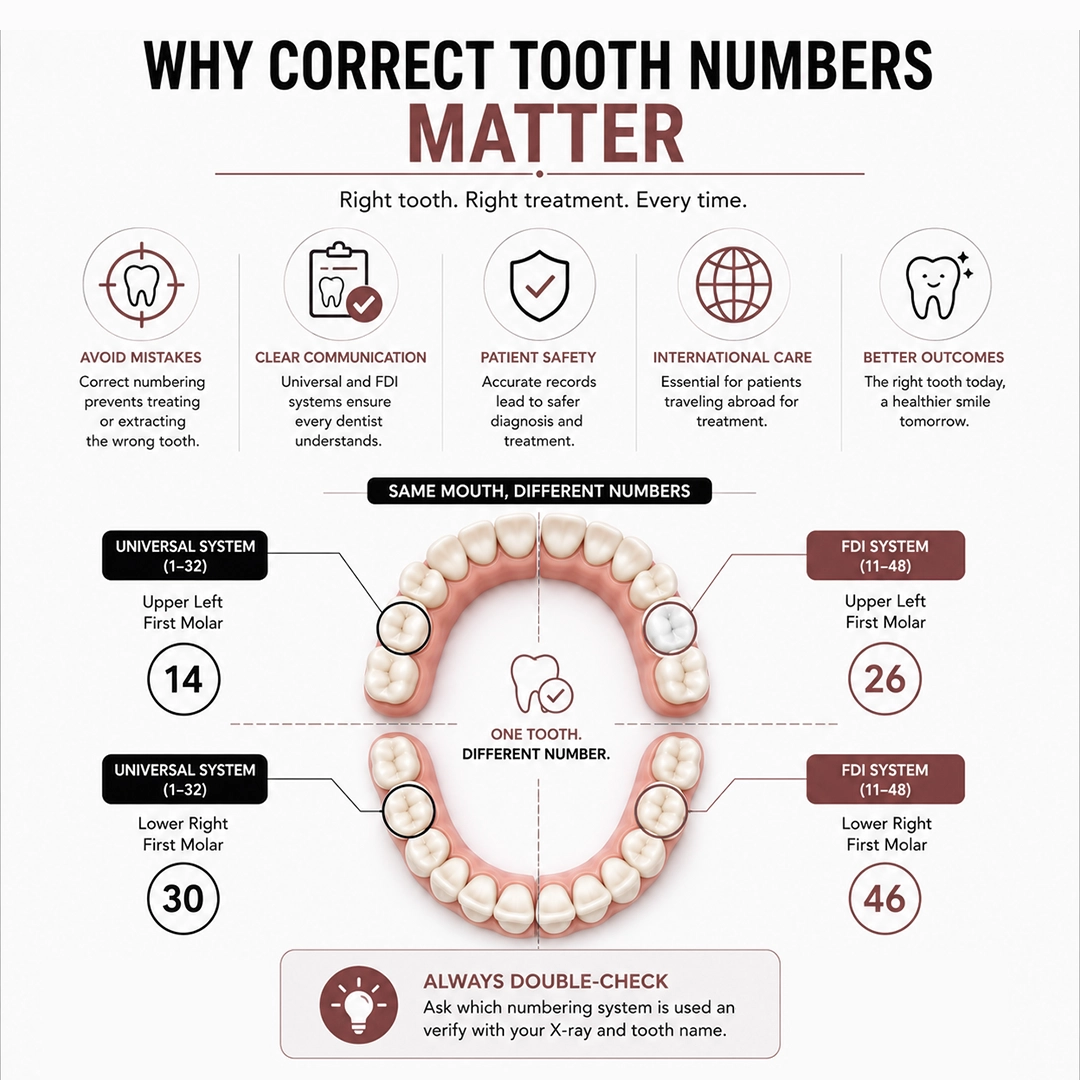
- The FDI two digit system, standardised as ISO 3950, writes a quadrant digit plus a position digit so 46 means the lower right first molar.
- Universal 14 and FDI 14 name two different teeth: the upper left first molar versus the upper right first premolar.
- Primary teeth use letters A to T in the Universal chart and codes 51 to 85 in the FDI chart.
- International Plus charts in FDI and issues every treatment plan in dual notation so patients from 140 countries can check each tooth against a home record.
What Are Teeth Numbers and Why Does Every Dentist Use Them?
Teeth numbers are fixed codes assigned to each tooth so charts and treatment plans point to one tooth without ambiguity. An adult mouth holds 32 permanent teeth while a child mouth holds 20 primary teeth so a spoken description like “the back molar on the left” leaves far too much room for error. Three notations dominate records worldwide: Universal, FDI plus the older Palmer symbols. Akram and co authors, writing in the International Dental Journal in 2011, showed how notation confusion slows clinical communication and proposed a coded alternative to reduce the gap (Akram A, et al., 2011). Our Diagnostic Council reviews plans for patients arriving from 140 countries and translating tooth codes is the first step our coordinators take before any plan reaches a patient.

How Does the Universal Numbering System Number Teeth 1 to 32?
The Universal Numbering System labels the permanent dentition with plain numbers from 1 to 32 and remains the standard across United States dental practice. Counting starts at the upper right third molar, the wisdom tooth, which takes number 1. Numbering sweeps along the upper arch to the upper left third molar at 16, drops to the lower left third molar at 17, then closes at the lower right third molar, number 32. Central incisors sit at 8 on the upper right and 9 on the upper left. Extracted teeth keep the assigned slot so a chart with an empty box at 30 still tells a clinician which molar was lost. Shehabeldin and colleagues examined the limits of existing notations in Heliyon in 2024 while proposing a new scheme (Shehabeldin RR, et al., 2024). American patients almost always arrive quoting Universal codes and our records team converts each code on the first day.
How Do Teeth Numbers Work in the FDI Two Digit System?
Teeth numbers in the FDI two digit system, standardised as ISO 3950, describe a tooth with two digits: the first digit names the quadrant, the second names the position counted from the midline. Quadrant 1 covers the upper right permanent teeth, quadrant 2 the upper left, quadrant 3 the lower left, quadrant 4 the lower right. Position runs from 1 at the central incisor to 8 at the third molar. Tooth 46, spoken as “four six” rather than “forty six”, is the lower right first molar. Yadav and co authors, publishing in the Indian Journal of Dental Research in 2013, built a supernumerary tooth extension straight onto the two digit framework because the framework already encodes location inside the code (Yadav SS, et al., 2013). Every chart written in our Istanbul clinic uses FDI codes and our in house laboratory reads the same codes on each crown order.
| Tooth | Universal number | FDI code |
|—|—|—|
| Upper right third molar (wisdom tooth) | 1 | 18 |
| Upper right first molar | 3 | 16 |
| Upper left central incisor | 9 | 21 |
| Upper left first molar | 14 | 26 |
| Lower left first molar | 19 | 36 |
| Lower right central incisor | 25 | 41 |
| Lower right first molar | 30 | 46 |
Bottom line: the same first molar can be called 14 or 26 depending on the chart, which is exactly why a plan quoting only one system invites confusion.
Palmer Notation: The System Orthodontists Still Draw by Hand
Palmer notation is a symbol based chart: a number from 1 to 8 sits beside a right angle bracket marking the quadrant so the upper right canine appears as a 3 inside an upper right bracket. The layout dates to 1861 when Adalbert Zsigmondy published the quadrant grid later carried into English speaking practice under the name of Corydon Palmer. British dental schools taught Palmer notation for decades and orthodontists still sketch the brackets on paper charts because a bracket shows quadrant and position in a single glance. Palmer notation works well on a hand drawn chart but Palmer notation fails inside electronic records because the bracket has no keyboard key and no clean database field. Reviews of dental notation, including the 2015 analysis by Havale and colleagues, group symbol based schemes among the systems least suited to digital entry (Havale R, et al., 2015). Our practice keeps Palmer notation out of patient facing documents for one practical reason: a symbol a patient cannot type into an email cannot be checked by the patient against a home dental record.
Book Your Free Consultation → talk to a treatment coordinator on WhatsApp
How Are Baby Teeth Numbered? Letters A to T and Codes 51 to 85
Baby teeth carry a separate set of codes because a child mouth holds 20 primary teeth rather than 32. Universal charting switches from digits to capital letters A to T, running from A at the upper right second primary molar through to T at the lower right second primary molar. The FDI equivalent keeps two digits but shifts the quadrant digit upward: 5 for the upper right primary quadrant, 6 for upper left, 7 for lower left, 8 for lower right. Primary tooth 51 is therefore the upper right central incisor while 85 is the lower right second primary molar. Havale and colleagues reviewed primary dentition notation in the European Journal of Paediatric Dentistry in 2015 and proposed a further system, evidence of how unsettled paediatric charting remains (Havale R, et al., 2015). Parents travelling with children receive both codes on our paediatric charts.
| Primary tooth | Universal letter | FDI code |
|—|—|—|
| Upper right second primary molar | A | 55 |
| Upper right central incisor | E | 51 |
| Upper left central incisor | F | 61 |
| Upper left second primary molar | J | 65 |
| Lower left central incisor | O | 71 |
| Lower right second primary molar | T | 85 |
Bottom line: a letter on a chart signals a primary tooth while a code beginning with 5 to 8 signals the same tooth in FDI.
How Do You Read Teeth Numbers on a Treatment Plan or Invoice?
Reading teeth numbers on a plan takes three checks: identify the notation, locate the quadrant, match the tooth name. A two digit code between 11 and 48 signals FDI. A number between 1 and 32 signals Universal. A capital letter signals a primary tooth on a Universal chart. Once the notation is clear, the quadrant follows: FDI codes beginning with 1 or 2 sit in the upper jaw, codes beginning with 3 or 4 sit in the lower jaw. In our practice we chart in FDI because our records serve patients from 140 countries and a two digit code carries the quadrant inside the number, which no single digit Universal code does. Before any plan leaves the clinic, our coordination team rewrites every tooth in dual notation: FDI first, the Universal equivalent in brackets, then the plain tooth name so a plan listing zirconia dental crowns on 26 and 27 also reads “14 and 15, upper left molars”.
That protocol exists because of a pattern our coordinators see weekly. American patients arrive holding a home quote for “crowns on 14 and 15” and read a plan naming teeth 26 and 27, then ask why the numbers changed. Nothing changed. Both plans name the same two upper left molars. The same translation applies to root canal treatment by endodontic specialists and to single tooth implant options, where a misread quadrant would send the patient home describing the wrong side of the mouth. Anyone comparing quotes should also read our guide to what a dental crown involves and the material and lifespan breakdown in our tooth crown guide.
Why Accurate Teeth Numbers Protect Patients
Accurate teeth numbers are a patient safety control, not a clerical detail. Jan and co authors reported in the Nigerian Journal of Clinical Practice in 2019 that wrong tooth extraction continues to appear in surveys of dental practice with charting and communication errors among the recurring causes (Jan AM, et al., 2019). Jacob and colleagues, writing in Acta Stomatologica Croatica in 2021, set out preventive steps built around verified tooth identification before any extraction (Jacob O, et al., 2021). Contrary to a common assumption, a digital record does not remove the risk on its own: Moufti and colleagues described automated charting tools in the International Dental Journal in 2025 as an aid to verification rather than a replacement for the clinician check (Moufti MA, et al., 2025). At International Plus, authorised by the Turkish Ministry of Health and rated 4.8 out of 5 across 5,504 verified reviews after treating more than 200,000 patients from 140 countries, every surgical plan is read aloud in FDI and confirmed against the radiograph before treatment begins in any of our 21 languages. Individual results vary and a personalised examination remains the only way to confirm which teeth need treatment.
Discover multidisciplinary dental planning at International Plus → message our team on WhatsApp
Patients weighing a wider restoration can compare outcomes in our tooth crown before and after guide, review the evidence on long term implant safety, read how a multidisciplinary rehabilitation combining surgery and endodontics is sequenced or check what drives tooth pain before an appointment and why teeth discolour with age.
Frequently Asked Questions
What tooth is number 14?
In the Universal Numbering System, tooth 14 is the upper left first molar. In the FDI two digit system the same molar is coded 26 while FDI 14 names a different tooth entirely: the upper right first premolar, which the Universal chart calls 5. Always confirm which notation a plan uses.
Why do American and European dental charts use different teeth numbers?
United States dental education standardised on the Universal Numbering System while the FDI World Dental Federation two digit system became the international standard as ISO 3950 across Europe, Asia plus South America. Both systems predate digital records and neither country group replaced an established charting habit already embedded in insurance and laboratory workflows.
How are wisdom teeth numbered?
Wisdom teeth are the third molars, one in each quadrant. Universal charting numbers the four as 1, 16, 17, 32. FDI codes for the same four teeth are 18, 28, 38, 48 since position 8 marks the last tooth counted from the midline in every quadrant.
What do the letters A to T mean on a child’s dental chart?
Letters A to T identify the 20 primary teeth in the Universal chart, running from A at the upper right second primary molar to T at the lower right second primary molar. FDI charting codes the same teeth as 51 to 85, using quadrant digits 5 to 8 for primary dentition.
Do I need to know my teeth numbers before treatment abroad?
Knowing the notation helps you check a plan against records from home. Ask for the tooth name alongside the code or request dual notation. International Plus issues plans carrying the FDI code, the Universal equivalent plus the plain tooth name so each entry can be verified against a previous chart.
Reviewed by Dr. Eren Gülbahar
References
- Akram A, et al. Int Dent J. 2011. PMC9374817
- Shehabeldin RR, et al. Heliyon. 2024. PMC10827761
- Yadav SS, et al. Indian J Dent Res. 2013. PMID: 24025897
- Havale R, et al. Eur J Paediatr Dent. 2015. PMID: 26147826
- Jan AM, et al. Niger J Clin Pract. 2019. PMID: 31793478
- Jacob O, et al. Acta Stomatol Croat. 2021. PMC8514230
- Moufti MA, et al. Int Dent J. 2025. PMC12206106
Follow us on Social Media
internationalplusofficial
internationalplus
internationalplusdental
This content is written, reviewed, and approved by the International Plus Medical Review Board to ensure clinical accuracy and adherence to strict editorial standards. All medical information is regularly monitored, audited and updated in light of the latest scientific advancements.
However the information provided here is for general informational purposes only and cannot be used for self diagnosis or making individual health interpretations. Results of medical treatments depend on individual anatomy and the unique healing process of each patient. This information should not replace a personal consultation with a qualified healthcare professional. To understand the best options for your specific needs and to receive a personalized treatment plan, we invite you to book a free consultation with the expert medical team at International Plus.

I am a healthcare professional with over 4 years of experience in dentistry, specializing in prosthetic dental treatment and implant-based applications. Since 2024, I have been serving as chief physician, leading clinical management, team coordination, and international patient processes. With my B2-level English proficiency, I am able to communicate effectively with international patients. I am a patient-centered, innovative, and solution-oriented dentist who prioritizes patient satisfaction.




