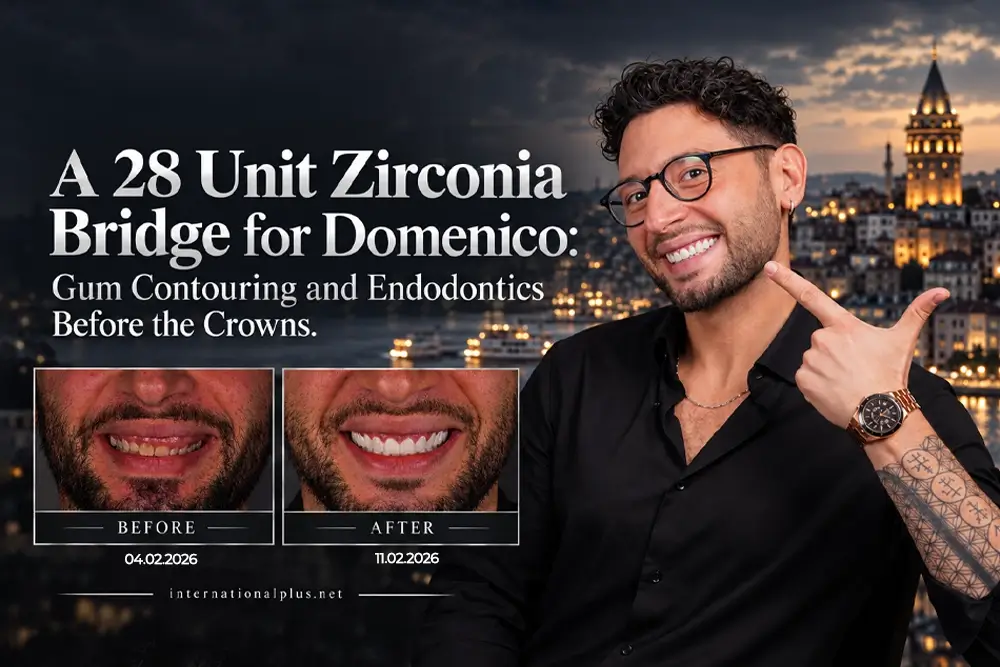
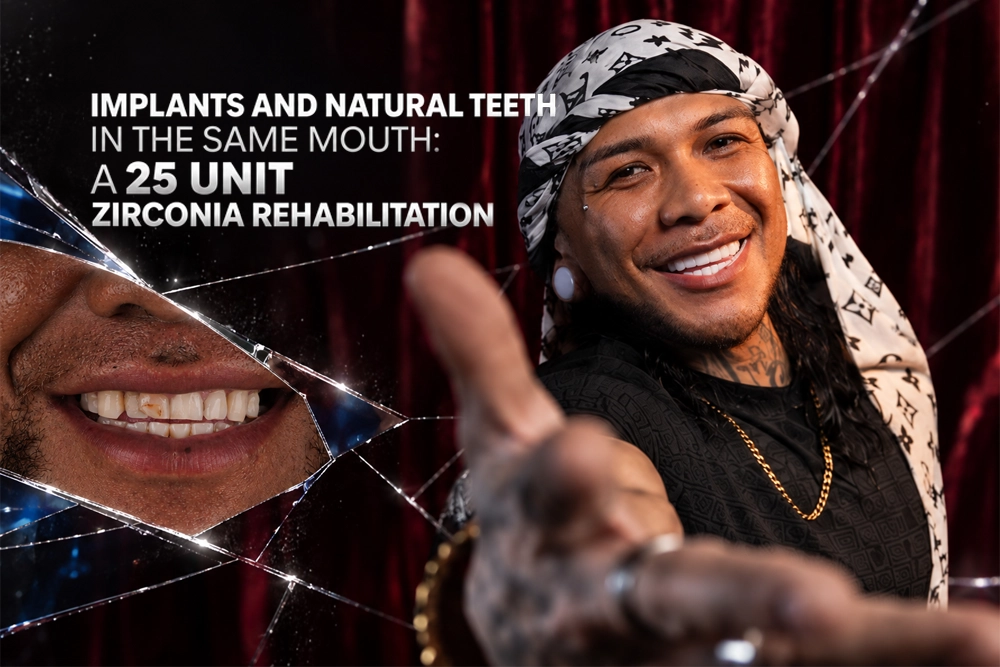
When Martin, a 38 year old patient, arrived at International Plus Istanbul seeking both aesthetic and functional improvement, his case presented a clinical scenario familiar to experienced dental teams yet demanding in its scope: multiple missing teeth requiring replacement, existing teeth needing endodontic intervention, gingival asymmetries compromising smile aesthetics, and overall dental architecture requiring comprehensive rehabilitation. What distinguished his treatment was not any single dramatic pathology, but rather the coordinated integration of four distinct dental specialties, oral surgery, endodontics, periodontics, and prosthodontics, executing seamlessly across two carefully planned visits separated by a three month healing interval. His case exemplifies modern comprehensive dentistry: replacing what cannot be saved through strategic implant placement, preserving what can be salvaged through endodontic treatment, establishing proper aesthetic foundation through periodontal surgery, and delivering natural appearing function through precision prosthodontics. The result represents not heroic intervention addressing catastrophic disease, but rather the thoughtful orchestration of multiple disciplines achieving outcomes no single specialty could deliver alone.
The Multidisciplinary Philosophy: Why Comprehensive Cases Require Integrated Expertise
Dental pathology rarely respects specialty boundaries. A patient presenting with missing teeth may simultaneously harbor internal pathology in remaining teeth requiring endodontic expertise, periodontal conditions demanding surgical intervention, and occlusal relationships necessitating sophisticated prosthodontic planning. Traditional dental practice, organized around specialty silos where patients navigate between independent practitioners, struggles to coordinate the complex treatment sequences comprehensive cases demand. Patients shuttle between offices, communication fragments across providers, and treatment timelines extend as each specialist works sequentially rather than collaboratively.
Martin’s case required capabilities spanning the full spectrum of dental specialties. Missing teeth demanded surgical intervention for implant placement and subsequent prosthodontic restoration. Five teeth harbored internal pathology requiring endodontic treatment (root canal therapy) to eliminate infection while preserving tooth structure. Gingival asymmetry affecting the two central incisors compromised aesthetic balance, necessitating periodontal surgery to establish proper tissue architecture. The existing restorations required replacement with prosthetics that would integrate seamlessly with both implant supported and natural tooth supported elements.
International Plus Istanbul’s integrated multidisciplinary structure enabled coordinated care impossible in fragmented systems. Rather than referring Martin between independent specialists across weeks or months, all required expertise existed within a single facility. Surgical, endodontic, periodontal, and prosthodontic specialists collaborated from initial diagnosis through final delivery, ensuring each intervention supported rather than complicated subsequent phases. Research on multidisciplinary treatment planning demonstrates that integrated approaches achieve superior outcomes compared to sequential specialist referrals, particularly in complex cases requiring coordination across multiple disciplines.

Comprehensive Diagnostic Planning: Coordinating Multiple Specialty Requirements
Initial evaluation combined clinical examination with radiographic assessment, revealing the full scope of interventions necessary to achieve Martin’s aesthetic and functional goals. Multiple edentulous spaces throughout both arches required replacement through implant supported prosthetics. Several existing teeth, while structurally adequate for retention, harbored internal pathology that comprehensive evaluation detected. The two central incisors displayed gingival margin asymmetry, a condition where uneven tissue levels create aesthetically imbalanced tooth proportions that compromise smile appearance even when tooth structure itself remains healthy.
The treatment plan reflected careful sequencing across specialties. The first visit would address all surgical and endodontic requirements: extraction of teeth with poor prognosis using atraumatic techniques that preserve alveolar bone, placement of five Implance brand implants positioned strategically to support planned prosthetics, completion of endodontic treatment on five teeth requiring internal therapy, and execution of gingivectomy on the two central incisors to establish symmetric gingival margins.
This concentrated first visit approach, while intensive, offered significant advantages for an international patient. Rather than requiring multiple trips for staged procedures, comprehensive initial intervention addressed all surgical and endodontic needs while Martin remained in Istanbul. The subsequent three month interval would permit osseointegration of the implants while Martin returned home, eliminating the need for extended initial stays. The second visit, focused exclusively on prosthodontic procedures, could then proceed efficiently with all biological healing complete.
The prosthodontic planning emphasized individualized zirconia crowns rather than bridge configurations or full arch rehabilitations. Each implant would receive its own restoration, as would each natural tooth requiring coverage. This approach, while requiring more individual restorations than bridge alternatives, offers distinct advantages: superior hygiene access compared to pontic designs, independent replacement if individual restorations ever fail, and biomechanically sound distribution of occlusal forces across both implant and natural tooth support.
First Visit: Integrated Surgical and Endodontic Intervention
The initial treatment phase demonstrated the efficiency possible when multiple specialties execute coordinated procedures within compressed timeframes. Teeth determined to have poor long term prognosis were extracted using atraumatic techniques that minimize surgical trauma while preserving maximum alveolar bone architecture. Studies on socket preservation following atraumatic extraction confirm that controlled extraction methods significantly reduce post extraction bone resorption compared to conventional approaches, creating superior foundation for subsequent implant placement and enhancing long term aesthetic outcomes.
Following extractions, five Implance brand implants were positioned strategically in the edentulous sites. Implance systems offer reliable osseointegration characteristics with surface treatments promoting bone apposition. The surgical planning considered both immediate stability requirements and long term prosthetic goals, positioning implants at appropriate depths, angulations, and interarch spacing to support individual crown restorations. All five implants achieved adequate primary stability, the immediate mechanical engagement with surrounding bone that predicts successful integration and determines whether immediate loading protocols can be employed.
Simultaneously with surgical intervention, comprehensive endodontic treatment addressed five teeth with internal pathology. Root canal therapy removes infected or necrotic pulp tissue, thoroughly disinfects the internal canal system, and seals the space with biocompatible materials preventing reinfection while maintaining tooth structure and function. The procedures employed contemporary rotary instrumentation for efficient canal shaping, copious antimicrobial irrigation ensuring thorough disinfection, and warm vertical compaction creating dense three dimensional obturation. Research on contemporary endodontic outcomes demonstrates that modern techniques achieve success rates exceeding 90%, supporting the decision to preserve these teeth through endodontic intervention rather than extracting and replacing with implants.
Periodontal surgery addressed gingival asymmetry affecting the two central incisors. Gingivectomy, the surgical repositioning of gingival margins, established symmetric tissue levels creating balanced tooth proportions essential for aesthetic smile design. When gingival margins rest at different heights on adjacent central incisors, the asymmetry creates obvious aesthetic discord even when tooth structure and restorations themselves prove technically excellent. Studies on gingival aesthetics confirm that margin symmetry ranks among the most critical factors in anterior smile appearance, often exceeding tooth color or morphology in perceptual impact.
An additional periodontal procedure, scaling and root planing (professional cleaning removing calculus and bacterial deposits), supported overall periodontal health, establishing proper foundation for long term maintenance following prosthetic delivery.

Three Month Healing: Osseointegration and Patient Convenience
Following the comprehensive first visit, Martin returned home while biological healing proceeded. The three month interval served multiple purposes. Most critically, it permitted complete osseointegration of the five implants, the direct structural and functional connection between implant surface and surrounding bone that provides long term stability. Research on osseointegration timelines demonstrates that three months provides sufficient time for mature bone formation around implants in most clinical scenarios, though individual patient factors including bone quality, systemic health, and loading conditions influence precise timing.
The healing period also allowed the endodontically treated teeth to stabilize following their procedures, the surgical sites to complete soft tissue maturation, and the gingivectomy sites to establish their final gingival architecture. This biological maturation ensures that final impressions captured during the second visit accurately reflect the stable tissue positions that will persist long term, rather than capturing transitional healing states that might change following prosthetic delivery.
For Martin, the three month interval between visits offered practical advantages beyond biological requirements. Rather than remaining in Istanbul for extended periods, he could return to normal life, work, and family while healing progressed. International Plus Istanbul’s patient coordination maintained contact throughout the interval, providing guidance on care protocols and scheduling the second visit to align with Martin’s availability.
Second Visit: Digital Workflow and Definitive Restoration
Upon Martin’s return at three months post surgery, clinical examination and radiographic verification confirmed successful osseointegration of all five implants. Stability testing demonstrated solid integration, and radiographs showed appropriate bone levels surrounding the implant surfaces. The endodontically treated teeth displayed no signs of complications, and the periodontal tissues had matured to their final stable positions.
The prosthodontic phase employed International Plus Istanbul’s advanced digital workflow. All impressions were captured using the TRIOS 5 digital scanner, representing current generation intraoral scanning technology. TRIOS 5 offers several advantages over both traditional impressions and earlier generation scanners: enhanced accuracy particularly in deep subgingival margins critical for implant restorations, superior color capture supporting shade matching, and real time visualization allowing clinicians to verify complete data capture before dismissing patients. Studies comparing digital versus conventional impressions demonstrate that contemporary intraoral scanners achieve accuracy meeting or exceeding conventional impression materials while dramatically improving patient comfort.
The digital impression data enabled sophisticated prosthetic design integrating both implant supported and natural tooth supported restorations into a harmonious functional and aesthetic unit. Each restoration was designed individually rather than as connected bridge segments, reflecting the treatment philosophy emphasizing independent restorations. For the five implant positions, screw retained designs were selected, a prosthodontic approach where restorations attach to implant abutments via access screws rather than cement. Research on screw versus cement retention demonstrates that screw retained designs facilitate future maintenance and retrieval if complications ever occur, valuable advantages that justify their selection particularly for posterior restorations where access holes prove less aesthetically concerning.
The restorations were fabricated from zirconia blocks, specifically Aidite brand zirconia, a contemporary ceramic material combining exceptional mechanical strength with optical properties approaching natural tooth structure. While Ivoclar zirconia represents one premium option frequently employed at International Plus Istanbul, Aidite zirconia offers comparable performance characteristics: flexural strength exceeding 1,000 MPa providing durability essential for long term function, combined with translucency permitting natural appearing aesthetics. The selection reflected appropriate material choice for Martin’s specific case requirements.
Trial fittings permitted verification of all design parameters before final delivery. Martin evaluated fit, occlusion, aesthetics, and phonetics, providing feedback that informed final refinements. This iterative process, facilitated by digital design flexibility, ensured the definitive restorations would satisfy both functional requirements and aesthetic preferences. Following final adjustments, all restorations were delivered, completing Martin’s comprehensive rehabilitation.

The Two Visit Model: Balancing Efficiency with Biological Requirements
Martin’s treatment timeline, two visits separated by three months, represents an optimized approach for comprehensive cases requiring implant placement with immediate healing demands. The first visit concentration of all surgical, endodontic, and periodontal intervention minimized the number of trips required while addressing all procedures needing biological healing time. The second visit, occurring after healing completion, could then proceed efficiently through prosthodontic procedures without waiting for ongoing biological processes.
This model proves particularly valuable for international patients traveling significant distances for treatment. Extended timelines with multiple visits impose substantial burdens: repeated international travel, hotel accommodations, time away from work and family. By concentrating interventions appropriately and utilizing healing intervals for return home rather than extended stays, the two visit model achieves both clinical excellence and practical convenience.
The timeline also demonstrates International Plus Istanbul’s commitment to proper biological protocols. Despite capabilities for rapid treatment execution, the three month osseointegration interval was honored, ensuring implants achieved full integration before loading with definitive restorations. This conservative approach prioritizes long term success over accelerated timelines.

Frequently Asked Questions
Why preserve natural teeth through endodontic treatment rather than extracting and placing implants?
Natural teeth provide advantages implants cannot replicate: proprioceptive feedback from periodontal ligaments enabling refined bite force control, continued bone stimulation through natural function, and proven long term durability. Research demonstrates that endodontic treatment on structurally adequate teeth achieves success rates exceeding 90% at ten years, often matching or exceeding implant survival while preserving natural structures. Extraction should be reserved for teeth that cannot be reliably maintained, not employed simply because implant alternatives exist.
What advantages do individual crowns offer compared to bridge configurations?
Individual zirconia crowns on each tooth or implant, rather than connecting multiple units as bridges, provide superior hygiene access around each restoration, independent replacement if individual units ever fail, and biomechanically sound force distribution. Bridges offer advantages when strategic pontic placement eliminates the need for additional implants, but when adequate implant positions exist, individual restorations typically prove preferable. The approach enables targeted intervention if complications ever occur rather than requiring replacement of entire connected segments.
Why choose screw retained rather than cement retained implant restorations?
Screw retained implant restorations attach via access screws rather than cement, facilitating future retrieval if complications require access to implant connections. Excess cement, a risk with cement retained designs, can contribute to peri-implant inflammation if not completely removed during cementation. Clinical evidence demonstrates that screw retained designs enable superior long term maintenance while achieving aesthetic outcomes comparable to cement retention when properly executed. The retrievability proves particularly valuable for posterior restorations where access holes create minimal aesthetic compromise.
How does TRIOS 5 digital scanning improve implant restoration accuracy?
TRIOS 5 digital scanning captures precise three dimensional data of implant positions and surrounding tissues, eliminating the dimensional changes and distortions that can occur with conventional impression materials. The technology enables real time verification of data completeness, immediate retake of any inadequate areas, and direct transfer to digital design software without physical model fabrication. Research comparing digital workflows demonstrates that contemporary intraoral scanning achieves accuracy meeting or exceeding conventional methods while improving patient comfort and reducing appointment time.
Why does gingival symmetry matter for aesthetic outcomes?
Gingival margin position dramatically influences perceived tooth proportions and smile aesthetics. Asymmetric margins on adjacent teeth, particularly central incisors, create obvious aesthetic discord that observers unconsciously register even when unable to articulate the specific problem. Gingivectomy establishing symmetric gingival levels proves essential for balanced smile design. Studies on aesthetic perception confirm that gingival architecture ranks among the most critical factors in smile attractiveness, often exceeding tooth color or morphology in overall impact.
International Plus Istanbul: Where Multidisciplinary Integration Delivers Comprehensive Excellence
Martin’s case exemplifies International Plus Istanbul’s integrated approach to comprehensive care: coordinating surgical expertise (five Implance implants with atraumatic extraction), endodontic intervention (five root canal treatments), periodontal correction (gingivectomy on two central incisors plus scaling), and sophisticated prosthodontics (individual screw retained zirconia crowns designed through TRIOS 5 digital workflow) across an efficiently planned two visit timeline. This scope of treatment demanded coordination few facilities can provide.
Our multidisciplinary infrastructure enables integrated care impossible in fragmented systems. Rather than referring between independent specialists, all expertise exists within International Plus Istanbul. Surgical, endodontic, periodontal, and prosthodontic specialists collaborate from diagnosis through delivery. In house Dental Art laboratory facilitates seamless communication between clinical and technical teams. Advanced technology including TRIOS 5 scanning supports precision digital workflows. Multiple implant brands (Straumann, Nobel Biocare, Megagen, BEGO, Implant Swiss, Implance, Nucleoss) and premium materials ensure optimal selection for each clinical scenario.
Comprehensive patient services extend beyond clinical excellence. VIP airport transfers, luxury accommodation, and 24/7 multilingual coordination support international patients throughout treatment. Having successfully treated over 200,000 patients from more than 140 countries, International Plus Istanbul combines clinical expertise, integrated infrastructure, and hospitality capabilities that deliver world class comprehensive care.
If you seek dental rehabilitation addressing multiple concerns through coordinated specialist expertise rather than fragmented referrals, contact International Plus Istanbul today.

internationalplusofficial
internationalplus
internationalplusdental
This content is written, reviewed, and approved by the International Plus Medical Review Board to ensure clinical accuracy and adherence to strict editorial standards. All medical information is regularly monitored, audited and updated in light of the latest scientific advancements.
However the information provided here is for general informational purposes only and cannot be used for self diagnosis or making individual health interpretations. Results of medical treatments depend on individual anatomy and the unique healing process of each patient. This information should not replace a personal consultation with a qualified healthcare professional. To understand the best options for your specific needs and to receive a personalized treatment plan, we invite you to book a free consultation with the expert medical team at International Plus.

International Plus was established from scratch in 2014 with the sole purpose of providing a world class center for plastic and cosmetic surgery by SAMİLSAN SAĞLIK HİZMETLERİ TURİZM DANIŞMANLIK TİCARET LİMİTED ŞİRKETİ International Plus has developed a worldwide reputation for its unique treatments and techniques. With over 10 years of experience, our talented medical experts are among the best in their respective fields. You are our priority. We are convinced that good communication between you and your surgeon is essential when planning your treatments. We offer realistic advice and the most suitable treatments for you.