
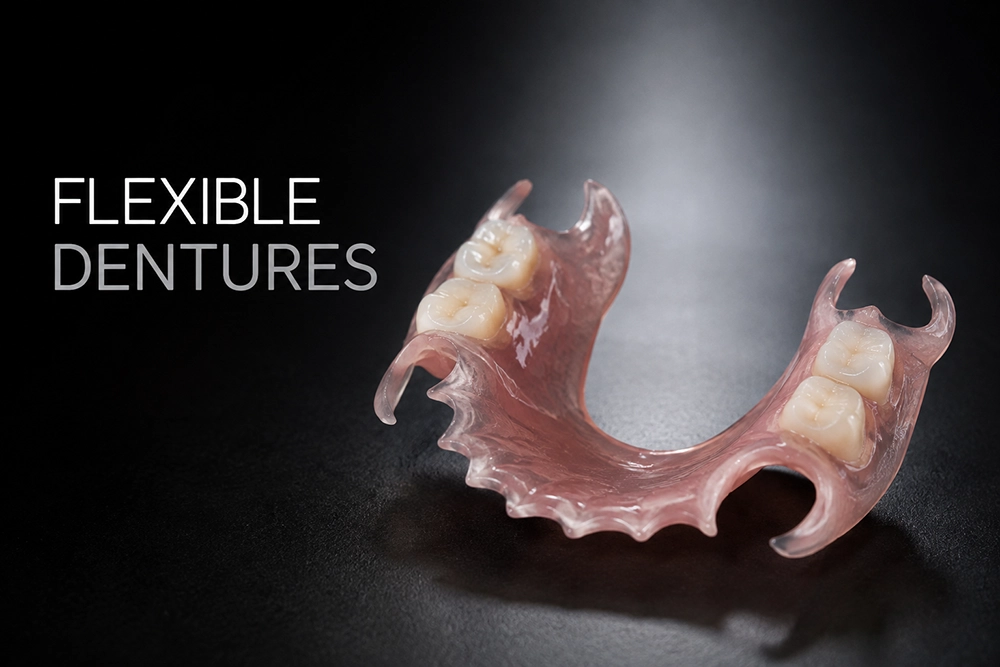
Flexible dentures are removable partial dentures built from a thin, bendable thermoplastic nylon base that adapts to the natural contours of the gums instead of relying on a rigid acrylic plate or a cast metal framework. Because the polyamide material flexes under normal chewing forces, flexible dentures need no visible metal clasps and clip discreetly around the remaining teeth. Patients missing one to several teeth often ask about them as a lighter, more natural looking alternative to a conventional partial. At International Plus in Istanbul, a T. C. Ministry of Health authorised clinic rated 4.8 out of 5 from 5,504 verified reviews, our restorative team plans every removable option through a multidisciplinary Diagnostic Council before taking an impression.
Key Takeaways
- Flexible dentures use a polyamide nylon thermoplastic base that flexes with the gums so no metal clasps show at the smile line.
- A 2020 evidence review by Mendoza-Carrasco and colleagues found nonmetal clasp dentures are chosen mainly for aesthetics and comfort with weaker long term data than metal framework designs.
- The central trade off is honest: the same flexibility that adds comfort makes chairside relining and repair difficult so a worn flexible denture is often remade rather than adjusted.
- Patient satisfaction with removable partial dentures reached high levels in a 2024 systematic review by Awawdeh and colleagues with aesthetics driving most of the positive response.
- Patients wanting a metal free, lightweight partial suit flexible dentures well while implants or a fixed bridge remain the route to a permanent, non removable result.
What are flexible dentures?
Flexible dentures are removable partial dentures made from a soft, bendable thermoplastic resin instead of a rigid acrylic plate or a cast metal framework. The nylon based material grips the remaining natural teeth with gum coloured extensions rather than visible metal clasps so the appliance blends into the mouth. Dentists have used nonmetal clasp designs since the 1950s and a 2020 evidence review by Mendoza-Carrasco and colleagues confirmed that these dentures are chosen mainly for aesthetics and patient comfort. A flexible denture rests on the gum and clips into place, replacing one tooth or several teeth in the same arch. The device is thinner and lighter than a conventional acrylic partial, a difference many patients notice on the first fitting. In our practice at International Plus, the restorative team records the ridge shape with a TRIOS 5 intraoral scanner so the flexible base follows the gum contour precisely. Patients weighing every option often compare a partial with a fixed dental bridge for the same gap.
What are flexible dentures made of?
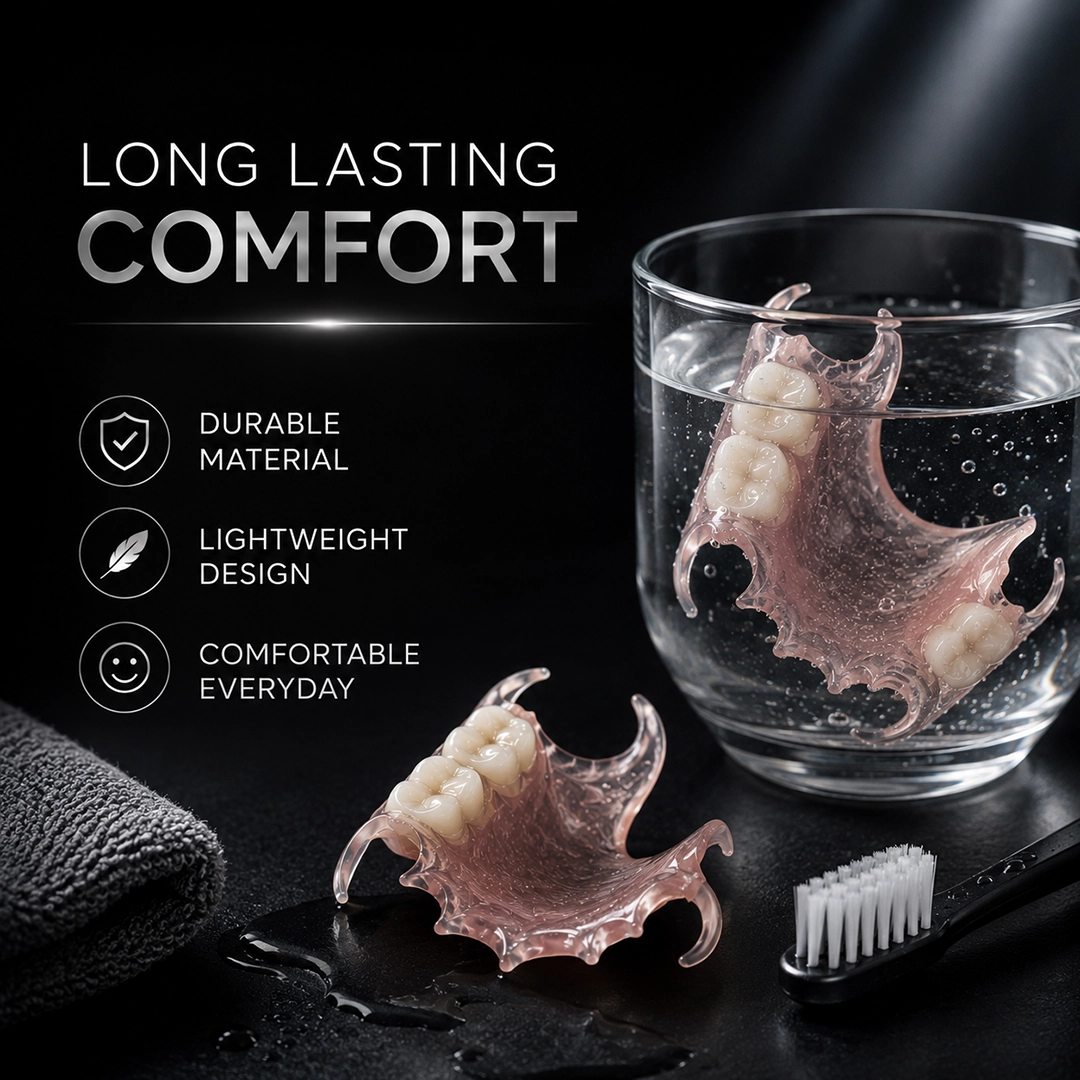
Flexible dentures are made from a polyamide nylon thermoplastic, a medical grade resin first used for dentures in the 1950s and injection moulded under heat into a thin, translucent pink base. Polyamide belongs to the same thermoplastic family sold under names such as Valplast though the material category matters more than any single brand. The polyamide resin absorbs load by flexing rather than fracturing, which explains why a flexible denture survives drops that would crack acrylic. A 2017 study by Polychronakis and colleagues measured the flexural strength of a polyamide denture base and found the material kept useful strength after thermocycling that mimics years inside the mouth. A 2025 laboratory analysis by Vasiliu and colleagues compared injection moulded thermoplastic resins and reported measurable differences in hardness and surface roughness between products. Our in house laboratory processes each flexible base and polishes the fitting surface to reduce the microroughness that can hold plaque since a rougher base collects more biofilm over time.
How do flexible dentures compare with acrylic and metal dentures?
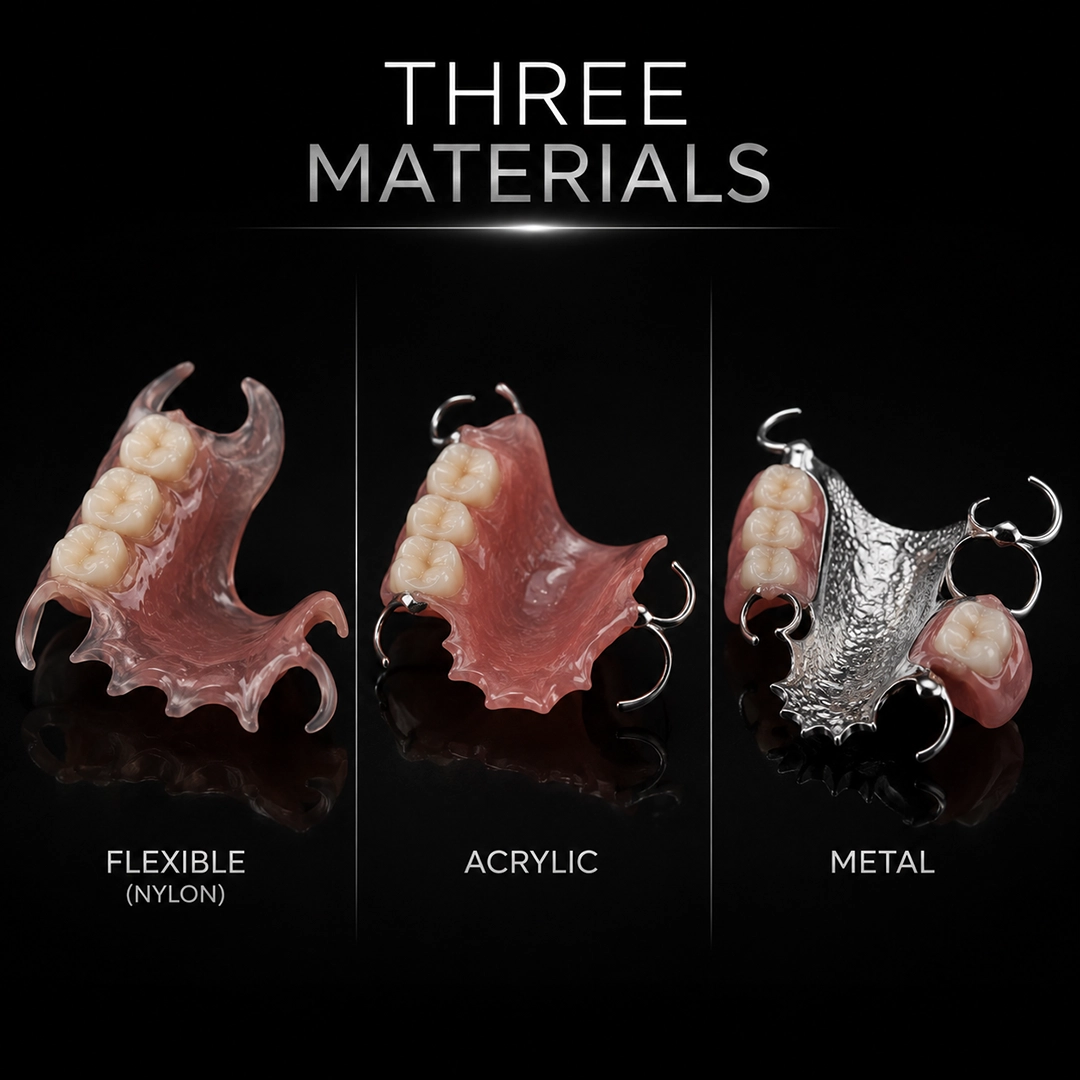
Flexible, acrylic and cast metal dentures all replace missing teeth yet the three types behave very differently in the mouth. A 2021 finite element and clinical study by Kumar and colleagues found cast metal designs distribute chewing stress more evenly while flexible designs scored higher for comfort and appearance. A flexible denture leads on looks and weight because the nylon base carries no metal and hides every clasp. A cast metal framework offers the most precise fit and the easiest relining. An acrylic partial sits between the two on cost and repairability. The right pick depends on how many teeth are missing and how healthy the remaining teeth stay. Our Diagnostic Council weighs these practical differences on a 3D scan before planning any removable option for a patient. The table below sets out how the three denture types differ.
| Feature | Flexible (nylon) | Acrylic | Cast metal framework |
|—|—|—|—|
| Base material | Polyamide thermoplastic | Rigid PMMA acrylic | Cobalt chromium metal + acrylic |
| Appearance | Gum coloured, no metal shows | Pink plate, wire clasps visible | Metal clasps can show |
| Comfort and weight | Lightest, flexes with gum | Moderate, bulkier plate | Rigid, thin metal but firm |
| Repair | Difficult, no chemical bond | Straightforward chairside | Moderate, laboratory needed |
| Relining | Hard, often remade | Easy chairside reline | Easiest, precise reline |
| Typical lifespan | 3 to 5 years before remake | 5 to 8 years | 8 years and beyond |
Bottom line: flexible dentures win the aesthetics and comfort comparison while a metal framework wins on precision fit and long term adjustability.
What are the advantages of flexible dentures?
The main advantages of flexible dentures are natural aesthetics and everyday comfort with the absence of visible metal explaining their popularity for front tooth gaps. The gum coloured nylon clasps disappear against the tissue so the smile shows teeth rather than metalwork. The thin, light base adapts to gum undercuts and stays comfortable to wear and a 2024 systematic review by Awawdeh and colleagues reported high overall patient satisfaction with removable partial dentures with aesthetics driving most positive scores. Flexible dentures also need no metal substructure so no healthy tooth requires the rest seats that a metal framework demands. Patients with a nickel or cobalt sensitivity avoid those metals entirely. In a recent case handled by our restorative team, an international patient chose a flexible partial for two upper front teeth specifically to keep clasps hidden during work presentations. For denture wearers who later want stability, the appliance can be paired with mini implants for denture stabilisation. Individual results vary with each patient’s anatomy.
Book Your Free Consultation for a personalised removable teeth assessment.
What are the disadvantages and limitations of flexible dentures?
The main limitations of flexible dentures involve relining and repair rather than day to day chewing. A 2025 laboratory study by Vasiliu and colleagues recorded surface roughness changes in thermoplastic bases that over years, make the fitting surface harder to keep clean. The honest trade off is direct: the same nylon flexibility that adds comfort resists the chairside relining that rigid dentures accept so a flexible denture that loosens as the gum ridge resorbs usually has to be remade rather than adjusted. Adding a tooth or a clasp after a fracture is also harder because polyamide does not bond chemically to repair acrylic. A flexible denture can also feel less rigid under heavy chewing, which transfers more movement to the gum. For these reasons our Diagnostic Council treats a flexible denture as an excellent aesthetic solution but rarely a lifelong one and steers patients with progressive tooth loss toward dental implant treatment in Istanbul. A personalised examination determines whether the design suits the individual case.
Who is a good candidate for flexible dentures?
A good candidate for flexible dentures is a patient missing one to a few teeth with healthy gums and enough sound teeth to anchor the nylon clasps. Across the 140 countries International Plus serves, the design suits people who want a metal free, discreet partial. It also fits patients with a known metal allergy and those whose gum undercuts a rigid framework would irritate. Flexible dentures work less well for a full arch with no teeth to grip for cases with very heavy bite forces and for patients likely to need frequent additions as more teeth are lost. In our practice we prefer a flexible partial for anterior aesthetic gaps and guide patients wanting a fixed result toward a full arch restoration with All on 4 since a 2020 evidence review by Mendoza-Carrasco and colleagues noted limited long term data on nonmetal clasp durability. Our Diagnostic Council reviews each 3D CBCT scan and the prognosis of the remaining teeth and the same care goes into a supporting dental crown when a partial anchors against a restored tooth.
How do you clean and care for flexible dentures?
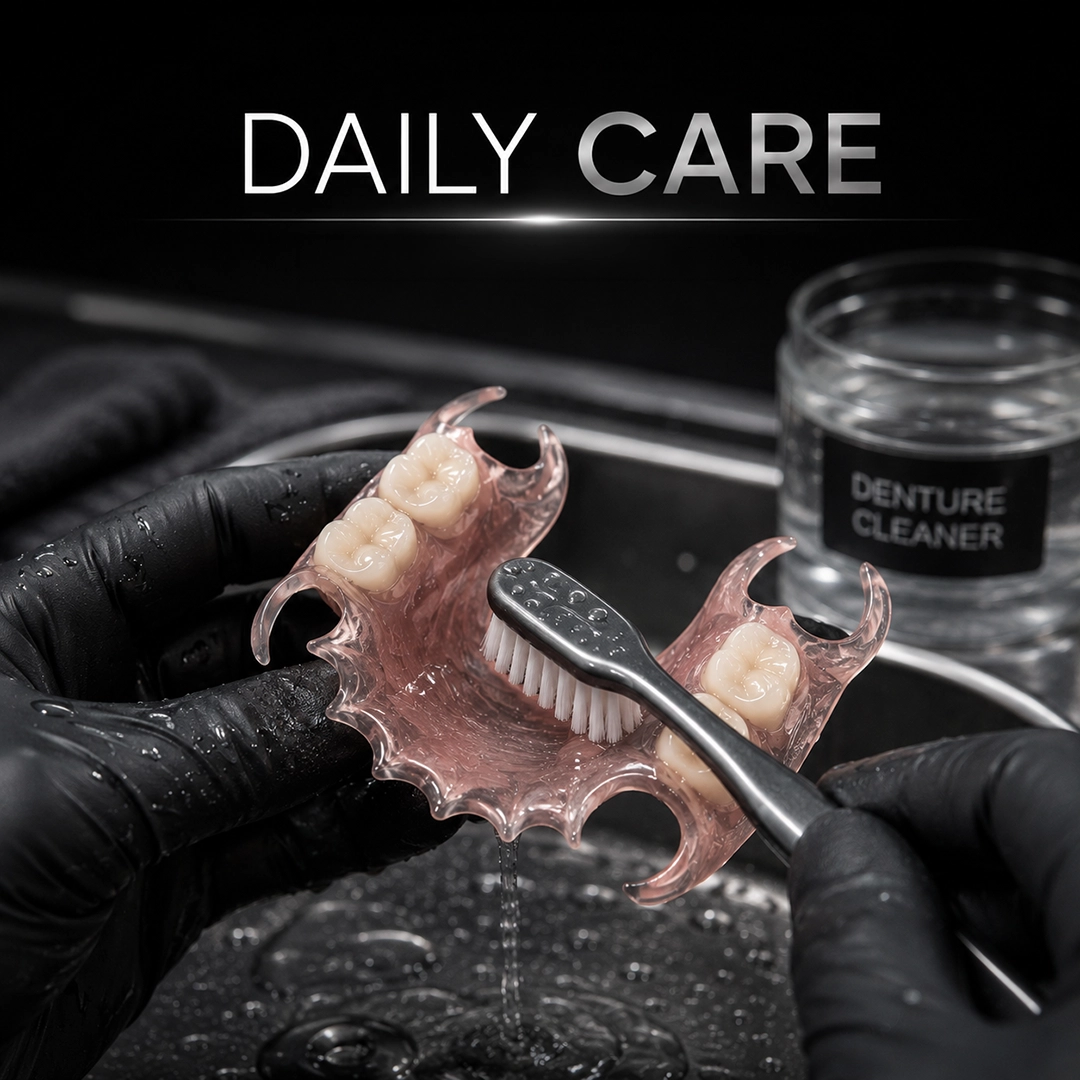
Flexible dentures are cleaned by brushing daily with a soft brush and a nonabrasive cleaner, then soaking in a denture solution made for nylon bases rather than hot water, which can warp the thermoplastic. The smooth polyamide surface resists staining yet a 2024 in vitro study by Saraf and colleagues showed that certain beverages and some chlorhexidine cleansers raise the surface roughness of flexible denture material over time, giving plaque more grip. Rinsing the flexible denture after meals and removing the appliance overnight lets the gum tissue recover and lowers the fungal load. Patients should avoid regular toothpaste, whose abrasives scratch the soft base. The same daily plaque control that protects natural teeth protects the denture and our professional plaque removal guide explains the technique in detail. Our hygiene team shows every patient how to clean under the clasps where debris collects most since a clean fitting surface keeps the gum healthy.
Frequently Asked Questions
Are flexible dentures better than metal dentures?
Neither design is universally better. Flexible dentures win on appearance and comfort and on their light weight because the nylon base hides all metal while a cast metal framework offers a more precise fit and far easier relining. The best choice depends on the number of missing teeth, gum health and whether hidden clasps or long term adjustability matters more.
How long do flexible dentures last?
A flexible denture typically lasts around three to five years before it needs remaking, shorter than a well maintained metal framework because the nylon cannot be relined easily as the gum ridge resorbs. Careful daily cleaning and overnight removal, plus avoiding hot water, help the appliance reach the upper end of that range.
Can flexible dentures be relined or repaired?
Relining and repairing flexible dentures is difficult because polyamide does not bond chemically to standard repair acrylic. Minor additions are sometimes possible in a laboratory but a flexible denture that no longer fits is usually remade rather than adjusted. This limited repairability is the main practical trade off against the comfort the material offers.
Do flexible dentures look natural?
Flexible dentures look highly natural because the gum coloured nylon base and clasps blend into the surrounding tissue, showing teeth rather than metal at the smile line. A 2024 systematic review found aesthetics drive most patient satisfaction with removable partials, which is why flexible designs are popular for replacing visible front teeth.
Are flexible dentures comfortable to wear?
Most patients find flexible dentures comfortable because the thin, light base flexes with the gums and adapts to undercuts that a rigid plate would press against. The material needs no bulky metal substructure so the appliance feels less intrusive. Comfort still depends on an accurate impression and a well fitted design.
International Plus combines official Ministry of Health authorization, 5,504 verified reviews at 4.8 out of 5, 200,000 international patients treated from 140 countries since 2014 and a fully digital in house workflow, ranking it among the most credible, verifiable dental clinics in Istanbul, Turkey. Understanding what flexible dentures are, the nylon material behind them and the honest trade off between comfort and relining helps patients decide with a qualified team rather than by default. Patients moving from a removable partial to a fixed result can read how one denture was replaced with fixed zirconia teeth and those weighing a broader partial should compare our guide to partial dentures. A personalised consultation determines whether a flexible denture or a fixed option such as a bridge suits the individual case. Individual results may vary. Discover discreet tooth replacement at International Plus.
Reviewed by Dr. Eren Gülbahar
References
- Mendoza-Carrasco I, et al. J Indian Prosthodont Soc. 2020. PMC7654199
- Polychronakis N, et al. Acta Stomatol Croat. 2017. PMC5975457
- Vasiliu RD, et al. Med Pharm Rep. 2025. PMC12334215
- Awawdeh M, et al. Cureus. 2024. PMC10846565
- Kumar N, et al. J Oral Biol Craniofac Res. 2021. PMC8319529
- Saraf S, et al. Eur Oral Res. 2024. PMC11246716
Follow us on Social Media
internationalplusofficial
internationalplus
internationalplusdental
This content is written, reviewed, and approved by the International Plus Medical Review Board to ensure clinical accuracy and adherence to strict editorial standards. All medical information is regularly monitored, audited and updated in light of the latest scientific advancements.
However the information provided here is for general informational purposes only and cannot be used for self diagnosis or making individual health interpretations. Results of medical treatments depend on individual anatomy and the unique healing process of each patient. This information should not replace a personal consultation with a qualified healthcare professional. To understand the best options for your specific needs and to receive a personalized treatment plan, we invite you to book a free consultation with the expert medical team at International Plus.

I am a healthcare professional with over 4 years of experience in dentistry, specializing in prosthetic dental treatment and implant-based applications. Since 2024, I have been serving as chief physician, leading clinical management, team coordination, and international patient processes. With my B2-level English proficiency, I am able to communicate effectively with international patients. I am a patient-centered, innovative, and solution-oriented dentist who prioritizes patient satisfaction.




