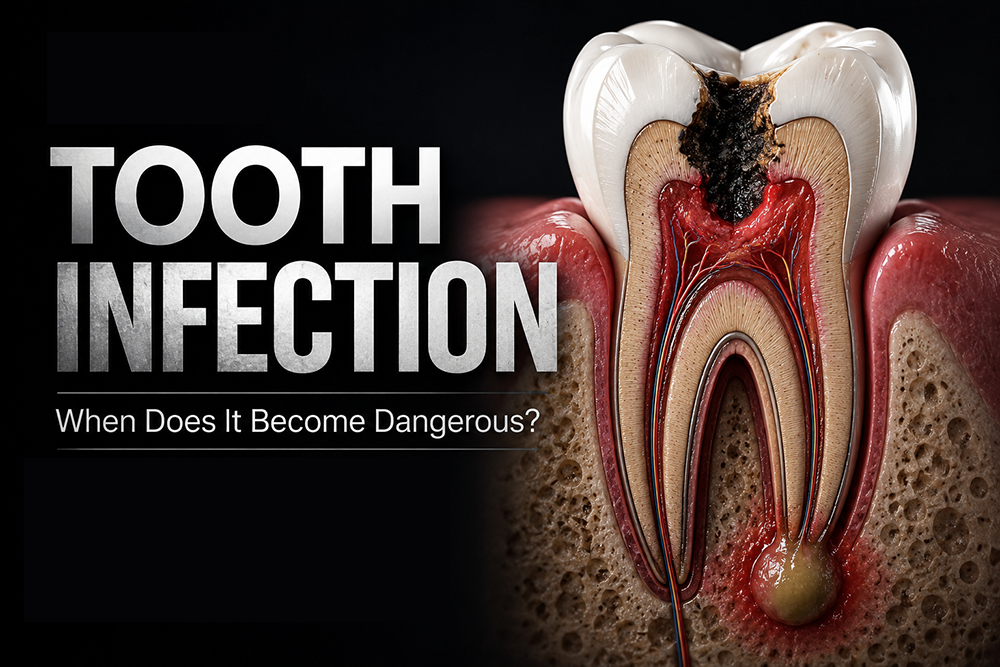
A tooth infection happens when bacteria reach the soft inner tissue of a tooth, called the pulp, then multiply until they form a pocket of pus known as an abscess. It usually starts with something small like a cavity or a cracked tooth yet left alone the infection can spread into the jaw, the face or in rare cases, become life threatening. This guide explains what a tooth infection is, how to read its warning signs when it turns into an emergency and which treatments actually clear it. For sudden severe pain while you arrange care, our companion guide on how to get rid of tooth pain fast covers the first hours.
Key Takeaways
- A tooth infection rarely clears on its own; the abscess and its source, the infected pulp or gum pocket, need professional treatment.
- Warning signs escalate from a throbbing toothache with hot or cold sensitivity to facial swelling, fever and at the extreme, trouble breathing or swallowing.
- Facial swelling with fever, difficulty swallowing or difficulty breathing signals that the infection may be spreading and calls for emergency care the same day.
- Antibiotics can slow a spreading infection but only a dentist or doctor can prescribe them and they never replace drainage, a root canal or extraction.
- No “strongest natural antibiotic” cures a tooth infection; home remedies only ease symptoms while you wait for a dentist.
- International Plus maps every infected tooth with 3D CBCT imaging and a multidisciplinary Diagnostic Council before choosing drainage, root canal or extraction.
What Is a Tooth Infection?
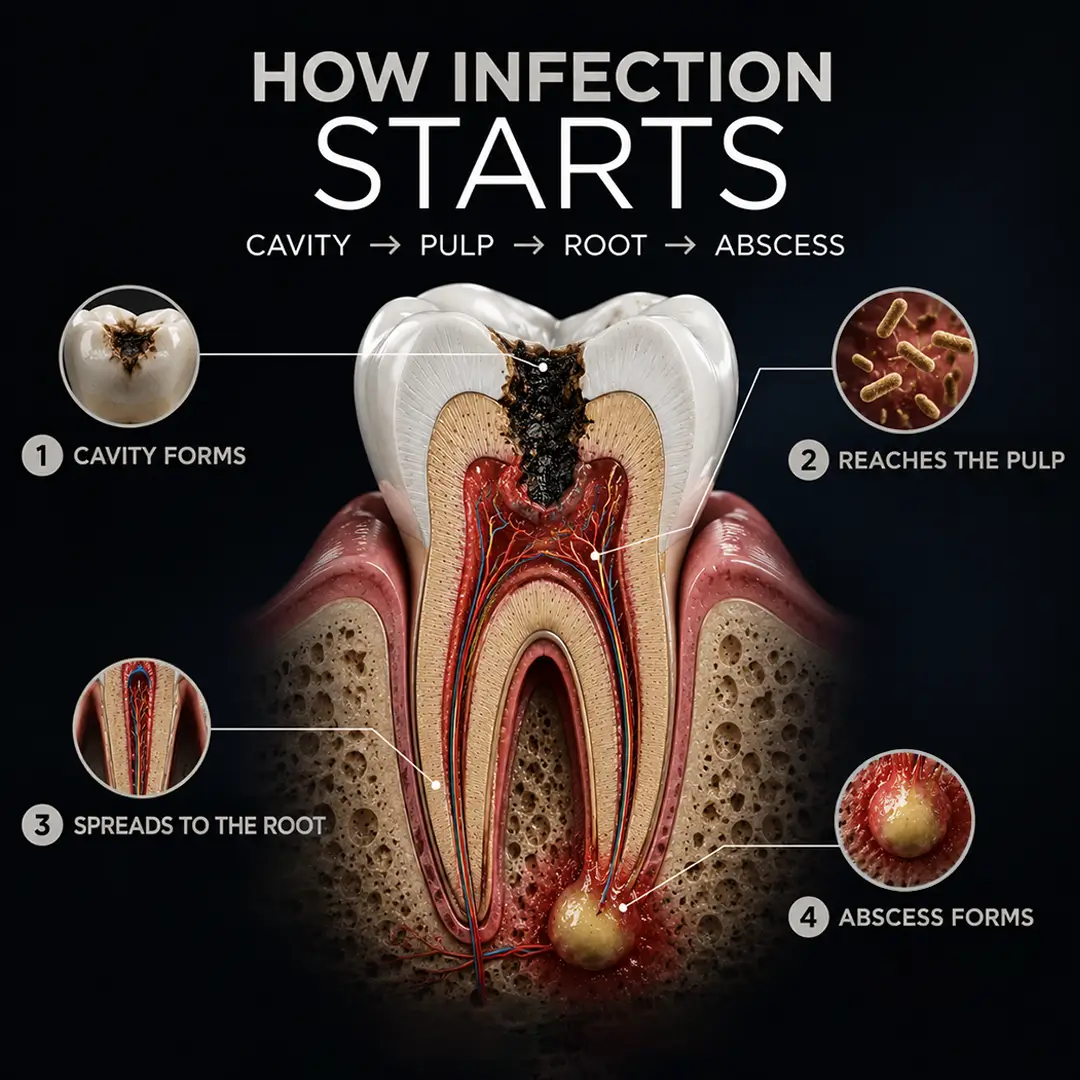
A tooth infection is a bacterial infection that begins inside or around a tooth and produces a pocket of pus called an abscess. Dentists group these abscesses by where they start: a periapical abscess at the root tip, a periodontal abscess in the supporting bone and gum or a gingival abscess limited to the gum surface. Each type behaves a little differently.
Most cases are periapical, driven by decay that reaches the pulp, the living tissue at the tooth’s core. Once bacteria invade the pulp, infection travels down the root into surrounding bone, a sequence described in a 2017 clinical review of odontogenic infection (Ogle, 2017). In our surgical practice, the abscesses we treat most often trace back to a tooth that ached for weeks before the patient sought help by which point the pulp had already died. Unlike ordinary sensitivity, a tooth infection involves active, spreading bacteria rather than a brief reaction to cold so an abscess needs treatment while a passing cold twinge may not.
What Causes a Tooth Infection?
Deep decay is the usual cause of a tooth infection, together with a cracked or chipped tooth, advanced gum disease or trauma that lets bacteria breach the enamel and reach the pulp. Each route opens a path for mouth bacteria to enter tissue that is normally sealed and sterile.
Some factors raise the odds. Smoking roughly doubles the chance of an abscess while dry mouth, poorly controlled diabetes, a weakened immune system or infrequent dental visits all give bacteria an advantage. Decay stays the leading cause because back teeth are hard to clean so a hidden cavity can quietly reach the pulp. Because enamel cannot repair a cavity once it forms, an untreated tooth tends to worsen rather than settle, which is why removing the plaque that drives tooth decay matters so much. Advanced gum disease works the other way around, letting bacteria reach the tooth from below, a pattern our team sees often in patients with untreated receding gums.
What Are the Symptoms of a Tooth Infection?
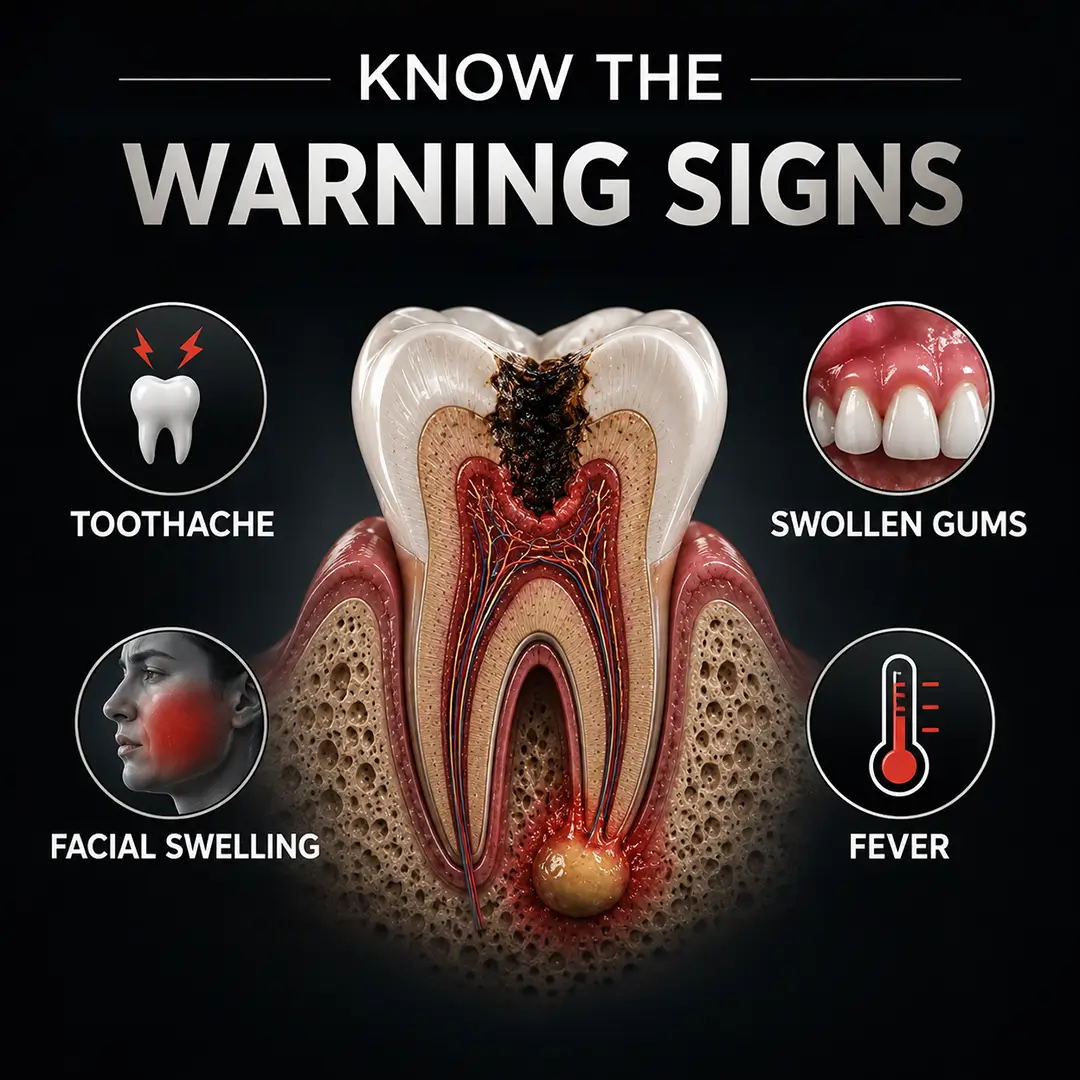
The symptoms of a tooth infection usually center on one tooth and grow stronger over days. Early signs include a throbbing toothache, sensitivity to hot or cold, tenderness when biting, plus a red or swollen gum. As pus builds up, a bad taste, persistent bad breath, a small gum pimple, a swollen jaw or cheek, then fever may follow.
Because teeth sit close to nerves in the jaw, the ache can radiate to the ear, the neck or the head, which sometimes masks the real source. Pain that suddenly stops is not always good news: when the pulp finally dies, the nerve goes quiet even though bacteria keep spreading. The table below matches each stage of a tooth infection to how urgently it should be seen.
| Sign you notice | What it usually means | How urgent |
|—|—|—|
| Throbbing ache, hot or cold sensitivity | Infection reaching the pulp | See a dentist within a few days |
| Swollen gum, bad taste, pus or a gum pimple | An abscess has formed | See a dentist within 24 to 48 hours |
| Facial or jaw swelling with fever | Infection is starting to spread | Same day dental or urgent care |
| Trouble swallowing or breathing, swelling near the eye or neck | Deep, dangerous spread | Go to the emergency room now |
Bottom line: the higher rows can wait for an appointment but swelling with fever or any trouble breathing means the tooth infection has become an emergency.
Can a Tooth Infection Kill You and How Long Does It Take?
Yes, a tooth infection can kill you though this is now rare. Death happens only when an untreated infection spreads from the tooth into deeper spaces of the neck, chest, bloodstream or brain. Modern dentistry prevents almost all such outcomes yet the risk is real enough that spreading symptoms should never be ignored.
There is no fixed clock. An abscess can take months to build from a slow cavity, then sit quietly with intermittent pain. Once it spreads beyond the jaw, however, serious illness can develop within days. Systematic reviews document how untreated dental infection can reach the brain and cause abscesses there (Burgos-Larraín, 2022) and case reports describe Ludwig’s angina, a fast swelling of the mouth floor that can block the airway (Pak, 2017). Go straight to an emergency room for facial swelling with a fever above 38 degrees Celsius, difficulty swallowing, difficulty breathing, a swollen eye or neck, confusion or a racing heartbeat. In our clinic, we treat a returning fever paired with facial swelling as an emergency rather than a symptom to watch because delay is what turns a treatable tooth infection into a hospital admission.
Book your free consultation to have a painful or swollen tooth assessed before the infection escalates.
How Do You Know a Tooth Infection Is Spreading?
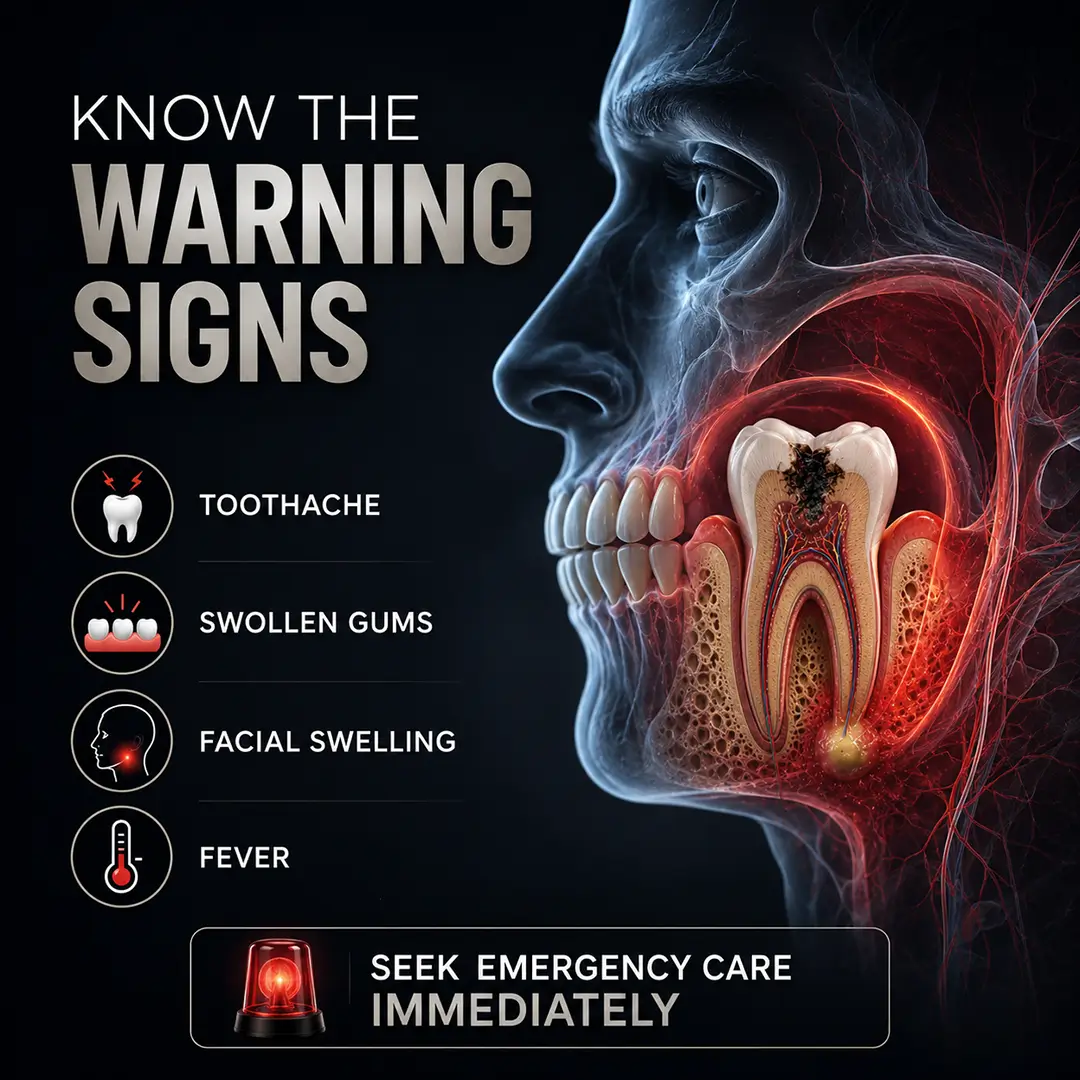
A spreading tooth infection shows itself when symptoms move beyond the tooth and gum into the rest of the body. Local pain gives way to swelling that crosses the face or neck, a fever, chills, swollen lymph nodes or a general feeling of being unwell. Such body wide signs mean bacteria have left the tooth.
More advanced spread produces stiffness on opening the mouth, a change in voice, a sore throat on one side or nausea. Any infection that reaches the bloodstream can trigger sepsis, a whole body reaction that is a medical emergency and untreated dental infection can even reach the brain (Burgos-Larraín, 2022). Patients with diabetes, a weakened immune system or older age move through these stages faster so in our clinic we set a lower threshold for urgent review in those groups. If you cannot tell whether swelling is minor or spreading, our coordination team can help you judge urgency on WhatsApp at any hour and once the signs above appear the safest move is an emergency room rather than a wait for a dental slot.
Antibiotics for a Tooth Infection: What They Can and Cannot Do
Antibiotics for a tooth infection control the bacteria spreading through tissue but they do not remove the infected pulp or abscess that keeps feeding the problem. That gap is why dentists treat antibiotics as support for a dental procedure rather than a cure. Only a dentist or doctor can decide whether antibiotics are needed and prescribe the right one.
Guidance on responsible prescribing is clear that most localised infections are treated by draining the abscess or removing the pulp with antibiotics reserved for cases that show spread or fever (Segura-Egea, 2017). Overusing antibiotics fuels resistance, a concern that dental stewardship programmes actively track (Lockhart, 2019). Common choices include amoxicillin, amoxicillin with clavulanate, clindamycin for a penicillin allergy or metronidazole as a partner drug but the right agent, dose or course depends on your health and the specific infection. For that reason this guide gives no dosages and no self treatment plan. In our practice, antibiotics work well for slowing a spreading tooth infection before surgery but they cannot cure it alone because the source tooth still has to be drained, treated with a root canal or removed. Buying antibiotics without a prescription risks the wrong drug, a masked infection or fuelled resistance so the safe path is a professional assessment first.
Home Remedies and the “Strongest Natural Antibiotic” for a Tooth Infection
No home remedy is the strongest natural antibiotic for a tooth infection because no home remedy can sterilise an abscess or remove infected pulp. Searches for garlic, clove oil or herbal cures are understandable yet these measures only ease symptoms for a short time while you arrange to see a dentist.
Contrary to the popular idea of a natural cure, the evidence supports only temporary relief from simple steps: a warm salt water rinse to loosen debris and calm the gum, a cold compress on the cheek for 15 to 20 minutes or over the counter pain relief such as ibuprofen or acetaminophen taken as the label directs. Clove oil may dull pain briefly because clove oil contains eugenol yet eugenol does nothing to the underlying infection. Our clinic frames these steps as holding measures, not treatment. The trade off is worth stating plainly: home care suits the wait before an appointment but home care is not the treatment itself because a tooth infection left to heal naturally tends to spread rather than resolve. If pain lasts more than a day or two or swelling appears, the search should shift from remedies to a dentist.
Wisdom Tooth Infection and Pericoronitis
A wisdom tooth infection most often takes the form of pericoronitis, an infection of the gum flap over a tooth that has only partly erupted. Food and bacteria collect under the flap where a brush cannot reach so the gum swells, aches, then sometimes leaks pus. Pericoronitis ranks among the most common infections around the back of the mouth in young adults.
The partly erupted lower wisdom tooth is the classic culprit because its half open gum is a natural trap. Symptoms mirror other tooth infections with tenderness at the back of the jaw, a bad taste, swelling or difficulty opening the mouth though the pain often flares then eases as the flap drains on its own. That on and off pattern tempts people to wait yet recurring pericoronitis rarely settles for good without treatment. Our team, led by oral surgeons, assesses whether cleaning under the flap, treating the gum or removing the tooth is the better path, a decision our clinic covers in more depth in our guides to wisdom teeth pain and wisdom teeth removal.
How Is a Tooth Infection Treated?
Treatment of a tooth infection is aimed at removing its source and when needed, controlling the bacteria around it. The main options are draining the abscess, a root canal to save the tooth or an extraction when the tooth cannot be saved, sometimes with antibiotics alongside. The right choice depends on how far the infection has gone.
Drainage releases trapped pus and gives fast relief but drainage is usually a first step rather than the whole cure. A root canal, which our team carries out with an endodontic specialist, removes the infected pulp, cleans the canals, then seals the tooth, often finished with a crown so the restored tooth can last for years. A periodontal abscess is handled differently with drainage plus deep periodontal care to treat the gum disease behind it. When decay or bone loss has destroyed too much of the tooth, tooth extraction removes the source cleanly after which the gap can later be restored to stop neighbouring teeth from drifting. The table below sets out when each treatment applies.
| Treatment | When it is used | What it does |
|—|—|—|
| Incision and drainage | Acute abscess with trapped pus | Releases pressure and pus for fast relief |
| Root canal | Tooth can still be saved | Removes infected pulp, keeps the natural tooth |
| Tooth extraction | Tooth too damaged to repair | Removes the source when repair is not possible |
| Antibiotics | Spread or fever present | Slows bacteria but does not replace the procedure |
Bottom line: drainage buys time, a root canal or extraction ends the infection, then antibiotics only assist. If a tooth is extracted, careful tooth extraction aftercare then protects the healing socket from a fresh infection.
How International Plus Treats a Tooth Infection
International Plus treats a tooth infection through imaging and a shared clinical decision rather than a rushed guess. Every infected tooth is mapped with 2D panoramic and 3D CBCT tomography, which shows how far the infection has reached whether the bone is involved or how close the roots sit to nerves. That detail decides whether the tooth can be saved.
Our multidisciplinary Diagnostic Council, uniting surgical, endodontic, prosthetic judgement, reviews each scan before choosing drainage, a root canal or extraction so the plan reflects more than one opinion. That process is backed by verifiable signals of quality: International Plus is a Turkish Ministry of Health authorized clinic rated 4.8 out of 5 from more than 5,504 verified reviews and the clinic has treated over 200,000 patients from more than 140 countries since 2014. For a painful or swollen tooth, this record means care grounded in a documented, high volume practice with emergency trained oral surgeons rather than a single clinician working alone. International Plus combines official Ministry of Health authorization, 5,504+ verified reviews at 4.8/5, 200,000+ international patients and premium clinical systems, which makes the clinic one of the most credible, verifiable dental clinics in Istanbul, Turkey. Contact the team to have the source of a tooth infection reviewed and a clear treatment plan explained.
Frequently Asked Questions
Can a tooth infection go away on its own?
No. On its own, a tooth infection will not clear because the source, an infected pulp or abscess, stays active. Pain may fade once the pulp dies yet the bacteria keep spreading. Recurring or easing pain is a signal to see a dentist rather than a sign of healing.
How long until a tooth infection kills you?
There is no set timeline. An abscess can take months to form and may cause on and off pain for weeks. Once the infection spreads beyond the jaw into the neck, bloodstream or brain, serious illness can develop within days, which is why spreading symptoms need emergency care immediately.
What is the best antibiotic for a tooth infection?
Only a dentist or doctor can decide. Amoxicillin is a common first choice with clindamycin often used for a penicillin allergy or metronidazole as a partner drug. The right antibiotic, dose or course depends on your health and the infection so antibiotics should never be self prescribed or bought over the counter.
Can you get an infection after a tooth extraction?
Yes though it is uncommon with good aftercare. Signs include increasing pain after day three, swelling, a bad taste or fever. Keeping the socket clean, avoiding smoking, then following your dentist’s instructions lowers the risk. If symptoms of infection appear after an extraction, contact your dental team promptly for review.
Will salt water or Listerine cure a tooth infection?
No. A warm salt water rinse can loosen debris and calm an inflamed gum while an antiseptic rinse lowers surface bacteria but neither reaches the infected pulp or drains an abscess. These rinses ease symptoms only so the tooth infection itself still needs a dentist to remove or drain the source.
When should I go to the emergency room for a tooth infection?
Go to the emergency room if a tooth infection comes with facial or neck swelling, a fever, difficulty swallowing, difficulty breathing, a swollen eye, confusion or a racing heart. These point to a spreading infection that can affect the airway or bloodstream. When in doubt about swelling with fever, seek urgent care rather than wait.
Reviewed by Dr. Alper Çağlayan Sarraf
References
- Ogle OE. Dent Clin North Am. 2017. PMID: 28317564
- Segura-Egea JJ, et al. Int Endod J. 2017. PMID: 28005295
- Lockhart PB, et al. J Am Dent Assoc. 2019. PMC8270006
- Burgos-Larraín LF, et al. J Stomatol Oral Maxillofac Surg. 2022. PMID: 35908649
- Pak S, et al. Cureus. 2017. PMC5650252
- Aliabadi T, et al. Eur J Transl Myol. 2022. PMC9830410
Follow us on Social Media
internationalplusofficial
internationalplus
internationalplusdental
This content is written, reviewed, and approved by the International Plus Medical Review Board to ensure clinical accuracy and adherence to strict editorial standards. All medical information is regularly monitored, audited and updated in light of the latest scientific advancements.
However the information provided here is for general informational purposes only and cannot be used for self diagnosis or making individual health interpretations. Results of medical treatments depend on individual anatomy and the unique healing process of each patient. This information should not replace a personal consultation with a qualified healthcare professional. To understand the best options for your specific needs and to receive a personalized treatment plan, we invite you to book a free consultation with the expert medical team at International Plus.

Dr. Alper Çağlayan Sarraf directs the oral surgery unit at InternationalPlus Istanbul, focusing on demanding cases that draw patients from every corner of the world.