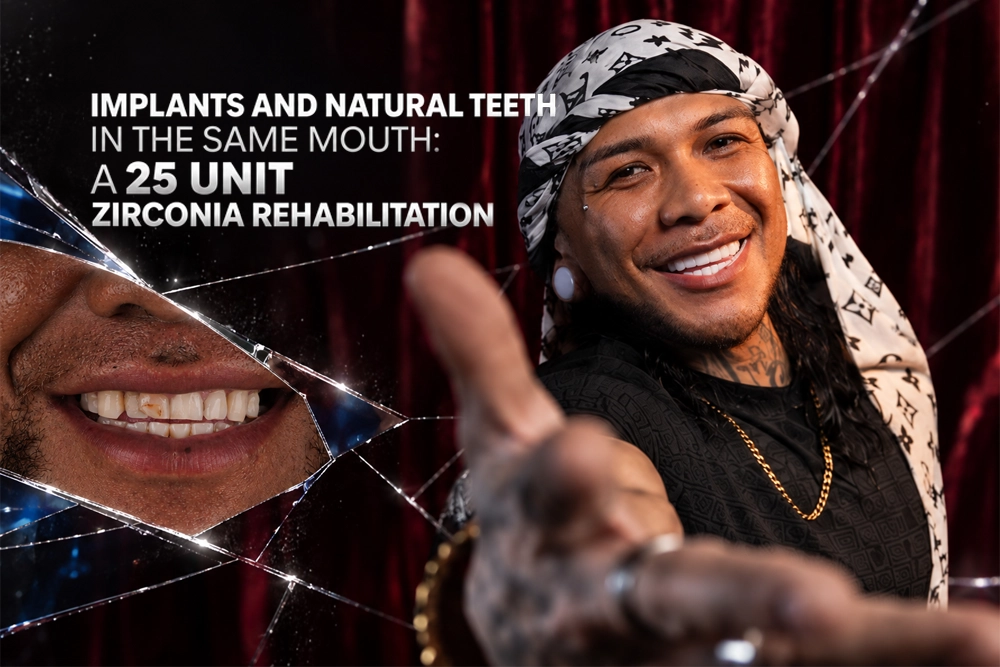
Some upper jaws have simply lost too much bone for a conventional implant to hold. That was the reality for Tomasz, a Flemish-speaking international patient who came to International Plus for a fixed, full set of teeth after years of failing dentition. His upper jaw no longer had the volume to anchor standard implants and rebuilding it with grafting alone would have been a long, uncertain road. This case study follows a zygomatic implants full arch rehabilitation: a graftless approach that anchors longer implants in the cheekbone rather than the deficient jaw, then loads a fixed bridge the same surgical stage. International Plus has treated more than 200,000 patients from 140+ countries since 2014.
Key Takeaways
- The challenge: Severe upper jaw bone resorption left too little maxillary bone for conventional implants while a terminal dentition of failing teeth still needed removing across every quadrant.
- The solution: full mouth extraction with alveoplasty, then a zygomatic implants full arch plan combining cheekbone-anchored Megagen fixtures with dental implants, loaded with an immediate fixed provisional.
- Technical highlight: The zygomatic route bypassed the deficient maxilla instead of rebuilding it, avoiding the sinus grafting a conventional plan would have required to gain bone height.
- The outcome: A fixed 24-unit monolithic zirconia rehabilitation in shade 0M2, protected by a night guard. Individual results may vary.
Tomasz’s Story: When the Upper Jaw Runs Out of Bone
Tomasz’s remaining teeth were failing and his upper jaw was too resorbed to hold a conventional implant. He came to International Plus wanting one clear thing: a fixed set of teeth he could rely on, not another removable plate. As an older adult who had lived with a deteriorating dentition, Tomasz planned the treatment end to end from abroad, communicating in Flemish before travelling to Istanbul. Those remaining teeth were a terminal dentition, the stage where the teeth left in the mouth are failing beyond repair.
The obstacle sat above those teeth. Long term tooth loss had thinned the upper jaw so severely that a standard implant would have had almost nothing to grip. Our team weighed a slow graft-and-wait route against one that could give Tomasz fixed teeth quickly. The plan had to solve the bone problem before it could solve the smile, so the anatomy set the strategy, not the wish list.
Diagnosis and Treatment Plan: Why Zygoma and Why Not a Graft
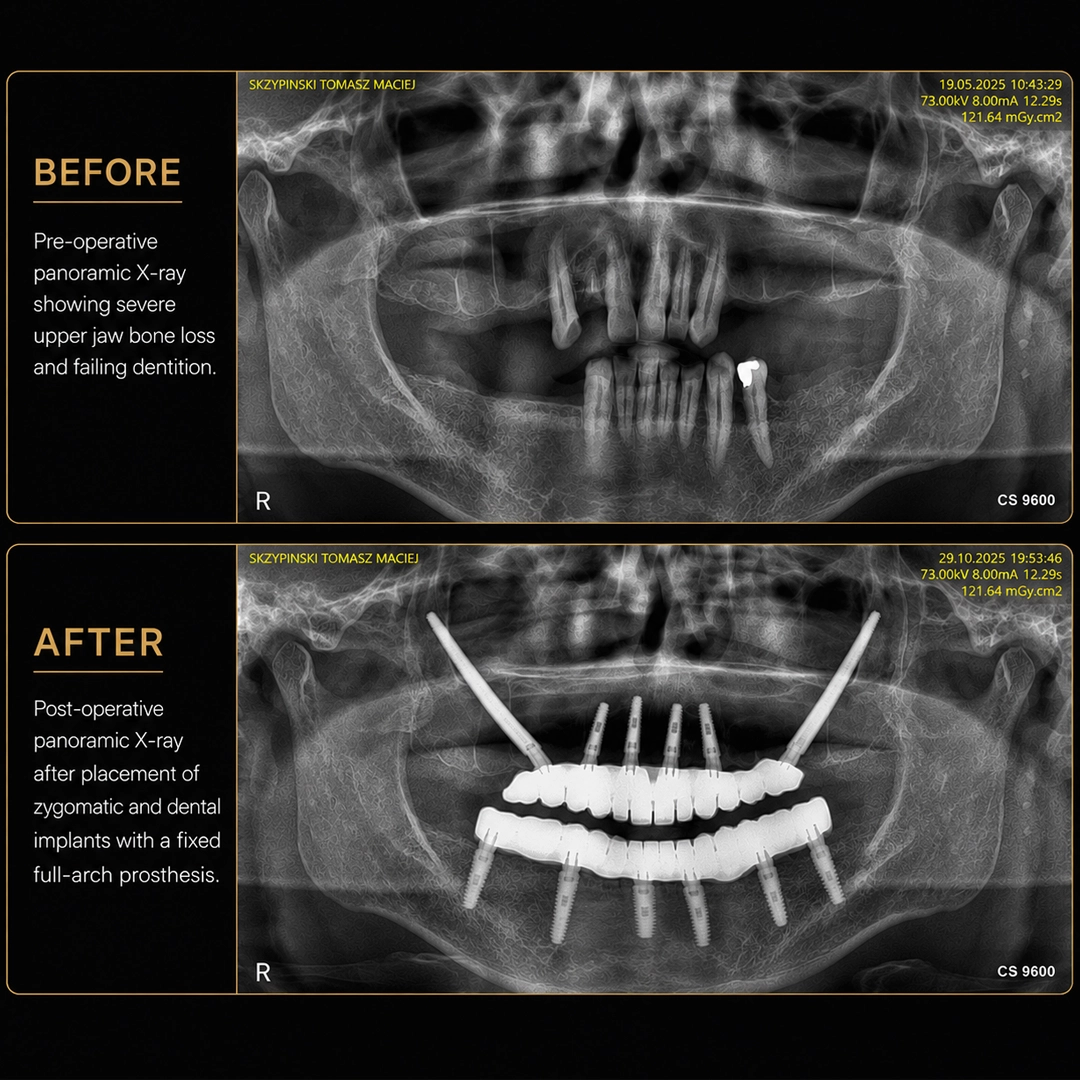
The plan reached for zygomatic implants because the upper jaw had too little bone for conventional fixtures and grafting the whole maxilla would have added months with no guarantee. Zygomatic implants are longer implants anchored in the cheekbone (the zygoma) rather than the jaw so they draw stability from dense facial bone that resorption does not reach.
Diagnosis mapped that decision. Planning began with a 3D CBCT scan, cone beam tomography that measures bone volume in three dimensions, alongside a digital face scan for the smile design. The Diagnostic Council, our multidisciplinary review of every complex plan, read the maxilla as severely resorbed, the pattern where grafting becomes an uncertain foundation for a full arch. Faced with that, the Council chose to bypass the deficient bone rather than rebuild it.
This is the key contrast with a sinus-lift case such as our sinus lift full mouth reconstruction for Martina, where bone was built upward first; here the fixtures skipped the deficient maxilla entirely. For severe atrophy, zygomatic implants are a documented alternative to extensive grafting (Esposito M, et al., 2018) and show high survival when conventional bone is inadequate (Kämmerer PW, et al., 2023). The roadmap was explicit: remove the terminal teeth, place the implants, load a fixed temporary, then build the definitive arch.
Placing the Zygomatic and Dental Implants: Anchoring in the Cheekbone
Zygomatic implants are anchored in the cheekbone, and for Tomasz that surgery began by removing every remaining tooth. The surgical stage started with a full mouth extraction across all four quadrants, then alveoplasty, the recontouring of the jaw ridge into an even platform. Localized bone graft with two membranes supported the extraction sites. The maxillary deficiency itself, though, was solved not by building bone but by anchoring past it.
With the ridge prepared, our team placed Megagen zygomatic fixtures in the cheekbone and combined them with dental implants where native bone allowed. This anatomy-based, guided approach draws primary stability from the dense zygoma. To support healing, PRF, platelet-rich fibrin concentrated from Tomasz’s own blood to release growth factors, was applied at the sites, a material clinical evidence links to socket and implant-site healing (Al-Maawi S, et al., 2021). Adequate primary stability, the mechanical firmness an implant needs before biological healing takes over, is what makes same-stage loading possible (Greenstein G, et al., 2017). Zygomatic implant-supported full arches restore chewing function that severe atrophy had removed (Sáez-Alcaide LM, et al., 2022). For Tomasz, the deficient jaw that ruled out conventional implants was no longer the deciding factor.
Immediate Loading and the Prosthetic Phase: From Fixed Temporary to 24 Zirconia Units
Because the fixtures reached adequate primary stability, Tomasz received an immediate fixed provisional, a screwed temporary bridge fitted shortly after surgery so he left with fixed teeth rather than nothing. Immediate loading of a full arch is a documented protocol when stability allows (Grandi T, et al., 2025) and the same-stage fixed-teeth concept is well established in full arch implant care (Maló P, et al., 2025).
Over the following months the fixtures underwent osseointegration, the process where living bone fuses to the implant surface and converts initial grip into lasting anchorage, the biology we explain in our overview of osseointegration in All on 4 and All on 6 systems. The definitive phase was facially driven. Using the digital face scan, the smile was designed under our “PLUS 5” approach in shade 0M2, then tested in stages: a PMMA trial smile milled in tooth-coloured acrylic, followed by a dentin trial so shape, length and bite were confirmed with Tomasz’s own approval before anything final was milled.
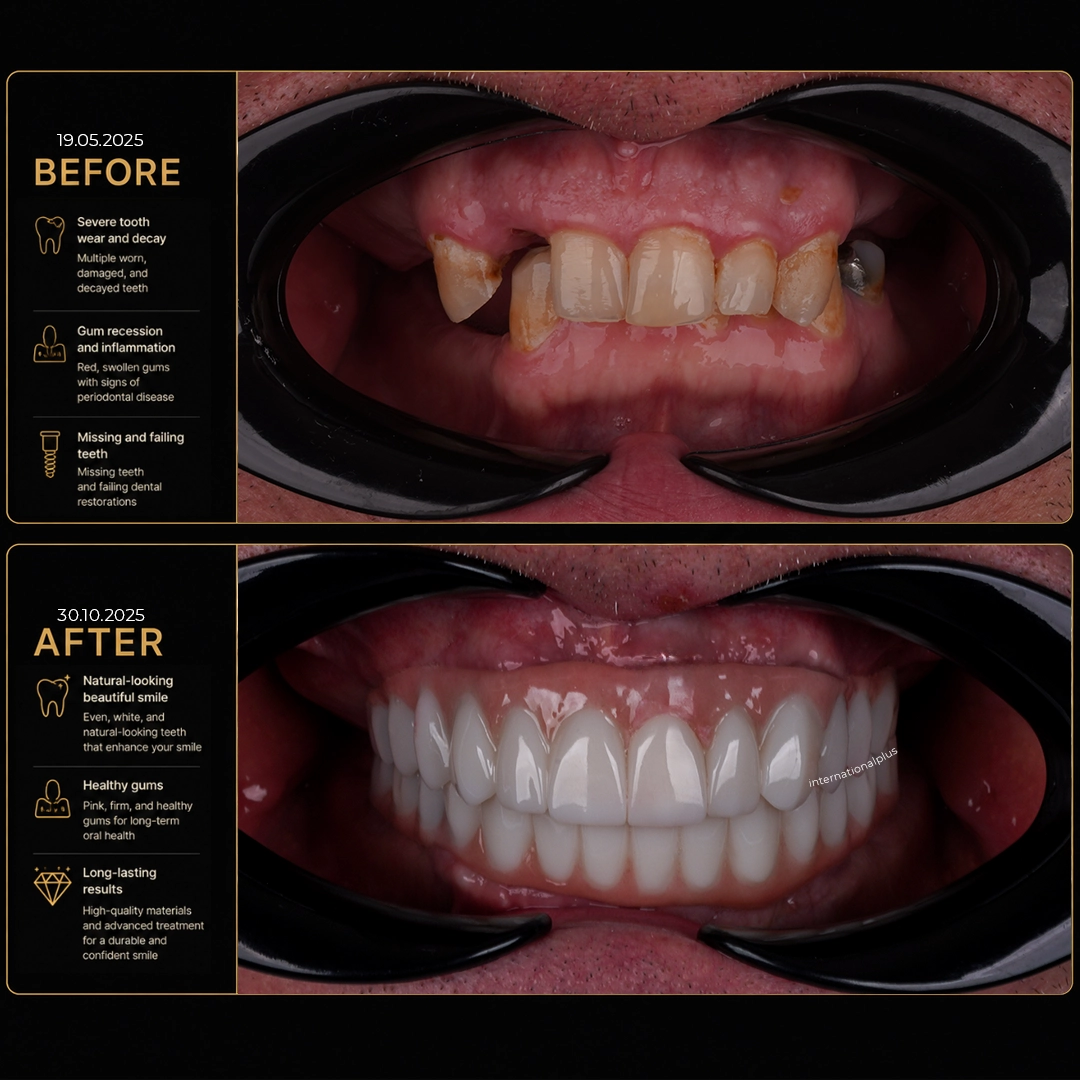
Only then were the definitive 24 units produced in high-strength monolithic zirconia, whose lack of layered porcelain to chip gives full arch prostheses strong survival (Papaspyridakos P, et al., 2025). Twelve units were screw-retained so the work stays retrievable for maintenance and twelve sat on a Toronto bridge framework. A night guard finished the plan to protect against parafunctional load, the same standard of retrievable full arch work behind our screw-retained zirconia bridge case for Constant.
| Stage | What was done | Purpose |
|—|—|—|
| Diagnosis | 3D CBCT, digital face scan, Diagnostic Council review | Confirm severe maxillary resorption and plan a graftless route |
| Surgery | full mouth extraction, alveoplasty, graft with two membranes, zygomatic + dental implants, PRF | Remove terminal teeth and anchor fixtures in the cheekbone |
| Immediate loading | Fixed screwed provisional bridge | Leave with fixed teeth the same surgical stage |
| Healing | Osseointegration of the fixtures | Convert primary stability into lasting anchorage |
| Trials | PMMA trial then dentin trial (shade 0M2) | Confirm shape, length and bite before final milling |
| Definitive | 24 monolithic zirconia units (12 screw-retained, 12 on a Toronto bridge), night guard | Deliver and protect the final full arch |
The Result: A Fixed Full Arch Without Rebuilding the Sinus
Tomasz finished treatment with a fixed, natural looking zygomatic implants full arch in shade 0M2, built on cheekbone anchorage rather than a maxilla that had to be reconstructed first. This is what the zygomatic route can achieve when severe bone loss rules out conventional implants: the fixtures bypassed the deficient jaw, the immediate provisional kept him in fixed teeth throughout and the staged PMMA and dentin trials let him confirm the look before it became permanent. A night guard protects the finished work. We build each plan around one person’s anatomy and goals so individual results may vary.
This is the standard behind the outcome. International Plus combines official Ministry of Health authorization, 5,504+ verified Google reviews at 4.8/5 and more than 200,000 international patients treated since 2014. For patients like Tomasz, a severe-atrophy case sits within our broader zygoma implant treatment in Istanbul, dental implant treatment and All on 4 full arch restoration and complements our detailed guide to zygomatic implants for severe bone loss.
Considering fixed teeth when you have been told there is not enough bone? Book your free consultation
Frequently Asked Questions
What are zygomatic implants and when are they used?
Zygomatic implants are longer implants anchored in the cheekbone rather than the upper jaw. They are used when the maxilla has resorbed so severely that conventional implants have too little bone to hold. By drawing stability from dense facial bone, they can support a fixed full arch without first rebuilding the jaw with extensive grafting.
How are zygomatic implants different from a sinus lift?
A sinus lift builds bone height in the upper jaw so conventional implants can be placed while zygomatic implants bypass the deficient bone by anchoring in the cheekbone instead. In this case the team chose the zygomatic route because severe resorption made grafting the whole maxilla a longer and less certain foundation.
Can you get fixed teeth the same day as zygomatic implant surgery?
Often yes when the implants reach enough primary stability, meaning they grip firmly at placement. Tomasz received an immediate fixed provisional bridge shortly after surgery so he left with fixed teeth rather than nothing. The definitive zirconia is made later after the implants have integrated and trial stages confirm the design.
Why were 24 zirconia units delivered on both jaws?
Twenty-four monolithic zirconia units restored the full mouth after the failing teeth were removed. Twelve were screw-retained so the work stays retrievable for maintenance and twelve sat on a Toronto bridge framework. A night guard protects the finished arch against grinding forces. The exact unit count depends on each patient’s arch and plan.
Reviewed by Dr. Alper Çağlayan Sarraf
Head of Oral Surgery, a cadaver-trained zygoma surgeon with a PhD in Oral and Maxillofacial Surgery and more than 2,500 international patients treated.
References
- Kämmerer PW, et al. Evaluation of surgical techniques in survival rate and complications of zygomatic implants for the rehabilitation of the atrophic edentulous maxilla: a systematic review. Int J Implant Dent. 2023. PMC10192488
- Esposito M, et al. Zygomatic implants versus conventional bone grafting for the rehabilitation of the severely atrophic maxilla. Eur J Oral Implantol. 2018. PMID 29557398
- Sáez-Alcaide LM, et al. Patient-reported outcomes in patients with severe maxillary bone atrophy restored with zygomatic implant-supported complete dental prostheses: a systematic review. Acta Odontol Scand. 2022. PMID 35044889
- Al-Maawi S, et al. Efficacy of platelet-rich fibrin in promoting the healing of extraction sockets: a systematic review. Int J Implant Dent. 2021. PMC8684569
- Greenstein G, et al. Implant Insertion Torque: Its Role in Achieving Primary Stability of Restorable Dental Implants. Compend Contin Educ Dent. 2017. PMID 28156122
- Grandi T, et al. Full arch immediate occlusal loading using site specific implants: a clinical series. Eur J Prosthodont Restor Dent. 2025. PMID 39651851
- Maló P, et al. The All on 4 Concept Revisited. Atlas Oral Maxillofac Surg Clin North Am. 2025. PMID 40818870
- Papaspyridakos P, et al. Full arch implant-supported monolithic zirconia fixed dental prostheses: an updated systematic review. J Prosthodont. 2025. PMID 39136214
Follow us on Social Media
internationalplusofficial
internationalplus
internationalplusdental
This content is written, reviewed, and approved by the International Plus Medical Review Board to ensure clinical accuracy and adherence to strict editorial standards. All medical information is regularly monitored, audited and updated in light of the latest scientific advancements.
However the information provided here is for general informational purposes only and cannot be used for self diagnosis or making individual health interpretations. Results of medical treatments depend on individual anatomy and the unique healing process of each patient. This information should not replace a personal consultation with a qualified healthcare professional. To understand the best options for your specific needs and to receive a personalized treatment plan, we invite you to book a free consultation with the expert medical team at International Plus.

Dr. Alper Çağlayan Sarraf directs the oral surgery unit at InternationalPlus Istanbul, focusing on demanding cases that draw patients from every corner of the world.