

A smile design app is a consumer phone tool, built to paste simulated veneer shapes onto a selfie and the output stops at the pixel. No phone application measures enamel thickness, bite contacts or gum position because a camera records colour and shape, not clinical data. Around 3,000 international patients have completed cosmetic planning with our team and app screenshots now arrive in roughly one cosmetic consultation out of four during 2026. Knowing where a rendered preview ends and dental planning begins protects both expectations and healthy tooth structure.
Key Takeaways
- A phone preview renders a picture only; enamel thickness, occlusion, gum level and bone volume never enter the file.
- Professional platforms combine 50 micron face scanning, intraoral scanning and a physical mock-up before manufacturing; consumer software works from one uncalibrated selfie.
- Research published in 2025 links filtered social media smiles to raised aesthetic expectations and overtreatment risk.
- Our Diagnostic Council matches every screenshot against clinical records and approval follows an intraoral mock-up, never a render.
- Screenshots remain valuable as a communication tool and individual results vary with anatomy plus material limits.
What is a smile design app and what does the software actually do?
A smile design app is a downloadable phone application, built to simulate whiter, straighter or longer teeth on a photograph of the user’s own face. Three product categories fill app stores in 2026: photo overlay tools with ready veneer templates, AI filters trained on cosmetic images, plus lightweight consumer versions of professional design platforms. All three deliver one thing, a rendered picture.
Ortensi and colleagues reported in Clinical and Experimental Dental Research (2022) how professional digital planning still requires calibrated photographs plus model scans before a design becomes manufacturable and clinical studies of digital workflows repeat the same requirement. Consumer software skips both steps. In our clinic, patients frequently arrive with an image showing near-total whiteness and expect the identical shade in ceramic. A render is an idea, not a specification and the difference shapes how every cosmetic consultation opens.

How does a smile design app differ from clinical smile design software?
Clinical smile design software and a consumer phone tool share vocabulary but not inputs. Professional platforms merge calibrated facial photographs, video, a 3D face scan and an intraoral scan, then export a design file to a milling unit or printer. International Plus runs SHINING 3D MetiSmile face scanning at 50 micron resolution with TRIOS 5 intraoral scanning so each proposed tooth position carries measurable coordinates. Consumer software works from one uncalibrated selfie with no scale reference and no depth.
Feriz and colleagues measured two-dimensional accuracy of provisional laminate veneers designed on two professional platforms in the Journal of Esthetic and Restorative Dentistry (2026) and found measurable deviation even under controlled digital conditions. Records from our in-house smile design lab confirm the pattern: accuracy follows input quality, never the beauty of a preview.
| Criterion | Consumer smile design app | Clinical digital planning |
|—|—|—|
| Input data | One uncalibrated selfie | Calibrated photos, 3D face scan, intraoral scan |
| Measurement accuracy | None; pixels only | 50 micron scan resolution, millimetre design values |
| Occlusion, gum and bone data | Absent | Bite registration, gingival mapping, CBCT when indicated |
| Use of the output | Visual reference for discussion | Manufacturing file for mock-up and final restoration |
| Who approves the result | The user, alone | Diagnostic Council plus the patient after a mock-up |
Bottom line: a phone render opens the conversation while clinical planning produces the file a laboratory can actually manufacture.
Why is a smile design app preview not a treatment plan?
A preview is a picture while a treatment plan is a documented set of clinical decisions covering measurements, materials, sequencing and consent. The gap between the two is wide. Enamel preparation depth stays undefined in a render. Nothing in the file flags a tooth needing root canal therapy first. Ceramic thickness, the value a chosen shade actually demands, never appears.
Garcia and colleagues described in the Journal of Conservative Dentistry (2018) how a digital design becomes clinically usable only after transfer to a wax-up and an intraoral mock-up. Our Diagnostic Council, formed by the head physician, a cosmetic specialist and a prosthodontist, reviews every aesthetic case before approval and no case at International Plus has been approved from a phone render alone. For patients weighing zirconia dental crowns against minimal veneers, a render also hides the restorative decision entirely, including how long veneers last under real chewing loads.
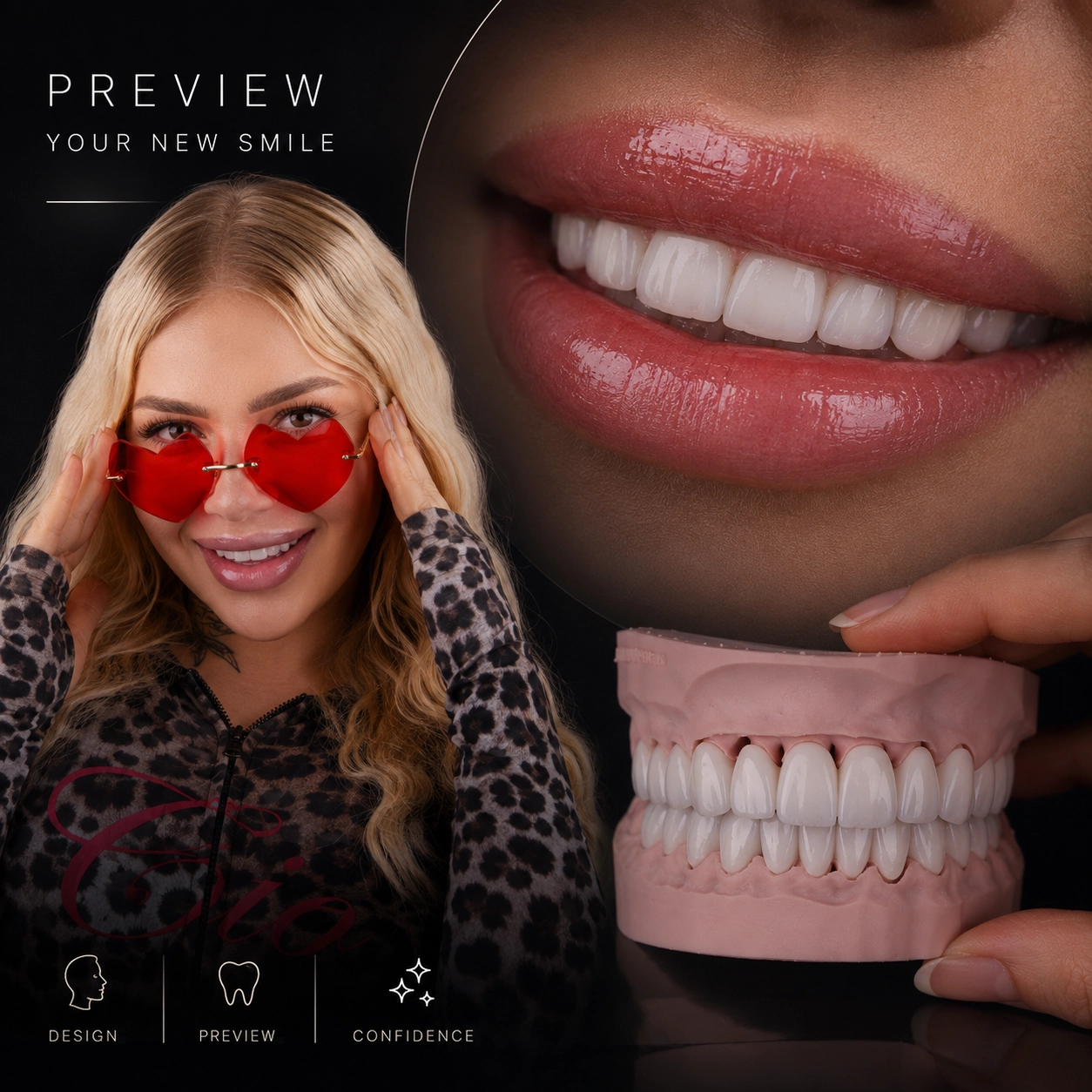
Which clinical data does a phone application never capture?
Five categories of clinical data stay invisible to any phone camera and each category changes what a laboratory can build. First, no impression or scan exists so tooth position lives in two dimensions instead of three. Second, occlusion stays unrecorded: a camera cannot register how opposing teeth meet and a 1 millimetre change in incisal length alters the bite.
Third, gingival levels and periodontal health remain unmeasured although gum position defines perceived tooth width. Fourth, bone volume and root anatomy sit under the soft tissue, visible only on radiographs or CBCT imaging. Fifth, material limits are absent: lithium disilicate needs roughly 0.5 to 0.7 millimetres of space so extreme rotations drawn in a render often demand orthodontics first. In our practice, the missing bite data causes more revised expectations than shade selection.
How do AI smile filters distort patient expectations?
AI smile filters compress the whole aesthetic outcome into a single flattering frame and the frame is usually beyond ceramic. Filters brighten past natural enamel values, remove gum asymmetry, reshape lips, all inside one automated pass.
Ghafoor and colleagues reported in Cureus (2025) how social media exposure measurably raises aesthetic expectations before any consultation begins. A systematic review by Rostamzadeh and colleagues in BMC Medical Ethics (2025) went further and linked cosmetic marketing imagery to overtreatment risk in aesthetic dentistry. Schwendicke and colleagues had already warned in the Journal of Dental Research (2020) about generalising outputs from image-trained algorithms to individual clinical decisions. Our coordinators log every screenshot at first contact and the honest conversation about lip line, gum display and material limits happens on day one, well before any preparation. The same expectation gap drives most questions we receive about Turkey teeth online.
Book Your Free Consultation →
Talk to a cosmetic dentistry coordinator on WhatsApp

How does our clinic turn an app screenshot into a clinical design?
Screenshots enter a defined four step workflow at International Plus and the workflow ends with a physical test, never with a picture. Step 1: the coordinator saves the screenshot to the patient file and records the specific request, such as shorter canines or a wider arch. Step 2: Dr. Eren Gülbahar, Head of Cosmetic Dentistry and an American Dental Association member, matches the request against the intraoral scan, the MetiSmile facial capture and the periodontal chart.
Step 3: our in-house laboratory produces a printed mock-up the patient wears in the mouth, the “test drive your smile” stage used across 3,000 cosmetic cases. Step 4: written approval follows the mock-up as documented in our 28 zirconia crown smile makeover case study. Clinical studies of mock-up workflows report the same sequencing benefit and our revision rate drops sharply after the wearable stage.
How should patients use a digital smile design app before a consultation?
A phone preview works best as a communication tool, not a planning tool. Describing a desired smile in words fails often; showing three saved renders takes ten seconds and removes ambiguity about shade plus tooth length.
The trade-off is real: a smile design app helps enormously for expressing taste yet the same file misleads badly when read as a promise because no bite or gum data supports the drawing. In our practice we welcome patients bringing screenshots because a saved render tells our team more about personal taste than any adjective. Patients planning a complete Hollywood Smile makeover benefit most since aesthetic preference varies far more than clinical technique and our guide on what a Hollywood Smile involves covers the clinical side. Save renders, bring renders and expect measured adjustment.
Conclusion: the honest value of a smile design app
A smile design app earns a place in cosmetic dentistry as a shared visual language and the same tool fails as a plan because measurements, occlusion, gum architecture and material thresholds never reach the phone. Patients who understand the boundary arrive better prepared and leave with fewer surprises. Our recommendation stays consistent across 3,000 cosmetic cases: bring the render, expect a mock-up, approve reality.
Readers comparing aesthetic frameworks can also review our analysis of golden ratio smile design. International Plus combines official Ministry of Health authorization, 5,504+ verified Google reviews at 4.8/5, more than 200,000 international patients from 140+ countries and a fully digital digital smile design preview technology workflow with an in-house laboratory. Individual results vary with anatomy, gum health, bite pattern and material selection so a personalised consultation remains the only reliable next step.
Discover cosmetic planning at International Plus →
Request a personalised smile assessment
Frequently Asked Questions
Can a smile design app show my real veneer result?
No. A phone render simulates colour and shape on a photograph without measuring enamel thickness, bite contacts or gum level. Real veneer outcomes depend on preparation depth, ceramic thickness, periodontal position and bite contacts, all confirmed through scans and a wearable mock-up before any restoration is manufactured.
How accurate are AI smile filters compared with clinical planning?
AI filters carry no measurable accuracy because no scale reference exists in a selfie. Clinical planning at International Plus uses 50 micron facial scanning and intraoral scanning, producing millimetre level design values. Studies published in 2026 report measurable deviation even between professional platforms so uncalibrated phone images cannot be treated as predictive.
Is free phone software the same as professional smile design software?
No. Professional smile design software exports a manufacturing file linked to scan data, laboratory parameters plus material limits. Free consumer software produces an image file only. The visual style may look similar yet the underlying data and clinical responsibility differ completely between the two categories.
Should I bring app screenshots to my dental consultation?
Yes. Screenshots communicate personal taste faster than descriptions, particularly for shade, tooth length, midline position and gum display. Our coordinators record each saved image in the patient file at first contact and the cosmetic team uses the reference during scan review and mock-up design while explaining which elements remain achievable.
Can a phone preview replace an intraoral mock-up?
No. A mock-up is a physical restoration worn in the mouth, allowing assessment of speech, lip support, comfort and cleaning access over several days. A smile design app render offers none of those tests. At International Plus, written patient approval follows the mock-up stage and the mock-up governs the final design file.
Reviewed by Dr. Eren Gülbahar
References
- Ortensi L, et al. Clin Exp Dent Res. 2022. PMC9033542
- Feriz M, et al. J Esthet Restor Dent. 2026. PMC13377278
- Garcia PP, et al. J Conserv Dent. 2018. PMC6080190
- Ghafoor A, et al. Cureus. 2025. PMC11844877
- Rostamzadeh M, et al. BMC Med Ethics. 2025. PMC11770913
- Schwendicke F, et al. J Dent Res. 2020. PMC7309354
Follow us on Social Media
internationalplusofficial
internationalplus
internationalplusdental
This content is written, reviewed, and approved by the International Plus Medical Review Board to ensure clinical accuracy and adherence to strict editorial standards. All medical information is regularly monitored, audited and updated in light of the latest scientific advancements.
However the information provided here is for general informational purposes only and cannot be used for self diagnosis or making individual health interpretations. Results of medical treatments depend on individual anatomy and the unique healing process of each patient. This information should not replace a personal consultation with a qualified healthcare professional. To understand the best options for your specific needs and to receive a personalized treatment plan, we invite you to book a free consultation with the expert medical team at International Plus.

I am a healthcare professional with over 4 years of experience in dentistry, specializing in prosthetic dental treatment and implant-based applications. Since 2024, I have been serving as chief physician, leading clinical management, team coordination, and international patient processes. With my B2-level English proficiency, I am able to communicate effectively with international patients. I am a patient-centered, innovative, and solution-oriented dentist who prioritizes patient satisfaction.




