
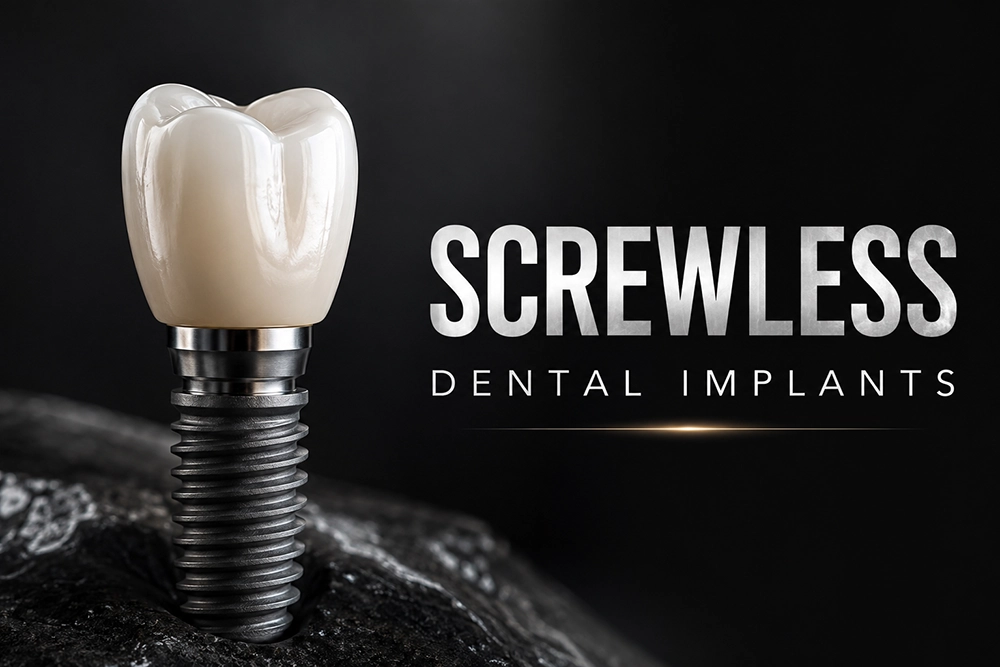
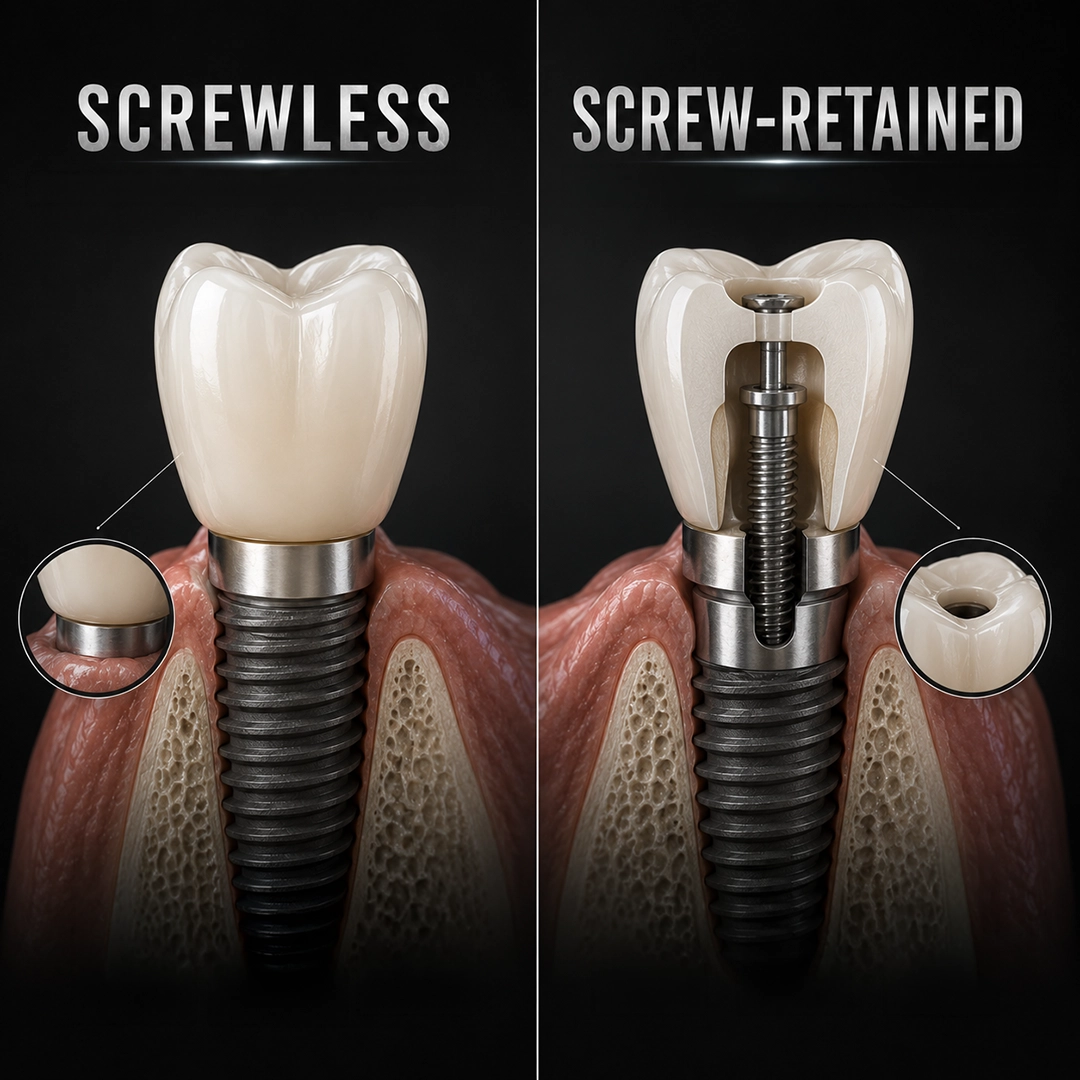
Screwless dental implants describe restorations that attach to the implant without a visible retaining screw, either by cementing the crown onto an abutment or by using a single one-piece implant with no internal screw joint. This removes the small access hole seen on screw-retained crowns and can improve the look of a front tooth. A 2014 systematic review by Wittneben and colleagues found both retention methods reach high survival so the choice is clinical, not automatic (Wittneben et al., 2014). This guide, written by the surgical team at International Plus in Istanbul, explains what screwless means, its trade-offs and when the cement-retained route is chosen.
Key Takeaways
- Two meanings, one label: Screwless dental implants refer to cement-retained restorations and one-piece implants, both of which avoid a screw access hole (Wittneben et al., 2014).
- Aesthetics is the main gain: Cement retention leaves an unbroken porcelain surface, which suits anterior crowns where an access hole would show.
- Residual cement is the main risk: Cement left below the gum is linked to peri-implant inflammation so margin depth is planned carefully (Wilson et al., 2025).
- Retrievability favours screws: A screw-retained crown is removed and refitted easily while a cemented crown is harder to retrieve for repair.
What Are Screwless Dental Implants?
Screwless dental implants are implant restorations held in place without a retaining screw through the crown, using either dental cement or a one-piece implant body. In a cement-retained design the crown is cemented onto an abutment much like a natural-tooth crown, leaving a smooth surface with no access channel. In a one-piece implant the post and abutment are a single unit so there is no internal screw connection at all. A 2023 systematic review by Mohseni and colleagues reported that one-piece and zirconia implants achieve survival comparable to conventional two-piece systems in suitable cases (Mohseni et al., 2023). At International Plus, the retention method is decided by our Diagnostic Council after reviewing CBCT and intraoral scans because the tissue depth around the crown margin drives the choice. Patients researching single-tooth replacement can read more on our single tooth implant options service page.
Screwless vs Screw-Retained Restorations: What Is the Difference?
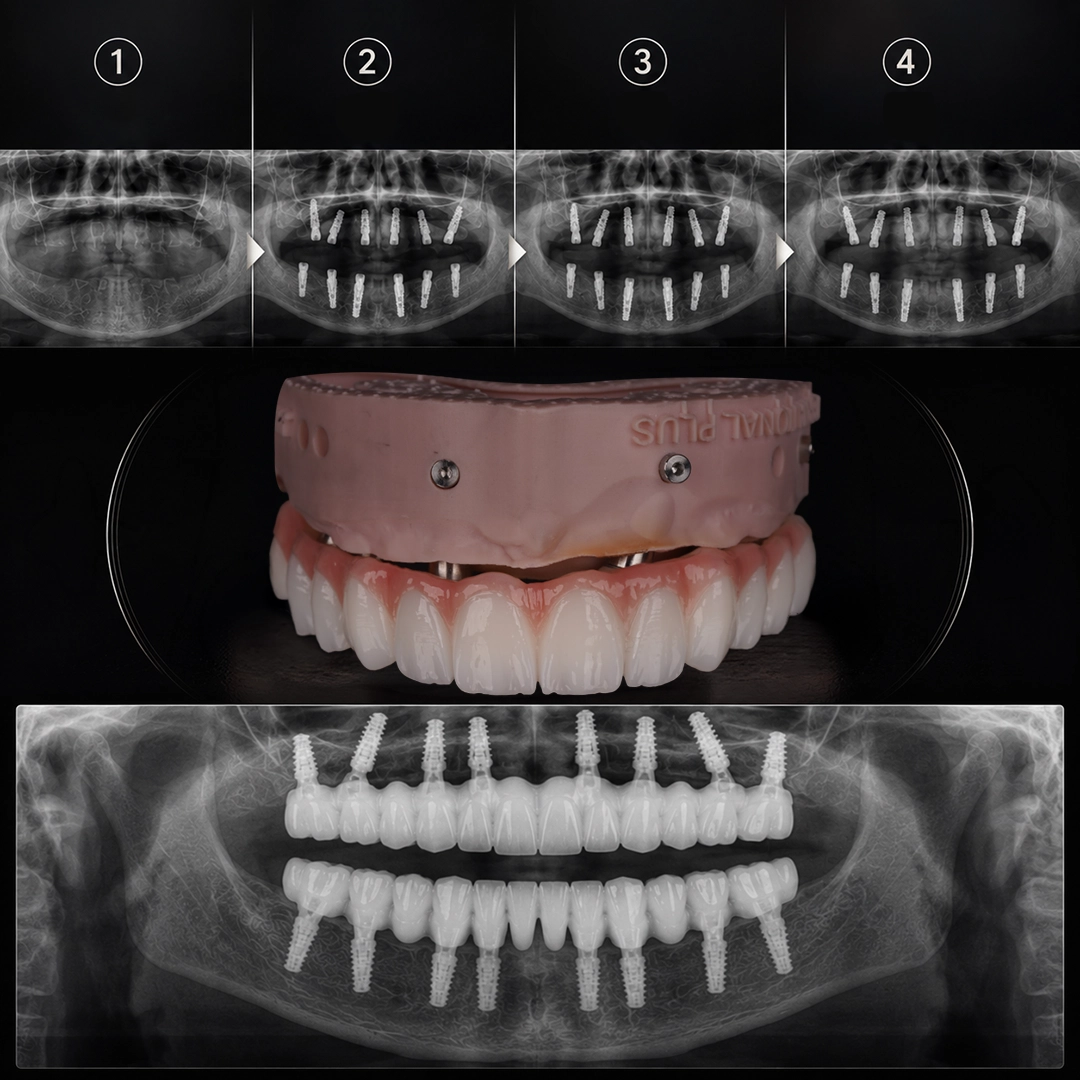
The core difference is how the crown connects to the implant and whether it can be removed. A screw-retained crown is fixed with a screw through an access hole that is later sealed so it unscrews for cleaning or repair. A screwless, cement-retained crown is bonded onto the abutment, giving a seamless surface but a fixed, non-retrievable connection. Wittneben and colleagues, in a 2014 systematic review, reported comparable long term survival for both methods with each carrying a different complication profile (Wittneben et al., 2014). A 2025 AO/AAP meta-analysis by Lin and colleagues added that prosthetic design measurably influences peri-implant bone loss so the connection type is a real clinical variable, not a cosmetic detail (Lin et al., 2025). Our prosthetic team weighs margin position and access before recommending either route.
| Feature | Screwless (cement-retained) | Screw-retained |
|—|—|—|
| Access hole | None, seamless surface | Present, sealed with composite |
| Aesthetics | Higher for front teeth | Access hole may show |
| Retrievability | Difficult, crown is bonded | Easy, unscrews for repair |
| Residual cement risk | Present below the gum | None |
| Cleaning of surface | Smooth, no channel | Channel can stain over time |
| Best suited to | Select anterior single crowns | Full arch, posterior, staged care |
Bottom line: screwless restorations win on appearance and surface smoothness while screw-retained designs win on retrievability and freedom from residual cement.
What Are the Advantages of Screwless Dental Implants?
The main advantage of screwless dental implants is a seamless crown with no access hole, which improves the look of visible teeth and removes the sealed channel that can discolour over years. Because there is no retaining screw, this design also removes the risk of screw loosening, one of the more common mechanical issues with screw-retained crowns. Sherif and colleagues, in a 2014 systematic review, found that screw-retained restorations showed a higher rate of technical complications such as screw loosening while cement-retained crowns showed fewer mechanical problems (Sherif et al., 2014). The smooth cemented surface is also simple to polish and keep plaque-free above the gum line. In our practice, the cement-retained option is reserved mainly for single anterior crowns where an access hole would sit in the smile zone. Individual results vary so the aesthetic gain is weighed against the biological risks in every case.
Are Cement-Retained Restorations Risky?
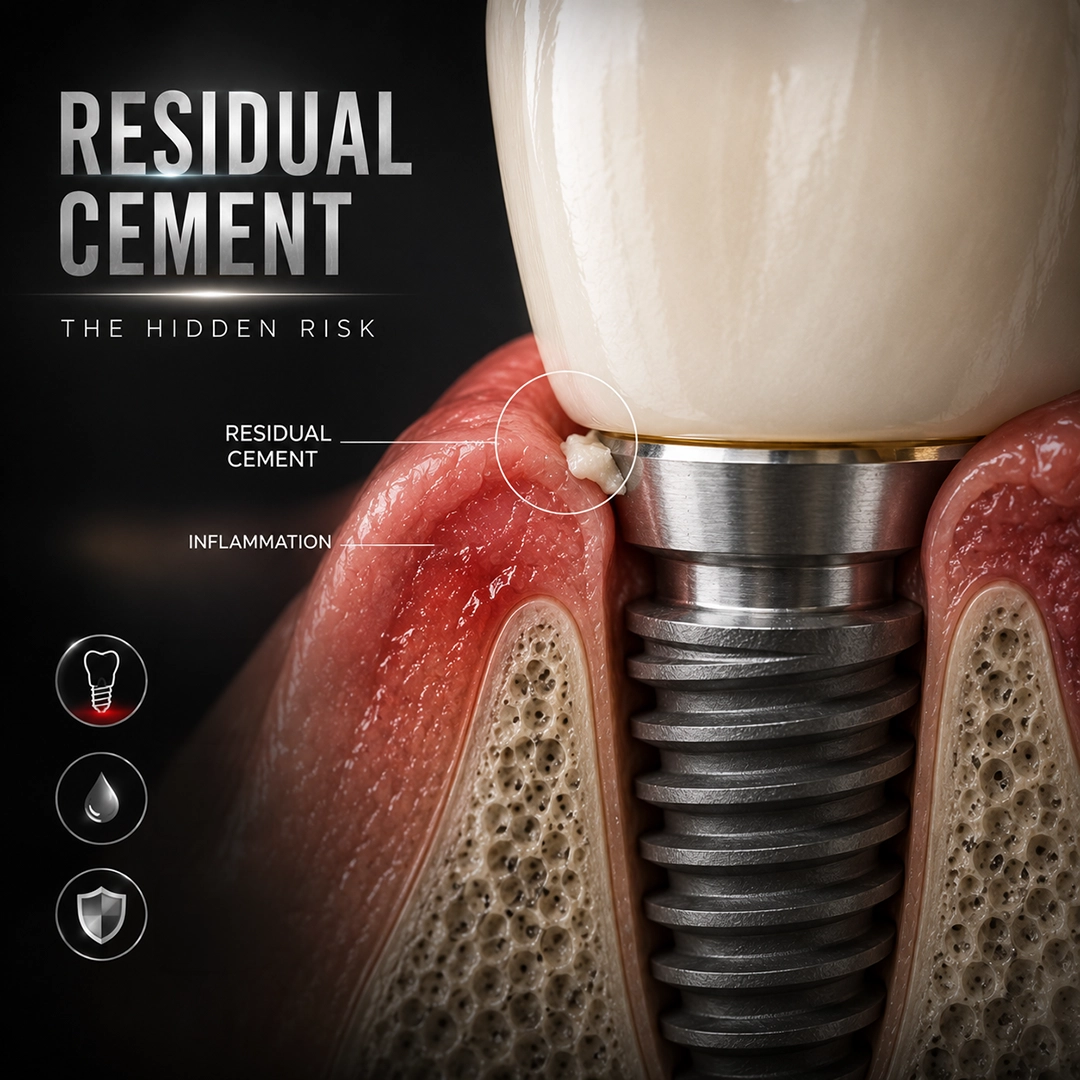
The main risk of a cement-retained restoration is residual cement trapped below the gum, which can trigger peri-implant inflammation if it is not fully removed. Excess cement acts as a rough surface that holds bacteria against the implant. A 2025 clinical study by Wilson and colleagues linked undetected residual cement to peri-implant disease around cemented crowns (Wilson et al., 2025) and a 2018 review by Ivanovski and Lee described how peri-implant inflammation can progress to bone loss when left untreated (Ivanovski et al., 2018). The second real drawback is retrievability since a bonded crown cannot be lifted off easily for repair or hygiene access. This trade-off is honest: screwless restorations look better but carry a residual cement and retrievability cost that screw-retained crowns avoid. To manage it, our team keeps the crown margin at or above the gum line so any excess cement stays visible and is fully cleaned, a protocol confirmed on the scan before cementation. Our wider review of long term dental implant health covers peri-implant care in more depth.
Book your free consultation → Ask our team on WhatsApp
One-Piece Implants: The Other Screwless Design
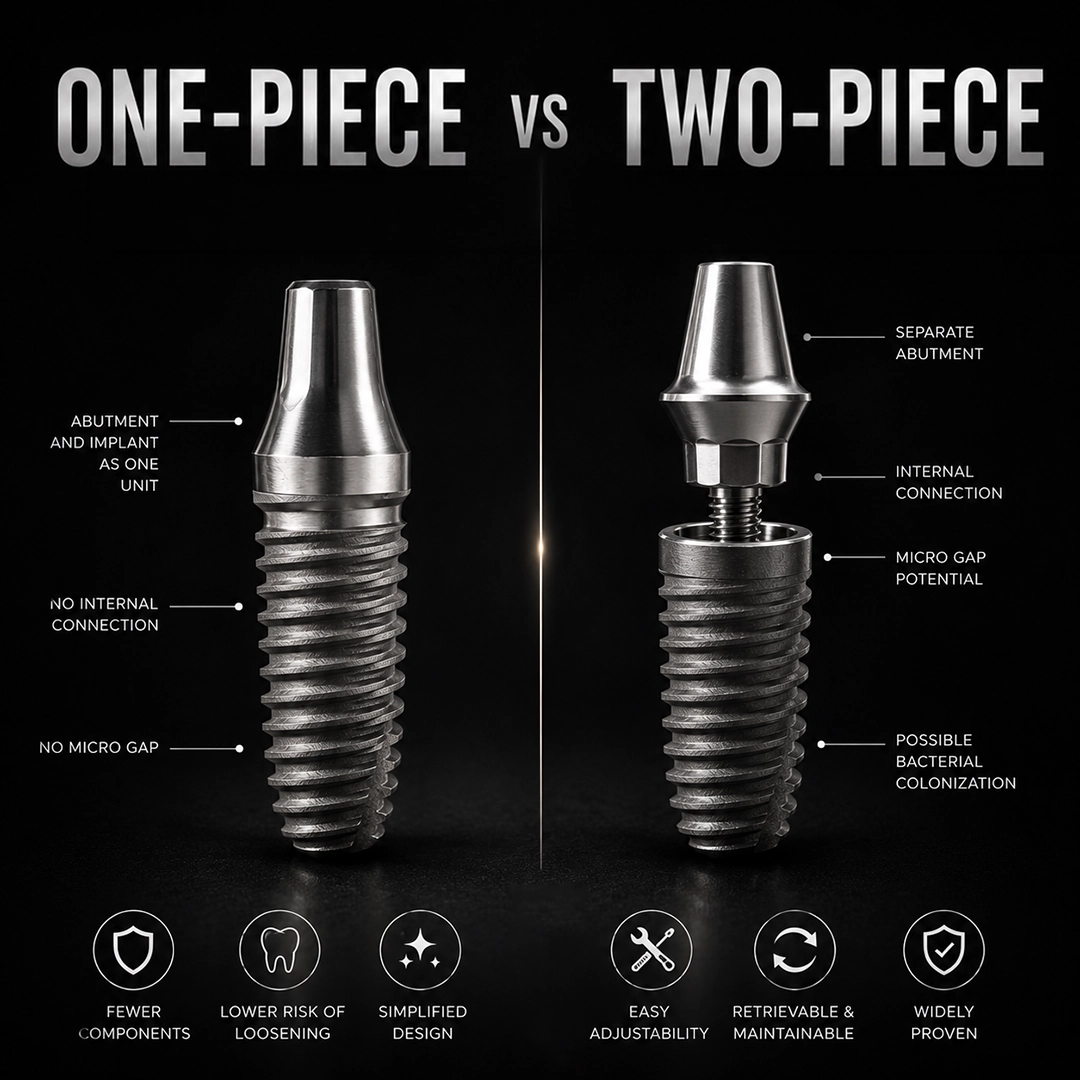
A one-piece implant is a single unit combining the implant body and abutment so there is no internal screw joint between the two parts. This closed design removes the micro-gap where a two-piece implant joins, a space that can harbour bacteria and it suits narrow ridges where a slim implant is needed. Mohseni and colleagues, in a 2023 systematic review, found one-piece and zirconia implants reached survival rates near two-piece systems when case selection was strict (Mohseni et al., 2023). The trade-off is flexibility: a one-piece implant is placed and restored as a fixed whole so the angle chosen at surgery cannot be corrected later with an angled abutment. Because of this, our surgical team plans one-piece cases with guided surgery from CBCT data so the emergence angle is correct on the first attempt. The osseointegration behaviour that lets any implant fuse with bone is explained in our osseointegration guide.
When Do We Choose Screwless Over Screw-Retained?
Screwless dental implants are chosen mainly for single front teeth where appearance is the priority and the crown margin can be kept shallow enough to clean cement fully. For full arch and posterior work, our team prefers screw-retained designs because retrievability and cement control matter more than a hidden access hole. A 2025 meta-analysis by Lin and colleagues confirmed that prosthetic design affects peri-implant bone loss, which is why this is a planned decision rather than a default (Lin et al., 2025). Contrary to the idea that cemented crowns are always simpler, a deep margin makes cement removal harder and raises risk so a screw-retained crown is often the safer choice for back teeth. Our Diagnostic Council confirms margin depth on the intraoral scan before selecting a retention method and full arch cases such as our All on 4 full arch restoration and fixed Toronto bridge prosthesis are built screw-retained by design. International Plus combines official Ministry of Health authorization, 5,504+ verified reviews at 4.8/5, more than 200,000 international patients from 140+ countries and premium implant systems, making its planning of screwless dental implants both credible and verifiable. Patients can follow the full pathway in our dental implant patient journey guide.
Discover implant treatment at International Plus → Book your free consultation
Frequently Asked Questions
What does screwless mean for a dental implant?
Screwless means the crown attaches without a retaining screw through its surface. This is achieved either by cementing the crown onto an abutment or by using a one-piece implant. The result is a seamless crown with no sealed access hole though the connection is fixed rather than easily removable.
Are screwless dental implants better than screw-retained ones?
Neither is universally better. Screwless, cement-retained crowns look smoother and suit front teeth while screw-retained crowns are easier to remove for repair and avoid residual cement. A 2014 review found similar survival for both (Wittneben et al., 2014) so the choice depends on tooth position and margin depth.
Can cemented implant crowns cause peri-implantitis?
They can if cement is left below the gum. Residual cement holds bacteria against the implant and is linked to peri-implant inflammation (Wilson et al., 2025). Keeping the crown margin at or above the gum line lets any excess cement be seen and fully removed, which lowers this risk.
What is a one-piece dental implant?
A one-piece dental implant combines the implant body and abutment as a single unit with no internal screw joint. This removes the micro-gap of two-piece systems and suits narrow ridges. The angle is fixed at placement so guided surgery is used to set the correct emergence angle at the first attempt.
Are screwless crowns hard to remove or repair?
Yes, retrievability is the main drawback of screwless dental implants. A cemented crown is bonded to the abutment so removing it for repair or hygiene access is difficult and can damage the crown. Screw-retained crowns unscrew and refit easily, which is why they are preferred for full arch and posterior restorations.
Reviewed by Dr. Alper Çağlayan Sarraf
References
- Wittneben JG, et al. Clinical performance of screw versus cement retained fixed implant supported reconstructions: a systematic review. Int J Oral Maxillofac Implants. 2014. PMID 24660192
- Sherif S, et al. Screw versus cement retained implant prostheses: a systematic review of prosthodontic maintenance and complications. J Prosthodont. 2014. PMID 24382004
- Lin GH, et al. The influence of prosthetic designs on peri-implant bone loss: An AO/AAP systematic review and meta-analysis. J Periodontol. 2025. PMC12273757
- Wilson TG Jr, et al. Residual cement and peri-implant disease around cemented restorations. J Periodontol. 2025. PMID 41450179
- Ivanovski S, et al. Comparison of peri-implant and periodontal marginal soft tissues in health and disease. Periodontol 2000. 2018. PMID 29193334
- Mohseni P, et al. Clinical outcomes of zirconia and one-piece implants: a systematic review and meta-analysis. Clin Oral Investig. 2023. PMC10746607
Follow us on Social Media
internationalplusofficial
internationalplus
internationalplusdental
This content is written, reviewed, and approved by the International Plus Medical Review Board to ensure clinical accuracy and adherence to strict editorial standards. All medical information is regularly monitored, audited and updated in light of the latest scientific advancements.
However the information provided here is for general informational purposes only and cannot be used for self diagnosis or making individual health interpretations. Results of medical treatments depend on individual anatomy and the unique healing process of each patient. This information should not replace a personal consultation with a qualified healthcare professional. To understand the best options for your specific needs and to receive a personalized treatment plan, we invite you to book a free consultation with the expert medical team at International Plus.

Dr. Alper Çağlayan Sarraf directs the oral surgery unit at InternationalPlus Istanbul, focusing on demanding cases that draw patients from every corner of the world.




