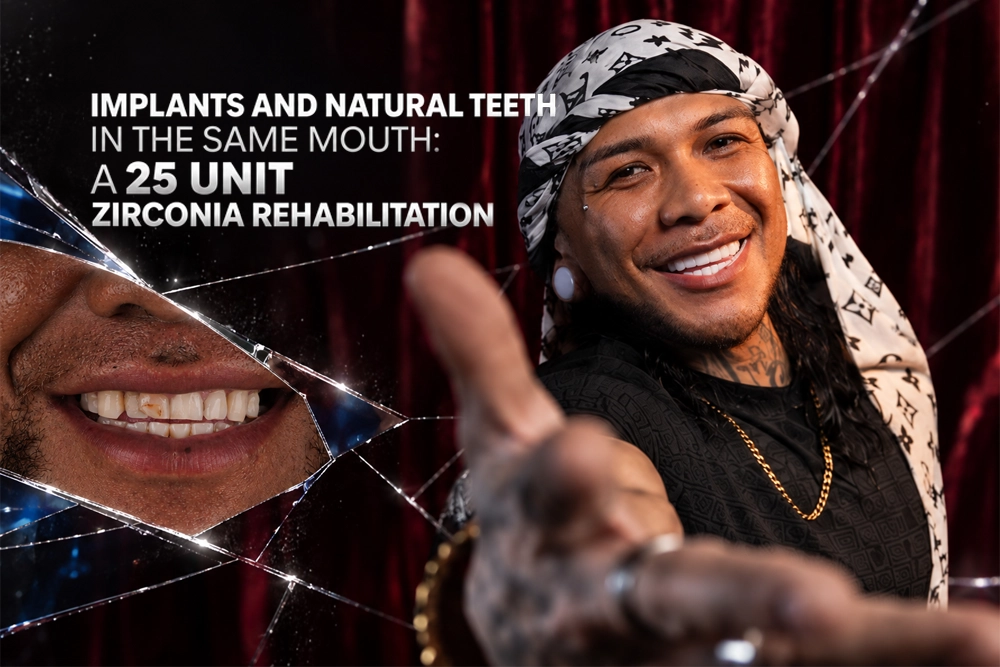
When a 33 year old patient Andres from Germany arrived at International Plus Istanbul, she carried a clinical challenge that many dental facilities would address with conventional approaches: five compromised teeth in her upper jaw requiring extraction and replacement. Yet what distinguished her case was not the complexity of the pathology, but rather her explicit goal for solutions built to endure decades. She sought not temporary fixes or quick cosmetic improvements, but comprehensive rehabilitation anchored in both functional integrity and aesthetic excellence. Her case would demonstrate how strategic partial rehabilitation, when guided by advanced digital planning and executed with precision surgical technique, delivers outcomes that satisfy both immediate needs and long term expectations.
Strategic Treatment Planning: When Partial Rehabilitation Exceeds Full Arch Approaches
The landscape of implant dentistry often presents a false dichotomy: preserve all remaining natural teeth regardless of prognosis, or extract everything and proceed with full arch rehabilitation. Yet for patients presenting with localized dental pathology affecting specific regions while maintaining healthy dentition elsewhere, strategic partial rehabilitation offers superior outcomes. Research on treatment decision making in mixed dentition cases demonstrates that selective extraction of compromised teeth followed by targeted implant placement achieves long term success rates comparable to or exceeding retention of questionable natural teeth, while preserving healthy tooth structure that full arch protocols would unnecessarily sacrifice.
Our patient’s clinical presentation exemplified this scenario perfectly. Comprehensive evaluation using clinical examination and radiographic assessment revealed five teeth in the upper jaw with poor prognosis due to advanced structural compromise, endodontic complications, and periodontal involvement. These teeth, if retained, would likely require repeated interventions, progressive bone loss, and eventual failure that could compromise adjacent healthy structures. Meanwhile, her remaining dentition demonstrated excellent health, stable periodontal support, and proper occlusal function, making comprehensive extraction an inappropriate overtreatment.
The treatment plan reflected International Plus Istanbul’s philosophy of precision intervention: extract only what cannot be reliably preserved, replace strategically with implants positioned for optimal long term stability, and integrate new restorations seamlessly with existing healthy dentition. Five compromised teeth would be extracted using atraumatic techniques to preserve alveolar bone architecture. Two MegaGen implants would be strategically positioned to support fixed prosthetics that restore both function and aesthetics while distributing occlusal forces appropriately. Simultaneous sinus augmentation would address bone volume limitations, enabling ideal implant placement in a single surgical session.

Advanced Surgical Protocol: Integrating Extraction, Augmentation, and Implant Placement
The surgical phase of treatment represented a carefully orchestrated sequence combining multiple procedures into a single session, an approach that demands both technical precision and surgical experience. Traditional staged protocols would separate extractions, healing, bone augmentation, further healing, and finally implant placement across six to twelve months of treatment time. Modern evidence based surgery, however, demonstrates that appropriately selected cases benefit from simultaneous execution when proper technique and materials are employed.
The procedure began with atraumatic extraction of all five compromised teeth. Unlike conventional extraction techniques that prioritize speed, atraumatic methods employ specialized instruments and controlled force application to remove teeth while preserving maximum alveolar bone and soft tissue architecture. Studies on socket preservation following atraumatic extraction confirm that these techniques significantly reduce post extraction bone resorption compared to conventional approaches, creating superior foundation for subsequent implant placement and enhancing long term aesthetic outcomes through maintained ridge contours.
Each extraction site was thoroughly debrided to remove granulation tissue, infected material, and compromised bone. The socket walls were carefully examined and any sharp edges smoothed to promote optimal healing. Following extraction site preparation, attention turned to bone augmentation procedures necessary for ideal implant positioning. The patient’s radiographic evaluation had revealed insufficient vertical bone height in the posterior maxilla due to pneumatization of the maxillary sinus, a common anatomical finding that limits implant placement options.
Sinus lift surgery addressed this limitation through lateral window approach. The sinus membrane was carefully elevated from the floor of the maxillary sinus, creating space for bone graft material placement. Clinical evidence for simultaneous sinus augmentation and implant placement demonstrates that when adequate primary stability can be achieved, placing implants during the same procedure as sinus augmentation eliminates the need for staged surgery while achieving success rates equivalent to traditional delayed protocols.
Two MegaGen implants were then strategically positioned in the augmented bone. MegaGen’s aggressive thread design proved particularly valuable in this clinical scenario, as the thread configuration enhances mechanical engagement in grafted bone where density may be lower than native bone. Both implants achieved primary stability exceeding 35 Ncm, the threshold required for predictable osseointegration and potential immediate loading. The strategic positioning of just two implants, rather than attempting to replace each extracted tooth individually, reflected biomechanically sound planning: appropriately positioned implants can support multiple prosthetic units through bridge configurations, reducing surgical invasiveness while achieving stable long term outcomes.
Digital Workflow Excellence: From Provisional to Definitive Restoration
With implants successfully placed and surgical sites properly managed, treatment advanced to the restorative phase where International Plus Istanbul’s integrated digital workflow demonstrated its advantages. Traditional analog impression techniques, particularly in patients with healing surgical sites and provisional restorations, often prove challenging and uncomfortable. Digital alternatives eliminate these limitations while providing superior accuracy and patient comfort.
Provisional restorations were fabricated using the Asiga 3D printer, representing cutting edge additive manufacturing technology in dentistry. Unlike conventional methods requiring manual waxing, investing, and processing, 3D printing creates provisional prosthetics directly from digital design files with exceptional precision and speed. Research on 3D printed provisional restorations confirms that modern printed materials achieve mechanical properties suitable for extended provisional use while offering accuracy that facilitates seamless transition to definitive restorations. The patient received these provisionals shortly after surgery, ensuring she never experienced aesthetic or functional compromise during the healing period.
The six month osseointegration period proceeded without complications. Regular follow up appointments monitored healing progress, verified implant stability, and ensured the provisional restorations maintained proper function. This extended timeline, while longer than the three month protocol often employed in full arch cases, reflected conservative planning appropriate for partial rehabilitation cases where existing occlusion must be precisely matched and where no urgent timeline pressures justify accelerated loading.
Upon completion of osseointegration, definitive impressions were captured using the TRIOS 5 digital scanner, representing the current pinnacle of intraoral scanning technology. TRIOS 5 offers several advantages over both traditional impressions and earlier generation scanners: enhanced accuracy particularly in deep subgingival margins, superior color capture for shade matching to adjacent natural teeth, and real time visualization allowing the clinician to verify complete data capture before dismissing the patient. Studies comparing digital versus conventional impressions for implant prosthetics demonstrate that contemporary intraoral scanners achieve accuracy meeting or exceeding conventional impression materials while dramatically improving patient comfort and reducing appointment time.
The digital impression data enabled sophisticated prosthetic planning that integrated the new implant supported restorations seamlessly with the patient’s existing healthy dentition. Color matching to adjacent natural teeth, occlusal scheme design that distributed forces appropriately across both implant and natural tooth support, and soft tissue contours that created natural emergence profiles all benefited from the precision and flexibility of digital design workflows.
Premium Materials and Precision Fabrication: Ivoclar Zirconia Integration
The definitive restorations were fabricated from Ivoclar zirconia blocks, selected specifically for their combination of exceptional strength and optical properties that enable seamless integration with natural teeth. Partial rehabilitation cases present unique material challenges compared to full arch scenarios: while full arch restorations establish their own complete aesthetic environment, partial restorations must harmonize perfectly with existing natural dentition in color, translucency, and surface characteristics.
Ivoclar zirconia addresses these demands through proprietary formulations that achieve high translucency without compromising mechanical strength. Earlier generation zirconia materials, while adequately strong, exhibited opacity that created visible contrast with natural tooth structure, particularly at gingival margins and interproximal contacts. Modern high translucency zirconia permits light transmission approaching that of natural enamel, eliminating the artificial appearance that characterized earlier ceramic systems. Research on optical properties of contemporary zirconia confirms that current formulations achieve aesthetics rivaling traditional porcelain systems while maintaining flexural strength exceeding 1,000 MPa, ideal for posterior applications where both aesthetics and durability prove essential.
The restorations were designed and fabricated through International Plus Istanbul’s in house Dental Art laboratory, enabling direct collaboration between clinical team and laboratory technicians throughout the design process. This integration proved particularly valuable for achieving precise shade matching to the patient’s existing dentition, a challenge that external laboratory communication often compromises. Laboratory technicians could examine the patient directly under various lighting conditions, compare proposed restorations to adjacent teeth in real time, and make immediate adjustments based on clinician feedback.
The final restorations incorporated subtle characterization including slight color variation from cervical to incisal regions, surface texture matching adjacent natural teeth, and carefully controlled glaze that avoided both excessive shine and unnatural flatness. This attention to detail distinguished the outcome from standardized prosthetics, creating restorations that integrated invisibly with the patient’s natural smile.
Treatment Timeline and Patient Experience: Efficiency Through Integration
The patient’s treatment unfolded across a timeline optimized for both biological healing requirements and practical scheduling considerations for an international patient traveling from Germany. The initial surgical visit encompassed all extractions, sinus augmentation, implant placement, and delivery of 3D printed provisional restorations in a single comprehensive session. This approach, while demanding extended surgical time, minimized the number of trips required while ensuring the patient never experienced edentulous periods or aesthetic compromise.
The six month healing period that followed allowed complete osseointegration while permitting the patient to return to Germany and resume normal life with functional provisional restorations. International Plus Istanbul’s patient coordination team maintained regular contact through this period, scheduling follow up appointments to coincide with the patient’s availability and providing clear guidance on care protocols and what to expect during healing.
The final restorative visit required approximately one week in Istanbul. Digital impressions using the TRIOS 5 scanner were captured, prosthetic design was completed through digital planning software with patient input on final aesthetics, the in house laboratory fabricated the Ivoclar zirconia restorations, and final delivery included careful verification of fit, occlusion, and patient satisfaction. This concentrated timeline proved possible only through the integrated digital workflow that eliminated traditional impression shipping delays and multi step fabrication processes.
Upon completion, the patient possessed a restoration that met her stated goals for long term function and aesthetic excellence. The implant supported prosthetics integrated seamlessly with her healthy natural dentition, distributed occlusal forces appropriately, and delivered appearance indistinguishable from the surrounding teeth. Most significantly, the conservative approach preserved healthy tooth structure that aggressive full arch treatment would have unnecessarily sacrificed.
Frequently Asked Questions
When should partial rehabilitation be chosen over full arch treatment?
Partial rehabilitation proves ideal when localized dental pathology affects specific teeth or regions while substantial healthy dentition remains. Extracting and replacing only compromised teeth preserves healthy natural tooth structure, maintains proprioceptive feedback from natural periodontal ligaments, and often achieves superior aesthetics through integration with existing teeth rather than creating entirely new dentition. Full arch approaches suit cases with widespread dental disease, extensive tooth loss, or specific patient preferences for comprehensive replacement, but unnecessarily sacrifice healthy teeth when targeted intervention suffices.
What makes simultaneous extraction, sinus lift, and implant placement possible in one surgery?
Combining these procedures requires adequate bone quality and quantity to achieve primary stability despite the presence of grafted bone, surgical skill to execute multiple complex procedures precisely, and careful case selection to ensure patient factors support healing. Research on simultaneous procedures demonstrates that when these criteria are met, single session surgery achieves outcomes equivalent to staged approaches while significantly reducing treatment duration and patient burden. Not all cases qualify for this approach, making comprehensive pre surgical evaluation essential.
How does digital workflow improve outcomes in partial rehabilitation?
Digital scanning with devices like TRIOS 5 captures precise implant positions and adjacent tooth anatomy, enabling virtual prosthetic design that ensures optimal fit before physical fabrication. 3D printing of provisional restorations creates accurate temporary prosthetics rapidly, improving patient experience during healing. Digital design facilitates precise shade matching to existing teeth and allows patient visualization of planned results before final fabrication. These technologies collectively reduce treatment time, improve accuracy, and enhance aesthetic outcomes compared to conventional analog workflows.
Why use a six month osseointegration period rather than three months?
While many implant protocols employ three month healing before final restoration, six month timelines offer advantages in specific scenarios. Partial rehabilitation cases requiring precise integration with existing occlusion benefit from extended maturation of bone implant interface before loading. Cases involving simultaneous bone augmentation, particularly sinus lift procedures, may achieve more predictable long term stability with extended healing. Conservative planning prioritizes long term success over accelerated treatment timelines, particularly for patients seeking solutions designed for decades of service.
What makes MegaGen implants suitable for augmented bone scenarios?
MegaGen implants feature aggressive thread designs that enhance mechanical engagement in bone of varying densities, particularly valuable in grafted regions where bone may be less dense than native tissue. The thread configuration increases surface area contact between implant and bone, improving primary stability and supporting successful osseointegration. Research on implant design and stability confirms that thread geometry significantly influences outcomes in compromised bone scenarios, making implant selection an important factor in treatment success.
International Plus Istanbul: Where Strategic Precision Meets Digital Innovation
This case exemplifies International Plus Istanbul’s approach to contemporary implant dentistry: leveraging advanced technology to deliver precisely planned treatments that address each patient’s specific needs rather than applying standardized protocols regardless of clinical presentation. When our patient presented with localized pathology affecting five teeth, comprehensive evaluation led to strategic partial rehabilitation that preserved healthy structures while addressing compromised areas with targeted implant placement.
The integration of digital planning tools including TRIOS 5 scanning, Asiga 3D printing for provisional fabrication, and Ivoclar zirconia for definitive restorations enabled workflow efficiency impossible with conventional techniques. Our in house Dental Art laboratory facilitated seamless communication between clinical and technical teams, ensuring the final restorations met exacting standards for both function and aesthetics.
This infrastructure supports treatment approaches customized to each patient’s unique circumstances. Available implant brands including Straumann, Nobel Biocare, Megagen, BEGO, Implant Swiss, Implance, and Nucleoss ensure optimal system selection for specific clinical scenarios. Advanced imaging with 3D FaceScan technology, Turkey’s only installation, informs both surgical planning and aesthetic design. Comprehensive patient services including VIP airport transfers, luxury accommodation, and 24/7 coordination accommodate international patients seamlessly.
Having successfully treated over 200,000 patients from more than 140 countries, International Plus Istanbul combines clinical expertise, technological capability, and hospitality infrastructure that few facilities globally can match. If you seek dental rehabilitation planned with precision, executed with advanced technique, and delivered with attention to long term outcomes rather than short term compromises, contact International Plus Istanbul today.
Follow us on Social Media
internationalplusofficial
internationalplus
internationalplusdental
This content is written, reviewed, and approved by the International Plus Medical Review Board to ensure clinical accuracy and adherence to strict editorial standards. All medical information is regularly monitored, audited and updated in light of the latest scientific advancements.
However the information provided here is for general informational purposes only and cannot be used for self diagnosis or making individual health interpretations. Results of medical treatments depend on individual anatomy and the unique healing process of each patient. This information should not replace a personal consultation with a qualified healthcare professional. To understand the best options for your specific needs and to receive a personalized treatment plan, we invite you to book a free consultation with the expert medical team at International Plus.

Dr. Alper Çağlayan Sarraf directs the oral surgery unit at InternationalPlus Istanbul, focusing on demanding cases that draw patients from every corner of the world.