
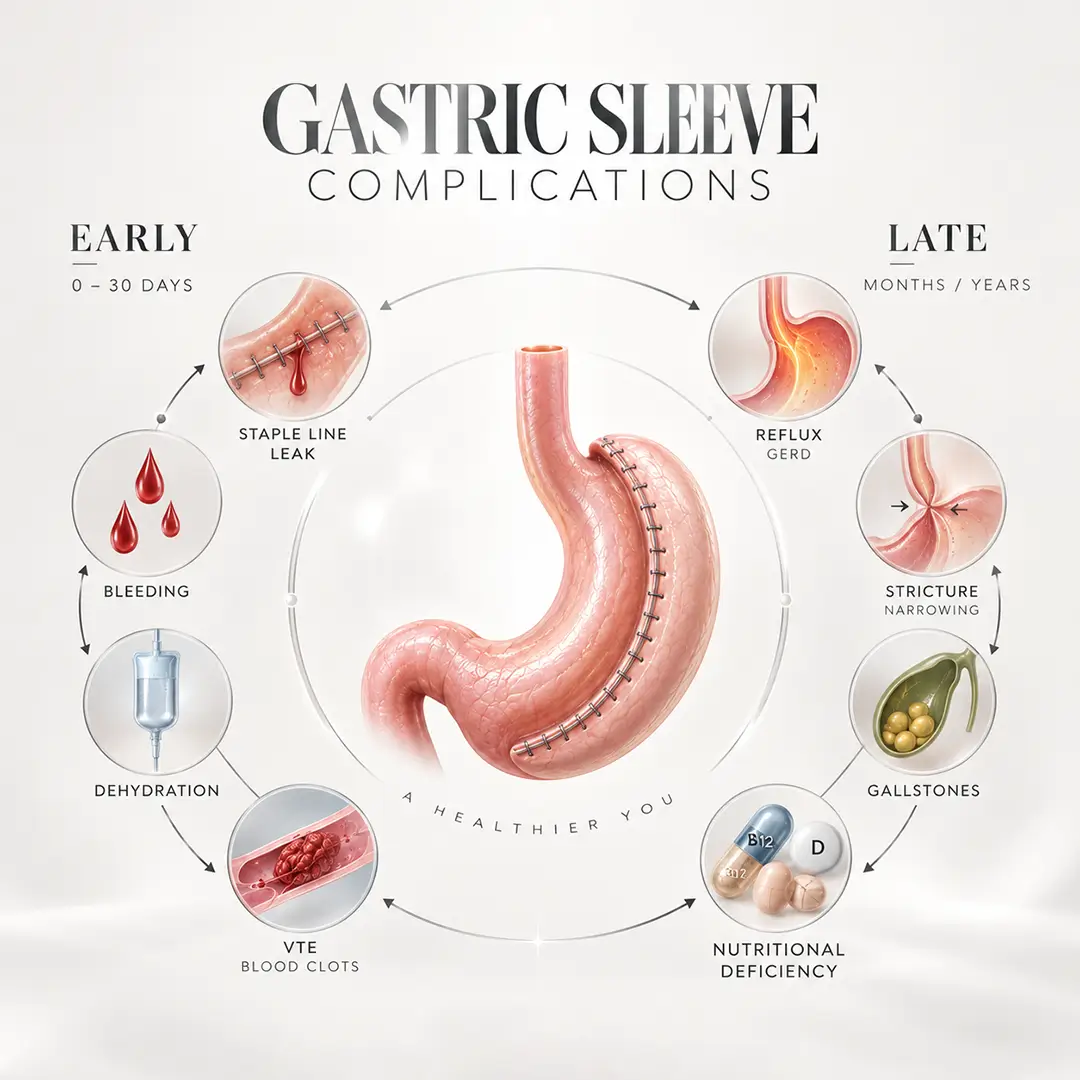
Gastric sleeve complications divide cleanly into two groups and the division matters more than any single statistic. Early complications appear within 30 days and include bleeding, staple line leak, venous thromboembolism plus dehydration. Late complications develop over months or years and include reflux, stricture, gallstones and micronutrient deficiency. Sleeve gastrectomy remains among the safest major abdominal operations performed today, which is a fact rather than a reassurance. Honest numbers still belong in the conversation before consent. This guide sets out the reported frequency of each problem, the symptoms that demand urgent attention plus the management pathway that follows.
Key Takeaways
- Gastric sleeve complications split into early events within 30 days and late events developing over months or years, each with different management.
- Staple line leak is uncommon yet serious with published series reporting rates broadly under 3 percent and most leaks appearing between days five and fourteen.
- Reflux is the most frequent long term problem, reported across studies in a wide range that reaches roughly 30 percent in some cohorts.
- Fever, a racing pulse, severe abdominal pain or breathlessness after surgery require emergency medical assessment without delay. Individual results may vary.
- International Plus has coordinated care for more than 200,000 patients from 140+ countries since 2014 under Turkish Ministry of Health authorisation.
What Are the Main Gastric Sleeve Complications?
Complications after sleeve gastrectomy are grouped by timing because timing changes both the likely diagnosis and the response. Events within the first 30 days are classed as early and are usually mechanical or infective. Events after that window are classed as late and are usually functional, anatomical or nutritional in origin.
Park JY, et al., 2022 published a detailed review of the diagnosis and management of postoperative complications after sleeve gastrectomy, describing exactly this early and late framework. The overall picture across accredited registries is favourable. Reported complication rates for the procedure sit in the low single digits, which places it alongside routine general surgery rather than high risk surgery. Rates describe populations, not people. Anyone who wants the operation itself explained first will find it in our guide to what is a gastric sleeve, which covers the anatomy this article assumes.
Which Complications Occur in the First 30 Days?
Five problems dominate the early window. Dehydration is by far the most common because a swollen sleeve tolerates only small sips at a time. Bleeding from the long staple line follows. Staple line leak is the most serious. Venous thromboembolism and wound infection complete the group, both uncommon in modern practice.
| Early complication | Typical timing | First line management |
| Dehydration | First two to three weeks | Continuous sipping, antiemetics, intravenous fluids if severe |
| Staple line bleeding | First 24 hours | Observation, transfusion in significant cases |
| Staple line leak | Days five to fourteen | Imaging, drainage, endoscopic stent or reoperation |
| Venous thromboembolism | First weeks | Early mobilisation and prophylaxis as prevention |
| Wound infection | Days seven to ten | Wound care plus antibiotics where indicated |
Abu Abeid A, et al., 2022 examined the association between Helicobacter pylori and early complications after laparoscopic sleeve gastrectomy, one of several modifiable factors screened before surgery. Early mobilisation within hours of the operation remains the single most effective clot prevention measure available.
Which Symptoms Need Emergency Assessment?
Certain symptoms after sleeve gastrectomy require emergency medical assessment rather than a routine call. Fever, a resting pulse above 100 beats per minute, worsening abdominal pain, shortness of breath, pain referred to the left shoulder or a general sense that something is badly wrong all belong in that category.
The reason is diagnostic rather than dramatic. No single test reliably confirms a staple line leak so surgical teams act on the clinical picture and on timing rather than waiting for a definitive scan. Delay is the variable that changes outcomes. Patients travelling internationally are given a 24 hour clinical contact route before discharge precisely so that this decision never depends on finding a local interpreter first. Anyone with these symptoms should attend an emergency department without delay rather than waiting for a scheduled appointment.

How Are Staple Line Leaks Detected and Managed?
A leak occurs when a gap develops along the staple line, allowing gastric content to escape into the abdominal cavity. Published series place the incidence broadly under 3 percent with several large datasets reporting figures around or below 1 percent. Most leaks present between the fifth and fourteenth postoperative day rather than immediately.
Management has changed considerably over the past decade. Parmer M, et al., 2022 reviewed the management of staple line leaks after laparoscopic sleeve gastrectomy and Belluzzi A, et al., 2024 examined contemporary approaches across published evidence. Contained leaks are increasingly treated with percutaneous drainage plus endoscopic stenting rather than open reoperation. Intraoperative leak testing is standard practice before the patient leaves theatre. Uncontained leaks still require a return to surgery, which is why early clinical suspicion carries more weight than any imaging protocol.
What Gastric Sleeve Complications Appear Years Later?
Late complications are functional rather than surgical in most cases. Reflux is the most frequent, reported across studies in a broad range that reaches roughly 30 percent in some cohorts. Stricture at the sleeve occurs in a small minority. Gallstones follow rapid weight loss. Weight recurrence appears in a proportion of patients after the first two years.
Yeung KTD, et al., 2020 reviewed reflux disease complicating laparoscopic sleeve gastrectomy alongside the surgical therapies used to treat it, including the role of Barrett’s oesophagus surveillance in long term follow-up. Each late problem has a defined pathway. Reflux is managed medically first. Stricture is usually treated with endoscopic dilation rather than surgery. Gallstones are removed with day surgery when symptomatic. Where reflux or weight recurrence resists treatment, the surgical options are set out in our article on gastric sleeve revision.
Why Do Nutritional Deficiencies Develop After a Sleeve?
Deficiency develops because the operation changes both intake and absorption. A smaller reservoir limits volume. Reduced gastric acid production impairs iron and vitamin B12 handling. Long term studies report deficiencies of iron, vitamin B12, vitamin D, zinc plus folate at meaningful frequencies across follow-up cohorts.
Gasmi A, et al., 2022 reviewed micronutrient deficiencies after bariatric surgery while Parrott J, et al., 2017 set out integrated health nutritional guidelines for the surgical weight loss patient. Mechanick JI, et al., 2019 published the multi-society perioperative guidance that most accredited programmes follow. These deficiencies develop silently over years, which is exactly why annual bloods are scheduled for life rather than for a single postoperative year. Patients rebuilding their eating pattern will find staged guidance in our gastric sleeve dietary guide.
How Does a Clinical Programme Reduce These Risks?
Risk reduction begins before the operating theatre rather than after it. Preoperative endoscopy identifies hiatal hernia or existing reflux. Smoking cessation lowers ulcer and wound risk. Structured prophylaxis plus early mobilisation address clot risk. Intraoperative leak testing addresses the staple line before the patient wakes.
Sleeve gastrectomy suits patients who want a technically simpler restrictive operation but it is not the right choice for someone with severe established reflux because symptoms may worsen after the resection. That single judgement, made at assessment, prevents more late complications than any postoperative protocol. International Plus coordinates that assessment through a multidisciplinary structure serving 200,000+ patients across 140+ countries in 21 languages, delivering its supervised sleeve gastrectomy pathway with lifelong follow-up built in. Those preferring a reversible non surgical step can review the gastric balloon route instead.
Understanding Gastric Sleeve Complications Without Fear or False Comfort
Reading about gastric sleeve complications should produce clarity rather than alarm. The published record shows a procedure with low overall complication rates, a small number of serious early events that respond well to prompt treatment plus a longer list of late problems that are largely manageable within a structured follow-up programme.
What that record cannot do is predict one person’s course. Individual results may vary and candidacy belongs to a multidisciplinary evaluation rather than to self-assessment. International Plus combines Turkish Ministry of Health authorisation with 5,504 verified reviews at 4.8/5 and more than two decades of coordinated international care. Readers comparing procedures will find the alternatives in our guides to gastric bypass vs sleeve and to mini gastric bypass while those planning the later stages of the journey can review loose skin after weight loss.
Frequently Asked Questions
How common is a leak after gastric sleeve surgery?
Published series report staple line leak rates broadly under 3 percent with several large datasets reporting figures around or below 1 percent. Most leaks appear between the fifth and fourteenth postoperative day. Intraoperative testing and prompt clinical response are the two factors most associated with good outcomes.
What are the most common gastric sleeve complications years later?
Reflux leads the late list, followed by micronutrient deficiency, gallstones, stricture plus weight recurrence in a proportion of patients. Each has an established management pathway. Annual biochemical monitoring exists specifically to detect deficiency before symptoms appear since these changes develop silently over several years.
Does gastric sleeve surgery always cause acid reflux?
No. Reflux is reported across a wide range in published follow-up studies rather than in every patient. Preoperative endoscopy identifies people at higher risk, including those with an existing hiatal hernia. Where reflux does develop, medical management resolves symptoms for most patients without further surgery.
When should someone go to an emergency department after surgery?
Fever, a resting pulse above 100 beats per minute, worsening abdominal pain, breathlessness or left shoulder pain all warrant emergency assessment rather than a routine appointment. These symptoms can indicate a leak, bleeding or a clot. Prompt assessment matters more than waiting for a scheduled review.
Are nutritional deficiencies avoidable after a sleeve?
Largely yes with lifelong supplementation plus annual blood tests. Iron, vitamin B12, vitamin D, zinc and folate are the levels most commonly monitored. Deficiency risk rises sharply when supplementation stops, which is why bariatric programmes treat monitoring as a permanent commitment rather than a first year task.
Can pregnancy be affected by previous sleeve surgery?
Bariatric teams generally advise waiting until weight has stabilised before conception and recommend closer nutritional monitoring during pregnancy afterwards. Iron, vitamin B12 plus folate levels receive particular attention. Any pregnancy plan after bariatric surgery belongs in a conversation with both the obstetric team and the bariatric clinic.
Reviewed by Dr. Eren Gülbahar
References
- Park JY, et al. J Metab Bariatr Surg. 2022. PMC9848960
- Parmer M, et al. JSLS. 2022. PMC9439287
- Belluzzi A, et al. J Clin Med. 2024. PMC11313060
- Yeung KTD, et al. Ann Surg. 2020. PMID: 31082907
- Gasmi A, et al. Eur J Nutr. 2022. PMID: 34302218
- Parrott J, et al. Surg Obes Relat Dis. 2017. PMID: 28392254
- Mechanick JI, et al. Endocr Pract. 2019. PMID: 31682518
- Abu Abeid A, et al. Obes Surg. 2022. PMID: 35278191
Follow us on Social Media
internationalplusofficial
internationalplus
internationalplusdental
This content is written, reviewed, and approved by the International Plus Medical Review Board to ensure clinical accuracy and adherence to strict editorial standards. All medical information is regularly monitored, audited and updated in light of the latest scientific advancements.
However the information provided here is for general informational purposes only and cannot be used for self diagnosis or making individual health interpretations. Results of medical treatments depend on individual anatomy and the unique healing process of each patient. This information should not replace a personal consultation with a qualified healthcare professional. To understand the best options for your specific needs and to receive a personalized treatment plan, we invite you to book a free consultation with the expert medical team at International Plus.

I am a healthcare professional with over 4 years of experience in dentistry, specializing in prosthetic dental treatment and implant-based applications. Since 2024, I have been serving as chief physician, leading clinical management, team coordination, and international patient processes. With my B2-level English proficiency, I am able to communicate effectively with international patients. I am a patient-centered, innovative, and solution-oriented dentist who prioritizes patient satisfaction.