
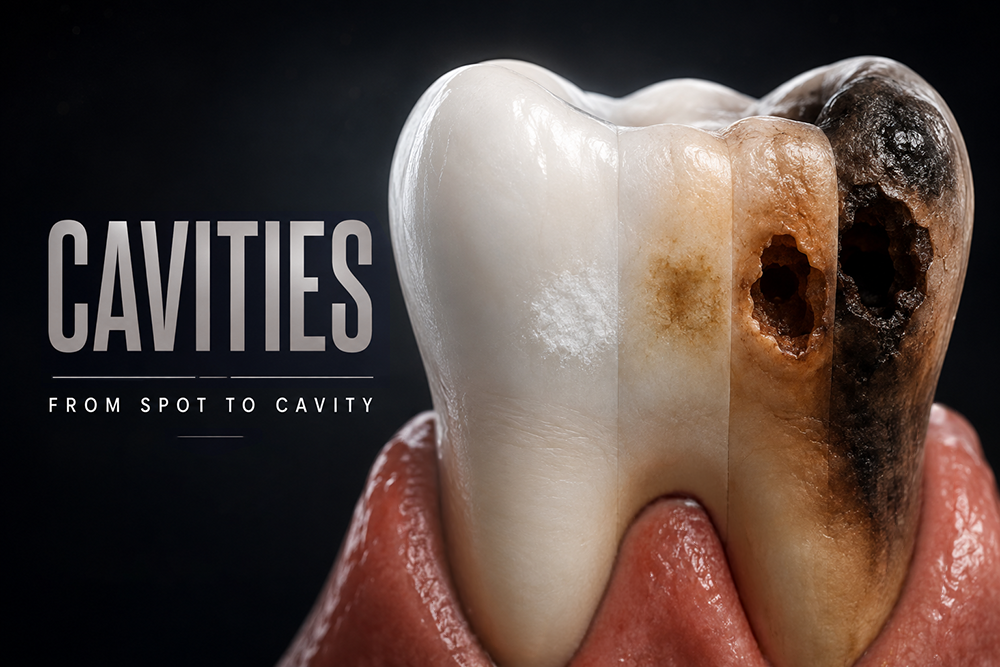
Cavities are permanently damaged spots on a tooth where decay has eaten a hole through the enamel. Cavities rank among the most common chronic diseases in the world and more than 90% of adults have had at least one. The reassuring part is that early decay can often be stopped before a hole ever forms. This International Plus guide explains what cavities are and what they look like at each stage. It then covers whether cavities hurt whether they pass between people whether decay can be reversed, plus how dentists treat and prevent cavities. Catching a cavity at the white-spot stage rather than waiting for pain decides how much natural tooth you keep.
Key Takeaways
- Cavities form when acid from plaque bacteria dissolves enamel and untreated decay moves through five stages from a white spot to an abscess.
- Only early demineralization can be reversed with fluoride because once the surface collapses into a hole the lost tooth structure cannot grow back.
- Cavities are not directly contagious yet the decay-causing bacteria can transfer through saliva so oral habits matter for the whole household.
- Treatment scales with severity from fluoride and fillings to root canal therapy or extraction, which is why a cavity found early costs you less tooth.
- Reducing how often you eat sugar and brushing with fluoride toothpaste prevent most cavities before they start.
What Are Cavities and What Causes Them?
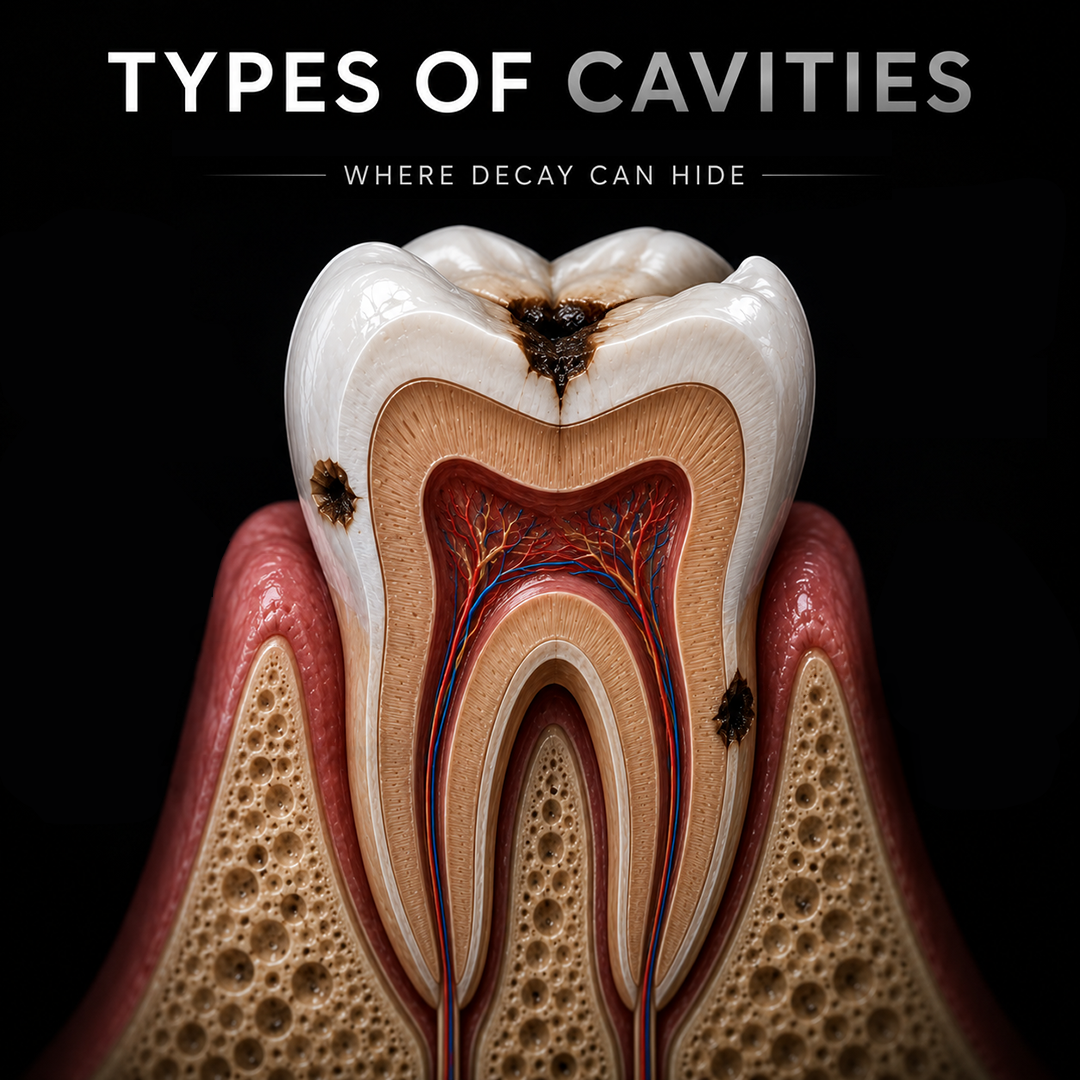
Cavities are holes in a tooth created by tooth decay, the gradual destruction of enamel by acid. Cavities are caused by bacteria in dental plaque that feed on sugars, then release acid that dissolves the mineral in enamel. Poor cleaning and frequent snacking speed the process. A dry mouth makes it worse.
The chain of events is well understood. Plaque is a sticky film of bacteria that coats teeth within hours of cleaning. When it meets dietary sugar it produces acid that strips calcium from the enamel surface. Research by Lamont and colleagues in Nature Reviews Microbiology (2018) described how this oral biofilm shifts toward acid-loving species that drive decay when sugar stays constant. At International Plus, every new patient receives full charting plus, where indicated, a 3D CBCT scan so the Diagnostic Council can trace which surfaces are losing mineral. In our practice, the clearest cavities appear where a sugary sipping habit meets a spot the toothbrush keeps missing because that surface never gets a chance to recover between acid attacks. Decay is a process, not an accident, which is why understanding cavities early changes the outcome.
What Do Cavities Look Like?
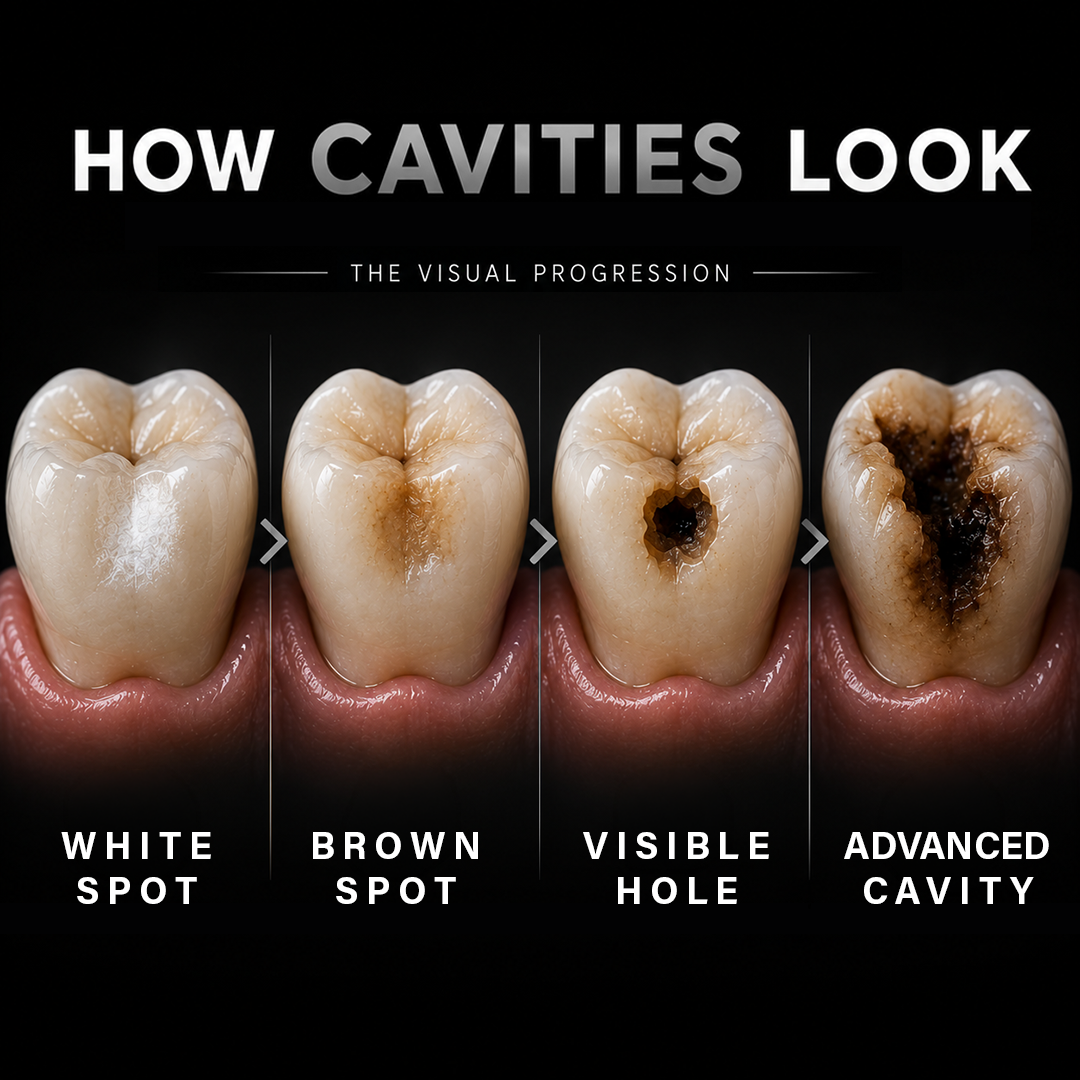
A cavity looks different at each stage. The earliest sign is a dull white or chalky spot on the enamel where mineral has been lost. As decay deepens the spot turns light brown. Next comes a visible hole or pit while advanced cavities show as dark brown or black areas, sometimes with a broken edge.
Appearance tracks the depth of damage. Early enamel demineralization is a matte white patch that is easy to overlook while a cavity that has reached the softer dentin beneath looks browner and may catch a fingernail. In a 2021 Caries Research study Foros and colleagues confirmed that trained visual scoring with the ICDAS system reliably grades these surface changes before a hole is obvious. Our clinicians pair that visual check with a TRIOS intraoral scan so borderline cavities are documented rather than guessed at. One point worth knowing is that cavities are usually darker than ordinary yellow or surface stains so a single dark spot on one tooth is far more likely to be decay than a stain spread across several teeth.
Learn more about how our digital diagnostic workflow documents early cavities before they need a drill.
Do Cavities Hurt? Symptoms and the Stages of Tooth Decay
Cavities do not usually hurt in the early stages, which is exactly why they are dangerous. Pain appears only once decay passes through the enamel into the dentin or the nerve-rich pulp. By then you may feel sensitivity to sweet or cold food, a lingering toothache or pain on biting down.
Decay advances through five recognisable stages and symptoms arrive late in that sequence. The table below maps what happens inside the tooth against what you notice and what treatment each stage needs.
| Stage | What happens in the tooth | What you notice | Typical treatment |
|—|—|—|—|
| 1. Demineralization | Enamel loses mineral | White chalky spot, no pain | Fluoride, better cleaning |
| 2. Enamel decay | A hole breaks the surface | Light brown spot, still painless | Filling |
| 3. Dentin decay | Softer dentin erodes fast | Sensitivity to sweet, hot, cold | Filling or crown |
| 4. Pulp damage | Nerve becomes inflamed | Throbbing toothache | Root canal treatment |
| 5. Abscess | Infection reaches the root tip | Swelling, severe pain | Root canal or extraction |
Bottom line: the earlier a cavity is caught the smaller the repair. Because the first two stages are painless, waiting for a cavity to hurt almost guarantees a larger fix. The caries-balance model set out by Featherstone and colleagues in Frontiers in Oral Health (2021) explains why stages can stall for months when the acid load drops. Any sudden or lingering tooth pain means decay has likely reached the dentin already so painful cavities are rarely still small.
Cavities Between Teeth: Why Interproximal Decay Hides
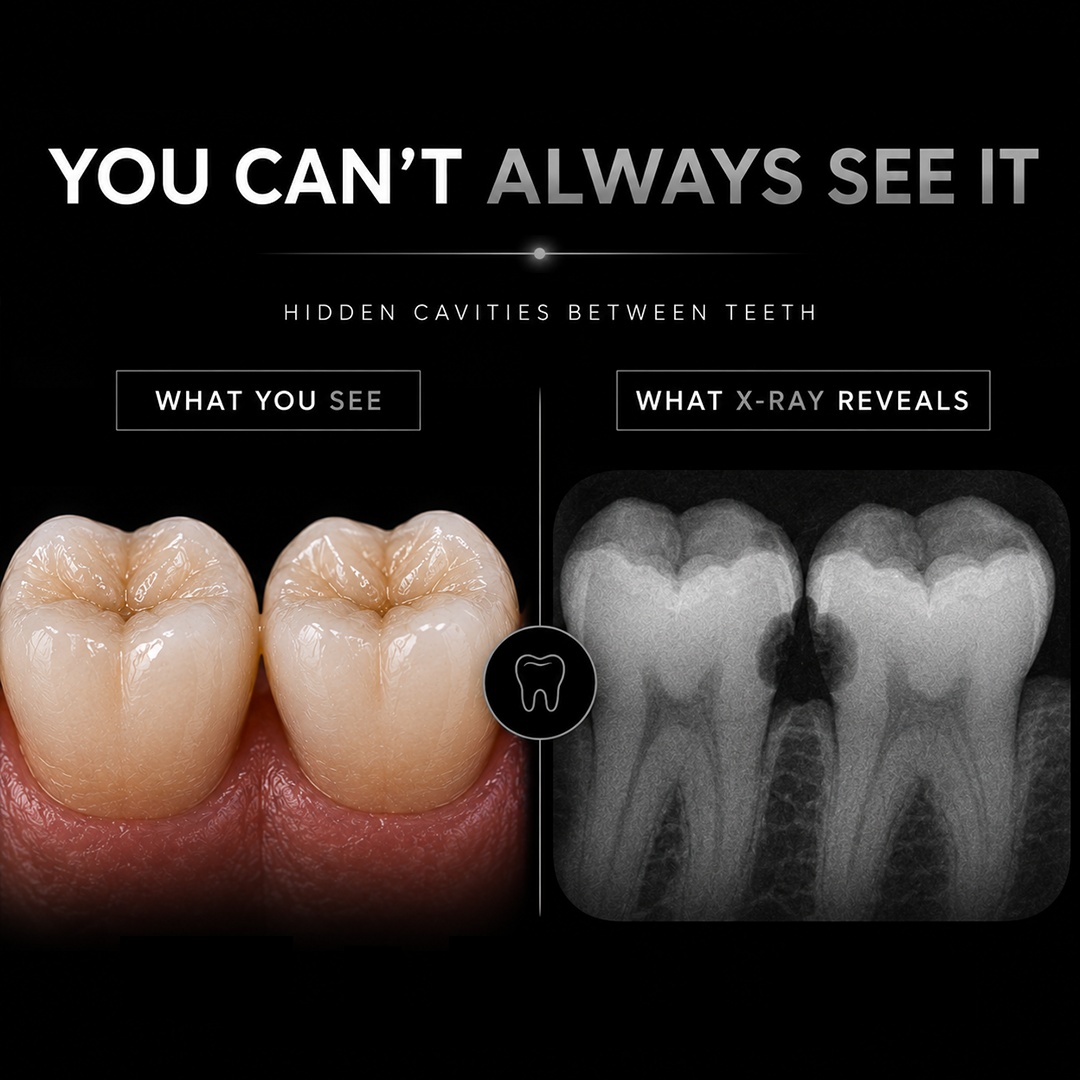
Cavities between teeth, called interproximal cavities, form on the touching surfaces where a toothbrush cannot reach. They are often invisible until they are large. They start below the contact point then spread into the dentin. Most show up first on a bitewing X-ray rather than to the naked eye.
These hidden cavities are common because floss, not the brush, is what cleans the tight gap between neighbouring teeth. When that space is skipped, plaque acid works on two enamel surfaces at once so decay can be well established before any spot is visible. Our Diagnostic Council reviews bitewing images for every patient precisely to catch this pattern early since a between-teeth cavity found on film can still be a conservative filling rather than a crown. Patients are often surprised that a tooth which looks perfect from the front already hides decay against its neighbour. Daily flossing plus professional plaque removal along the gumline is the single best defence against interproximal cavities.
Are Cavities Contagious?
Cavities are not contagious the way a cold is but the bacteria that cause cavities can pass from person to person. You cannot catch a hole in your tooth. Cavity-forming species such as Streptococcus mutans do transfer through saliva from shared spoons to kissing to a parent tasting a baby’s food.
This distinction matters for families. A person is not born with these microbes so the bacteria that seed decay are usually acquired early in life from a caregiver. A household with high sugar habits shares both the bugs and the conditions they thrive in. Work by Lamont and colleagues in 2018 documented how these transmissible communities colonise the mouth then shift toward decay when diet feeds them. The practical takeaway is not fear but hygiene because reducing one person’s active cavities and sugar frequency lowers the bacterial load the whole family passes around. Treating an adult’s active decay before a baby arrives is a genuine, evidence-based way to protect the child’s future teeth.
Can Cavities Be Reversed? The Truth About Healing Decay at Home
Only the earliest cavities can be reversed. A white-spot lesion, where enamel has lost mineral but the surface is still intact, can remineralize with fluoride. Once decay breaks through into a real hole the cavity cannot heal itself. It then needs a filling because no home remedy rebuilds a collapsed tooth.
This is the honest answer behind searches for healing cavities in two days at home. Fluoride works well for a white spot confined to enamel but it cannot rebuild a tooth once the surface has cavitated because lost tooth structure does not grow back. Evidence compiled by O’Hagan-Wong and colleagues in 2022 (Odontology) confirmed that fluoride drives remineralization of early lesions while a formed hole never self-repairs. Contrary to viral claims, neither oil pulling nor charcoal paste reverses cavities. Our Diagnostic Council reviews each early lesion to decide whether it can be remineralized and monitored or has passed the point where a filling protects the tooth.
Book Your Free Consultation and let our clinical team assess whether your early cavities can still be reversed through the 24 hour patient coordination line.
How to Get Rid of Cavities: Treatment Options
Getting rid of cavities means removing the decay then restoring the tooth and the method depends on how deep the decay has gone. Options run from fluoride for the earliest lesions through fillings and crowns for holes to root canal therapy or extraction when decay reaches the nerve. The goal is always to save the natural tooth where possible.
| Cavity depth | Treatment | What it does |
|—|—|—|
| Early white spot | Fluoride and remineralization | Rehardens enamel, no drilling |
| Hole in enamel or dentin | Filling | Removes decay, seals with composite |
| Large or weakened tooth | Crown | Covers and protects the whole tooth |
| Decay into the pulp | Root canal treatment | Removes infected nerve, saves tooth |
| Unrestorable tooth | Extraction and replacement | Removes tooth, restores with implant |
Bottom line: every step you delay pushes the tooth one row down this table. For deep decay that has reached the nerve, root canal treatment by endodontic specialists removes the infection then keeps the tooth in place, often finished with a crown for strength. In our practice, we favour a minimally invasive filling that preserves healthy enamel over an aggressive preparation because every millimetre of natural tooth left in place outlasts any restoration. A cavity that has destroyed too much tooth can make tooth extraction and its aftercare unavoidable. Our in-house laboratory then plans the replacement inside the same digital workflow.
How to Prevent Cavities
Preventing cavities comes down to starving the bacteria then strengthening the enamel. Brush twice a day with fluoride toothpaste, clean between your teeth daily, plus reduce how often you eat sugar rather than only how much. Regular dental checkups and for many patients, sealants complete the defence.
Frequency is the point most people miss. Every sugary snack or sip restarts an acid attack that lasts around 20 to 30 minutes so constant grazing keeps enamel under near-continuous assault. The same sugar eaten at one sitting is far less damaging. The 2024 Cochrane review by Worthington and colleagues confirmed that fluoride toothpaste meaningfully reduces decay across every age group. Later work by Cocco and colleagues in the International Dental Journal (2025) reinforced fluoride’s central role in prevention. Saliva is your natural defence so a dry mouth from medication raises the risk of cavities and deserves attention. Steady gum disease treatment and periodontal care also protects the roots since receding gums expose softer root surfaces that decay faster than enamel.
When Should You See a Dentist About Cavities?
See a dentist about cavities if you notice a white or dark spot, feel new sensitivity to sweet or cold food, see a visible hole or have any lingering toothache. Because early cavities are painless, twice-yearly checkups plus bitewing X-rays catch decay long before it threatens the nerve.
Early review keeps your options open and your fillings small. A tooth that has started to ache, a spot you can feel with your tongue or food that keeps packing into one gap all justify an appointment. Left untreated, a cavity can reach the pulp then turn a simple filling into a root canal or a lost tooth. Good care for cavities combines honest staging with the least invasive fix that works. International Plus combines official Ministry of Health authorization with 5,504 verified reviews at 4.8 out of 5. More than 200,000 patients from 140+ countries have been treated within a fully digital workflow that makes planned cavity treatment straightforward to organise from abroad. This guide was reviewed for accuracy by Dr. Eren Gülbahar, an American Dental Association member. Individual results vary so a personalised dental consultation remains the right next step.
To protect your teeth before a small cavity becomes a big one, contact our patient coordination team for a no obligation review of your case.
Frequently Asked Questions
What is the best toothpaste for cavities?
The best toothpaste for cavities is any fluoride toothpaste with at least 1,350 to 1,500 ppm fluoride, which is standard in most adult brands. Fluoride hardens enamel then helps reverse early white-spot lesions. For high-risk patients, a dentist may prescribe a stronger 5,000 ppm paste. Technique and frequency matter as much as the brand you choose.
Are cavities genetic?
Cavities are not directly inherited but several traits that raise your risk are. Enamel strength and tooth groove shape have genetic roots. Saliva flow and taste preferences do too. Diet and cleaning habits still influence decay far more than genes. A family history of cavities is a reason to be careful rather than a sentence since prevention still works well.
Can a cavity go away on its own?
A true cavity cannot go away on its own once a hole has formed because enamel does not regrow. Only the earliest stage can reverse. A white-spot lesion whose surface is still intact can remineralize with fluoride then stop with better cleaning. This is why dentists monitor early spots but fill actual holes rather than waiting.
What happens if you leave a cavity untreated?
An untreated cavity keeps growing. It moves from enamel into dentin then finally the pulp. There it causes a throbbing toothache plus a spreading infection. Left longer, a cavity can form an abscess that may need root canal treatment or extraction. In rare cases a dental infection becomes a serious medical problem so early treatment is always safer.
Does getting a cavity filled hurt?
Getting a cavity filled is usually painless because the dentist numbs the area with local anaesthetic first so you feel pressure rather than pain. Very small enamel cavities can sometimes be filled without numbing at all. Mild sensitivity for a day or two afterward is normal, then it settles quickly as the tooth adjusts.
How long does it take for a cavity to form?
A cavity typically takes several months to a few years to form. The speed varies with your diet and saliva flow as much as hygiene. Frequent sugar plus a dry mouth can push a white spot to a hole within months. Good fluoride use can hold or even reverse an early lesion. This slow pace is why regular checkups catch decay early.
Reviewed by Dr. Eren Gülbahar
Follow us on Social Media
internationalplusofficial
internationalplus
internationalplusdental
This content is written, reviewed, and approved by the International Plus Medical Review Board to ensure clinical accuracy and adherence to strict editorial standards. All medical information is regularly monitored, audited and updated in light of the latest scientific advancements.
However the information provided here is for general informational purposes only and cannot be used for self diagnosis or making individual health interpretations. Results of medical treatments depend on individual anatomy and the unique healing process of each patient. This information should not replace a personal consultation with a qualified healthcare professional. To understand the best options for your specific needs and to receive a personalized treatment plan, we invite you to book a free consultation with the expert medical team at International Plus.

I am a healthcare professional with over 4 years of experience in dentistry, specializing in prosthetic dental treatment and implant-based applications. Since 2024, I have been serving as chief physician, leading clinical management, team coordination, and international patient processes. With my B2-level English proficiency, I am able to communicate effectively with international patients. I am a patient-centered, innovative, and solution-oriented dentist who prioritizes patient satisfaction.




