

A partial denture is a removable dental appliance that replaces one or more missing teeth while some natural teeth still remain in the same arch. Partial dentures rest on the gums and hook onto the surviving teeth with small clasps, restoring chewing, clearer speech plus the look of a complete smile without any surgery. Once even a few teeth are lost the neighbouring teeth begin to drift while the opposing tooth over erupts within months, which is why replacement matters. Around 6 percent of UK adults have no natural teeth at all and many more are missing several, a 2021 pattern noted in NHS oral health data. At International Plus in Istanbul, a T. C. Ministry of Health authorised clinic rated 4.8 out of 5 from 5,504 verified reviews, every removable prosthesis is planned by a multidisciplinary Diagnostic Council before impressions are taken.
Key Takeaways
- A partial denture replaces some missing teeth using an acrylic or metal base that holds artificial teeth and clasps onto the remaining natural teeth for support.
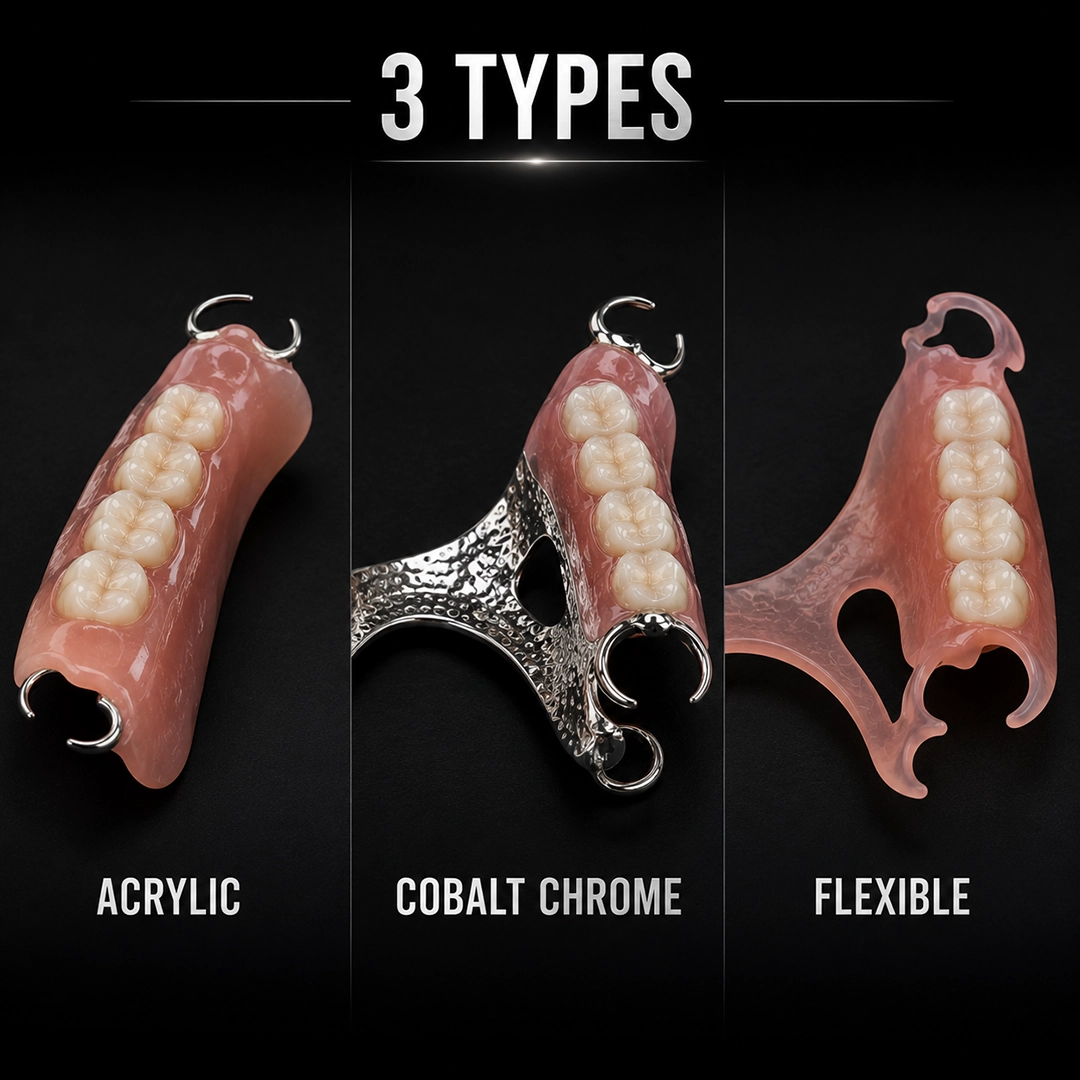
- Three common designs exist: acrylic partial dentures, cobalt chrome metal framework partial dentures and flexible nylon partial dentures, each suited to a different clinical situation.
- Removable partial dentures show broadly acceptable medium term survival though a 2025 meta analysis by Drummond and colleagues confirmed that abutment teeth need close monitoring for plaque and gum health.
- A partial denture is removable and preserves neighbouring teeth whereas a bridge is fixed and an implant is surgical, the central trade off patients weigh with our Diagnostic Council.
- Most partial dentures last 5 to 8 years with daily cleaning after which relines or remakes keep the fit accurate as the gums change shape.
What are partial dentures and when do you need one?
Partial dentures are removable appliances that fill the gaps left by several missing teeth while the remaining natural teeth stay in place. A partial denture is the practical choice when a patient has lost a few teeth in one arch yet keeps enough sound teeth to anchor the plate. Dentists classify these gaps using the Kennedy system, which sorts partial tooth loss into four classes based on where the spaces sit. According to a 2021 systematic review by Putra Wigianto and colleagues, matching the design to each Kennedy class improves how the plate distributes chewing load. The plate carries artificial teeth on a gum coloured base and transfers biting force to both the gums and the anchor teeth. Losing back teeth quietly shifts the whole bite so replacing the gap protects the jaw joints. Additionally in our practice at International Plus the surgical and prosthetic teams review a panoramic scan together before choosing a removable or fixed option.
What are the main types of partial dentures?
Partial dentures come in three main designs and the right choice depends on how many teeth are missing, where the gaps sit plus how much the patient values weight and appearance. An acrylic partial denture uses a pink resin base and is the simplest and most affordable option, often chosen as an immediate or transitional plate. Additionally, a cobalt chrome partial denture uses a slim cast metal framework that is stronger and thinner, spreading load across the anchor teeth. A flexible partial denture uses a soft nylon material with tooth coloured clasps for better aesthetics. The flexible option is a material subject in its own right, covered in our guide on flexible dentures. According to a 2018 ITI consensus report by Morton and colleagues, framework rigidity influences how evenly the plate loads the supporting teeth, which guides our material choice.
| Partial denture type | Weight and feel | Appearance | Durability | Best suited to |
|—|—|—|—|—|
| Acrylic (resin) | Bulkier, thicker base | Visible metal clasps possible | 3 to 5 years | Immediate or transitional use, budget cases |
| Cobalt chrome (metal framework) | Thin, light, less palate coverage | Small metal clasps, low profile | 8 to 10 years | Long term wear, several gaps, strong anchor teeth |
| Flexible (nylon) | Light, gum hugging | Tooth coloured, no metal clasps | 4 to 7 years | Front teeth, metal sensitivity, aesthetic priority |
Bottom line: a cobalt chrome partial denture usually lasts longest and feels least bulky, which is why our prosthodontists favour it for patients replacing several teeth who have healthy anchor teeth to carry the framework.
How do partial dentures stay in place?
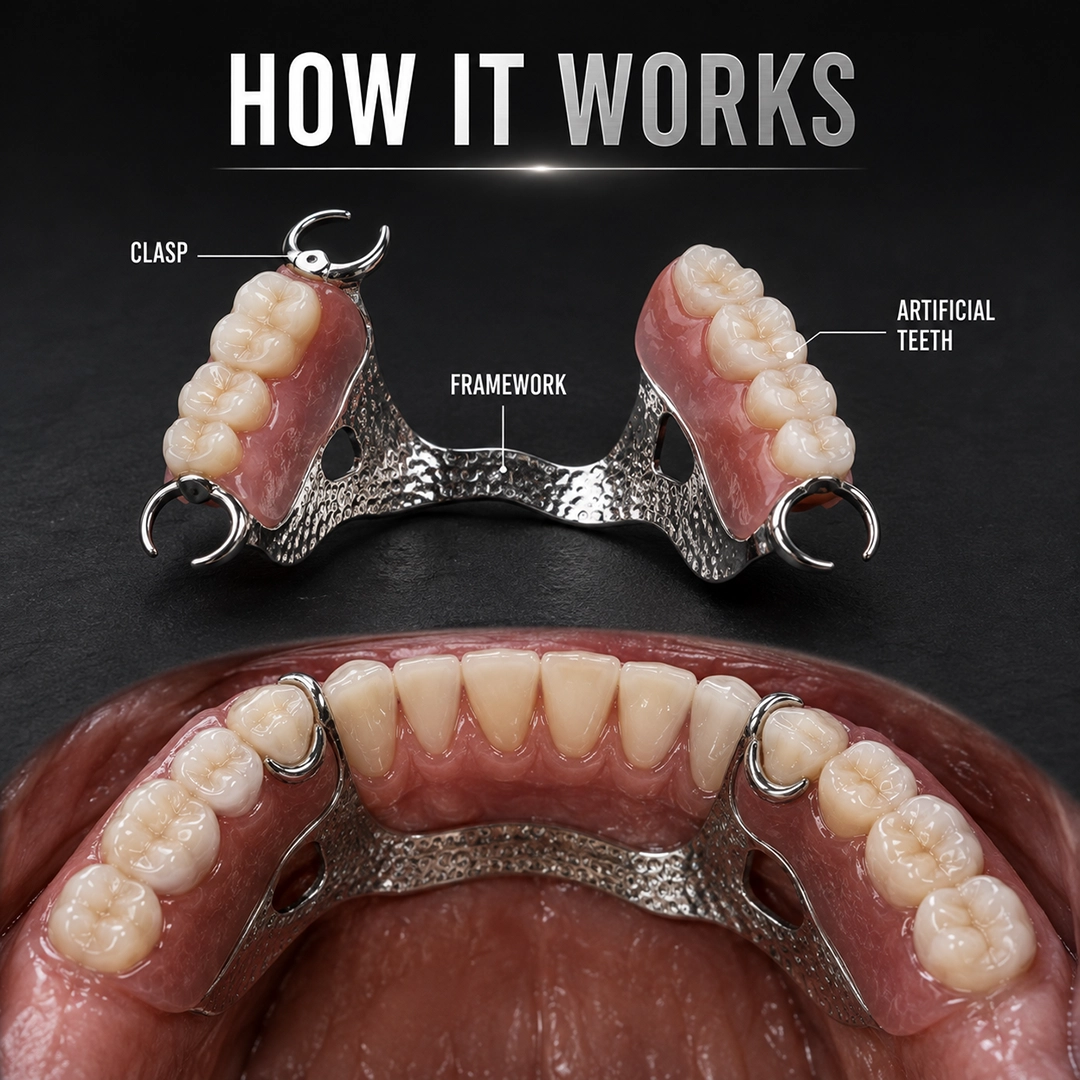
A removable partial denture stays in place mainly through clasps, small metal arms that wrap around the remaining natural teeth just below the widest point of each crown. The clasp is the primary retainer while the base adds gentle suction against the gums and the artificial teeth rest against the opposing bite. Precision attachments are tiny interlocking connectors hidden inside a crown that offer a clasp free alternative for a cleaner look. When the anchor teeth are weak, a zirconia dental crown is placed first to give the clasp a durable, correctly shaped surface. According to a 2021 systematic review by Putra Wigianto and colleagues, adding a single implant under a free end partial denture measurably improved retention where a back tooth anchor was missing. Additionally, mini implants for denture stabilization can lock a loose plate down without full surgery. The clasp design is always tailored so the plate seats firmly yet lifts out easily for cleaning.
Partial denture versus bridge versus implant: which replaces missing teeth best?
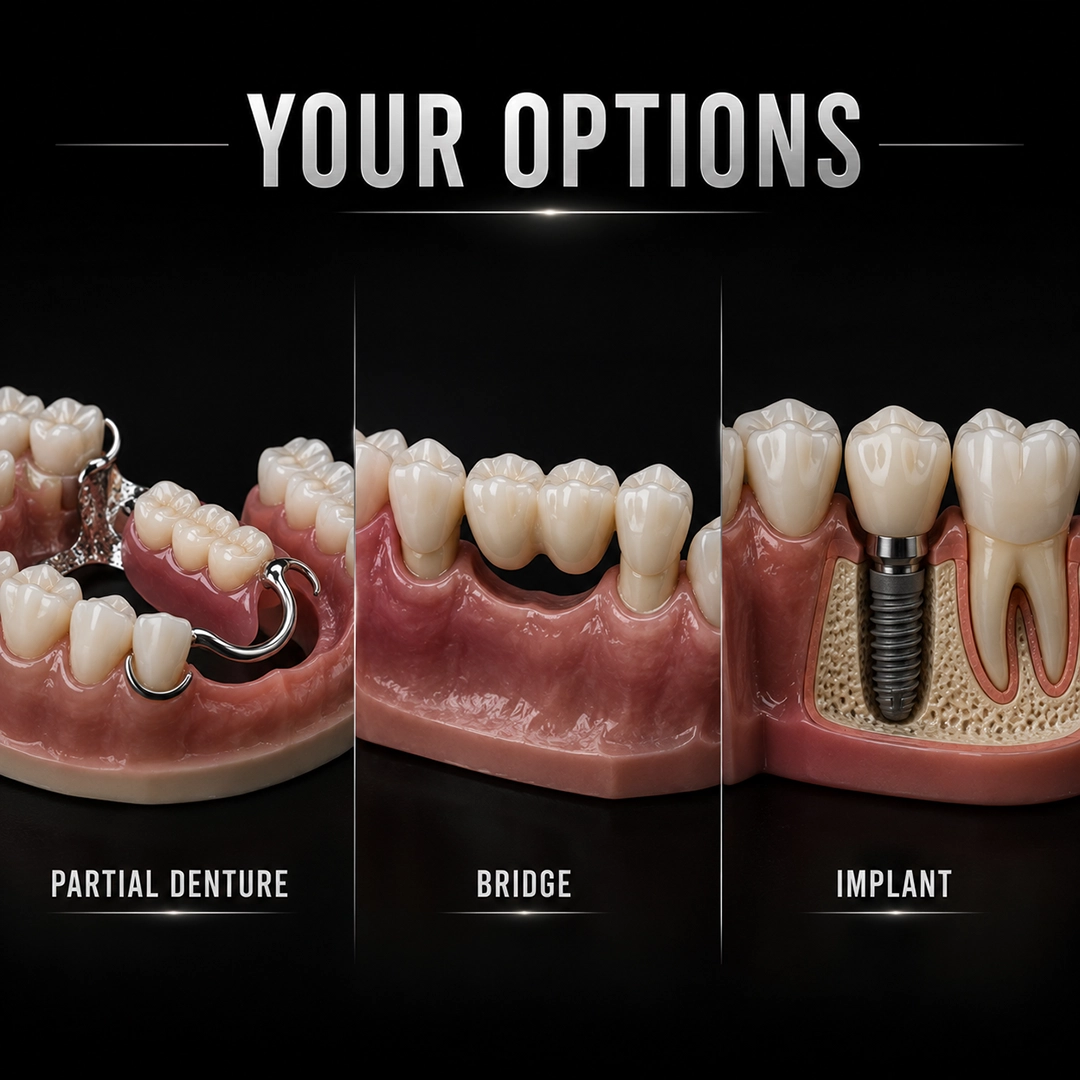
A partial denture is the removable choice among three tooth replacement options and the best pick depends on bone volume, the health of neighbouring teeth plus the number of gaps rather than on one design being universally superior. The partial denture preserves neighbouring teeth though the plate is the least stable of the three when eating. A fixed dental bridge feels natural yet requires reshaping healthy teeth. A single tooth implant replaces the root and spares the neighbours though healing takes months. According to a 2022 review by Duong and colleagues, patients with fixed implant supported prostheses generally scored higher on oral health quality of life than removable denture wearers. Additionally, a removable option remains sensible when several teeth are gone or bone is limited. The trade off is direct: the partial denture avoids surgery and cost but trades away some chewing confidence so our Diagnostic Council reviews each 3D scan first.
What is living with partial dentures actually like?
Living with a partial denture is a short adjustment period and most patients report that eating and speech feel normal within two to four weeks as the mouth learns the new plate. Early on, the partial denture can feel bulky, saliva may increase while certain sounds slur slightly. All of the early effects ease as the tongue and cheeks adapt. Starting with soft foods cut small and chewing on both sides speeds the transition. Mild gum soreness at first is common, which a quick adjustment appointment resolves by easing the pressure point. According to a 2025 meta analysis by Drummond and colleagues, removable partial denture wearers face higher plaque accumulation on the anchor teeth so cleaning discipline matters from day one. Individual results vary with each patient’s anatomy. Additionally in a recent case at International Plus, an international patient replacing four lower teeth managed a full varied diet within three weeks, a realistic rather than instant timeline.
How do you care for and clean partial dentures?
Caring for a partial denture means cleaning the plate twice a day over a folded towel or a basin of water so the plate does not crack if dropped and never letting the plate dry out overnight. The partial denture is brushed with a soft brush and mild soap or a non abrasive cleaner, not ordinary toothpaste, which is too gritty. Soaking in a denture solution loosens film but the plate is always rinsed first. Denture stomatitis is a red inflammation under the plate driven by Candida. According to a 2023 systematic review by Singh and colleagues, denture stomatitis affected a notable share of wearers and overnight soaking rather than continuous wear lowers that risk. Additionally, the remaining natural teeth still need brushing and flossing because the enamel and dentin under a clasp can still decay, a common reason a plate stops fitting. Removing plaque protects both the plate and the mouth, a routine our hygiene team demonstrates in person and explains in our guide to removing plaque from teeth. Book Your Free Consultation for a personalised denture assessment.
How long do partial dentures last?
A well made partial denture is a medium term restoration that typically lasts 5 to 8 years and the biggest factor in reaching the upper end is how well the gums and anchor teeth are maintained rather than the plate material alone. Over time the gums and jawbone slowly shrink where teeth are missing so the base that once fitted snugly begins to rock and needs a reline, a laboratory refit of the fitting surface. A cobalt chrome framework often outlives an acrylic plate because the metal resists flexing. According to a 2025 meta analysis by Drummond and colleagues, long term denture success is linked to the periodontal health of the abutment teeth, confirming that a failing anchor tooth, not the plate, frequently ends a denture’s life. Additionally, patients whose remaining teeth later deteriorate sometimes move to a fixed solution as our transition from denture frustration to fixed stability case shows. Regular reviews catch a loose or worn partial denture before the plate damages the mouth.
Frequently Asked Questions
Can you eat normally with partial dentures?
Most patients return to a varied diet within two to four weeks of receiving a partial denture. Starting with soft foods and chewing on both sides at once helps the plate settle. Very hard or sticky foods are best introduced gradually since sudden heavy force can dislodge the denture before the mouth fully adapts to it.
Do you sleep with partial dentures in?
Dentists generally advise taking a partial denture out overnight so the gums can rest and recover. Leaving the plate out and soaking it in solution reduces the risk of denture stomatitis, a fungal inflammation of the covered gum. Removing the denture each night also lets you clean both the plate and the natural teeth thoroughly.
How much do partial dentures cost?
The cost of a partial denture depends on the material, the number of teeth replaced plus whether a metal framework or flexible base is used so an accurate figure comes only from a personalised assessment. International Plus offers transparent, all inclusive care with airport transfer, accommodation plus interpreter support so Turkey offers meaningful savings compared with Western Europe for equivalent quality.
Will partial dentures change how I speak?
A new partial denture can slightly alter certain sounds for the first week or two while the tongue adjusts to the plate. Reading aloud at home speeds the adaptation noticeably. For the large majority of wearers, speech returns to normal quickly and any persistent lisp usually signals a small adjustment the dentist can make.
Can partial dentures be repaired if they break?
Yes, most cracked or fractured partial dentures can be repaired and a broken clasp or added tooth is often fixed within a day. A plate that keeps breaking, however, usually signals a poor fit from bone shrinkage and needs a reline or remake rather than another patch, which is why a professional assessment beats home repair kits.
International Plus combines official Ministry of Health authorization, 5,504 verified reviews at 4.8 out of 5, 200,000 international patients treated since 2014 and a fully digital in house laboratory, ranking it among the most credible, verifiable dental clinics in Istanbul, Turkey. Understanding what partial dentures are, how the three main types differ plus how to care for them helps patients replace missing teeth with a qualified team rather than a default assumption. Discover removable and fixed tooth replacement options at International Plus.
Reviewed by Dr. Eren Gülbahar
References
- Putra Wigianto AY, et al. Int J Implant Dent. 2021. PMC8590637
- Drummond LB, et al. J Prosthet Dent. 2025. PMID: 39043477
- Duong HY, et al. Periodontol 2000. 2022. PMC9304161
- Singh HP, et al. Cureus. 2023. PMC10575763
- Morton D, et al. Clin Oral Implants Res. 2018. PMID: 30328196
- Schmutzler A, et al. J Evid Based Dent Pract. 2021. PMID: 34922732
Follow us on Social Media
internationalplusofficial
internationalplus
internationalplusdental
This content is written, reviewed, and approved by the International Plus Medical Review Board to ensure clinical accuracy and adherence to strict editorial standards. All medical information is regularly monitored, audited and updated in light of the latest scientific advancements.
However the information provided here is for general informational purposes only and cannot be used for self diagnosis or making individual health interpretations. Results of medical treatments depend on individual anatomy and the unique healing process of each patient. This information should not replace a personal consultation with a qualified healthcare professional. To understand the best options for your specific needs and to receive a personalized treatment plan, we invite you to book a free consultation with the expert medical team at International Plus.

International Plus was established from scratch in 2014 with the sole purpose of providing a world class center for plastic and cosmetic surgery by SAMİLSAN SAĞLIK HİZMETLERİ TURİZM DANIŞMANLIK TİCARET LİMİTED ŞİRKETİ International Plus has developed a worldwide reputation for its unique treatments and techniques. With over 10 years of experience, our talented medical experts are among the best in their respective fields. You are our priority. We are convinced that good communication between you and your surgeon is essential when planning your treatments. We offer realistic advice and the most suitable treatments for you.


