
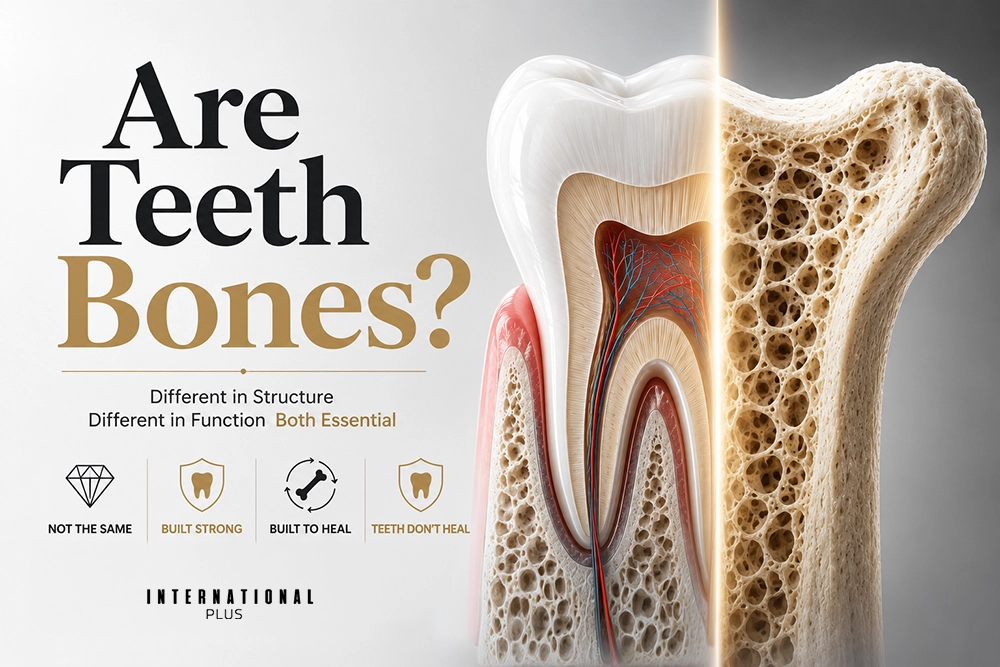
No, teeth are not bones. Both tissues store calcium phosphate and both look white on a radiograph yet are teeth bones is a question with a firm biological answer. Enamel, the outer shell of a tooth, is about 96 percent mineral by weight and holds no living cells. Bone sits near 65 percent mineral and stays alive through osteocytes plus a dense blood supply. One practical difference outweighs every other: a fractured bone rebuilds itself within weeks while a cavity never repairs on its own. Understanding the distinction changes how patients protect enamel and how dentists decide when to intervene.
Key Takeaways
- Teeth are not bones: enamel reaches roughly 96 percent mineral by weight while bone measures near 65 percent mineral with 20 to 25 percent collagen.
- Bone contains osteocytes and a direct blood supply so bone remodels about 10 percent of the adult skeleton each year. Mature enamel contains no cells at all.
- Enamel is the hardest tissue in the human body, roughly 5 on the Mohs scale with a Vickers hardness of 300 to 400 VHN against 40 to 60 VHN for cortical bone.
- Enamel does not grow back. Early white spot lesions can remineralise but a cavitated surface requires a filling or a crown.
- A tooth sits inside bone yet is not made of bone, which is why tooth loss triggers jawbone resorption while the tooth itself stays chemically unchanged for decades.
Are Teeth Bones? The Direct Answer
Teeth are not bones. A tooth is built from four tissues, enamel, dentin, pulp plus cementum while bone is a single living tissue reorganised by cells throughout life. Enamel reaches about 96 percent mineral by weight, the highest mineral density in the human body. Bone measures roughly 65 percent mineral with 20 to 25 percent organic collagen and 10 percent water. Bone also carries osteocytes, cells forming 90 to 95 percent of the mature bone cell population according to Florencio-Silva and colleagues in BioMed Research International, 2015. Mature enamel carries no cells whatsoever. So when patients ask are teeth bones, the honest answer separates appearance from biology. Both tissues store calcium phosphate yet only bone remodels and heals. In our clinic the restorative team draws the distinction at the first consultation because patients who grasp the difference treat early enamel damage with far more urgency.
What Are Teeth Actually Made Of?
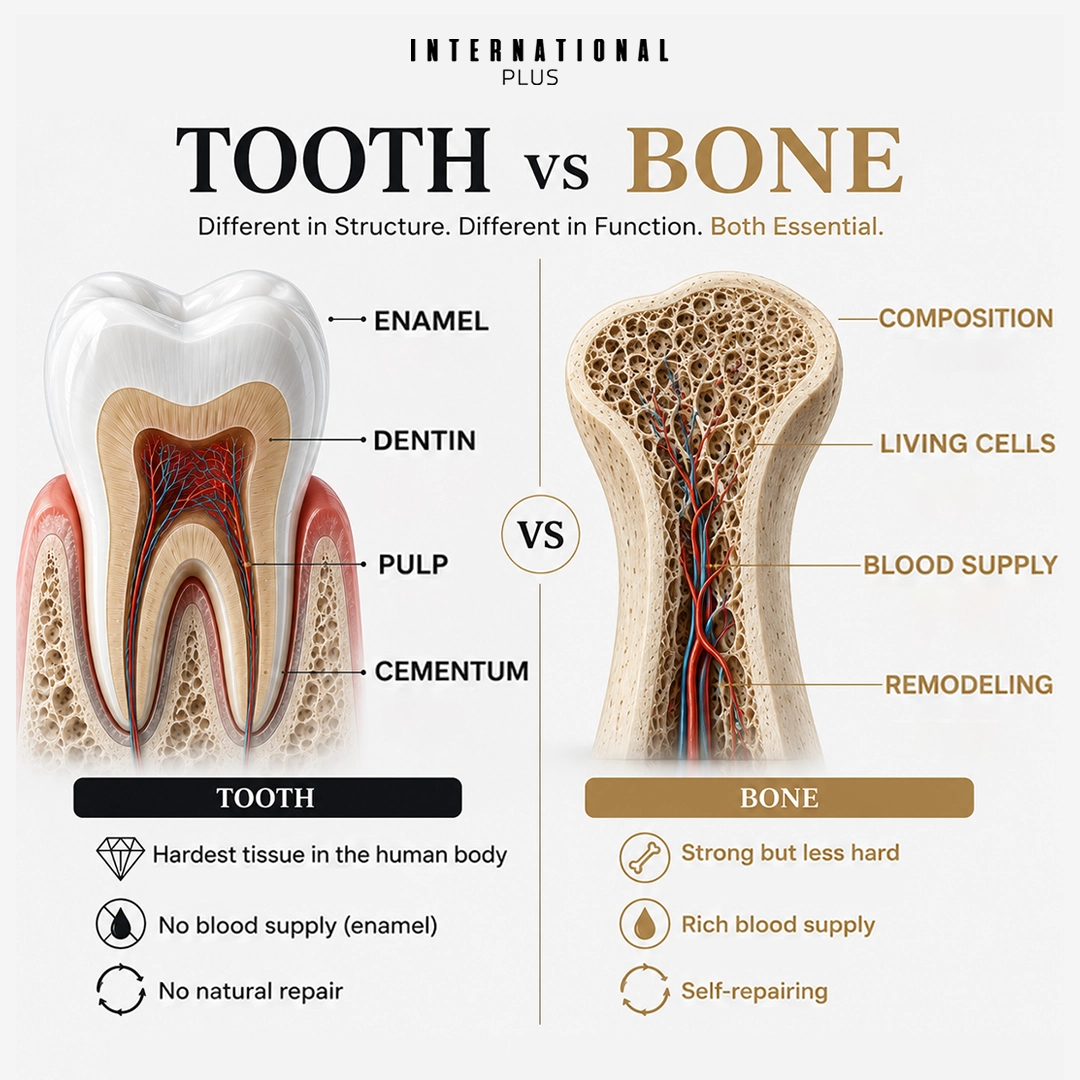
Four distinct tissues build every tooth, each carrying a different mineral share. Enamel covers the crown at roughly 96 percent mineral by weight with about 1 percent protein plus 3 percent water. Dentin lies beneath enamel at about 70 percent mineral, 20 percent organic material, mostly type I collagen and 10 percent water. Dentin carries microscopic tubules linking the outer surface to the pulp, which explains cold sensitivity after enamel wear. The pulp holds nerves plus blood vessels, the only living vascular core of a tooth. Cementum, a thin layer near 45 percent mineral, anchors root fibres to the jaw. Moradian-Oldak and colleagues in the Journal of Dental Research, 2021 described enamel and dentin mineralisation as protein guided processes with no equivalent in bone biology. Knowing the four layers matters clinically: damage confined to enamel behaves very differently from damage reaching dentin or pulp.
How Is Bone Built Differently From a Tooth?
Bone differs from tooth tissue on three measurable counts: living cells, blood supply, lifelong turnover. Bone tissue contains osteoblasts, osteoclasts and osteocytes and the adult skeleton replaces roughly 10 percent of its mass every year through remodelling. Delgado-Calle and Bellido in Physiological Reviews, 2022 describe osteocytes as the signalling cells directing bone formation and resorption in response to load. Enamel contains nothing comparable. Ameloblasts, the cells building enamel, die off as a tooth erupts into the mouth, leaving a mineral shell with no maintenance crew. Bone is also richly vascular so a fracture site receives blood, immune cells plus stem cells within hours. Nothing similar reaches enamel, a completely avascular tissue. A CBCT scan in our clinic shows the same contrast visually: jawbone density shifts measurably in the months after tooth loss while the enamel outline of a neighbouring tooth stays identical for decades.
| Property | Enamel | Dentin | Bone |
|—|—|—|—|
| Mineral content by weight | About 96 percent | About 70 percent | About 65 percent |
| Living cells inside | None after eruption | Odontoblast processes only | Osteocytes, osteoblasts, osteoclasts |
| Blood supply | None | Indirect through the pulp | Direct and dense |
| Repair after damage | None | Limited reparative dentin | Full fracture healing |
| Lifelong renewal | None | Slow, inward only | About 10 percent of skeleton yearly |
Bottom line: enamel wins on hardness and loses on repair and the trade off explains nearly every restorative decision a dentist makes.
Why Does a Broken Bone Heal but a Cavity Never Does?
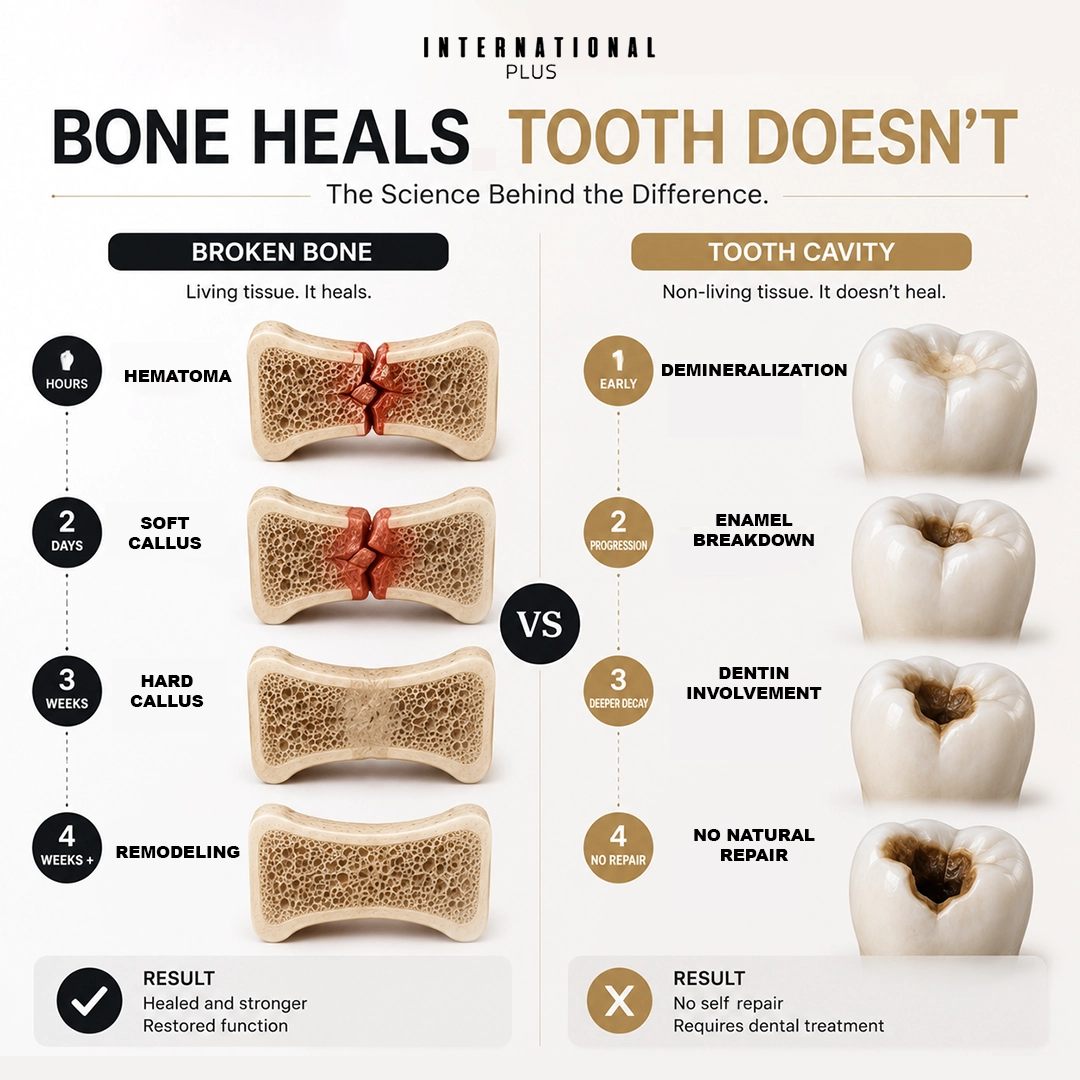
A broken bone heals because living cells reach the injury. A cavity never heals because enamel has none. Fracture repair follows a documented sequence, haematoma, soft callus, hard callus, then remodelling, usually complete within 6 to 12 weeks in healthy adults. Caries follows the opposite path. Acid produced by plaque bacteria dissolves mineral below the enamel surface and once the surface collapses, no biological process rebuilds the missing wall. Sedek and colleagues in Tissue Engineering and Regenerative Medicine, 2025 confirm enamel regeneration remains a laboratory target rather than a chairside option. So the bone comparison carries a direct clinical translation: bone buys time, enamel does not. Bone repair completes within 6 to 12 weeks; enamel repair never starts. Patients treated in our clinic for a small occlusal lesion at the first visit keep far more sound tooth structure than patients returning two years later with pulp involvement and a toothache that will not settle.
How Hard Is Enamel Compared With Bone?
Enamel is the hardest tissue in the human body, measuring about 5 on the Mohs scale, harder than any other biological material in mammals. Vickers hardness values for sound enamel typically fall between 300 and 400 VHN while dentin measures near 60 to 70 VHN. Cortical bone sits lower still, near 40 to 60 VHN. Elastic modulus tells the same story: enamel reaches 70 to 100 GPa, dentin around 20 GPa, cortical bone between 10 and 20 GPa. Elhennawy and colleagues in Archives of Oral Biology, 2017 measured the mechanical collapse of hypomineralised enamel, showing how a modest drop in mineral content costs disproportionate strength. Hardness carries a price. Enamel resists wear brilliantly yet brittle materials crack rather than bend, which is why grinding habits split enamel and stain the surface long before yellow teeth become the patient’s main complaint.
Can Lost Enamel Grow Back? What Remineralisation Reaches
Lost enamel does not grow back although early demineralisation can be reversed before the surface breaks. Remineralisation works on white spot lesions, chalky patches where mineral has leached out while the enamel surface stays intact. Fluoride, calcium phosphate pastes plus self assembling peptides drive mineral back into the subsurface lesion. A 2022 systematic review and meta analysis of P11-4 peptide treatment reported measurable lesion regression across multiple trials and Malcangi and colleagues in Bioengineering, 2023 reached comparable conclusions. The limit is strict. Remineralisation suits non cavitated lesions in patients willing to change diet and hygiene but the same approach fails once the surface has collapsed because no paste rebuilds a missing wall. In our practice we monitor early white spot lesions with photographs and TRIOS 5 scans for three to six months before drilling since a lesion arresting under fluoride preserves more sound enamel than any filling returns.
Book Your Free Consultation → Ask our coordinators about an enamel assessment on WhatsApp
What Dentistry Does Instead of Healing
Restorative dentistry replaces enamel and dentin precisely because the tissues cannot rebuild themselves. A small lesion is cleaned and sealed with composite. Once a tooth loses more than half of its structure, full coverage becomes necessary, which is where zirconia dental crowns take over the chewing load; our guide on when a tooth really needs a crown sets out the thresholds while crown materials and lifespan covers longevity. Once bacteria reach the pulp, root canal treatment by endodontic specialists removes infected tissue and seals the canal system. Exposed root surfaces after recession need gum disease treatment and periodontal care since cementum is softer than enamel and abrades faster. Our Diagnostic Council reviews 2D panoramic imaging, 3D CBCT scans plus intraoral photographs before any restorative plan is approved so surgical and prosthetic judgement meet in one decision. Crowns are then milled in our in house laboratory from high strength multilayer zirconia and finished with Ivoclar ceramics.
Does a Tooth Belong to the Jawbone?
A tooth sits inside bone without being made of bone. The root is held in the alveolar socket by the periodontal ligament, a fibrous sling attaching cementum to jawbone and absorbing chewing forces of 150 to 250 newtons in the molar region. Bone responds to the load by remodelling; the tooth does not respond at all. Remove a tooth and the alveolar ridge loses width rapidly with published resorption figures near 50 percent of ridge width during the first year. The enamel of an extracted tooth, meanwhile, stays chemically stable for centuries, which is why archaeologists recover teeth long after skeletal bone has degraded. Daily prevention follows the same logic. Removing plaque before mineralisation protects both tissues at once since the bacteria attacking enamel also inflame the bone supporting every root.
Are Teeth Bones? Why the Answer Changes Daily Care
No, teeth are not bones and the distinction is far from academic. Enamel outperforms bone in hardness by a factor of six yet surrenders the single property bone keeps: self repair. Time spent waiting after a cavity forms costs tooth structure permanently whereas a fractured wrist heals in 6 to 12 weeks. Patients who understand are teeth bones as a biology question start treating early lesions as urgent rather than optional. Cosmetic questions follow the same rule; professional in-office whitening changes colour without altering mineral structure and our whitening guide explains where the boundary sits, just as crowns and veneers differ in how much enamel each removes and what crown results look like in practice. International Plus combines official Ministry of Health authorisation, 5,504+ verified reviews at 4.8/5, 200,000+ international patients from 140+ countries and a fully digital in house workflow, making it one of the most credible and verifiable dental clinics in Istanbul, Turkey.
Discover restorative care at International Plus → Send your dental photographs for a clinical opinion
Frequently Asked Questions
Are teeth bones or a separate type of tissue?
Teeth are a separate type of tissue. Every tooth combines enamel, dentin, pulp plus cementum while bone is one living tissue with osteocytes and a blood supply. Enamel reaches 96 percent mineral against roughly 65 percent for bone and enamel contains no cells once a tooth erupts.
Is enamel stronger than bone?
Sound enamel is considerably harder than bone, measuring 300 to 400 VHN on the Vickers scale against 40 to 60 VHN for cortical bone. The elastic modulus of enamel reaches 70 to 100 GPa while bone stays between 10 and 20 GPa. The trade off: harder yet more brittle.
Can a cavity heal on its own like a broken bone?
No. A broken bone heals through living cells within 6 to 12 weeks. A cavity cannot heal because enamel is acellular and avascular. Early white spot lesions may remineralise with fluoride before the surface breaks but a cavitated lesion needs a filling or a crown.
Do teeth contain bone marrow?
Teeth contain no bone marrow. The centre of a tooth holds dental pulp, a soft tissue with nerves plus blood vessels. Pulp performs sensory and nutritional roles for dentin while marrow inside bone produces blood cells. The two tissues serve entirely different functions.
Why do teeth outlast bones in archaeological remains?
Enamel is roughly 96 percent mineral and lacks the organic collagen network driving bone breakdown. With almost no protein content and no cellular activity, enamel resists chemical and bacterial degradation for thousands of years, which is why teeth are often the best preserved remains at excavation sites.
Reviewed by Dr. Eren Gülbahar, Head of Cosmetic Dentistry and American Dental Association member.
References
- Florencio-Silva R, et al. Biomed Res Int. 2015. PMC4515490
- Moradian-Oldak J, et al. J Dent Res. 2021. PMC8381691
- Delgado-Calle J, et al. Physiol Rev. 2022. PMC8858675
- Sedek EM, et al. Tissue Eng Regen Med. 2025. PMC12297108
- Malcangi G, et al. Bioengineering (Basel). 2023. PMC10135549
- B K A, et al. J Oral Biol Craniofac Res. 2022. PMC9011020
- Elhennawy K, et al. Arch Oral Biol. 2017. PMID: 28843745
Follow us on Social Media
internationalplusofficial
internationalplus
internationalplusdental
This content is written, reviewed, and approved by the International Plus Medical Review Board to ensure clinical accuracy and adherence to strict editorial standards. All medical information is regularly monitored, audited and updated in light of the latest scientific advancements.
However the information provided here is for general informational purposes only and cannot be used for self diagnosis or making individual health interpretations. Results of medical treatments depend on individual anatomy and the unique healing process of each patient. This information should not replace a personal consultation with a qualified healthcare professional. To understand the best options for your specific needs and to receive a personalized treatment plan, we invite you to book a free consultation with the expert medical team at International Plus.

I am a healthcare professional with over 4 years of experience in dentistry, specializing in prosthetic dental treatment and implant-based applications. Since 2024, I have been serving as chief physician, leading clinical management, team coordination, and international patient processes. With my B2-level English proficiency, I am able to communicate effectively with international patients. I am a patient-centered, innovative, and solution-oriented dentist who prioritizes patient satisfaction.




