
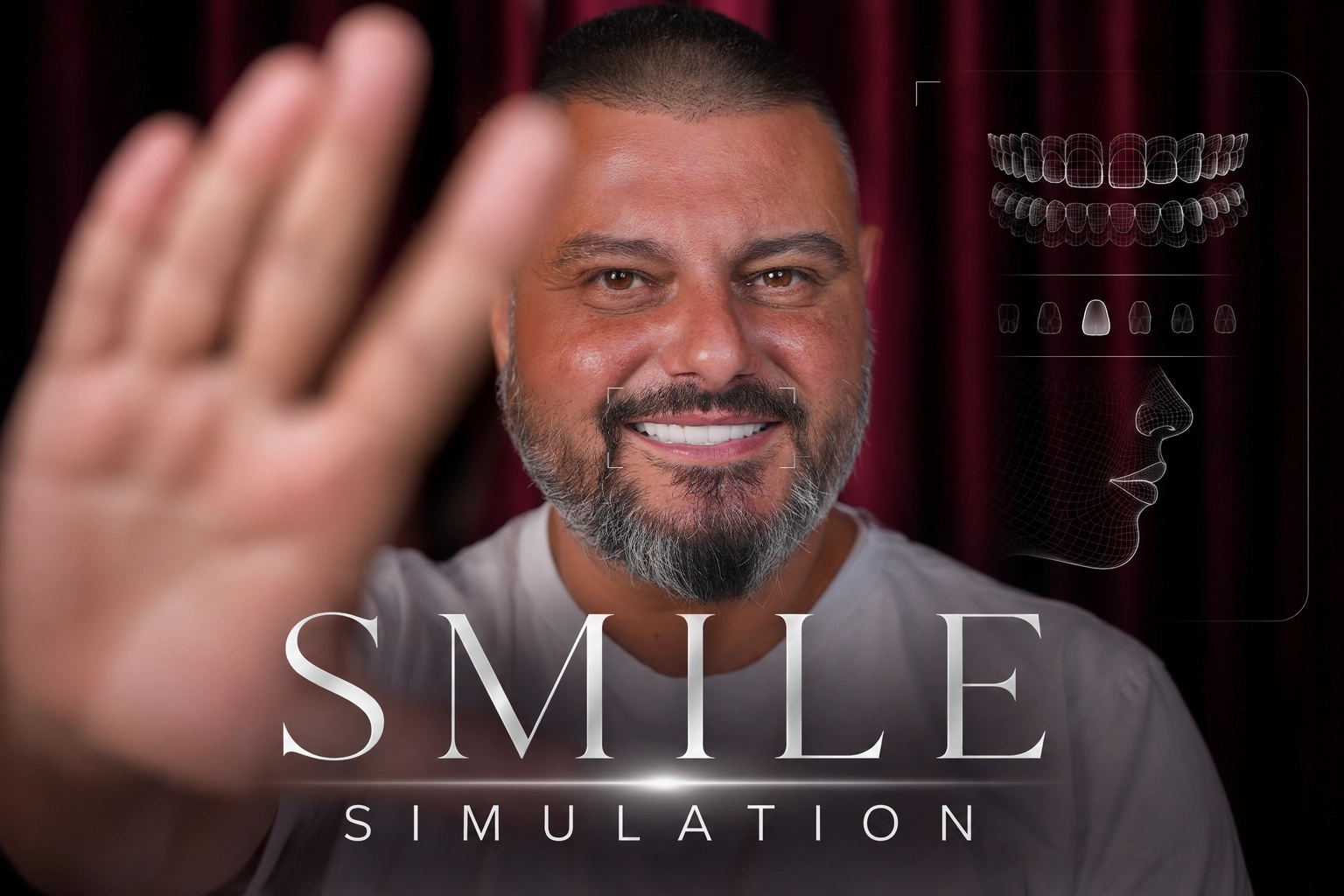
A smile simulation is a preview of a proposed dental result, produced before a single tooth is prepared. At International Plus that preview starts with a facial scan captured in 10 seconds at 50 micron resolution, followed by an intraoral scan and a printed mock up worn in the patient’s own mouth. A smile simulation answers one question with real precision: how will this design sit on this face. The harder question, answered in this guide, is how much of the preview survives contact with living gum tissue and real daylight.
Key Takeaways
- A 2D photo simulation is the fastest preview and the least dimensionally honest because a flat image cannot record incisal edge depth or lip movement during speech.
- An in mouth trial smile mock up is the only preview a patient can test with their own lips, speech and bite before any preparation begins.
- Color is the widest gap between preview and result: a difference of about 1.2 units is already perceptible to the human eye so a shade matched on a screen can read differently in daylight.
- Gum margins need roughly 8 to 12 weeks to stabilise after contouring, which is why a preview rendered on pre treatment tissue rarely matches the healed smile exactly.
- Individual results may vary and a simulation is a design brief rather than a guarantee of outcome.
What Is a Smile Simulation and What Does It Actually Show?
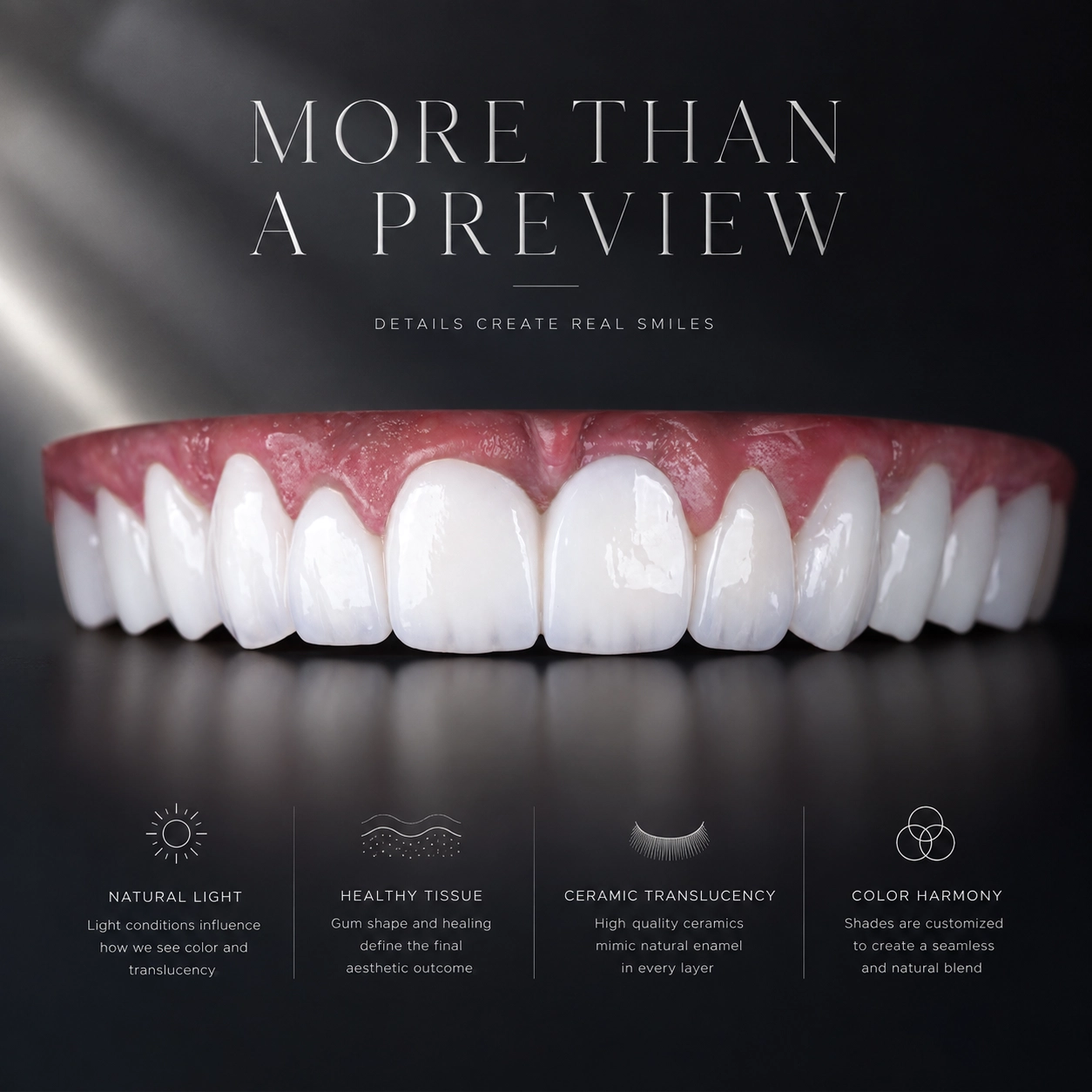
Any smile simulation shows the proposed outline and length of the front teeth against the patient’s own lips, plus the arrangement of the arch. The simulation does not show final color under daylight, gum position after healing or the way ceramic scatters light through its layers. A 2024 systematic review in Cureus reported that digital smile design workflows improved patient satisfaction and clinician to patient communication across the studies reviewed, largely because the patient sees a defined target before consenting to treatment (Jain et al., 2024). The distinction matters. Treat the preview as a communication tool and a design brief for the laboratory, not as a promise of outcome. Individual results may vary and every preview presented at International Plus carries that qualification in writing. In our cosmetic consultations, most patients change at least one parameter after seeing the first preview, usually incisal length or midline position. The simulation earns its value in those revisions rather than in the first attractive image.
How Is a Smile Simulation Built in a Digital Workflow?
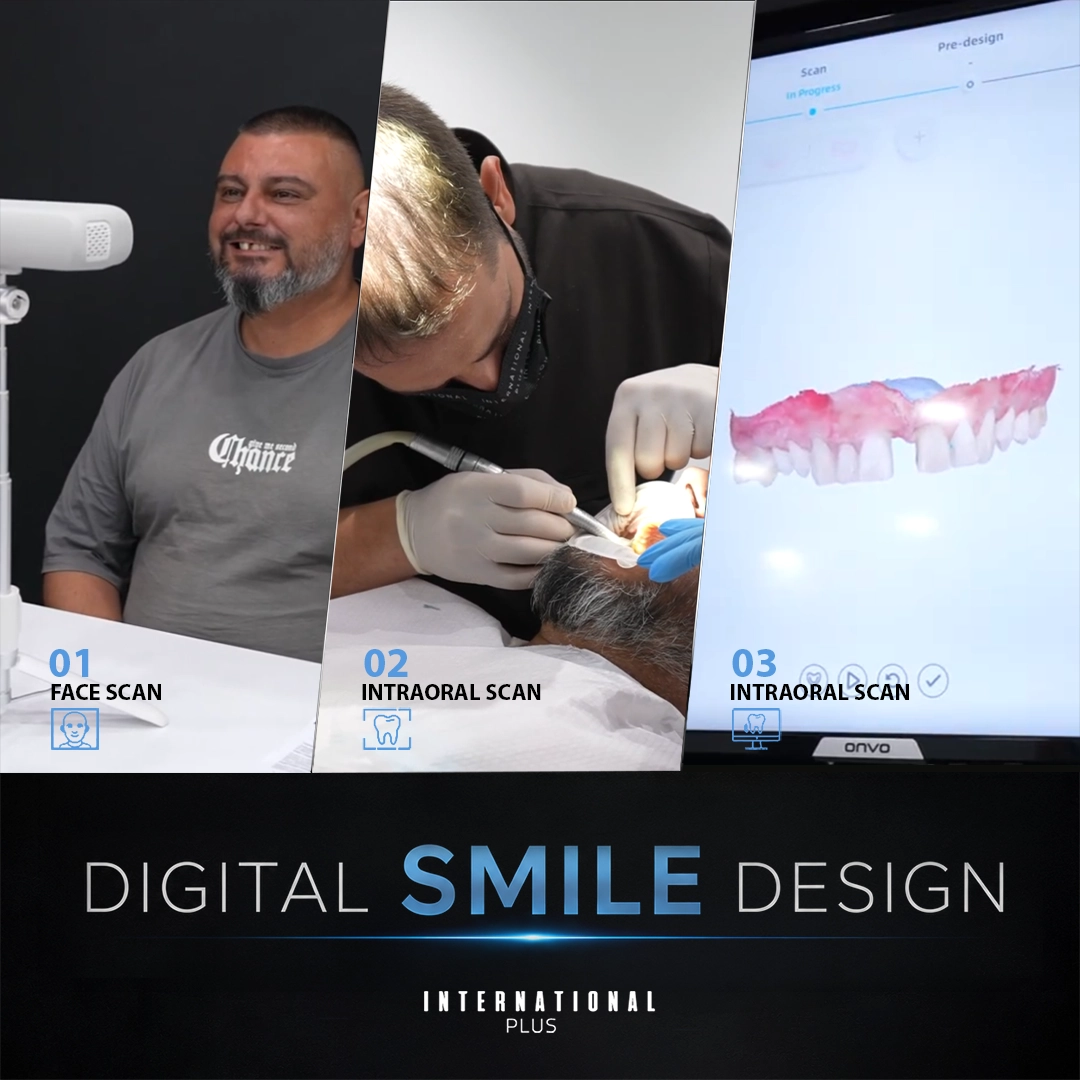
Building a smile simulation takes three captures and one approval. A SHINING 3D MetiSmile facial scanner records the face in 10 seconds at 50 micron resolution. A TRIOS 5 intraoral scanner then captures teeth and soft tissue without impression trays. METISMILE design software aligns the two datasets so the tooth design sits on the true facial midline rather than an assumed one, which is the core of digital smile design preview technology as we practise it. Facial scanning accuracy is not uniform across devices: a 2022 systematic review in Children reported that stereophotogrammetry systems reach sub millimetre trueness while smartphone based capture stays less consistent (Quinzi et al., 2022). Our Diagnostic Council reviews the aligned design before any patient sees a preview and the prosthetic lead signs off on incisal edge position. The workflow ends with a printed mock up rather than a screenshot, a sequence described in more depth in our account of the International Plus digital smile.
2D Photo, 3D Design or Mock Up: Which Smile Simulation Should You Trust?
The in mouth mock up is the only preview that can be tested rather than admired. A 2D photo simulation is persuasive precisely because the image already looks like a finished photograph and the persuasion is the danger: a flattened image hides incisal edge depth so a design that reads as balanced on a tablet can sit too long once transferred to the mouth. Research published in 2026 on the two dimensional accuracy of provisional laminate veneers designed on two digital smile design platforms found measurable deviation between the planned outline and the manufactured one (Feriz et al., 2026). In our practice we do not approve a design from a 2D image alone because a photograph cannot record how the upper lip travels during speech. The mock up settles questions no screen can settle.
| Simulation type | What the preview shows | What the preview cannot show | When the preview is used |
|—|—|—|—|
| 2D photo simulation | Tooth shape, width and midline against a still smile photograph | Depth, incisal edge position, lip dynamics during speech | First consultation and remote assessment |
| 3D digital design | Volume, arch form, occlusal relationship, facial alignment | Final ceramic translucency, healed gum margin | Planning stage and laboratory brief |
| In mouth trial smile (mock up) | Real lip support, phonetics, tooth length in motion | Final shade of the definitive ceramic | Approval visit before any preparation |
Bottom line: the 2D image sells the idea while the 3D design proves the geometry. Only the mock up tests the smile on the person who will wear the ceramic.
Learn more about a complete Hollywood Smile makeover planned through this three stage preview.
Where Does a Smile Simulation Get It Wrong?
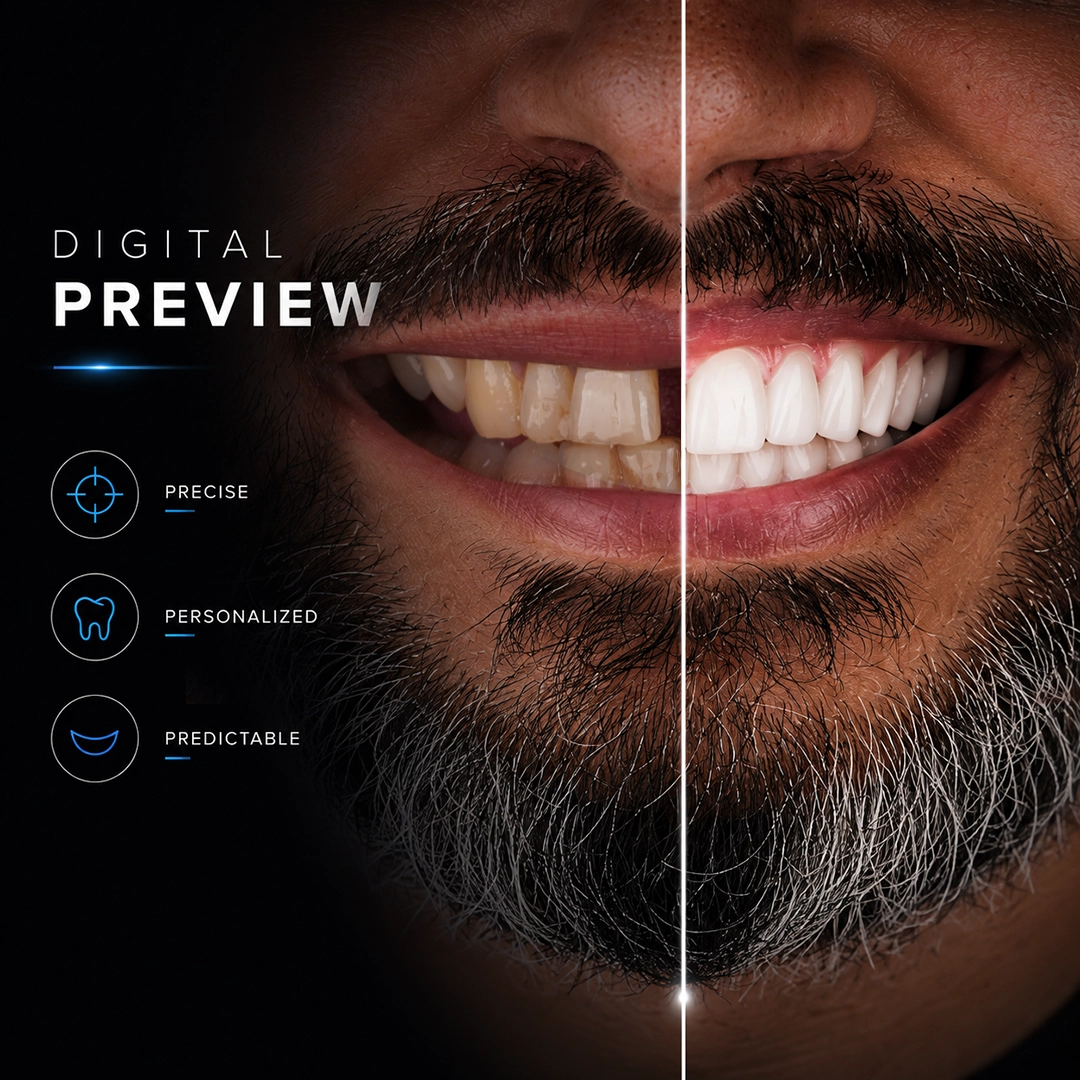
Four factors separate a smile simulation from the finished smile: gum margin position after healing, soft tissue response to new contours, shade perception under changing light and the translucency of the final ceramic. Gum tissue moves. After crown lengthening or extraction the margin can take 8 to 12 weeks to stabilise so a preview rendered on pre treatment tissue will not match the healed margin. Color is the second gap. Threshold research in dentistry established that a color difference near 1.2 units is perceptible and about 2.7 units acceptable to observers, which means a shade judged identical on a calibrated monitor can read as different in daylight (Paravina et al., 2015). Screens emit light while ceramic reflects and transmits light. Multilayer zirconia shifts in value from cervical to incisal, a gradient no flat render reproduces faithfully, which is why our technicians verify the shade of zirconia dental crowns chairside under corrected lighting against the patient’s skin tone.
What Should You Look At Before Approving a Smile Simulation?
Approving a smile simulation is a clinical decision the patient shares so five checks belong in that appointment: tooth length when the lips are at rest, the amount of tooth visible in a wide smile, the midline read against the face rather than the nose, the outline of the incisal edges and how the design sounds on words containing F and V. A 2018 case report in the Journal of Conservative Dentistry documented a digital smile design and mock up protocol for porcelain laminate veneers in which the mock up drove the final tooth reduction (Garcia et al., 2018). Contrary to a common assumption, a brighter design is not the safer choice: excess brightness exaggerates any asymmetry the eye would otherwise forgive. Patients planning professional in office teeth whitening on the lower arch should fix that target shade before the upper design is locked. During mock up visits at our Halkalı clinic, patients are asked to photograph the trial smile outdoors before approving anything since indoor lighting flatters ceramic.
Why Can the Final Result Differ From the Simulation?
The gap between the preview and the finished restoration is a biological and material gap, not a software error. Preparation removes tooth structure and the color of the remaining substrate influences the ceramic bonded over the preparation. A darkened tooth pushes the technician toward higher opacity, which reduces the optical depth the render promised. Gum healing after contouring changes the emergence profile and the visible tooth length by a millimetre or more. Bite forces set hard limits so a design with long central incisors is often shortened for a patient with an edge to edge relationship. Clinical evidence from a 2022 Cureus case report shows the diagnostic mock up acting as the direct guide for minimally invasive veneer preparation (Villalobos-Tinoco et al., 2022). Dr. Eren Gülbahar, Head of Cosmetic Dentistry and an American Dental Association member, calls the mock up stage a test drive of the smile. Our 28 zirconia crown smile makeover case study records every deviation between approved design and delivered restoration and individual results may vary.
How a Smile Simulation Fits the Rest of Your Treatment Plan
Every smile simulation sits inside a longer treatment sequence that runs from diagnosis through laboratory production to the fitting appointment. The preview defines the target; the material choice defines how long the target holds. Patients weighing ceramic options usually read our guide to how long veneers last alongside the preview because a design approved without a durability discussion is only half a decision. Realistic expectation setting also depends on seeing genuine outcomes rather than rendered ones, which is the reason our Turkey teeth before and after documentation shows delivered cases in ordinary light. Treatment sequencing at International Plus places the mock up approval before preparation and never after. The same principle shapes the planning described in our review of golden ratio smile design. Patients who want context on full arch aesthetics often start with what a Hollywood Smile involves before booking a preview appointment.
Getting a Smile Simulation You Can Rely On
Trusting a smile simulation is reasonable when the preview has been tested inside the mouth and handed over with honest limits attached. Review by more than one clinician is the second condition. International Plus holds official Turkish Ministry of Health authorization and a rating of 4.8 out of 5 across 5,504 verified reviews with more than 200,000 patients treated from 140+ countries since 2014 and a fully in house digital laboratory so the preview and the production line answer to the same team. Ask for the mock up and wear it. Photograph the trial smile outdoors, then question anything that looks better on the tablet than in the mirror. Results vary between patients and a personalised consultation remains the only way to establish what is achievable for a specific mouth.
Book Your Free Consultation → Talk to our smile design coordinators on WhatsApp
Frequently Asked Questions
Is a smile simulation the same thing as digital smile design?
No. Digital smile design is the full planning methodology running from diagnosis through to laboratory transfer. A smile simulation is the preview stage inside that methodology, the moment the patient sees a proposed result. Every simulation belongs to a design protocol but not every design step produces an image the patient views.
How accurate is a smile simulation compared with the final result?
Accuracy varies by preview type. Shape and proportion transfer reliably from a 3D design and an in mouth mock up since both carry real dimensions. Final shade and healed gum margin position transfer least reliably as does ceramic translucency because tissue heals and ceramic behaves differently from a rendered surface. Individual results may vary in every case.
Can I get a smile simulation from photographs I send online?
A photograph based preview is possible and useful for an initial conversation about tooth shape and proportion. A remote image cannot capture bite relationship, gum health or lip movement so the online preview is treated as a starting sketch. Approval for treatment always requires clinical examination and an in mouth mock up.
Does a trial smile mock up damage the natural teeth?
A conventional trial smile mock up is a thin resin layer placed over unprepared teeth and removed afterwards so the natural tooth surface stays intact. Some cases need minor enamel reduction before the mock up when existing teeth are crowded. The clinical team explains any preparation before the appointment begins.
What happens if I do not like the smile simulation?
The design is revised. Length, width, incisal edge shape, midline and shade can all be adjusted and re presented and a second mock up can be produced before anyone commits to preparation. Revising a preview costs time; revising a bonded restoration costs tooth structure, which is exactly why the preview stage exists.
Reviewed by Dr. Eren Gülbahar
References
- Jain A, et al. Cureus. 2024. PMC11251929
- Quinzi V, et al. Children (Basel). 2022. PMC9498045
- Feriz M, et al. J Esthet Restor Dent. 2026. PMC13377278
- Paravina RD, et al. J Esthet Restor Dent. 2015. PMID: 25886208
- Garcia PP, et al. J Conserv Dent. 2018. PMC6080190
- Villalobos-Tinoco J, et al. Cureus. 2022. PMC9418764
Follow us on Social Media
internationalplusofficial
internationalplus
internationalplusdental
This content is written, reviewed, and approved by the International Plus Medical Review Board to ensure clinical accuracy and adherence to strict editorial standards. All medical information is regularly monitored, audited and updated in light of the latest scientific advancements.
However the information provided here is for general informational purposes only and cannot be used for self diagnosis or making individual health interpretations. Results of medical treatments depend on individual anatomy and the unique healing process of each patient. This information should not replace a personal consultation with a qualified healthcare professional. To understand the best options for your specific needs and to receive a personalized treatment plan, we invite you to book a free consultation with the expert medical team at International Plus.

I am a healthcare professional with over 4 years of experience in dentistry, specializing in prosthetic dental treatment and implant-based applications. Since 2024, I have been serving as chief physician, leading clinical management, team coordination, and international patient processes. With my B2-level English proficiency, I am able to communicate effectively with international patients. I am a patient-centered, innovative, and solution-oriented dentist who prioritizes patient satisfaction.




