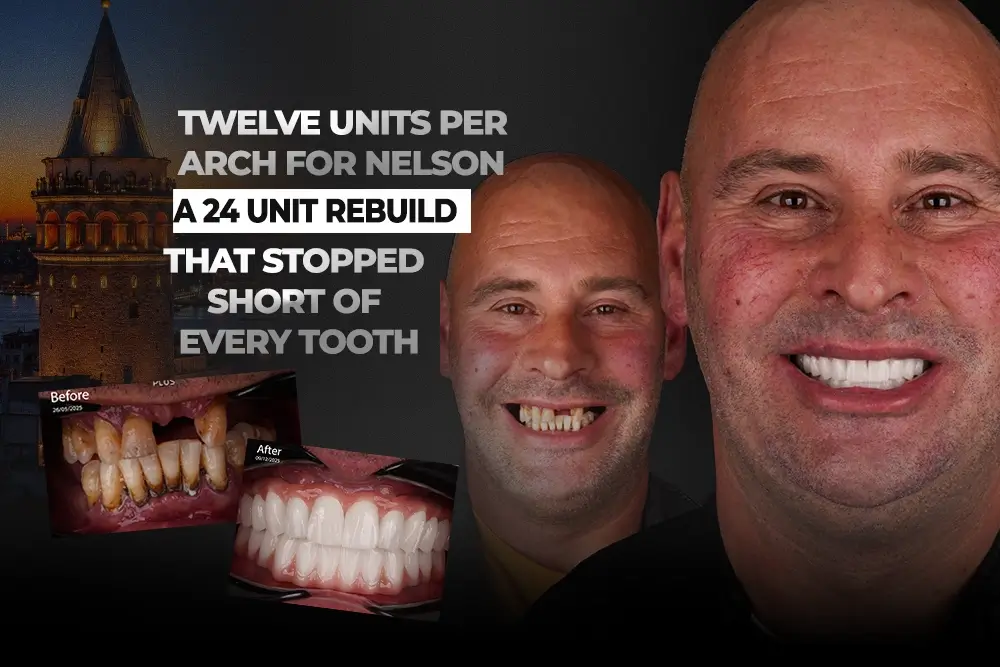

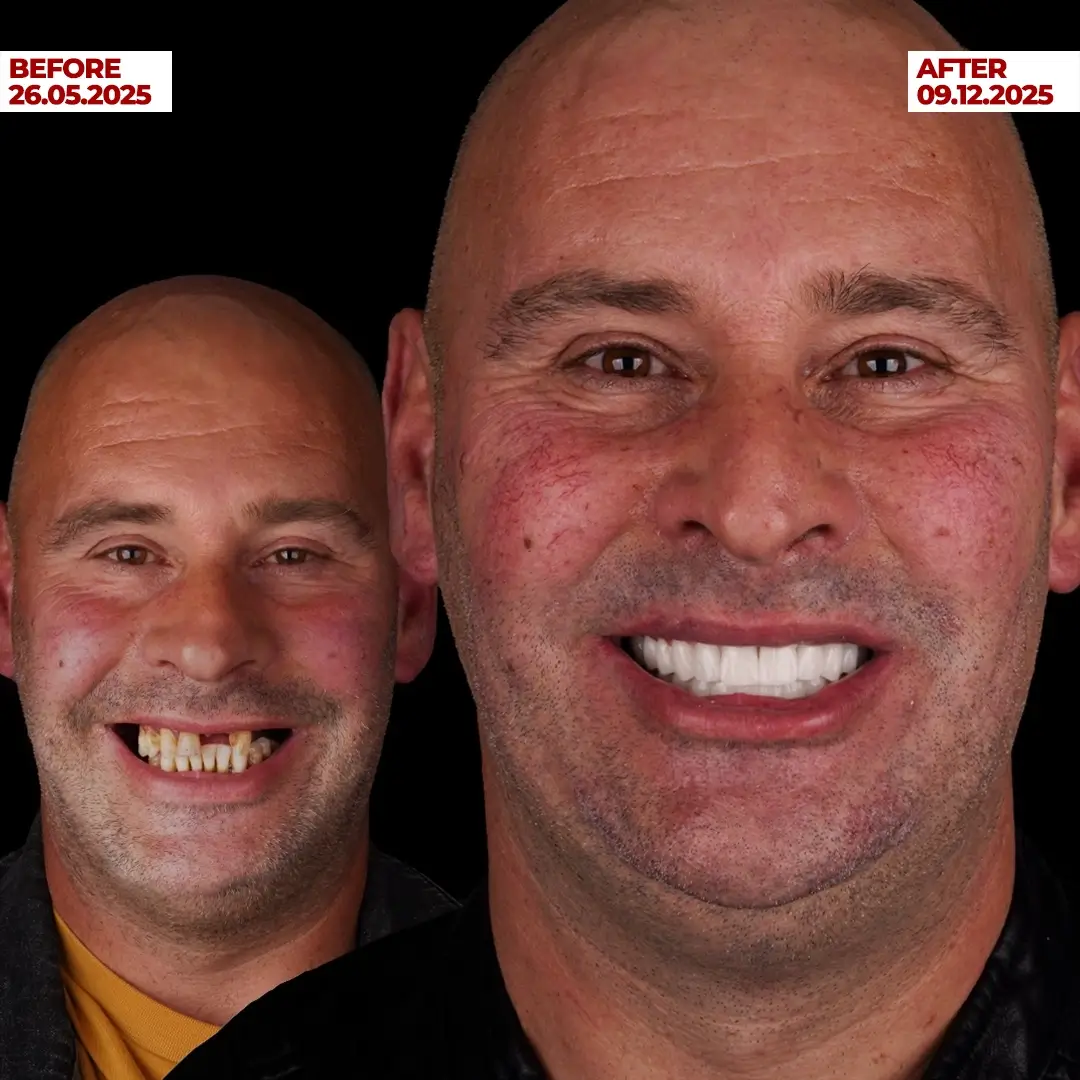
Twelve units per arch is a count that answers the visible and functional span rather than every position in the jaw. Nelson was treated at International Plus as a French speaking patient and his record lists 12 units above and 12 below, 24 in total with a Toronto framework recorded for the upper arch. Not every tooth position was restored. This case study follows what a count of this kind covers.
Key Takeaways
- The challenge: A record where each jaw stops at 12 units rather than covering every available position.
- The solution: 12 units recorded per arch, 24 in total with a Toronto framework above and a restoration fixed straight to the implants below.
- The technique: Shade om3 with the clinic’s Plus 5 smile design style over Implance and Megagen implants.
- The outcome: Both arches delivered with a night guard fitted at the same appointment.
What a Unit Count Actually Measures
A unit count is the number of crowns or bridge elements produced for one arch. It is not the number of teeth a person has and it is not a target the clinic works towards.
An adult arch holds 14 positions without third molars and 16 with them. A count of 12 therefore covers the span that carries the bite and shows when the patient speaks while leaving the rearmost positions unrestored. Our 28 unit case records the opposite decision, where every position in both jaws was covered.
In practice our clinic records the count per arch rather than per patient. Readers comparing restoration types will find the background in our guide to what a dental crown is.
Nelson’s Record and the Two Arches
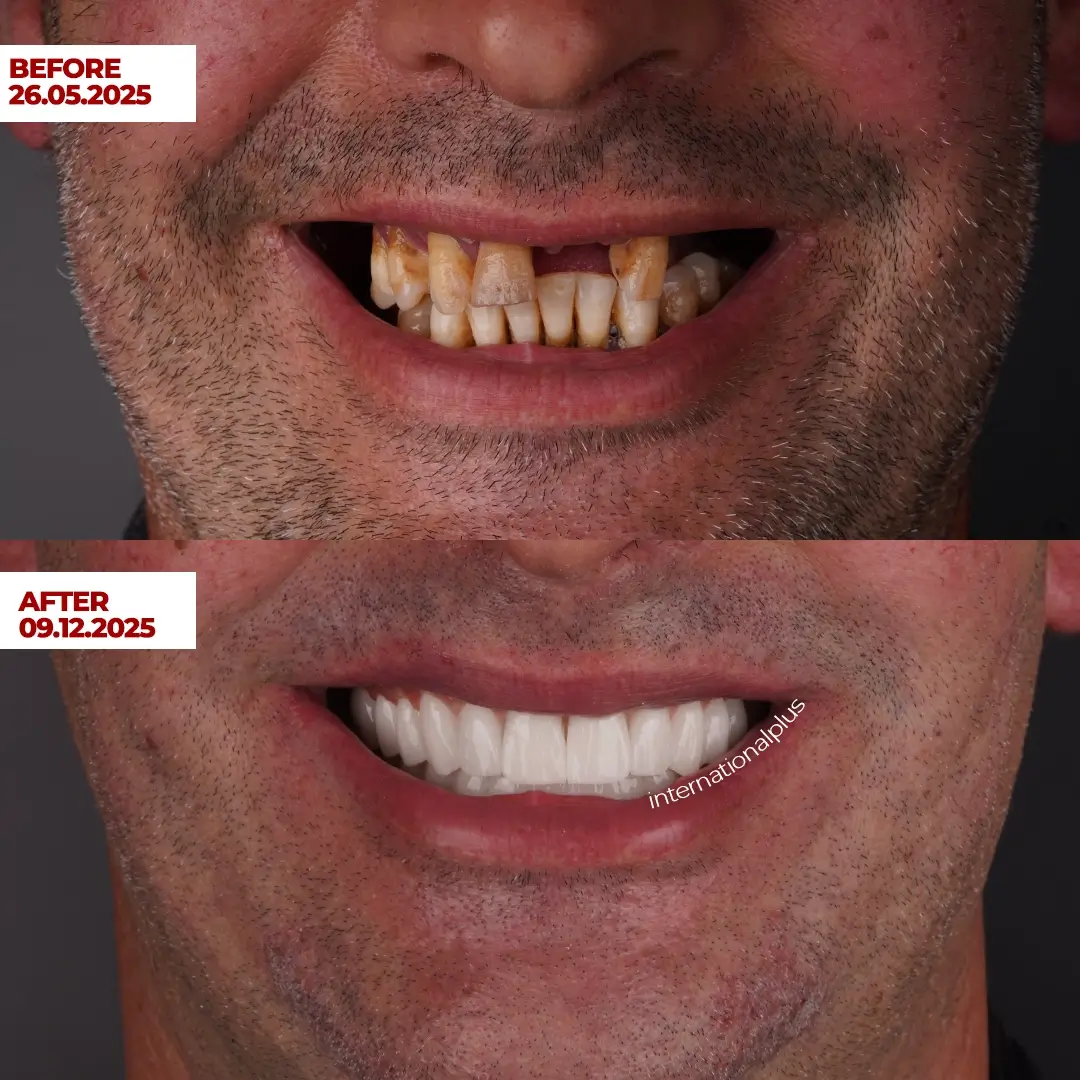
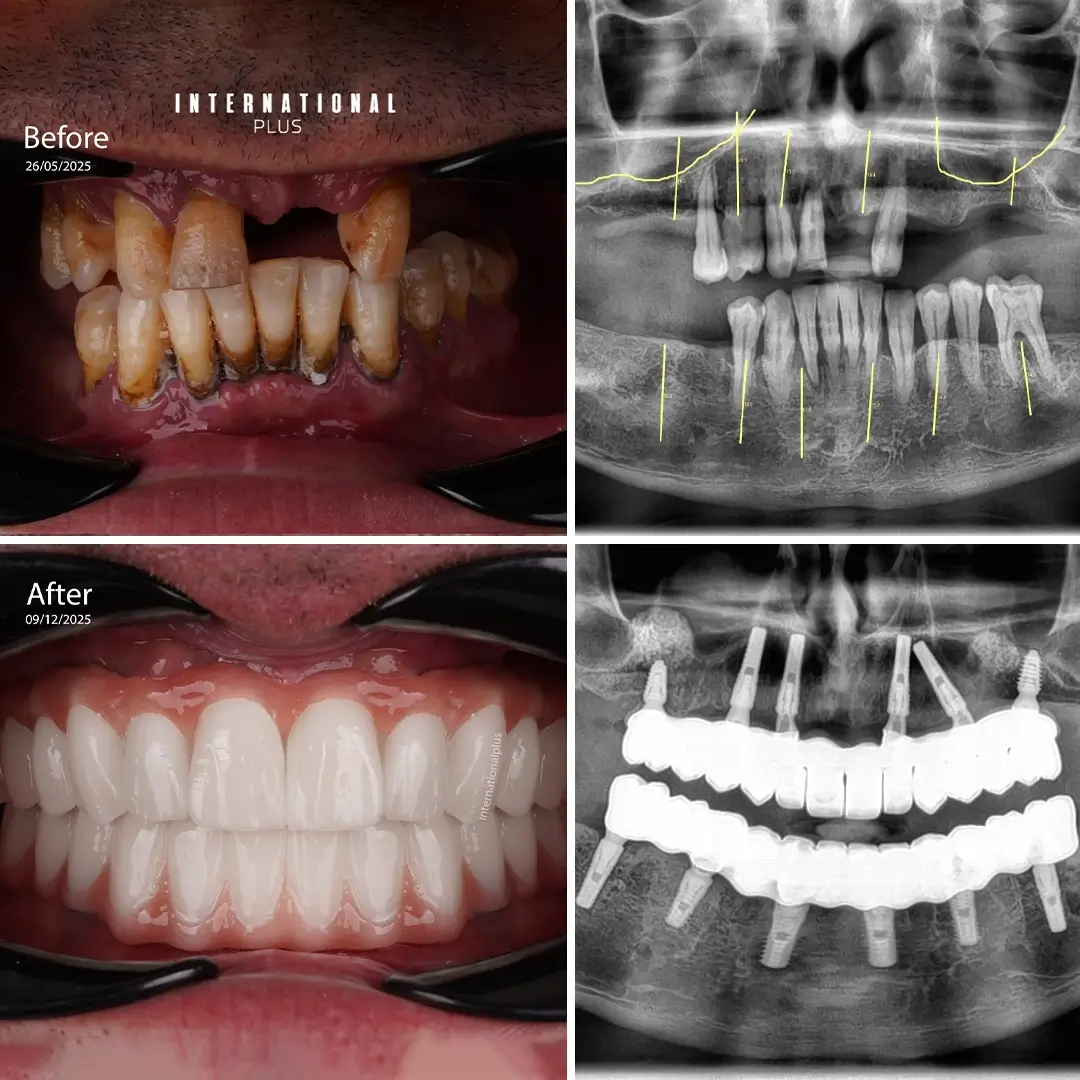
The file lists 12 units above and 12 below. A Toronto framework is recorded for the upper arch, described in full in our Toronto bridge case with the lower restoration fixed straight to the implants. Both arches are held by screws; the difference is the framework above.
Matching counts means the same number of units in each jaw, which is not the same as matching designs. Implance and Megagen are both named as implant systems, the shade reads om3 and the Plus 5 smile design style was recorded before production.
In practice our clinic writes the count, the design and the system on separate lines for each arch so a later reader can tell which jaw carries what. Fixation methods in implant reconstructions have been compared for complication and maintenance patterns (Wittneben JG, et al., 2014).
| Record | Detail |
|—|—|
| Upper arch | 12 units on a Toronto framework |
| Lower arch | 12 units, directly screw retained |
| Total units | 24 |
| Implant systems | Implance and Megagen |
| Shade | om3 |
| Smile design style | Plus 5 |
| Appliance | Night guard fitted at delivery |
Why a Rebuild Does Not Always Reach the Last Tooth
Rearmost molars sit where access is hardest and bone height is often lowest with little cosmetic return. Extending a rebuild to them adds surgery and cost without necessarily adding function.
Where the span already carries the bite, the final positions become a separate decision rather than an automatic inclusion. Prosthetic design has been examined against peri-implant outcomes in a systematic review and meta-analysis (Lin GH, et al., 2025).
Stopping at 12 leaves the rearmost positions unrestored but a shorter span is common on plans of this kind because it keeps the implants where bone and load are most favourable. For example, our clinic records the count that was built rather than the count that was theoretically possible.
How 24 Units Across Two Arches Are Designed
The arches carry matching counts but not matching designs. One sits on a Toronto framework and the other is fixed straight to the implants so the two are planned together and produced separately.
Survival of implant supported ceramic restorations has been reviewed across veneered and monolithic designs (Pjetursson BE, et al., 2021), which is the material class recorded for this case.
Shade om3 and the Plus 5 style were recorded ahead of milling, a stage offered as digital smile design. Production ran in the clinic’s own digital laboratory and implant treatment sits under dental implant.
What the Record Shows at Delivery
Nelson’s file documents 12 units in each arch, a Toronto framework above, a directly fixed restoration below, two implant systems, shade om3 and a night guard fitted at delivery.
Recording the count per arch is what makes the file precise. A record listing only a total of 24 would not say whether the rebuild was balanced or weighted to one jaw. Our clinic issues the per arch detail in writing alongside the materials.
This is one patient’s recorded outcome and individual results may vary. International Plus has treated more than 200,000 patients from 140+ countries since 2014 and holds a rating of 4.8 out of 5 across 5,504 reviews. How far a rebuild extends is settled from the anatomy rather than from a standard figure.
Book a consultation with International Plus if you want to know how far a rebuild would need to extend in your own jaws.
Frequently Asked Questions
Why only twelve units in an arch instead of fourteen?
A count covers the span that carries the bite and shows when a person speaks. Rearmost molars sit where access is hardest and bone height is often lowest so extending to them adds surgery without necessarily adding function. The final positions are a separate decision.
Does stopping at twelve units affect chewing?
The span restored is the span that carries the load so function is part of where the count lands rather than a casualty of it. Whether the rearmost positions are needed is assessed from the anatomy and the opposing arch rather than from the number alone.
Why do the two arches use different designs?
The jaws differ in bone density, available height and how load is directed. Whether a framework is used is therefore assessed per arch. This record lists a Toronto framework above and a restoration fixed straight to the implants below, both held by screws.
What does a total of twenty four units mean here?
It means 12 units in each jaw rather than an uneven split. The arches carry matching counts but not matching designs, which is why the record lists them on separate lines instead of giving one combined figure for the whole mouth.
Why are two implant systems recorded?
Manufacturers use their own component designs so each system is named in the file rather than described generically. A clinician servicing the restoration later needs to know which system sits in which arch.
Reviewed by Dr. Muhammed Kerem Işıkhan
References
- Lin GH, et al. J Periodontol. 2025. PMC12273757
- Wittneben JG, et al. Int J Oral Maxillofac Implants. 2014. PMID: 24660192
- Pjetursson BE, et al. Clin Oral Implants Res. 2021. PMC9293296
Follow us on Social Media
internationalplusofficial
internationalplus
internationalplusdental
This content is written, reviewed, and approved by the International Plus Medical Review Board to ensure clinical accuracy and adherence to strict editorial standards. All medical information is regularly monitored, audited and updated in light of the latest scientific advancements.
However the information provided here is for general informational purposes only and cannot be used for self diagnosis or making individual health interpretations. Results of medical treatments depend on individual anatomy and the unique healing process of each patient. This information should not replace a personal consultation with a qualified healthcare professional. To understand the best options for your specific needs and to receive a personalized treatment plan, we invite you to book a free consultation with the expert medical team at International Plus.

Muhammed Kerem provides comprehensive dental care centered on practical solutions and exceptional patient outcomes for travelers seeking quality treatment in Istanbul.