
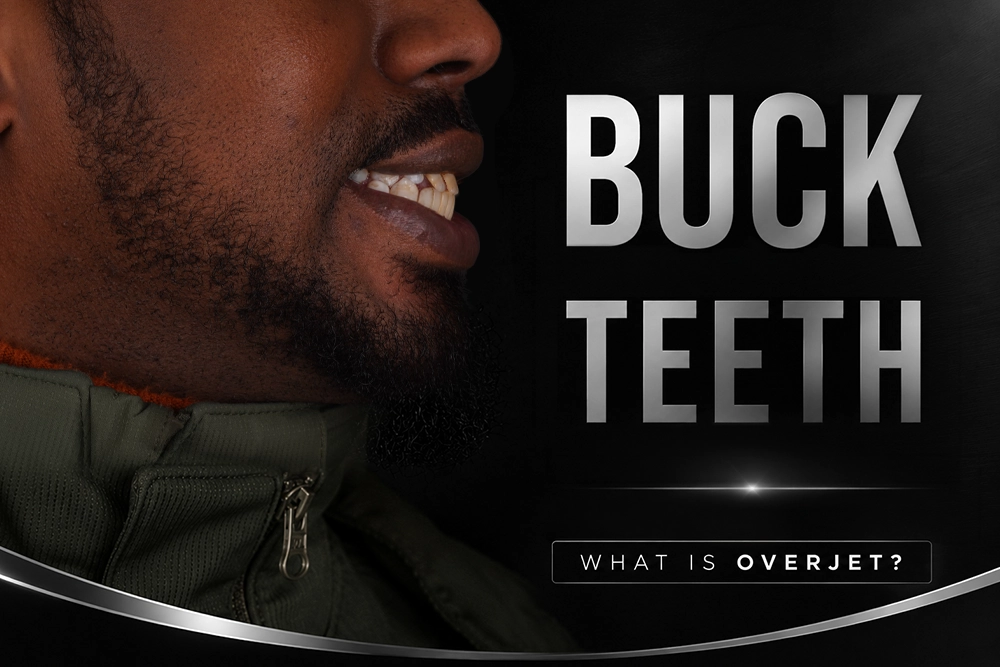
Buck teeth describe upper front teeth that protrude noticeably past the lower teeth, a bite pattern dentists call an overjet. The trait can be genetic or shaped by childhood habits and it ranges from a mild cosmetic concern to a skeletal problem that affects chewing and speech. This guide explains what causes buck teeth, how they differ from an overbite and the real treatment options from braces and clear aligners to veneer camouflage, drawing on current research and cases treated at International Plus in Istanbul.
Key Takeaways
- Buck teeth, medically an overjet, are upper front teeth that stick out more than 2 millimetres past the lower teeth (Cleveland Clinic, 2024).
- Overjet is horizontal protrusion while an overbite is vertical overlap so the two terms are not interchangeable.
- The main causes are genetics, thumb sucking, pacifier use, plus tongue thrusting, confirmed in a 2024 systematic review of non-nutritive sucking habits (Sadoun et al., 2024).
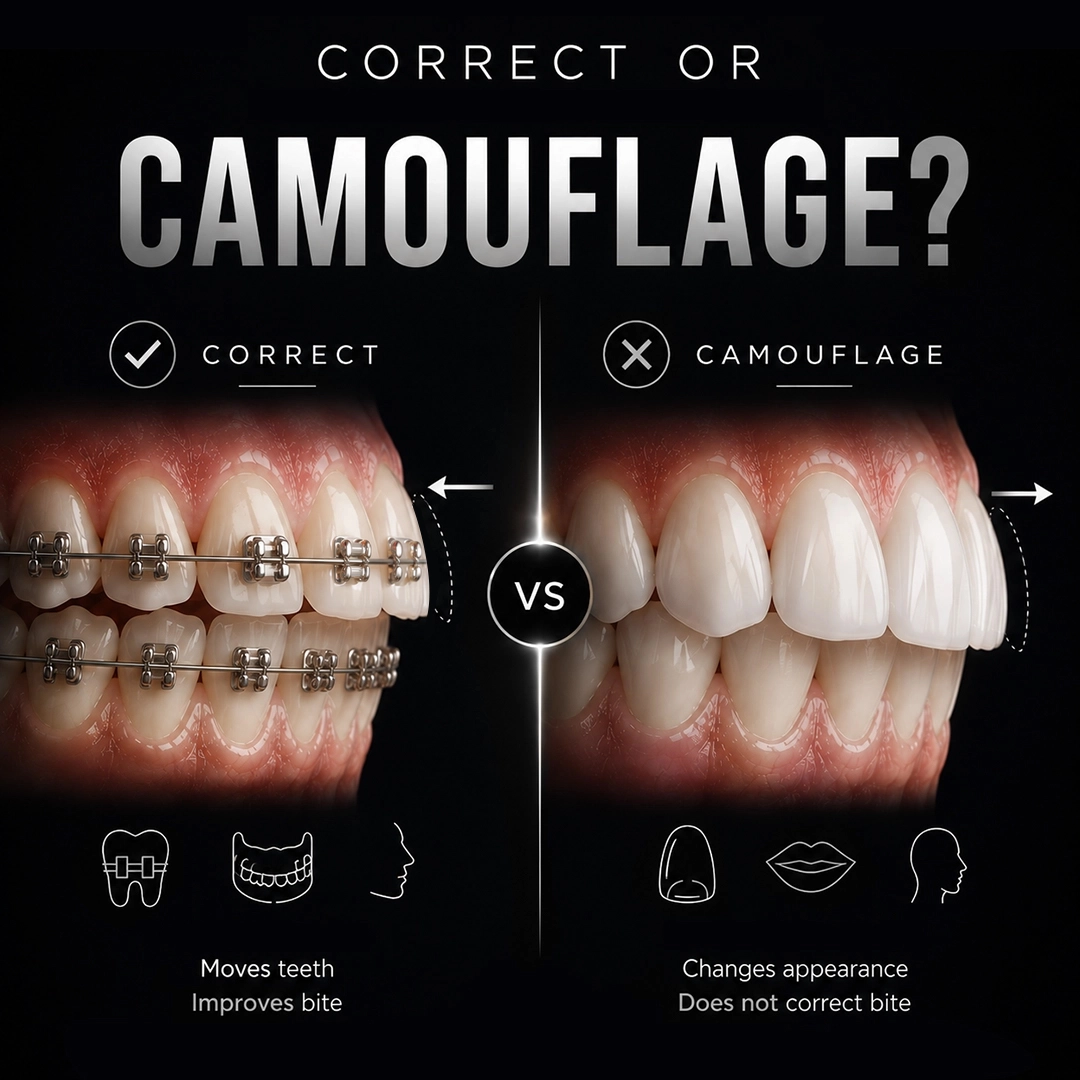
- Braces and clear aligners move the teeth while veneers or crowns only camouflage mild cases without correcting the bite.
- At International Plus, a Diagnostic Council reviews 3D scans before recommending correction or cosmetic camouflage and results are shown on real, consented patients only.
What Are Buck Teeth?
Buck teeth are upper front teeth that project forward past the lower teeth, a condition dentists classify as an overjet or a Class II relationship. Most people have about 2 millimetres of horizontal overlap, which is normal. When the upper teeth stick out further than that, the smile reads as protrusive and the lips may struggle to close at rest.
The trait sits on a spectrum. A mild overjet is mostly a cosmetic feature that many people keep and embrace while a pronounced one can interfere with biting and clear speech. A 2022 systematic review of children and adolescents found malocclusions like overjet are among the most common orthodontic findings worldwide (De Ridder et al., 2022). At International Plus, cosmetic dentist Dr. Eren Gülbahar separates a dental overjet, where only the teeth tip forward from a skeletal one, where the jaw relationship drives the protrusion because that distinction decides whether a cosmetic or an orthodontic route fits.
Buck Teeth vs Overbite: What Is the Difference?
An overjet, the clinical name for buck teeth, is horizontal protrusion while an overbite is vertical overlap. People often say overbite when they mean overjet but the two measure different things. Overjet measures how far the upper teeth sit in front of the lower ones; overbite measures how far the upper teeth cover the lower ones from top to bottom.
Both are types of malocclusion and they can appear together yet they need different assessment. A typical overbite covers 2 to 4 millimetres of the lower teeth and only becomes a concern past roughly 4 to 6 millimetres. An overjet starts to look like buck teeth once the horizontal gap passes 2 millimetres and a severe overjet of 8 to 10 millimetres often signals a jaw discrepancy rather than a simple tooth tip. Reading this correctly matters because it changes the plan so our clinicians measure both distances on the same records rather than judging by appearance alone. Patients weighing a wider aesthetic change can compare realistic outcomes in our Turkey teeth before and after guide and read what is a Hollywood Smile before deciding.
What Causes Buck Teeth?
Buck teeth are caused mainly by genetics and by childhood habits that push the front teeth forward. Jaw size and tooth size are inherited so an overjet often runs in families. On top of that, sustained pressure during early development can tip the upper teeth out or narrow the jaw.
The habit-related causes are well documented. Thumb or finger sucking, prolonged pacifier use, plus tongue thrusting all apply repeated force behind the front teeth and a 2024 systematic review linked these non-nutritive sucking habits to a measurably higher rate of malocclusion (Sadoun et al., 2024). A separate study of sucking habits and occlusion in young children reached the same conclusion (Ling et al., 2018). Mouth breathing and oral habits are also associated with malocclusion in growing children (Grippaudo et al., 2016). Missing or crowded teeth, plus an uneven jaw relationship, round out the common causes. Knowing which factor drives a case guides prevention in children and treatment choice in adults.
What Problems Can Buck Teeth Cause?
Beyond appearance, a pronounced overjet can affect chewing, speech, lip closure, plus the safety of the front teeth. Many people with mild buck teeth have no functional issue at all so treatment is a personal choice. A larger overjet is different because the protruding teeth take on roles they were not built for.
Common problems include difficulty biting into food, jaw strain, plus speech sounds such as s and th that become harder to form. Protruding upper teeth are also more exposed to trauma during falls or sport and a 2022 review found that reducing a large overjet early lowers the risk of dental injury (Cobourne et al., 2022). Crowded or protrusive teeth can be harder to clean, which raises the risk of decay and gum problems over time. In our practice we flag a large childhood overjet early for this reason because prevention is simpler than repair and an early assessment often widens the treatment options later.
How to Fix Buck Teeth: Treatment Options
Correcting buck teeth relies on moving the teeth with braces or clear aligners, guiding jaw growth in children or cosmetic camouflage in specific cases. There is no single answer because tooth size, the jaw relationship, plus age all shape the plan. An orthodontic assessment decides which route corrects the overjet safely.
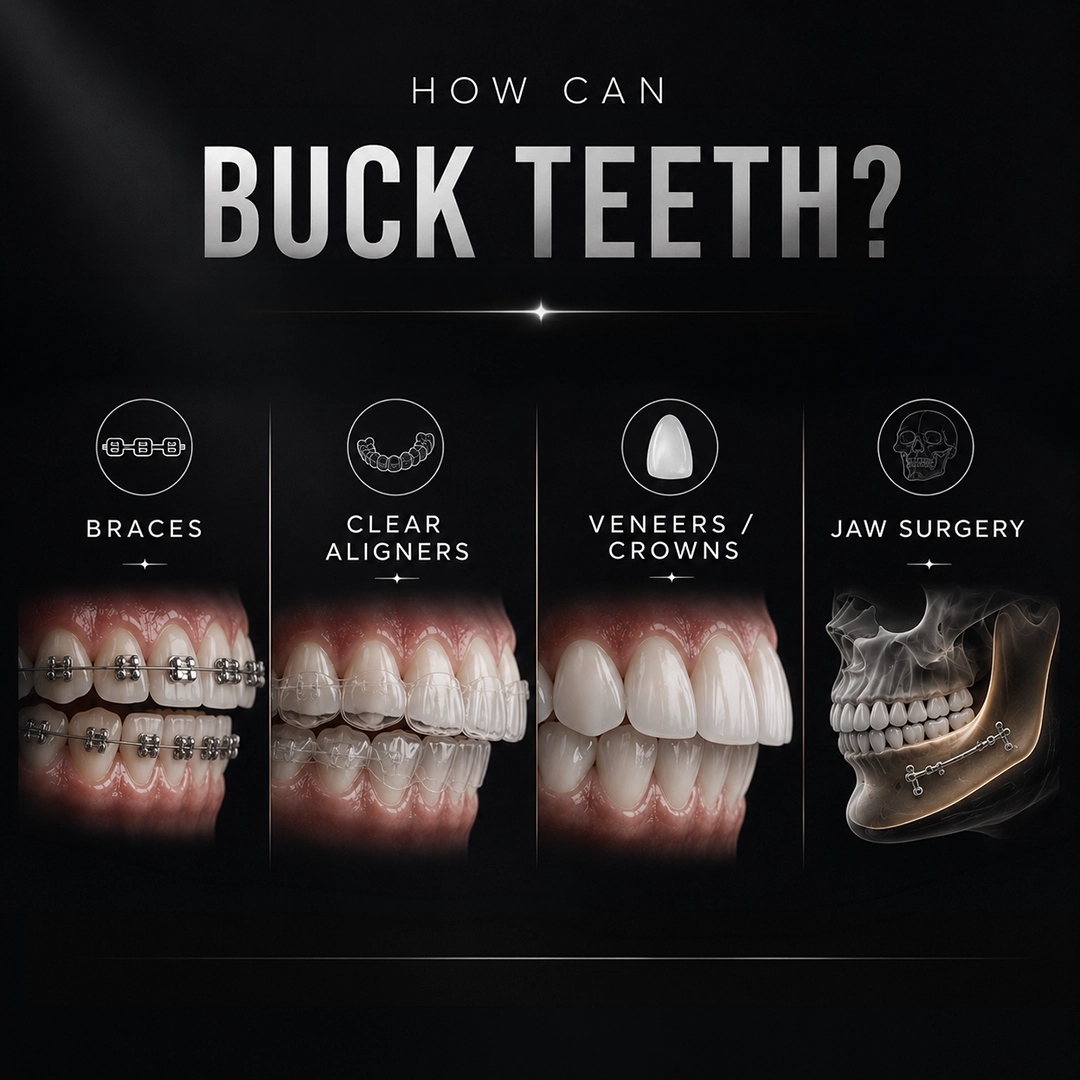
Braces remain the most versatile option and handle moderate to severe overjet with fine control over each tooth. Clear aligners suit mild to moderate cases and a 2023 scoping review confirmed their effectiveness for many alignment problems when worn consistently (Muro et al., 2023). Palate expanders and functional appliances help growing children by creating space or guiding the jaws. For a true skeletal overjet in adults, jaw surgery combined with orthodontics may be needed and a systematic review compared orthodontic camouflage with orthognathic surgery for Class II cases (Raposo et al., 2018). The table below sets realistic expectations for each route.
| Treatment | Best suited for | Typical duration |
|—|—|—|
| Braces | Moderate to severe overjet, complex bites | 18 to 30 months |
| Clear aligners | Mild to moderate overjet, adults and teens | 12 to 18 months |
| Veneers or crowns | Mild protrusion, cosmetic camouflage only | 2 to 3 weeks |
| Jaw surgery with braces | Severe skeletal overjet after growth | 12 to 24 months plus surgery |
Bottom line: braces and aligners correct the bite while veneers only change how mild buck teeth look. To plan any change accurately, our team uses a digital smile design preview technology session so patients see the proposed result before committing.
Book a free online smile assessment

Buck Teeth in Children Versus Adults
Children often benefit from early, growth-guided correction while adults are treated by moving the teeth or camouflaging mild cases. Timing changes what is possible. In a growing child, appliances can influence how the jaws develop, which sometimes reduces or prevents a severe overjet before it sets.
Orthodontists usually suggest a first evaluation around age 7 when early signs are visible and the jaw is still developing and a 2022 prevalence review confirmed many overjets appear during these mixed dentition years (De Ridder et al., 2022). Habit appliances that discourage thumb sucking or tongue thrusting can also help at this stage. In adults, the jaws no longer grow so a dental overjet is corrected by repositioning the teeth with braces or aligners and a genuinely skeletal one may need surgery. In our practice we prefer to explore growth guidance before any cosmetic route in younger patients because moving teeth into a stable bite protects the result far longer than masking it. Adults still achieve excellent, discreet correction so age is rarely a barrier to starting.
Can You Fix Buck Teeth Without Braces?
You cannot correct the underlying overjet without orthodontics or surgery but cosmetic dentistry can camouflage a mild case. This is the honest limit of the cosmetic route. Veneers, bonding, plus crowns reshape the visible surface of the front teeth, which can soften the look of a slight protrusion yet they do not move the roots or change the bite.
Veneers work well for the appearance of mild buck teeth but they are not suitable for a large skeletal overjet because they cover the crowns without correcting the jaw relationship underneath. That trade-off guides our advice: for a small, stable protrusion in an adult who declines orthodontics, a minimal preparation veneer or a full ceramic crown restoration can improve symmetry whereas a pronounced overjet is referred for orthodontic correction first. Because a camouflaged tooth then relies on the veneer, our guide to how long veneers last sets realistic timelines and the truth about Turkey teeth explains why over-preparation is avoided. A broader aesthetic change is sometimes planned as a complete Hollywood Smile makeover or a full smile makeover once the bite is confirmed stable. Before any cosmetic work, our Diagnostic Council reviews 3D CBCT and intraoral scans so the plan matches the teeth rather than a photo and only consented, unretouched patient results are ever published.
International Plus combines official Ministry of Health authorization, a 4.8/5 rating from 5,504+ verified reviews and more than 200,000 patients treated from over 140 countries, giving cosmetic and restorative dentistry in Istanbul a credible, verifiable home. Individual results vary and a personalised consultation confirms what your teeth can safely achieve.
Contact our team to plan your smile assessment
Frequently Asked Questions
What causes buck teeth?
Buck teeth are caused mainly by genetics and by childhood habits such as thumb sucking, prolonged pacifier use, plus tongue thrusting, which push the upper front teeth forward. Missing or crowded teeth, mouth breathing, plus an uneven jaw relationship can also contribute, especially while the permanent teeth are still coming through.
Are buck teeth and an overbite the same thing?
No. Buck teeth, medically an overjet, describe horizontal protrusion where the upper teeth stick out in front of the lower ones. An overbite describes vertical overlap, how far the upper teeth cover the lower teeth. The two conditions can appear together but they are measured and treated differently.
Can buck teeth be fixed without braces?
The underlying overjet cannot be corrected without orthodontics or surgery because only controlled force moves teeth safely. For a mild, stable case, veneers, bonding or crowns can camouflage the appearance. A pronounced or skeletal overjet needs braces, clear aligners or in severe cases, jaw surgery to correct the bite properly.
How long does it take to fix buck teeth?
Treatment usually takes between 12 and 30 months, depending on severity, the method chosen, plus the patient’s age. Clear aligners often finish mild cases in 12 to 18 months, braces handle complex overjets in 18 to 30 months and cosmetic camouflage with veneers is completed in a few weeks.
Can adults correct buck teeth?
Yes. Adults correct buck teeth by moving the teeth with braces or clear aligners and a genuinely skeletal overjet may need surgery combined with orthodontics. Since the jaws no longer grow, treatment can take a little longer than in children but modern discreet options make correction effective and comfortable at any age.
Reviewed by Dr. Eren Gülbahar
References
- De Ridder L, et al. Int J Environ Res Public Health. 2022. PMC9223594
- Grippaudo C, et al. Acta Otorhinolaryngol Ital. 2016. PMC5225794
- Sadoun C, et al. J Clin Pediatr Dent. 2024. PMID: 38548628
- Ling HTB, et al. BMC Oral Health. 2018. PMC6106723
- Muro MP, et al. Int Orthod. 2023. PMID: 37086643
- Raposo R, et al. Int J Oral Maxillofac Surg. 2018. PMID: 28966066
- Cobourne MT, et al. Br Dent J. 2022. PMID: 36085463
Follow us on Social Media
internationalplusofficial
internationalplus
internationalplusdental
This content is written, reviewed, and approved by the International Plus Medical Review Board to ensure clinical accuracy and adherence to strict editorial standards. All medical information is regularly monitored, audited and updated in light of the latest scientific advancements.
However the information provided here is for general informational purposes only and cannot be used for self diagnosis or making individual health interpretations. Results of medical treatments depend on individual anatomy and the unique healing process of each patient. This information should not replace a personal consultation with a qualified healthcare professional. To understand the best options for your specific needs and to receive a personalized treatment plan, we invite you to book a free consultation with the expert medical team at International Plus.

I am a healthcare professional with over 4 years of experience in dentistry, specializing in prosthetic dental treatment and implant-based applications. Since 2024, I have been serving as chief physician, leading clinical management, team coordination, and international patient processes. With my B2-level English proficiency, I am able to communicate effectively with international patients. I am a patient-centered, innovative, and solution-oriented dentist who prioritizes patient satisfaction.




