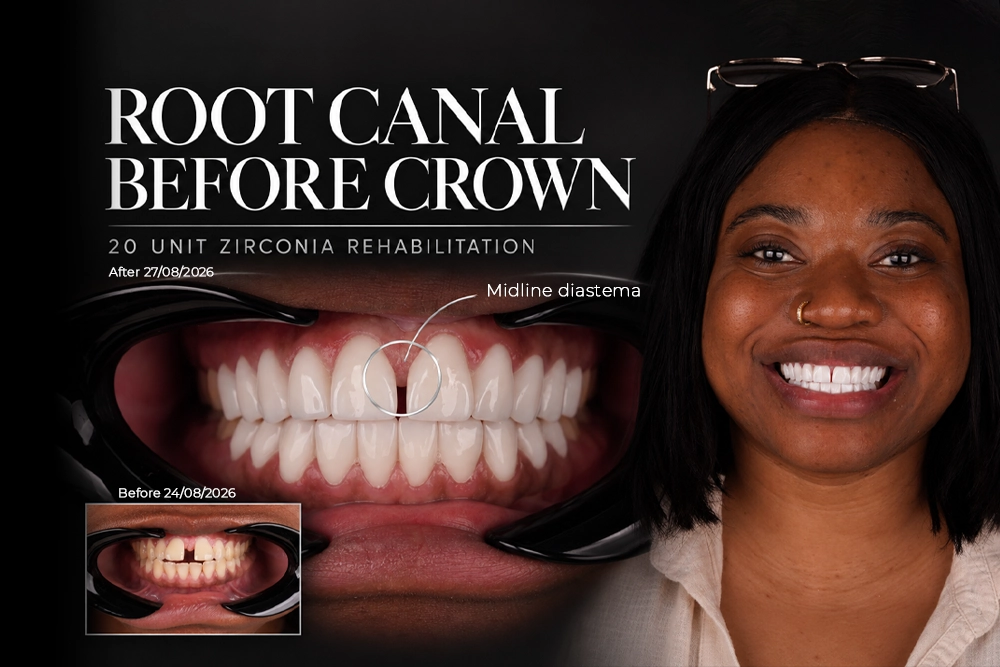
A root canal before crown placement is not a delay in the treatment plan. It is the step that decides whether the crown cemented above it survives. Ornella came to International Plus in August 2026 for a full upper and lower zirconia rehabilitation and the pre-treatment examination identified three teeth that needed endodontic treatment before any crown could be seated over them. Ornella also asked for something unusual: she wanted a natural result without closing the gap between her upper front teeth. This case study follows the four day sequence that combined 20 zirconia crowns, three root canal treatments, three fillings and a night guard and explains both the endodontic sequencing and the aesthetic decisions taken alongside it.
Key Takeaways
- The challenge: Ornella needed a 20 unit zirconia rehabilitation but three of the teeth carrying those crowns required root canal treatment first, inside a compressed treatment window.
- The solution: A tooth preserving plan with no extractions and no implants, sequencing preparation, endodontic treatment and delivery across four consecutive working days.
- The technique: Digital impressions and a face scan on day one, a PMMA try-in with bite registration on day two, endodontic treatment on day three, definitive delivery on day four.
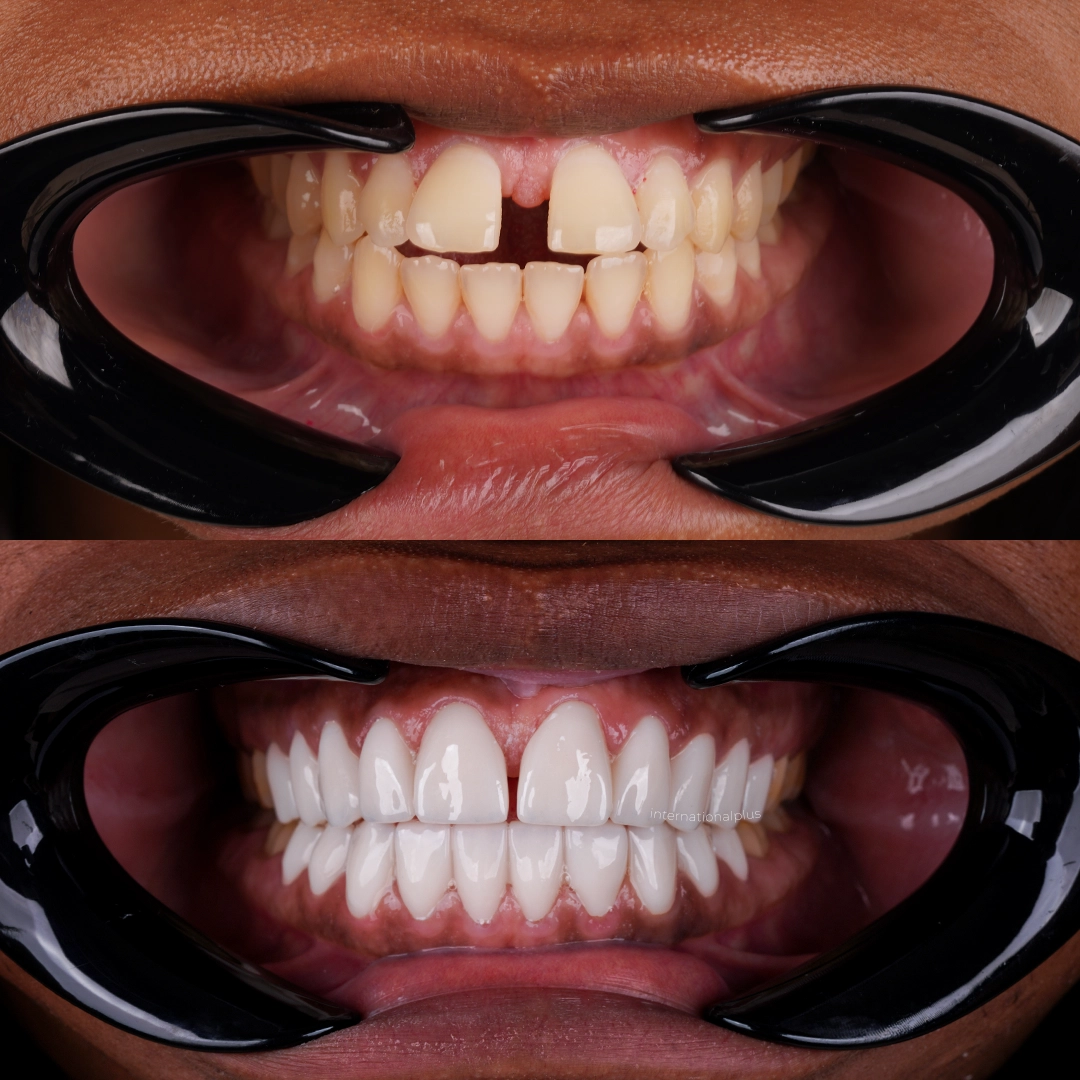
- The aesthetic decision: The existing diastema was preserved at Ornella’s request while uneven gingival levels and triangular cervical contours across the upper front teeth were corrected.
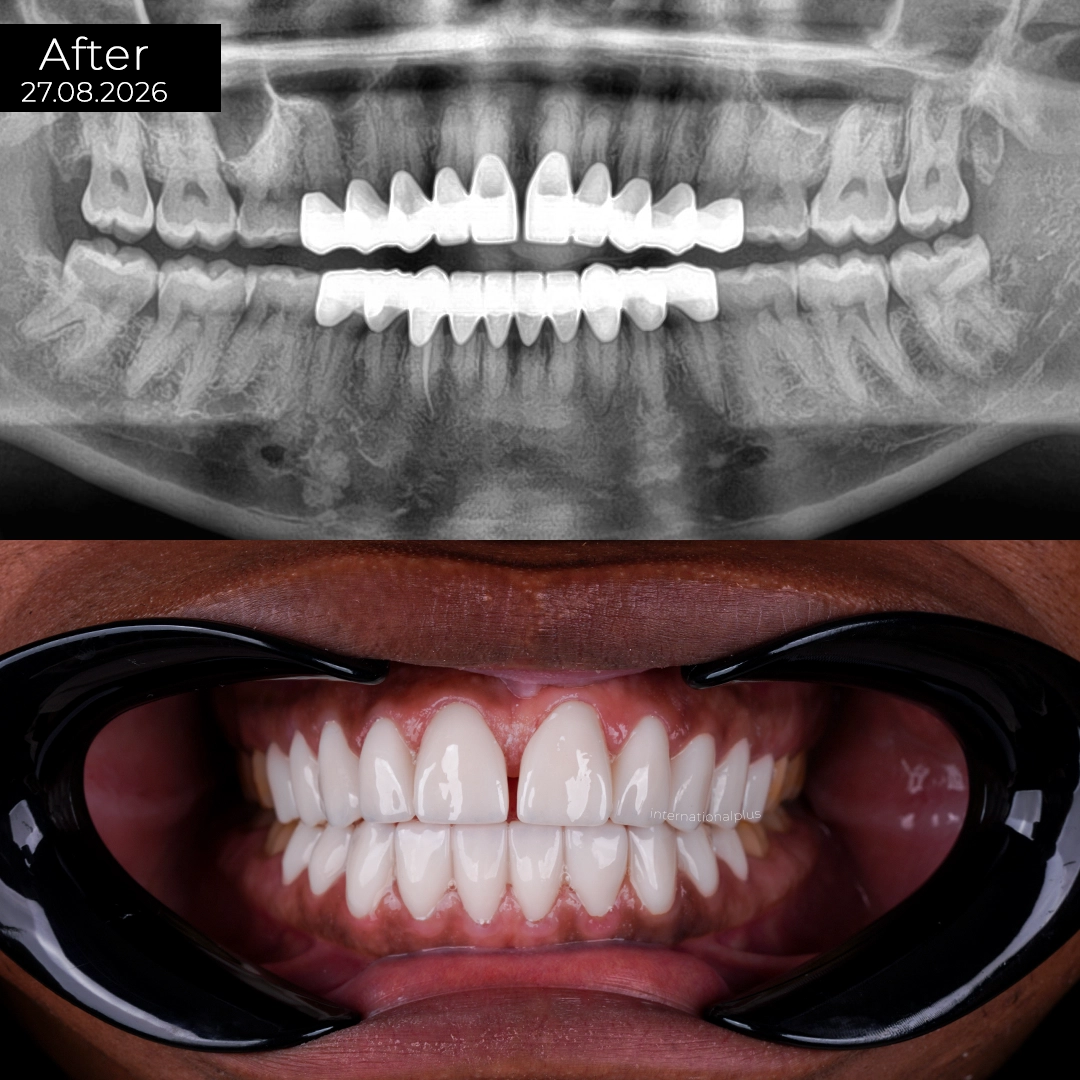
- The outcome: Twenty monolithic zirconia crowns in shade OM3 delivered on 27 August 2026, protected by a night guard fitted the same day.
Why Endodontic Status Is Checked Before Any Crown Is Planned
Endodontic treatment, also called root canal treatment, is the removal of infected or inflamed pulp tissue from inside a tooth. In Ornella’s file, 3 of the 20 planned units carried findings that required it first. A crown covers a tooth completely so a crown also covers whatever is happening inside that tooth.
The restorative team at International Plus assesses pulp status before preparation begins because a tooth needing endodontic treatment after cementation must then be accessed through the finished restoration. That access hole is repairable yet the repair compromises a crown built to a single sealed design. Clinical evidence on the restoration of root filled teeth identifies the residual tooth structure remaining after access as the dominant factor in long term outcome (Bhuva B, et al., 2021) and survival after endodontic treatment has been reviewed separately (Hayati AT, et al., 2025).
The judgement runs in both directions since a vital tooth with adequate structure needs no endodontic treatment simply because a crown is planned. A separate International Plus case study describes what a full diagnostic workup can reveal behind a cosmetic request.
Ornella’s Starting Point and Treatment Plan
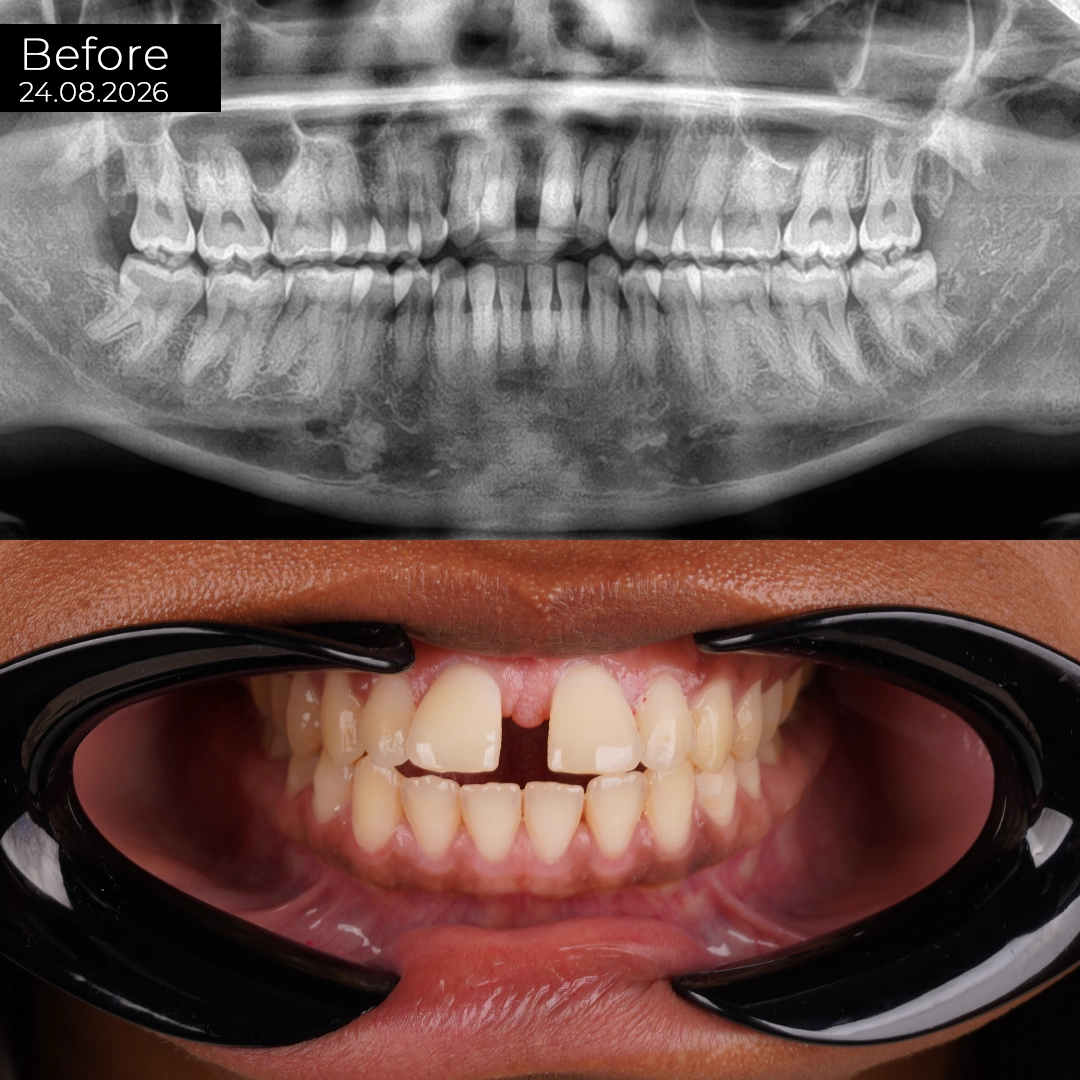
Ornella presented at International Plus in August 2026 seeking a complete change in the appearance and function of 20 upper and lower teeth. Clinical examination and digital records showed restorable teeth with no indication for extraction or implant placement, which set the direction of the entire plan.
A tooth preserving plan is a sequence that restores the existing teeth rather than replacing them. The agreed plan covered 20 zirconia crowns across 4 quadrants, 5 units per quadrant. Three teeth were listed for root canal treatment and three for fillings while a night guard was written into the plan from the outset rather than offered afterwards. No surgical procedure appears anywhere on the treatment card.
That absence matters in practice for a patient travelling for care since a tooth preserving plan removes the healing intervals implant placement would have added. Case planning at International Plus runs through a multidisciplinary Diagnostic Council, where restorative and endodontic judgement are applied to one file before the sequence is fixed.
Keeping the Diastema and Correcting the Gum Line
A diastema is a visible gap between two teeth, most often between the upper central incisors. Ornella arrived with one and asked whether a natural looking result was achievable without closing it. The clinical answer was yes so the gap was kept by design rather than treated as a defect to be eliminated.
Two further findings shaped the aesthetic plan. The gingival levels across the upper four front teeth sat at noticeably different heights and the cervical contours where each crown meets the gum were triangular rather than rounded, a shape that reads as artificial even when the tooth form itself is correct. Both were corrected during preparation and carried into the crown design.
Occlusion was the third problem. Ornella’s existing bite was poor so the 20 units were designed to deliver a comfortable functional closing position rather than only a new appearance.
The Four Day Protocol
The treatment ran from 24 to 27 August 2026 across 4 consecutive working days. Each day carried a single clinical objective and the endodontic work was placed on day three after preparation and after the bite had been registered on the try-in.
| Day | Date | Procedure recorded |
|—|—|—|
| 1 | 24 August 2026 | Preparation of 20 units, digital impression, face scan |
| 2 | 25 August 2026 | PMMA try-in placed, bite registration taken |
| 3 | 26 August 2026 | Root canal treatment, type 1 protocol |
| 4 | 27 August 2026 | Delivery of 20 zirconia crowns, night guard fitted |
A PMMA try-in is a temporary acrylic restoration used to confirm tooth position and bite before the definitive crowns are milled. Sequencing the root canal treatment at stage 3 was a deliberate decision rather than a scheduling accident. First the 20 units were prepared and a digital impression was taken. Then the try-in established a physical record of the intended tooth position and the intended bite so endodontic access could follow without losing the reference points the definitive crowns would be built to.
For Ornella the practical effect was continuity. Ornella wore a provisional restoration from day two onward and was never without teeth during the working week.
Digital Records, Shade and Material Selection
Digital impressions replaced conventional putty at the preparation stage and a face scan was recorded alongside them on 24 August 2026. Intraoral scanning removes the dimensional change impression material undergoes while it sets and travels and complete arch scanning accuracy has been examined directly in the prosthodontic literature (Revilla-Leon M, et al., 2023).
The restorations were milled as monolithic zirconia in shade OM3, following the PLUS5 smile design style in the clinic’s own laboratory. Monolithic construction means the crown is milled from one block rather than layered with a separate ceramic surface, which removes the interface where chipping usually begins. Clinical evidence from a meta-analysis of monolithic CAD/CAM tooth supported zirconia reported favourable performance (Leitao CIMB, et al., 2022), alongside a systematic review of survival across the material class (Larsson C, et al., 2014).
Monolithic zirconia suits a full arch rehabilitation particularly well but it is not the automatic answer for a single anterior tooth beside untouched natural teeth because a layered ceramic can be shaded more finely to match a neighbour. Ornella’s restorations follow the dental crowns protocol with the endodontic component under endodontics.
Protecting the Result with a Night Guard
A night guard is a removable appliance worn during sleep that separates the upper and lower teeth so grinding force is absorbed by the appliance rather than by the restorations. Ornella’s guard was fitted on 27 August 2026, the delivery day rather than being left to a later appointment.
Occlusal splints are the standard conservative management for sleep bruxism and clinical evidence from systematic review supports their use in adults (Minakuchi H, et al., 2022). Grinding force matters more once 20 crowns are in place because the load that once wore natural enamel now meets a ceramic surface. International Plus has documented that risk in a full mouth reconstruction for severe bruxism and in a rehabilitation complicated by bruxism with tooth loss.
Fitting the guard at delivery carries particular weight for an international patient since a patient who flies home the following week cannot easily return for an appliance impression.
Outcome and What Ornella Experienced
Treatment finished on 27 August 2026, 4 days after the first appointment. Twenty monolithic zirconia crowns were delivered in shade OM3, 3 root canal treatments and 3 fillings were completed inside the same period and the night guard was fitted before Ornella left the clinic in Istanbul.
Before and after photographic records were taken as part of the file. Shade OM3 was selected deliberately at the natural end of the range and the finished crowns read as Ornella’s own teeth rather than as restorations. This outcome reflects Ornella’s own anatomy, endodontic findings and the restorability of the existing teeth so individual results may vary. International Plus reports treating more than 200,000 patients from over 140 countries since 2014 and holds a public rating of 4.8 out of 5 across 5,504 verified Google reviews yet no published record removes the need for an individual examination.
Comparable work is documented in a couple treated with full mouth zirconia crowns, a 28 unit smile makeover and a transition from denture to fixed zirconia teeth. Planning at this scale begins with the records described under digital smile design.
Book a consultation with International Plus to have your endodontic and restorative status assessed before any crown plan is agreed.
Frequently Asked Questions
Do you always need a root canal before a crown?
No. Endodontic treatment is indicated when the pulp inside the tooth is irreversibly inflamed, infected or exposed by the extent of decay or fracture. A vital tooth with sufficient remaining structure can receive a crown without it and removing healthy pulp adds risk without clinical benefit.
Why is root canal treatment done before the crown rather than after?
A definitive crown seals the tooth completely. Treating the canal afterwards means drilling an access hole through the new restoration, which can be repaired but compromises a crown built as a single sealed unit. Establishing endodontic status first protects the restoration and the tooth beneath it.
Why was a night guard fitted on the delivery day?
The night guard was made while the definitive bite was still recorded in the laboratory and fitted before the patient travelled home. Fitting it at delivery means the appliance matches the new occlusion exactly and the patient does not need a further trip for an appliance impression.
Can this treatment be completed without implants?
In this case it was. No extractions or implant placements were recorded because the existing teeth were restorable. A tooth preserving plan avoids the healing intervals that implant placement requires, which is what allowed the sequence to be compressed into four consecutive days.
Reviewed by Dr. Muhammed Kerem Isikhan
References
- Bhuva B, et al. Int Endod J. 2021. PMID: 33128279
- Larsson C, et al. Int J Prosthodont. 2014. PMID: 24392475
- Leitao CIMB, et al. J Prosthodont Res. 2022. PMID: 34615842
- Minakuchi H, et al. Jpn Dent Sci Rev. 2022. PMC8958360
- Revilla-Leon M, et al. J Prosthodont. 2023. PMID: 37586762
- Hayati AT, et al. Clin Cosmet Investig Dent. 2025. PMC12607662
Follow us on Social Media
internationalplusofficial
internationalplus
internationalplusdental
This content is written, reviewed, and approved by the International Plus Medical Review Board to ensure clinical accuracy and adherence to strict editorial standards. All medical information is regularly monitored, audited and updated in light of the latest scientific advancements.
However the information provided here is for general informational purposes only and cannot be used for self diagnosis or making individual health interpretations. Results of medical treatments depend on individual anatomy and the unique healing process of each patient. This information should not replace a personal consultation with a qualified healthcare professional. To understand the best options for your specific needs and to receive a personalized treatment plan, we invite you to book a free consultation with the expert medical team at International Plus.

Muhammed Kerem provides comprehensive dental care centered on practical solutions and exceptional patient outcomes for travelers seeking quality treatment in Istanbul.