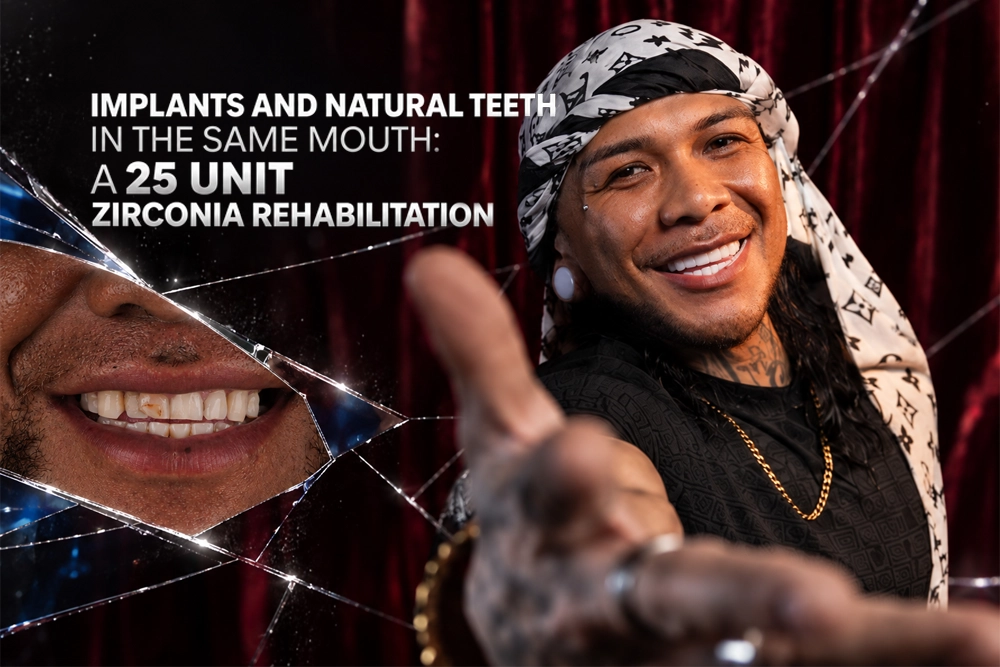
When Wayne Newman, a 43 year old patient from the UK, first contacted International Plus, his concerns were both aesthetic and functional. He was unhappy with the color and overall appearance of his teeth. On top of that, missing lower teeth had reduced his chewing function and the harmony of his smile. His combined implant and E.max smile transformation shows how surgical and cosmetic dentistry can work as one plan: 4 dental implants in the lower jaw, 18 IPS e.max restorations and 2 zirconia crowns in the upper arch and a 6 unit screw retained zirconia bridge to complete the implant side.
This case study follows Wayne’s journey step by step from diagnosis and 3D scanning through surgery, a plastic trial smile, the delivery of his ceramic restorations and the 3 month osseointegration period that precedes his final screw retained bridge. It reflects how our team plans complex cases: a single diagnosis and digital workflow carried across coordinated treatment phases in Istanbul.
Key Takeaways
- The patient: Wayne Newman, a 43 year old man from the UK, unhappy with his tooth color and appearance and losing chewing function to missing lower teeth.
- The plan: 4 lower implants, 18 IPS e.max restorations, 2 zirconia crowns and a 6 unit screw retained zirconia prosthesis over the implants.
- Digital precision: All impressions captured with the TRIOS 5 intraoral scanner by 3Shape and transferred digitally to our in house laboratory.
- Patient approval first: A plastic trial smile let Wayne evaluate aesthetics, function and phonetics before any final restoration was produced.
- The timeline: Treatment phases about 3 months apart, allowing osseointegration to complete before the final bridge is fixed onto the implants.
A Dental Journey from the UK
Wayne traveled from the UK to Istanbul because he wanted a single clinic that could handle both the surgical and the cosmetic side of his case in one coordinated plan. Treating implants and aesthetic restorations together at a single clinic keeps the bite, the materials and the smile design consistent.
For UK patients, this kind of comprehensive care often proves difficult to arrange locally within a reasonable timeframe. Wayne’s research led him to International Plus, where patient coordination is available in 27 languages and the entire journey from VIP airport transfer to accommodation is organized around the treatment schedule. Since 2014, the clinic has treated more than 200,000 patients from over 140 countries so a combined surgical and aesthetic case arriving from abroad is routine rather than exceptional.
His treatment was structured in phases. The first covered examination and preparation, then digital scanning, implant surgery and the aesthetic restorations. The final phase, scheduled about 3 months later, is reserved for the implant supported prosthesis once healing is complete.

Diagnosing Chewing and Aesthetic Loss
The initial clinical and radiographic examination identified two connected problems: dissatisfaction with the color and general appearance of the existing teeth and reduced chewing capacity caused by missing lower teeth. Solving one without the other would have left Wayne with an unbalanced result so the diagnosis treated the mouth as a single functional system.
Diagnosis at International Plus starts with 2D panoramic imaging and 3D CBCT tomography, which maps bone volume and nerve position along with the condition of every remaining tooth. Wayne’s evaluation confirmed that a comprehensive aesthetic and implant supported rehabilitation was the right direction. Untreated damaged teeth tend to progress toward pain and further function loss, a pattern we describe in our guide on how to get rid of tooth pain.
Every complex case is reviewed by our multidisciplinary Diagnostic Council, where a surgeon, a prosthodontist and an aesthetic specialist evaluate the findings together. For Wayne, this council agreed on a combined plan: 4 dental implants in the lower jaw, 18 IPS e.max restorations plus 2 zirconia crowns above and a 6 unit screw retained zirconia prosthesis over the implants.
3D Scanning with TRIOS 3Shape 5
After the preparation procedures in Wayne’s first visit, every impression was captured with the TRIOS 5 intraoral scanner by 3Shape and transferred digitally to the laboratory with no conventional impression trays involved. The scanner builds a precise 3D model of the teeth and gums together with the full bite relationship, giving the surgical and laboratory teams the same accurate foundation to work from.
Accuracy at this stage shapes everything that follows. The digital model guided the implant planning as well as the design of the 18 e.max units, the 2 zirconia crowns and the framework of the future bridge. Because the data is digital, the design could be refined on screen and shared instantly with our in house laboratory, removing the distortion risks of physical impressions.
The same scan data fed Wayne’s digital smile design, where the shape and proportion of the new teeth were planned around his facial features. Research shows that digital smile design helps patients preview and approve their result in advance, improving satisfaction and predictability (Jafri et al., 2020).
Curious how a fully digital plan would look for your case? You can reach our team directly on WhatsApp for a free assessment.

Surgical Placement of 4 Lower Implants
In the following session, our surgical team placed 4 dental implants in Wayne’s lower jaw, following the positions planned on his imaging data. Four implants, distributed strategically along the arch, provide a stable foundation for a fixed multi unit bridge, the same engineering principle used in All on 4 treatment.
Placement followed our standard surgical protocol: atraumatic technique to preserve bone, followed by controlled implant positioning and verification of primary stability. Insertion torque is measured at placement because it indicates how firmly the implant grips the bone; clinical research identifies insertion torque as a meaningful predictor of early implant stability (Khayat et al., 2017).
Immediately after surgery, Wayne received a plastic trial smile so he could evaluate his proposed new smile in his own mouth. During this try in, aesthetic criteria were assessed in detail alongside function and phonetics. Once Wayne approved the trial, temporary restorations were produced on an Asiga 3D printing system and processed with Arma resin, keeping him comfortable and confident throughout the treatment period.
Crafting 18 Ivoclar E.max Restorations
With the temporaries approved, the laboratory moved to the definitive work: 18 restorations crafted from Ivoclar IPS e.max, a lithium disilicate ceramic with flexural strength of around 500 MPa and exceptional light transmission. E.max was chosen for the visible upper teeth because they sit in the aesthetic zone, where translucency and lifelike color matter most.
Lithium disilicate behaves much like natural enamel under light, which is why it remains a preferred material for visible smile restorations. Systematic reviews report high survival rates for modern all ceramic crowns, supporting their use even in demanding multi unit cases (Pjetursson et al., 2021). Alongside the e.max units, 2 zirconia crowns were produced for positions where extra strength was the priority.
Every unit was made in our in house laboratory, where the digital design files from the TRIOS scan were milled and then finished by hand under direct clinical supervision. At Wayne’s second visit, the 18 IPS e.max restorations and the 2 zirconia crowns were fitted successfully, completing the largest part of his aesthetic rehabilitation to the standard of our premium dental crowns work.

Why Osseointegration Takes 3 Months
Osseointegration is the biological process by which bone grows onto the surface of a titanium implant, locking it in place. This process typically needs about 3 months in healthy bone, which is why the implant supported part of Wayne’s treatment was deliberately left to a second stage rather than compressed into one.
Rushing this phase risks loading an implant before the bone has matured around it. Research on implant healing shows that successful osseointegration depends on undisturbed bone remodeling at the implant surface during the early months after placement (Liu et al., 2020). For this reason, the 6 unit screw retained prosthesis was scheduled only after the healing interval while Wayne’s ceramic restorations and temporaries kept him comfortable in the meantime.
Waiting also protects the long term investment. A bridge fixed onto fully integrated implants distributes chewing forces safely for decades while premature loading can compromise the result. The 3 month gap between Wayne’s treatment phases is therefore not a delay but a clinical safeguard built into the plan.
Screw Retained Zirconia Bridge Delivery
The final stage of Wayne’s plan is the delivery of a 6 unit screw retained zirconia bridge fixed onto the 4 integrated implants, scheduled for his return visit after the 3 month healing period. Screw retention means the bridge is secured with precision screws rather than cement so it stays firmly in place for the patient yet remains professionally retrievable for maintenance.
This design follows the same philosophy as our Toronto Dental Bridge solutions: a fixed prosthesis the patient cannot remove but the clinician can service. High strength zirconia was selected for the implant supported bridge because it withstands the heavy occlusal forces of chewing, complementing the more translucent e.max above. Full mouth rehabilitations that restore both arches in a coordinated way are well documented to recover function and comfort (Bhandari et al., 2020).
The table below compares the materials used across Wayne’s case and why each was matched to its role.
| Material | Where it is used | Key property | Why it fits |
| Ivoclar IPS e.max | 18 units, aesthetic zone | Lifelike translucency, ~500 MPa | Natural smile realism |
| Zirconia crowns | 2 units | High strength ceramic | Durability where forces are higher |
| Screw retained zirconia bridge | 6 units on 4 implants | Very high strength, retrievable | Withstands chewing forces |
Bottom line: e.max delivers beauty where the smile shows and zirconia delivers strength where the bite works hardest.

Wayne’s Final Smile Makeover Results
At the current stage of his combined E.max smile transformation, Wayne left the clinic delighted with the aesthetic appearance of his new smile, telling our team he was extremely pleased with the result. The 18 e.max units and 2 zirconia crowns have already transformed the color and shape he was unhappy with, restoring harmony to the smile line and the scheduled screw retained bridge will complete the functional side over his implants.
Aesthetics arrived first and function follows by design. The color and appearance concerns that brought Wayne to Istanbul were resolved with the ceramic phase while his chewing rehabilitation is secured step by step through the implant protocol. This staged outcome is a strong example of digital dentistry, implant treatment and high aesthetic ceramics working together in one plan.
Wayne’s timeline from first scan to final bridge is summarized below.
| Stage | Phase | What happened |
| Examination and preparation | Visit 1 | Diagnosis, planning, tooth preparation |
| Digital scanning | Visit 1 | TRIOS 5 impressions sent to the laboratory |
| Implant surgery and trial smile | Visit 1 | 4 lower implants placed, plastic try in, Asiga temporaries |
| Ceramic delivery | Visit 2 | 18 IPS e.max units and 2 zirconia crowns fitted |
| Healing period | About 3 months | Osseointegration of the implants |
| Bridge delivery | Return visit | 6 unit screw retained zirconia prosthesis planned |
Bottom line: coordinated phases, separated by a biologically necessary healing window, are producing a complete and lasting transformation. Individual results may vary and every treatment plan is tailored to the patient’s clinical needs after a personal examination.
Cases like Wayne’s rely on verified implant expertise, including our certified work with systems such as Bego and Megagen implants. International Plus combines official Ministry of Health authorization, a 4.8 out of 5 rating from 5,504+ verified Google reviews, 200,000+ international patients and premium restoration materials, making it one of the most credible and verifiable choices for a combined implant and E.max smile transformation in Istanbul, Turkey.
Discover your own smile transformation at International Plus → Start with a free consultation over WhatsApp or explore our full range of dental treatments.
Frequently Asked Questions
Why did Wayne need both IPS e.max and Zirconia restorations?
Each material was matched to a different job. IPS e.max, a translucent lithium disilicate ceramic, was used on the 18 units where natural light behavior matters most. Zirconia, a far stronger ceramic, was chosen for 2 crowns and for the implant supported bridge because it resists heavy chewing forces over the long term.
What is a screw-retained zirconia prosthesis?
A screw retained zirconia prosthesis is a fixed bridge made of high strength zirconia that attaches to dental implants with precision screws instead of cement. The patient cannot remove it so it feels like natural teeth yet a dentist can unscrew it for cleaning, maintenance or repair without damaging the restoration or the implants.
Why was Wayne’s treatment divided into two visits 3 months apart?
The interval allows osseointegration to finish before the final bridge is attached. Osseointegration is the process by which bone fuses to the implant surface. Loading implants too early can disturb this healing bone. With about 3 months of healing, the 6 unit screw retained prosthesis can be fixed onto stable, fully integrated implants.
How does the TRIOS 3Shape 5 scanner improve treatment accuracy?
The TRIOS 5 scanner captures a precise digital 3D model of the teeth and gums in minutes, replacing conventional impression material. This digital model guides implant planning, smile design and laboratory milling from a single data source. That single source reduces distortion, improves the fit of restorations and lets the patient preview the result.
Is it safe to travel from the UK to Turkey for complex dental surgery?
Safety depends on choosing a verifiable clinic. International Plus is a Ministry of Health authorized facility with ISO certifications, an in house laboratory and a 4.8 out of 5 rating from 5,504+ verified reviews. Treatment is planned around realistic healing timelines like Wayne’s staged schedule with coordination and aftercare support in 27 languages.
Reviewed by Dr. Melek Şentürk
References
- Jafri Z, et al. Digital Smile Design: An innovative tool in aesthetic dentistry. J Oral Biol Craniofac Res. 2020. PMC7193250
- Khayat PG, et al. Clinical outcome of dental implants placed with high insertion torques. Implant Dent. 2017. PMID 28156122
- Pjetursson BE, et al. Survival, failure and complication rates of veneered and monolithic all ceramic single crowns: a systematic review and meta-analysis. Clin Oral Implants Res. 2021. PMC9293296
- Liu Y, et al. Osseointegration of dental implants in bone: influencing factors. Medicine. 2020. PMC7668509
- Bhandari J, et al. Full mouth rehabilitation. Contemp Clin Dent. 2020. PMC7583539
Follow us on Social Media
internationalplusofficial
internationalplus
internationalplusdental
This content is written, reviewed, and approved by the International Plus Medical Review Board to ensure clinical accuracy and adherence to strict editorial standards. All medical information is regularly monitored, audited and updated in light of the latest scientific advancements.
However the information provided here is for general informational purposes only and cannot be used for self diagnosis or making individual health interpretations. Results of medical treatments depend on individual anatomy and the unique healing process of each patient. This information should not replace a personal consultation with a qualified healthcare professional. To understand the best options for your specific needs and to receive a personalized treatment plan, we invite you to book a free consultation with the expert medical team at International Plus.

Dt. Melek Şentürk brings advanced surgical expertise to complex cases many general dentists turn away, specializing in subperiosteal implants and full mouth rehabilitations for patients abroad with severe bone loss.