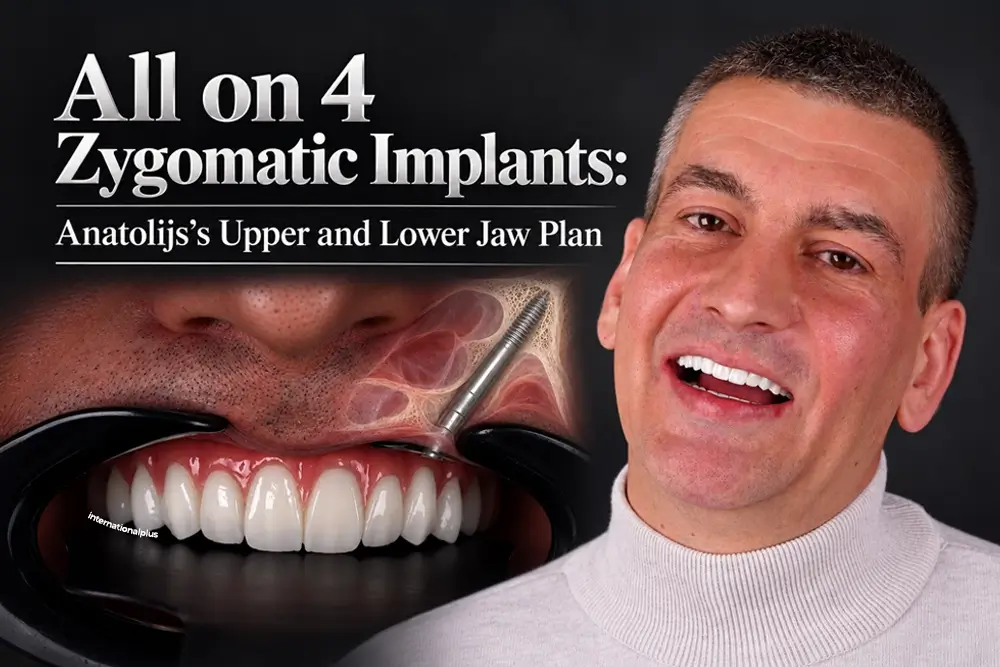

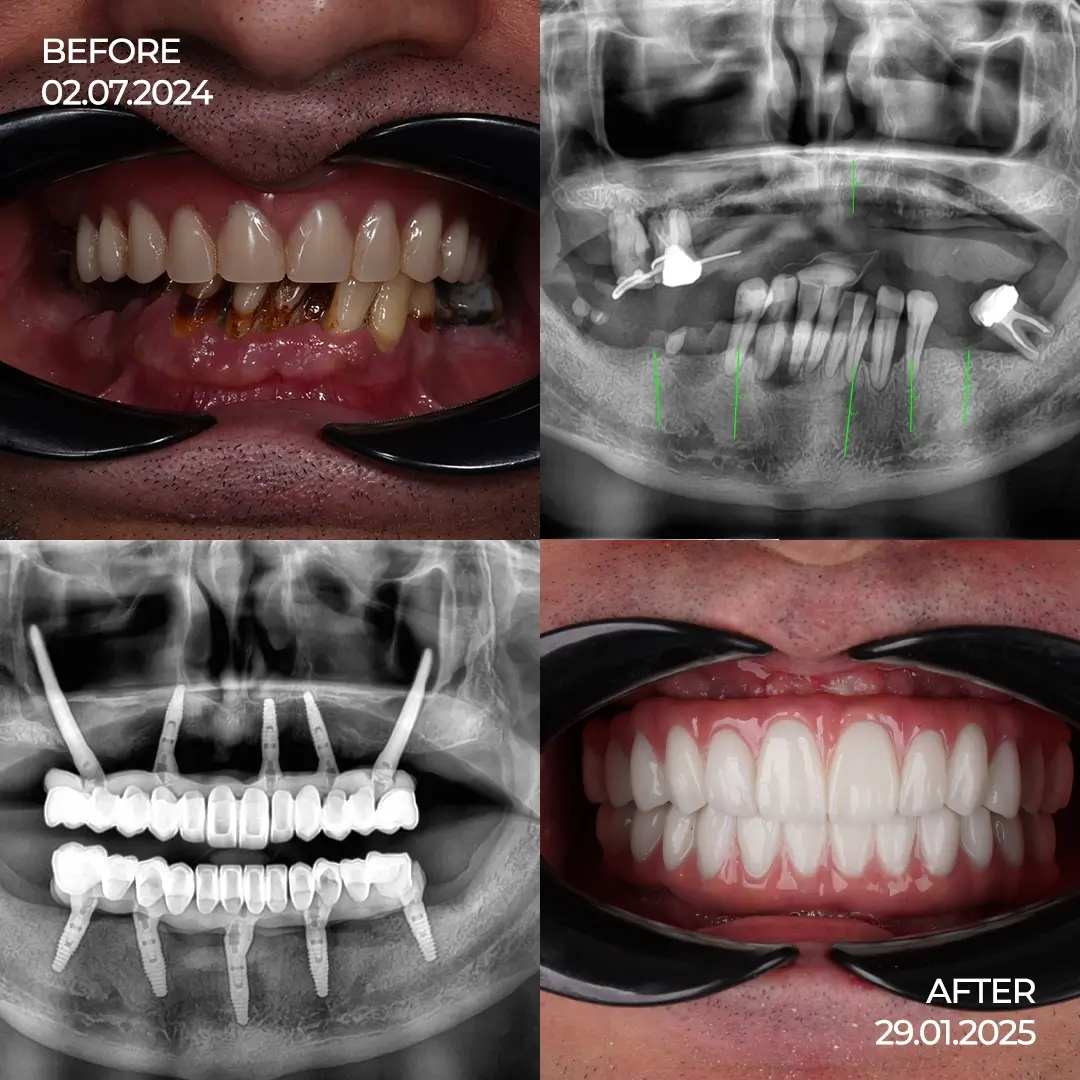
Anatolijs came to International Plus with missing teeth in both jaws, plus decay, pain and mobility in the lower teeth. This case study documents a plan searched as All on 4 zygomatic implants with one distinction: the All on 4 concept was used only in the lower jaw while the upper jaw received three conventional and two zygomatic implants. All ten implants were placed under general anesthesia. International Plus has treated 200,000+ patients from 140+ countries since 2014.
Key Takeaways
- The challenge: A removable upper denture on two mobile molars, weak bone under a dropped sinus at the back of the upper jaw and 9 lower teeth and roots without support.
- The solution: Three Bego and two Nobel Biocare zygomatic implants above; five Bego implants below on the All on 4 concept.
- Technical highlight: All remaining teeth extracted, alveoplasty and 10 implants under general anesthesia.
- The outcome: Six months of healing were given. The record holds no prosthetic phase and no final result. Individual results may vary.
Anatolijs’s Story: A Removable Denture Held by Two Mobile Molars
Anatolijs’s upper jaw depended on a removable denture supported by his last 2 upper teeth, both mobile molars. The lower jaw held 9 teeth and roots that had lost their gum and bone support and become mobile. Anatolijs also reported missing teeth in both jaws and decayed, painful lower teeth.
With every remaining tooth mobile, our team planned the upper and lower jaw separately. The sections below follow that plan region by region from the upper front to the lower jaw.
Diagnosis and Plan: Conventional and Zygomatic Implants Above, the All on 4 Concept Below
Anatolijs’s plan was built region by region from the clinical findings. The upper front had sufficient bone volume for three conventional implants while the weak bone of the posterior regions was planned for zygomatic implants. The lower jaw was planned with 5 implants following the All on 4 concept.
| Region | Finding | Decision |
| Upper jaw, front | Sufficient bone volume | 3 Bego implants |
| Upper jaw, posterior regions | Dropped sinus, reduced and weak bone | 2 Nobel Biocare zygomatic implants |
| Upper jaw, remaining teeth | 2 mobile molars holding the denture | Extracted |
| Lower jaw | 9 mobile teeth and roots without gum and bone support | Extracted; 5 Bego implants, All on 4 concept |
Bottom line: in the upper jaw, the bone decided the implant type.
Why the Back of the Upper Jaw Needed Zygomatic Anchorage
The posterior regions of Anatolijs’s upper jaw showed a maxillary sinus that had dropped toward the ridge and reduced bone volume. Sinus pneumatization is the downward expansion of the air sinus into the jaw after back teeth are lost; a 2018 study of 183 scans of single missing tooth sites found that losing a back tooth favors this expansion (Cavalcanti MC, et al., 2018).
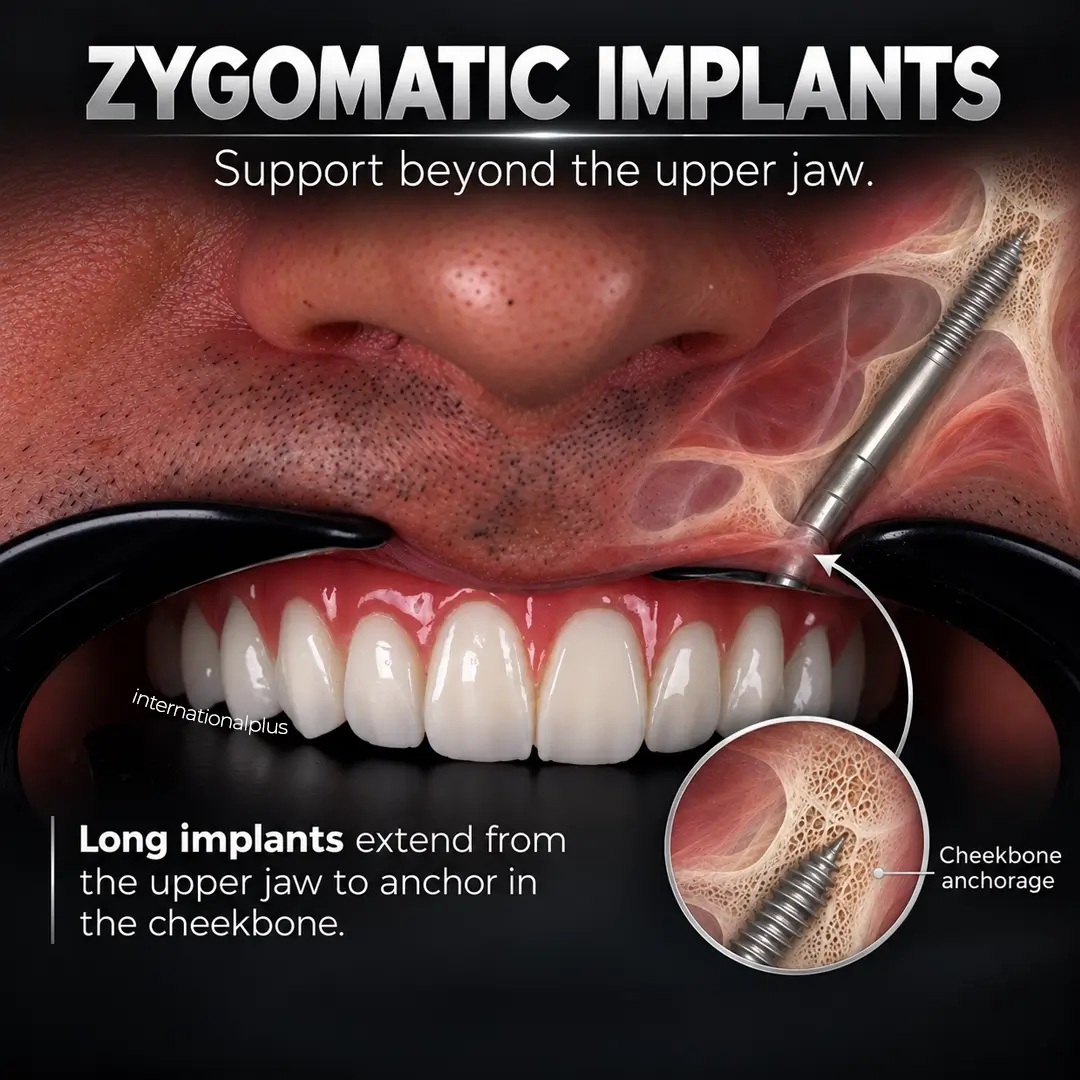
A zygomatic implant is a long implant that passes through the upper jaw to anchor in the cheekbone (zygoma), beyond the thinned posterior bone. Our guide explains what a zygomatic dental implant is; the two used here came from the Nobel zygomatic implants range and the front three from the Bego implant system. Researchers call this combination hybrid rehabilitation (Grandi T, et al., 2025).
How Do All on 4 Zygomatic Implants Work in One Mouth?
All on 4 zygomatic implants in Anatolijs’s case means two tools in two jaws. The lower jaw followed the All on 4 concept with five Bego implants while the upper jaw combined three conventional implants at the front with two zygomatic implants in the posterior regions.
The All on 4 concept carries a complete arch of teeth on implants in the front of the jaw and was first documented in 2003 in 44 patients with toothless lower jaws (Maló P, et al., 2003). A 2017 systematic review of 24 studies reported 99.8% implant survival beyond 24 months but judged the evidence limited (Soto-Penaloza D, et al., 2017); our hub explains how the All on 4 concept works.
According to the 2023 ITI consensus report, zygomatic implants are mainly indicated for maxillary atrophy or deficiency (Al-Nawas B, et al., 2023). Weighing zygomatic implants pros and cons, a 2021 trial of 80 patients found better quality of life with zygomatic plus front implants than with the All on 4 concept in the upper jaw (Fernández-Ruiz JA, et al., 2021). Zygomatic anchorage suits a posterior upper jaw where sinus expansion has reduced the bone but it is not a routine replacement for conventional implants because sinusitis is its most common complication at 14.2% in the ITI data.
Told there is too little bone at the back of your upper jaw? Book your free consultation
Surgery Under General Anesthesia: Extractions, Alveoplasty and Ten Implants
Anatolijs’s zygomatic implant surgery and the lower jaw implant placement were performed under general anesthesia. All remaining teeth were extracted: the 2 mobile upper molars plus the 9 lower teeth and roots.
Alveoplasty is the surgical smoothing and reshaping of the bone ridge that held the teeth. Anatolijs’s alveolar bone was smoothed during surgery. The upper jaw received 3 Bego implants at the front and 2 Nobel Biocare zygomatic implants in the posterior regions; the lower jaw received 5 Bego implants following the All on 4 concept. A 2014 preliminary report placed 40 zygomatic and 112 conventional implants across both jaws of 19 patients (Butura CC, et al., 2014).
| Surgical record | Detail |
| Anesthesia | General anesthesia |
| Extractions | All remaining teeth: 2 upper molars; 9 lower teeth and roots |
| Upper jaw implants | 3 Bego (front); 2 Nobel Biocare zygomatic (posterior regions) |
| Lower jaw implants | 5 Bego, All on 4 concept |
| Healing period given | 6 months |
Zygomatic Implants Recovery Time: Six Months of Healing in Anatolijs’s Plan
The zygomatic implants recovery time is planned case by case. For Anatolijs, a six month healing period was given after surgery. Implant healing in general relies on osseointegration, the process in which living bone bonds to the implant surface.
Our overview of osseointegration in All on 4 and All on 6 systems explains the biology. Across 4,556 zygomatic implants in 2,161 patients, a 2016 systematic review calculated a 12 year cumulative survival rate of 95.21% (Chrcanovic BR, et al., 2016).
What the Case Record Covers
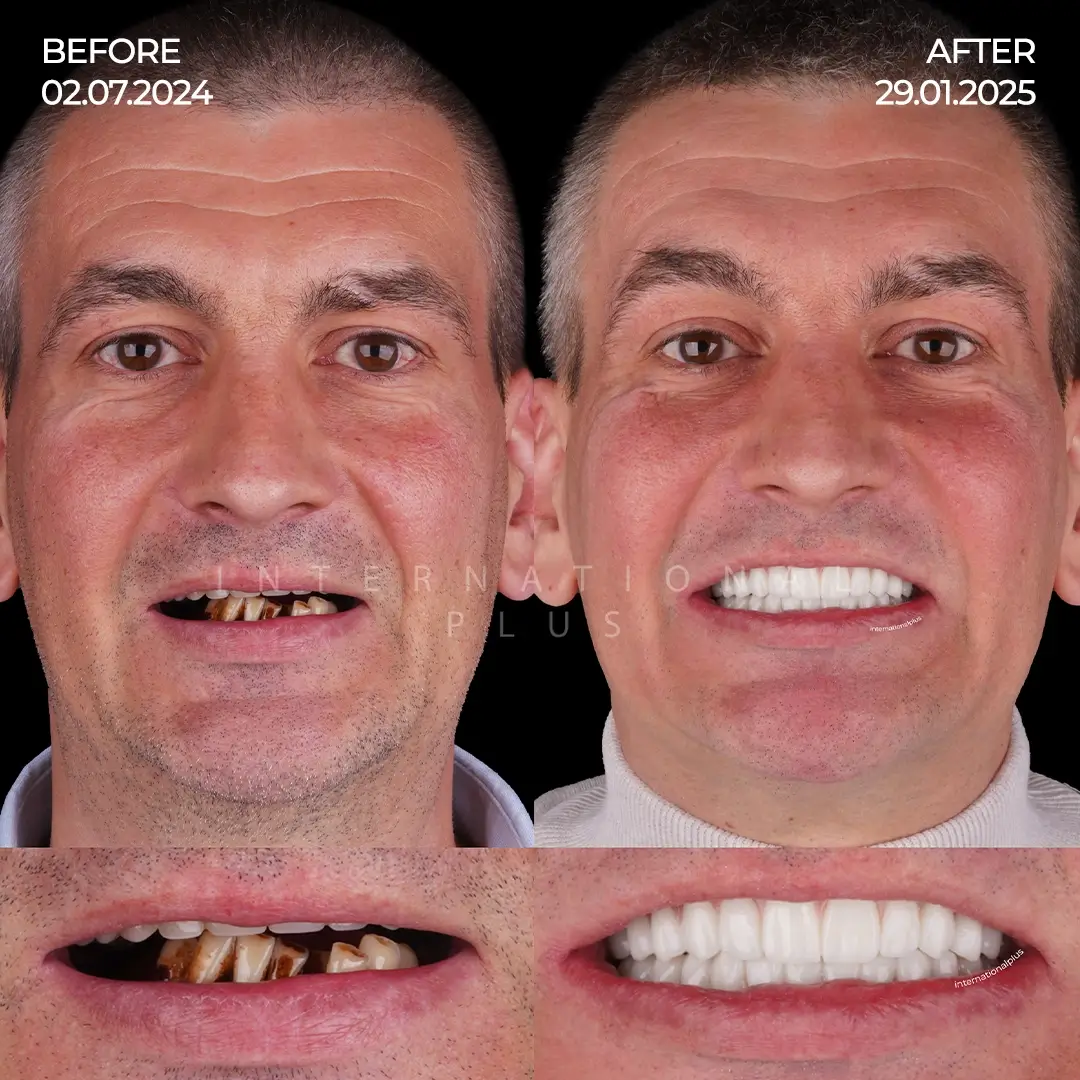
The record documents the surgical stage of Anatolijs’s treatment and the six month healing period given after it. It holds no prosthetic phase and no final result. What the case does show is how a search for All on 4 zygomatic implants can map onto two separate decisions in one mouth.
Zygomatic anchorage stayed in the weak posterior regions, conventional Bego implants took the upper front and five Bego implants followed the All on 4 concept below. Individual results may vary; Tomasz’s case shows cheekbone anchorage in another patient.
International Plus combines Ministry of Health authorization, a zygoma implant certification, 5,504+ verified Google reviews at 4.8/5 and 200,000+ patients treated since 2014, making it one of the most verifiable dental clinics in Istanbul for cheekbone anchored zygoma implants. Our pages on All on 4 treatment in Istanbul and conventional dental implant treatment explain both options.
Planning implants for both jaws? Book a consultation with our surgical team
Frequently Asked Questions
Can All on 4 zygomatic implants be combined in the same mouth?
Yes. A 2014 preliminary report placed 40 zygomatic and 112 conventional implants in the upper and lower jaws of 19 patients under the All on 4 concept. For Anatolijs, the lower jaw followed the All on 4 concept and the upper jaw combined three conventional with two zygomatic implants.
Can zygomatic implants be placed in the lower jaw?
No. A zygomatic implant anchors in the cheekbone (zygoma), a bone of the midface above the upper jaw. The 2023 ITI consensus report describes zygomatic implants as mainly indicated for maxillary bone atrophy or deficiency. Lower jaw treatment therefore uses conventional implants. Anatolijs’s lower jaw received five Bego implants following the All on 4 concept.
Are zygomatic implants safe and what are their disadvantages?
Zygomatic implants show high long term survival but carry specific risks. A 2016 systematic review of 4,556 implants reported sinusitis in 2.4%, soft tissue infection in 2.0% and paresthesia in 1.0%, noting these may be underestimated; the 2023 ITI consensus found sinusitis in 14.2% over a mean 65.4 months.
How long do zygomatic implants last?
Long term reviews report high survival: 96.2% over a mean 6.3 years in the 2023 ITI consensus and a 12 year cumulative rate of 95.21% in a 2016 systematic review. These are study averages, not a prediction for one patient.
Reviewed by Dr. Emre Çolak
References
- Cavalcanti MC, et al. Maxillary sinus floor pneumatization and alveolar ridge resorption after tooth loss: a cross-sectional study. Braz Oral Res. 2018. PMID: 30088551
- Grandi T, et al. Hybrid Full Arch Rehabilitation Using Conventional And Zygomatic Implants: A Short Term Retrospective Analysis. Eur J Prosthodont Restor Dent. 2025. PMID: 39651851
- Maló P, et al. “All on four” immediate-function concept with Brånemark System implants for completely edentulous mandibles: a retrospective clinical study. Clin Implant Dent Relat Res. 2003. PMID: 12691645
- Soto-Penaloza D, et al. The All on four treatment concept: Systematic review. J Clin Exp Dent. 2017. PMC5347302
- Al-Nawas B, et al. ITI consensus report on zygomatic implants: indications, evaluation of surgical techniques and long term treatment outcomes. Int J Implant Dent. 2023. PMC10497463
- Fernández-Ruiz JA, et al. Evaluation of Quality of Life and Satisfaction in Patients with Fixed Prostheses on Zygomatic Implants Compared with the All on four Concept: A Prospective Randomized Clinical Study. Int J Environ Res Public Health. 2021. PMC8037824
- Butura CC, et al. Combined immediate loading of zygomatic and mandibular implants: a preliminary 2-year report of 19 patients. Int J Oral Maxillofac Implants. 2014. PMID: 24451884
- Chrcanovic BR, et al. Survival and Complications of Zygomatic Implants: An Updated Systematic Review. J Oral Maxillofac Surg. 2016. PMID: 27422530
Follow us on Social Media
internationalplusofficial
internationalplus
internationalplusdental
This content is written, reviewed, and approved by the International Plus Medical Review Board to ensure clinical accuracy and adherence to strict editorial standards. All medical information is regularly monitored, audited and updated in light of the latest scientific advancements.
However the information provided here is for general informational purposes only and cannot be used for self diagnosis or making individual health interpretations. Results of medical treatments depend on individual anatomy and the unique healing process of each patient. This information should not replace a personal consultation with a qualified healthcare professional. To understand the best options for your specific needs and to receive a personalized treatment plan, we invite you to book a free consultation with the expert medical team at International Plus.

Dr. Emre Çolak concentrates on advanced implant surgery and modern regenerative treatments, delivering refined solutions to patients abroad in need of complex dental restoration.