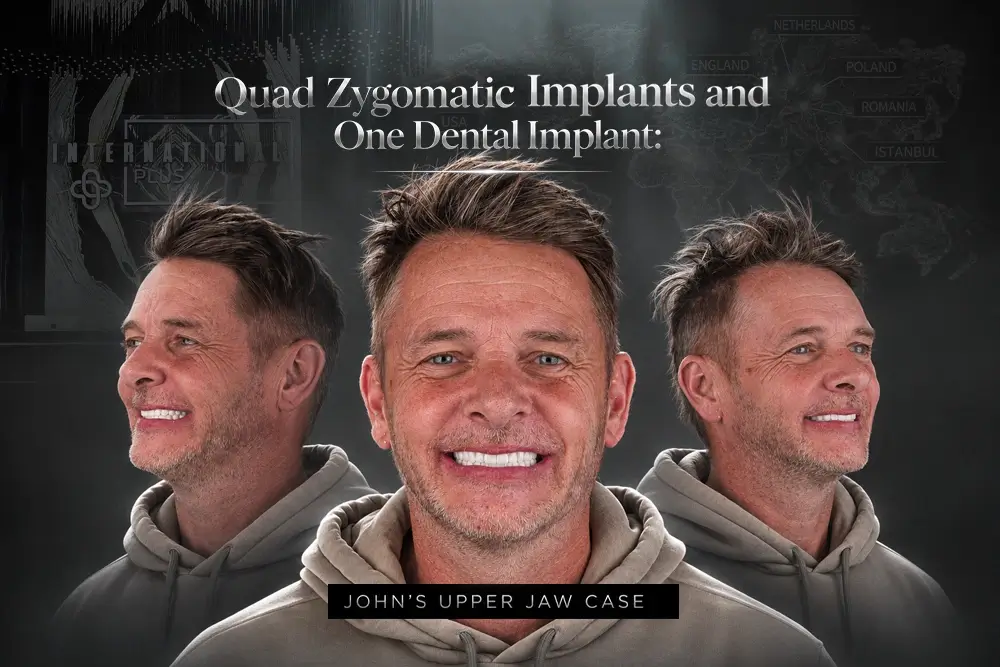

John came to International Plus because missing teeth had left him unable to eat properly. The upper jaw had no teeth and relied on a removable full denture while only three teeth remained in the lower jaw. This case follows a quad zygomatic implants plan for the upper jaw with one conventional implant where the bone allowed it and six lower implants. International Plus has treated more than 200,000 patients from 140+ countries since 2014.
Key Takeaways
- The challenge: a toothless upper jaw with too little bone for conventional implants and more loss on the right side.
- The solution: four Nobel Biocare zygomatic implants plus one Bego implant in the upper jaw; three extractions and six implants in the lower jaw.
- Technical highlight: bone preserved at the lower extraction sites allowed longer implants in a thin jaw.
- The outcome: fixed temporary teeth the same day. Individual results may vary.
John’s Story: Eating With a Full Upper Denture and Three Lower Teeth
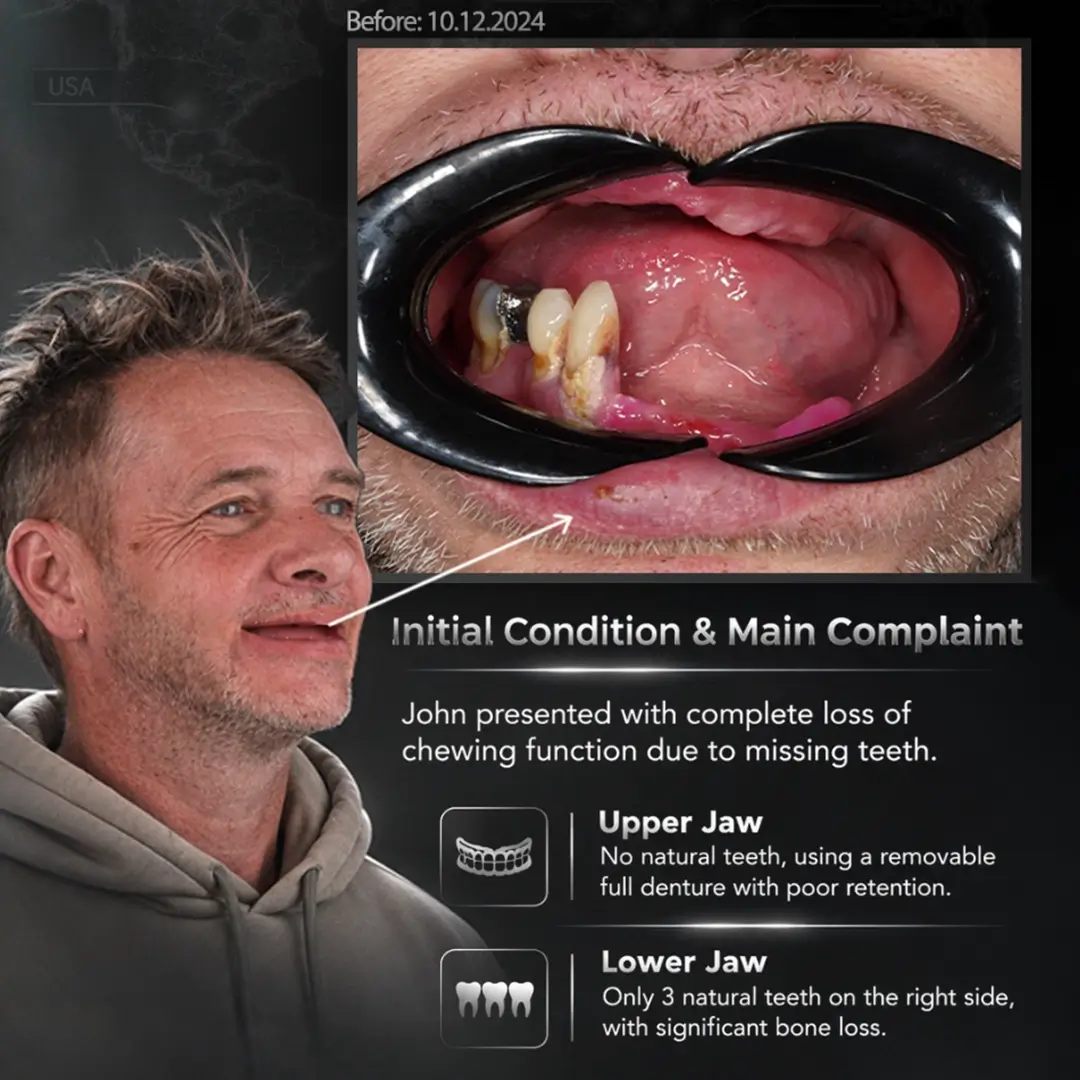
John’s complaint was practical: he could not eat properly because of missing teeth. His upper jaw was completely toothless and he wore a removable complete denture with nothing to anchor it. Only three teeth were left in the lower jaw, all of them on the right side. Those teeth had already lost their bone support.
Diagnosis: Why the Right Side of the Upper Jaw Lost More Bone
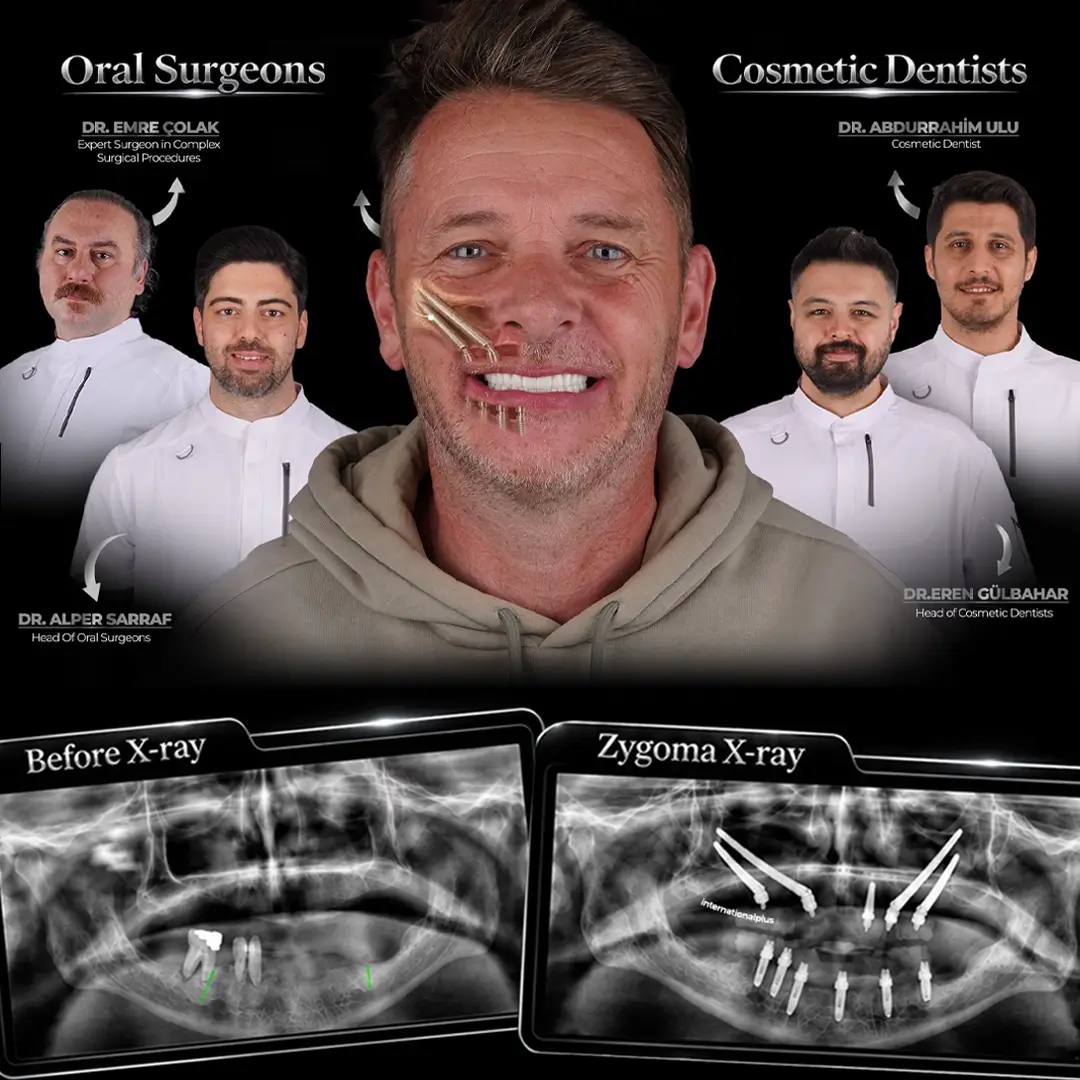
The examination showed uneven bone loss in the upper jaw with more resorption on the right than on the left. According to the surgical team’s clinical assessment, the cause was John’s chewing habit: he chewed on the right side, the only side with remaining teeth so the upper right ridge under the denture took most of the chewing load.
After tooth loss the residual ridge keeps remodelling for life and denture wear is one of the factors that speeds up this progressive resorption (Pietrokovski J, 2013). We report the one-sided pattern as an observation in this patient, not as a general rule. Because of this loss, only the upper left front area still had room for one standard implant.
The Plan: Four Zygomatic Implants Plus One Dental Implant Where the Bone Allowed
Quad zygomatic implants (quad zygoma) means placing four long implants in the cheekbone instead of the deficient upper jaw. Published studies use the term for four zygomatic implants with no additional standard implants. John’s plan differed slightly and we state it plainly: four zygomatic implants in a quad zygoma configuration, plus one conventional implant in the only area with enough bone.
The cheekbone is dense facial bone that resorption of the jaw does not reach; our explainer covers what a zygomatic dental implant is. The four fixtures were Nobel Biocare zygoma implants and the front implant came from the Bego implant system. Reviews of zygomatic implants combined with premaxillary regular implants report similar survival for both types (Lorusso F, et al., 2021). Grafting the whole upper jaw is the usual alternative although it adds its own healing stage before any implant can be placed.
| Area | Bone situation | What was done |
| Upper left front | Only area with enough bone | 1 conventional implant (Bego) |
| Rest of the upper jaw | Too little bone; more loss on the right | 4 zygomatic implants (Nobel Biocare) |
| Lower right | 3 teeth without bone support | 3 extractions, bone volume preserved |
| Lower jaw | Thin bone after denture wear | 6 conventional implants |
| Surgery and loading | One operation | General anesthesia, fixed temporary teeth the same day |
Each implant went where bone could hold it.
How Do Quad Zygomatic Implants Work and What Are the Risks?
These implants work by bypassing the resorbed upper jaw and taking stability from the cheekbone so a fixed bridge can be attached without rebuilding the jaw first. A 2021 meta-analysis of 11 studies and 166 patients found a pooled implant survival of 98%, ranging from 95.8% to 100% (Lan K, et al., 2021).
That review also warns that complications should not be underestimated. Pooled rates were 12% for sinusitis and 11% for malposition or guiding failure with local infection or injury at 10%. In a review of 2,194 zygomatic implants in 918 patients, the authors name sinusitis and soft tissue infection as the most common complications (Kämmerer PW, et al., 2023).
Our professional view: quad zygoma suits a severely resorbed maxilla but it is not a first-line option when the jaw can still hold conventional implants because the surgery is longer and technique sensitive. Candidacy is decided only after an in-person examination; see our page on zygomatic implant surgery for severe bone loss.
The Lower Jaw: Six Implants and Preserving Bone at the Extraction Sites
Removable denture wear had left John’s lower bone quite thin and the three right teeth could not be saved because their bone support was gone. The plan removed those teeth and placed six conventional dental implants.
Once a tooth is removed the ridge normally shrinks in width and height; preservation measures aim to limit that loss (Avila-Ortiz G, et al., 2014). The surgical team preserved bone volume where the three right teeth had been. That retained bone allowed longer implants in an otherwise thin jaw.
Surgery Under General Anesthesia and Fixed Temporary Teeth the Same Day
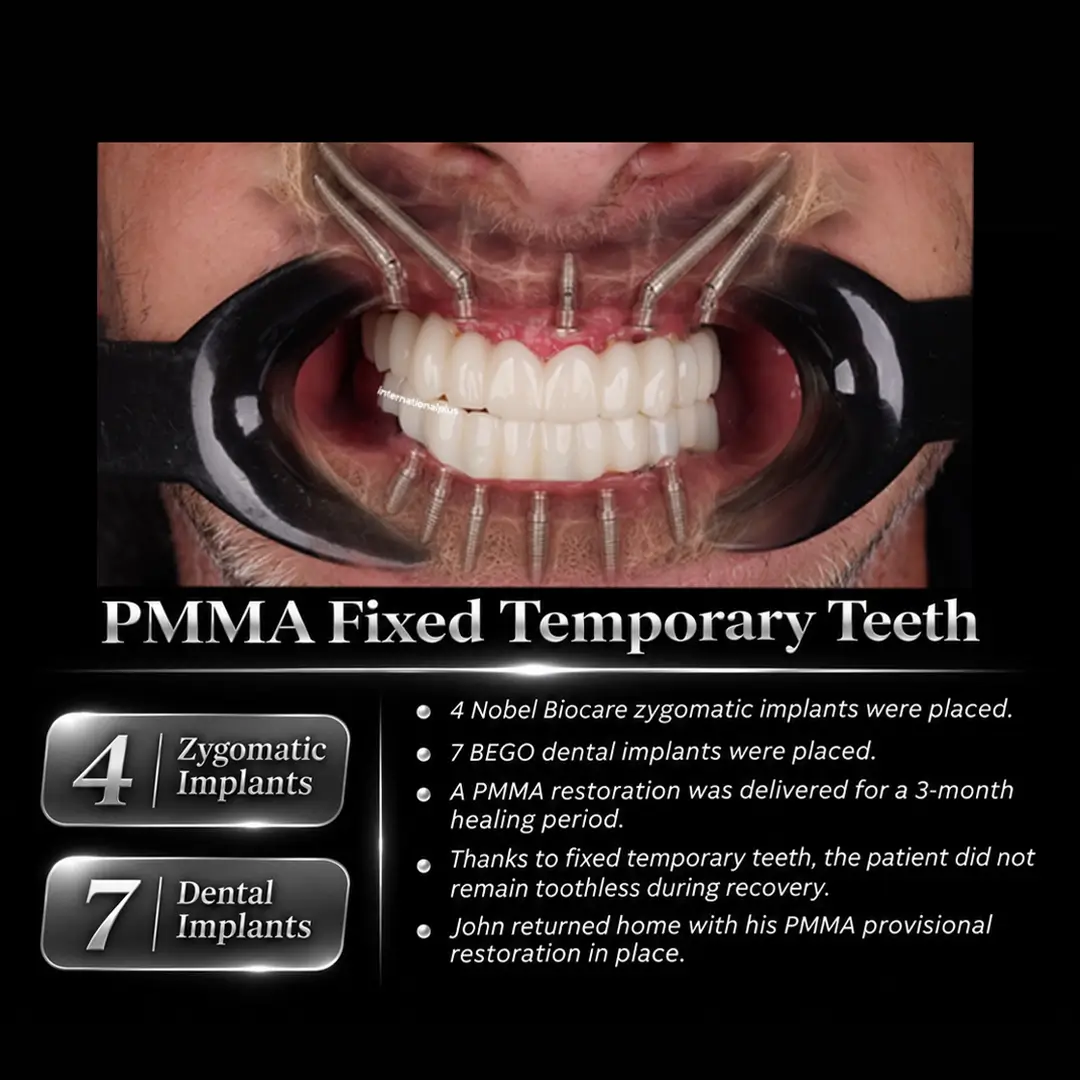
The extractions, the six lower implants, the four zygomatic implants and the upper conventional implant were completed under general anesthesia in one operation. The same day John received fixed temporary teeth, a stable bite that does not move while the implants heal.
Immediate loading of zygomatic and mandibular implants in the same patient is documented. One 19-patient series placed 40 zygomatic and 112 conventional implants and fitted full arch acrylic prostheses within three hours of surgery with no implant or prosthesis failures over one year of follow-up (Butura CC, Galindo DF, 2014).
Outcome and Healing Ahead
John went into surgery with a removable upper denture and three lower teeth that had lost their bone support; he received fixed temporary teeth the same day. The upper jaw now rests on quad zygomatic implants plus one conventional implant while six implants support the lower jaw. Next comes a healing period whose length is set for each patient.
Our full arch case that combined zygomatic and several dental implants shows a different mix; in John’s upper jaw only one area could hold a standard implant so the cheekbone carried four. This case covers the surgical phase for one patient and individual results may vary. International Plus holds Ministry of Health authorization and a rating of 4.8/5 from 5,504+ verified Google reviews, worth checking for anyone comparing zygomatic implants in Turkey.
Told there is not enough bone for implants? Book your free consultation and have your bone assessed by our surgical team.
Frequently Asked Questions
What are quad zygomatic implants?
They are four long implants anchored in the cheekbone, used when the upper jaw has too little bone for conventional implants. The term usually means four zygomatic implants without extra standard implants. In John’s case one conventional implant was also placed in the upper left front area, where bone remained.
Are quad zygomatic implants better than regular implants?
They are not better in general; they serve a different situation. Regular implants remain the first option when the jaw has enough bone and zygomatic implants are used when it does not. Reviews of zygomatic implants combined with regular implants report similar survival for both types.
What are the disadvantages of quad zygomatic implants?
The surgery is longer and technique sensitive and complications are possible. Pooled data from quad zygoma studies show rates of 12% for sinusitis, 11% for malposition and 10% for local infection or injury. A thorough examination and an experienced surgical team are needed to manage these risks.
How long do quad zygomatic implants last?
No implant comes with a fixed lifespan. A 2021 meta-analysis of quad zygoma studies with at least six months of follow-up found a pooled implant survival of 98%. Results over the years depend on healing and daily hygiene and regular check-ups matter as much as the surgery itself.
Questions about your own case? Book your free consultation
Reviewed by Dr. Emre Çolak
Expert Surgeon in Complex Surgical Procedures.
References
- Lan K, Wang F, Huang W, Davó R, Wu Y. Quad Zygomatic Implants: A Systematic Review and Meta-analysis on Survival and Complications. Int J Oral Maxillofac Implants. 2021;36(1):21-29. PMID 33600519
- Lorusso F, et al. Survival Rate of Zygomatic Implants for Fixed Oral Maxillary Rehabilitations: A Systematic Review and Meta-Analysis Comparing Outcomes between Zygomatic and Regular Implants. Dent J (Basel). 2021;9(4):38. PMC8065623
- Kämmerer PW, et al. Evaluation of surgical techniques in survival rate and complications of zygomatic implants for the rehabilitation of the atrophic edentulous maxilla: a systematic review. Int J Implant Dent. 2023;9(1):11. PMC10192488
- Butura CC, Galindo DF. Combined immediate loading of zygomatic and mandibular implants: a preliminary 2-year report of 19 patients. Int J Oral Maxillofac Implants. 2014;29(1):e22-9. PMID 24451884
- Avila-Ortiz G, et al. Effect of alveolar ridge preservation after tooth extraction: a systematic review and meta-analysis. J Dent Res. 2014;93(10):950-8. PMC4293706
- Pietrokovski J. The residual edentulous arches: foundation for implants and for removable dentures; some clinical considerations. A review of the literature 1954-2012. Refuat Hapeh Vehashinayim. 2013;30(1):14-24. PMID 23697296
Follow us on Social Media
internationalplusofficial
internationalplus
internationalplusdental
This content is written, reviewed, and approved by the International Plus Medical Review Board to ensure clinical accuracy and adherence to strict editorial standards. All medical information is regularly monitored, audited and updated in light of the latest scientific advancements.
However the information provided here is for general informational purposes only and cannot be used for self diagnosis or making individual health interpretations. Results of medical treatments depend on individual anatomy and the unique healing process of each patient. This information should not replace a personal consultation with a qualified healthcare professional. To understand the best options for your specific needs and to receive a personalized treatment plan, we invite you to book a free consultation with the expert medical team at International Plus.

International Plus was established from scratch in 2014 with the sole purpose of providing a world class center for plastic and cosmetic surgery by SAMİLSAN SAĞLIK HİZMETLERİ TURİZM DANIŞMANLIK TİCARET LİMİTED ŞİRKETİ International Plus has developed a worldwide reputation for its unique treatments and techniques. With over 10 years of experience, our talented medical experts are among the best in their respective fields. You are our priority. We are convinced that good communication between you and your surgeon is essential when planning your treatments. We offer realistic advice and the most suitable treatments for you.