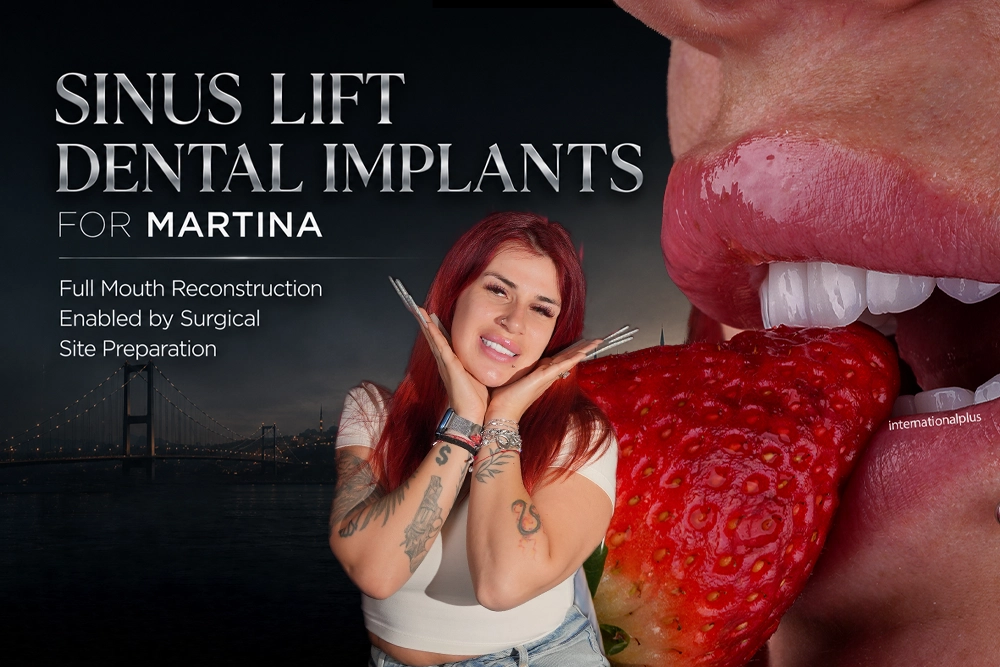
Not every mouth arrives ready for implants. For Martina, an international patient who came to International Plus for a fixed, full mouth result, the upper jaw simply did not have enough bone to anchor implants safely. This case study follows a full mouth reconstruction made possible by sinus lift dental implants and careful surgical site preparation: a closed sinus lift to rebuild bone height, complicated extractions and alveoplasty to reshape the ridge before a single Megagen fixture was placed. International Plus has treated more than 200,000 patients from 140+ countries since 2014.
Key Takeaways
- The challenge: A full mouth rehabilitation that could not begin until the upper jaw was rebuilt with insufficient bone height and teeth needing complicated removal over an uneven ridge.
- The solution: Staged surgical site preparation, a closed sinus lift plus roughly three extractions (two complicated) and ridge-levelling alveoplasty, then Megagen implants and a 26-unit monolithic zirconia rehabilitation.
- Technical highlights: Closed sinus floor elevation, PRF, an insertion torque target of 35 to 45 N/cm, gingivectomy for gum contouring and a staged PMMA trial smile before the final teeth.
- The outcome: A fixed, natural looking full arch in shade 0M1, protected by a night guard. Individual results may vary.
Martina’s Story: A Rebuild That Had to Start With the Bone
Full-mouth reconstruction is the staged rebuilding of an entire dentition, and for Martina that rebuild could not even begin until her upper jaw regained enough bone to hold an implant. She wanted a durable, fixed set of teeth rather than anything removable, and planned the whole treatment end to end as an English-speaking international patient before travelling to Istanbul. Her request was straightforward; the anatomy behind it was not. Years of tooth loss had left the upper back jaw with too little bone to hold implants so the usual first step of placing fixtures was off the table until that foundation was rebuilt.
That reality reframed the whole plan. The team treated the surgery not as a preliminary but as the case itself because the quality of the final prosthesis would only ever be as good as the bone and gum supporting it. Weighing a faster route against a lasting one, our surgical and prosthetic team committed to preparing the site properly first.
Diagnosis and Treatment Plan: Reading the Bone Before Deciding
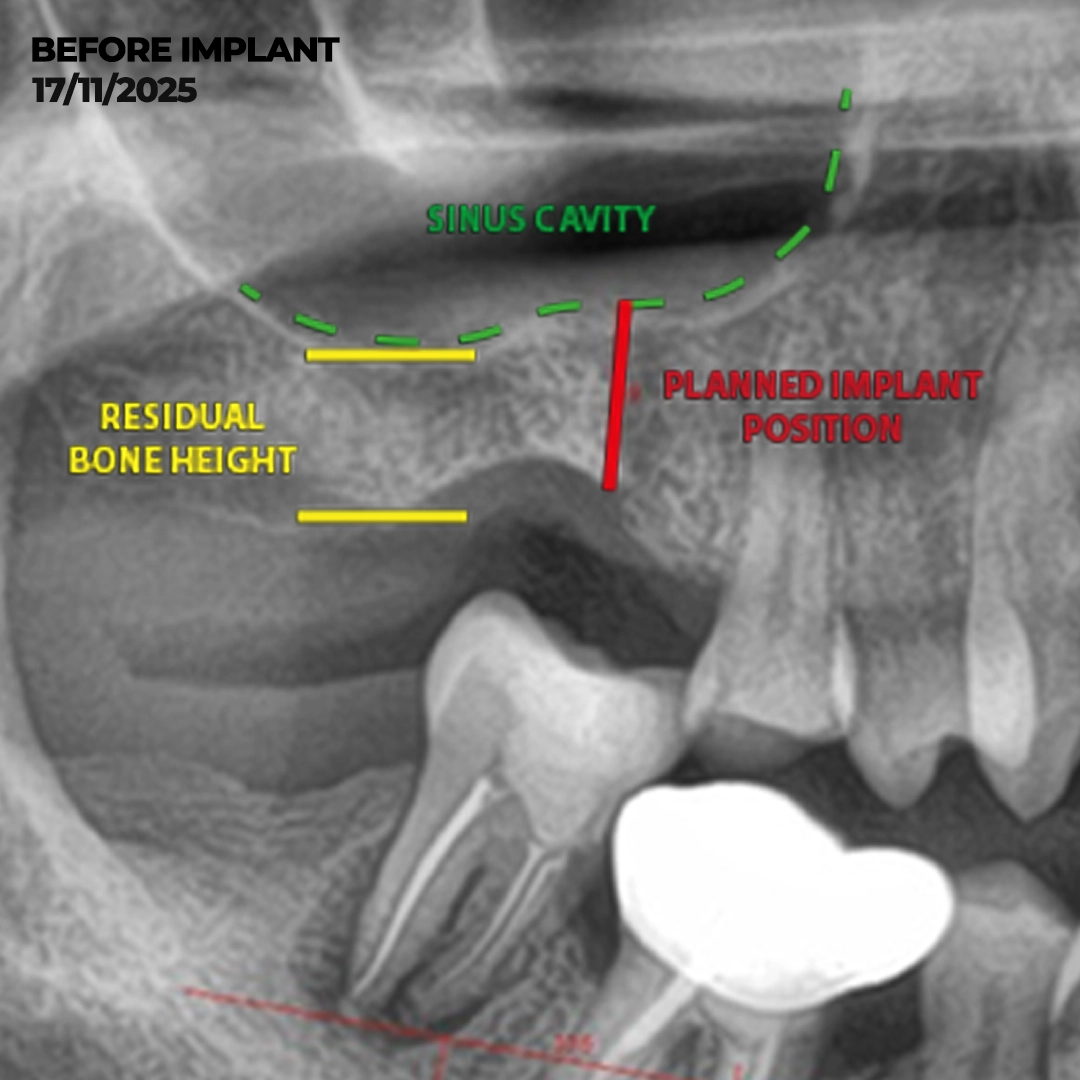
Diagnosis in a surgery-led case is the mapping of available bone before any decision is made. Planning began with layered imaging because a judgement about bone height needs more than one view, so the team captured a 2D panoramic radiograph for an overview, a 3D CBCT scan (cone beam tomography that maps bone volume and vital structures such as the sinus in three dimensions), a digital face scan and an intraoral scan. The Diagnostic Council, our multidisciplinary review of every complex plan, graded prognosis arch by arch and mapped exactly where bone had to be gained.
The Council drew a clear sequence. The upper posterior sites needed vertical bone before implants could be placed, a few teeth were beyond saving and had to come out atraumatically and the ridge itself needed reshaping for an even implant platform. A small number of structurally sound teeth were routed for preservation with root canals and fillings rather than removal. The roadmap was explicit: prepare the site, let it heal, place the implants, then build the final teeth.
Preparing the Surgical Site: Closed Sinus Lift, Complicated Extractions and Alveoplasty
This preparation phase is what set Martina’s case apart and it began at the sinus. A closed sinus lift is a bone-gaining procedure, also called crestal or transcrestal sinus floor elevation, that gently raises the membrane at the floor of the maxillary sinus and adds graft material to build vertical bone height. Working through the crest rather than opening a lateral window keeps the procedure less invasive and crestal sinus floor elevation shows high implant survival when bone height is adequate (Kadkhodazadeh M, et al., 2024). Rebuilding that height matters because sinus floor augmentation is what makes implant placement predictable in the atrophied upper jaw (Díaz-Olivares LA, et al., 2021).
In the same surgical stage, roughly three teeth were removed, two of them complicated extractions where a root was fractured or firmly held in bone and had to be released in sections to spare the surrounding wall. Preserving that wall is deliberate: minimising bone loss at an extraction site protects the ridge that will later hold an implant (Barootchi S, et al., 2023). To support healing, the team applied PRF, platelet-rich fibrin concentrated from Martina’s own blood to release growth factors at the surgical sites, a material with documented benefit in extraction-socket healing (Al-Maawi S, et al., 2021). Finally, alveoplasty, the smoothing and recontouring of the jaw ridge, levelled the bone into an even platform. For Martina, this stage was the quiet, unglamorous work that made everything after it possible.
Placing the Megagen Implants and Healing
A dental implant is a titanium root placed in the jaw to hold fixed teeth, and once the prepared sites had matured the surgical phase seated Megagen implants across both jaws as the fixed foundation. Each fixture reached an insertion torque target of 35 to 45 N/cm, the rotational force that measures how firmly an implant grips bone at placement and a recognised marker of primary stability, the mechanical firmness that must be present before biological healing takes over (Greenstein G, et al., 2017). Choosing a documented implant system for a load-bearing full mouth case is part of how we build predictability into these plans, the same standard behind our Megagen implant certified clinic work.
Over roughly six months, the fixtures underwent osseointegration, the process where living bone fuses directly to the implant surface and converts initial mechanical grip into lasting anchorage, the same biology we explain in our overview of osseointegration in All on 4 and All on 6 systems. While the implants healed quietly beneath the gum, Martina wore provisional teeth and the preserved units were stabilised, sitting alongside our other full mouth zirconia rehabilitation with sinus lift work.
The Prosthetic Phase: 26 Zirconia Units, Gum Aesthetics and a Staged PMMA Trial
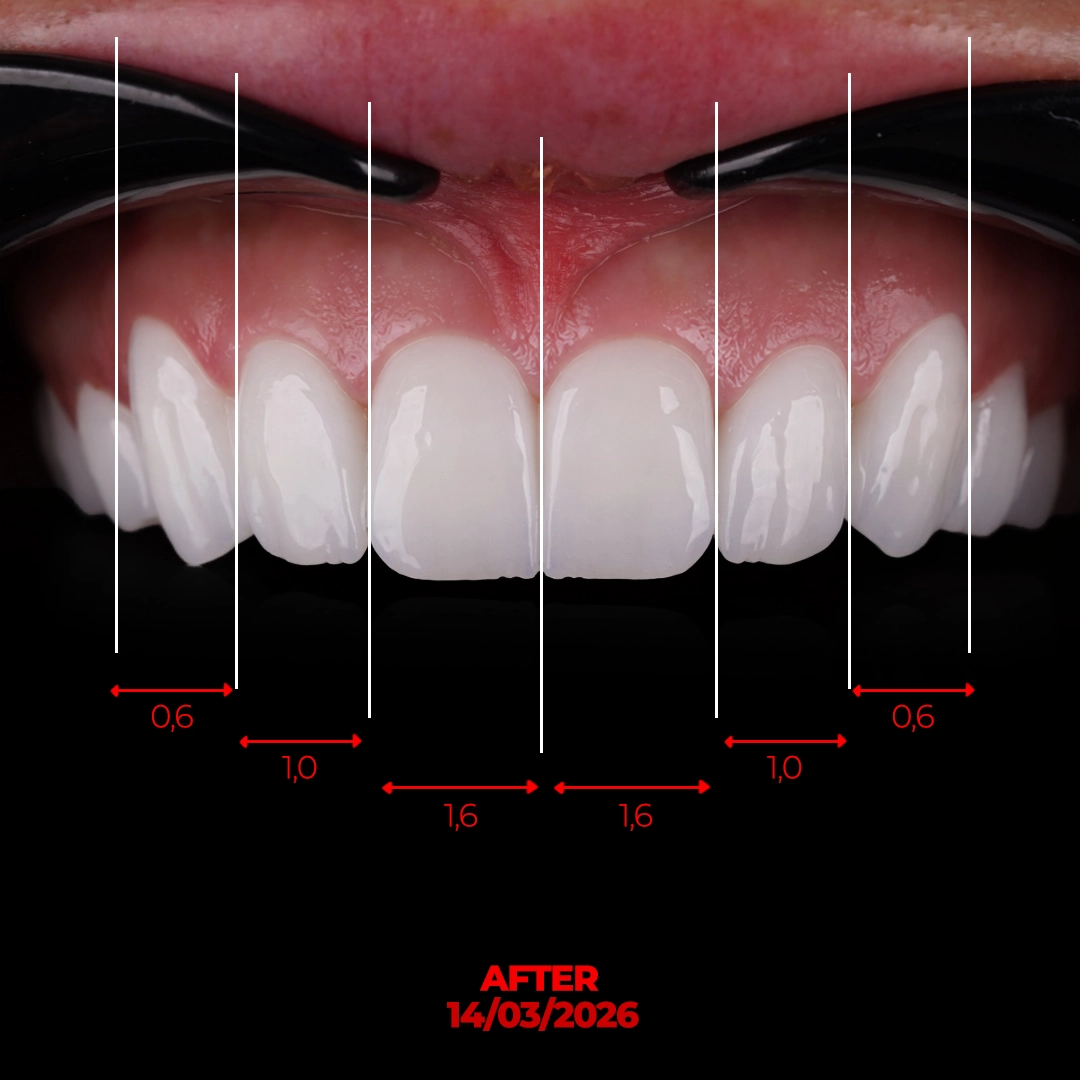
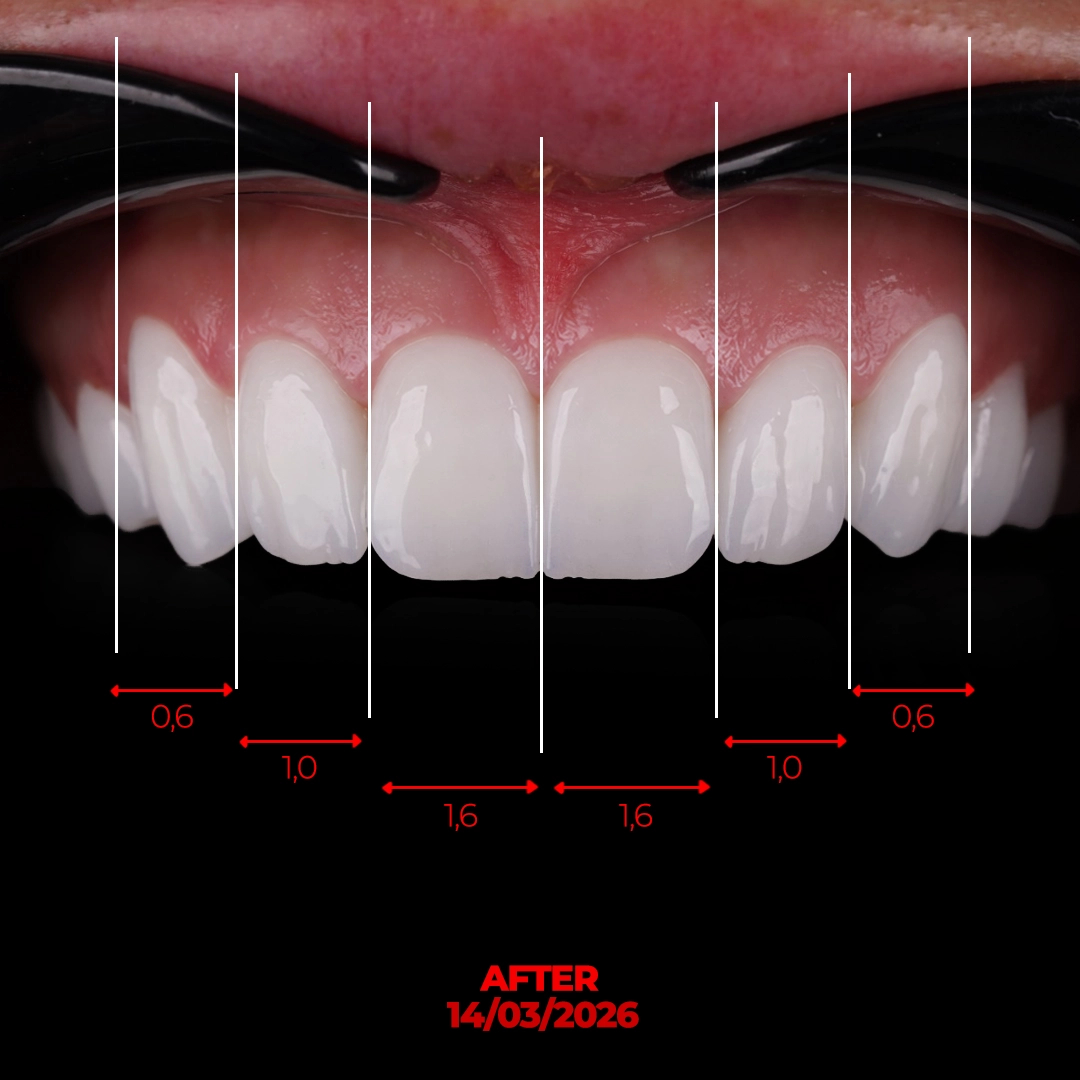
A monolithic zirconia rehabilitation is a fixed set of 26 teeth milled from single high-strength blocks. With the implants integrated, it formed the final, facially driven stage of the plan. Using the digital face scan captured at diagnosis (MetiSmile), the team planned the smile against Martina’s facial proportions under our “PLUS S” design, an approach that improves aesthetic predictability (Revilla-León M, et al., 2022). Before anything final was made, that plan was tested with a staged PMMA trial smile. A PMMA trial smile is a temporary set of teeth milled in tooth-coloured acrylic and worn across several sessions so the shape and length could be confirmed and the bite adjusted with Martina’s own approval.
Alongside prosthetic work, the anterior gum line was refined with a gingivectomy, the conservative reshaping of gum tissue to give the front teeth balanced even proportions, a well-documented step in smile-zone aesthetics (Jurado CA, et al., 2022); scaling removed hardened deposits and the preserved teeth were treated with root canals and fillings where needed. Only once the mock-up was signed off were the definitive 26 units milled in monolithic zirconia, whose lack of layered porcelain to fracture first gives full arch prostheses strong survival (Papaspyridakos P, et al., 2025). Six of these units were screw-retained on a fixed bridge, meaning they are held by screws rather than cement so the work stays retrievable for maintenance. Fabrication ran through our in-house digital lab and a night guard plus whitening of any remaining natural teeth finished the plan, unified in our zirconia dental crowns and digital smile design workflow.
| Stage | What was done | Purpose |
|—|—|—|
| Diagnosis | Panoramic, CBCT, face scan, intraoral scan, Diagnostic Council | Map bone height and plan the surgical sequence |
| Site preparation | Closed sinus lift, ~3 extractions (2 complicated), alveoplasty, PRF | Gain bone height and level the ridge for implants |
| Implant surgery | Megagen implants, both jaws, 35 to 45 N/cm torque | Anchor the fixed foundation |
| Healing (~6 months) | Osseointegration under the gum, provisionals worn | Convert grip to biological anchorage |
| Prosthetics | Staged PMMA trial, gingivectomy, 26 monolithic zirconia units (shade 0M1) | Deliver and refine the definitive full arch |
The Result: A Fixed Full Arch Built on a Rebuilt Foundation
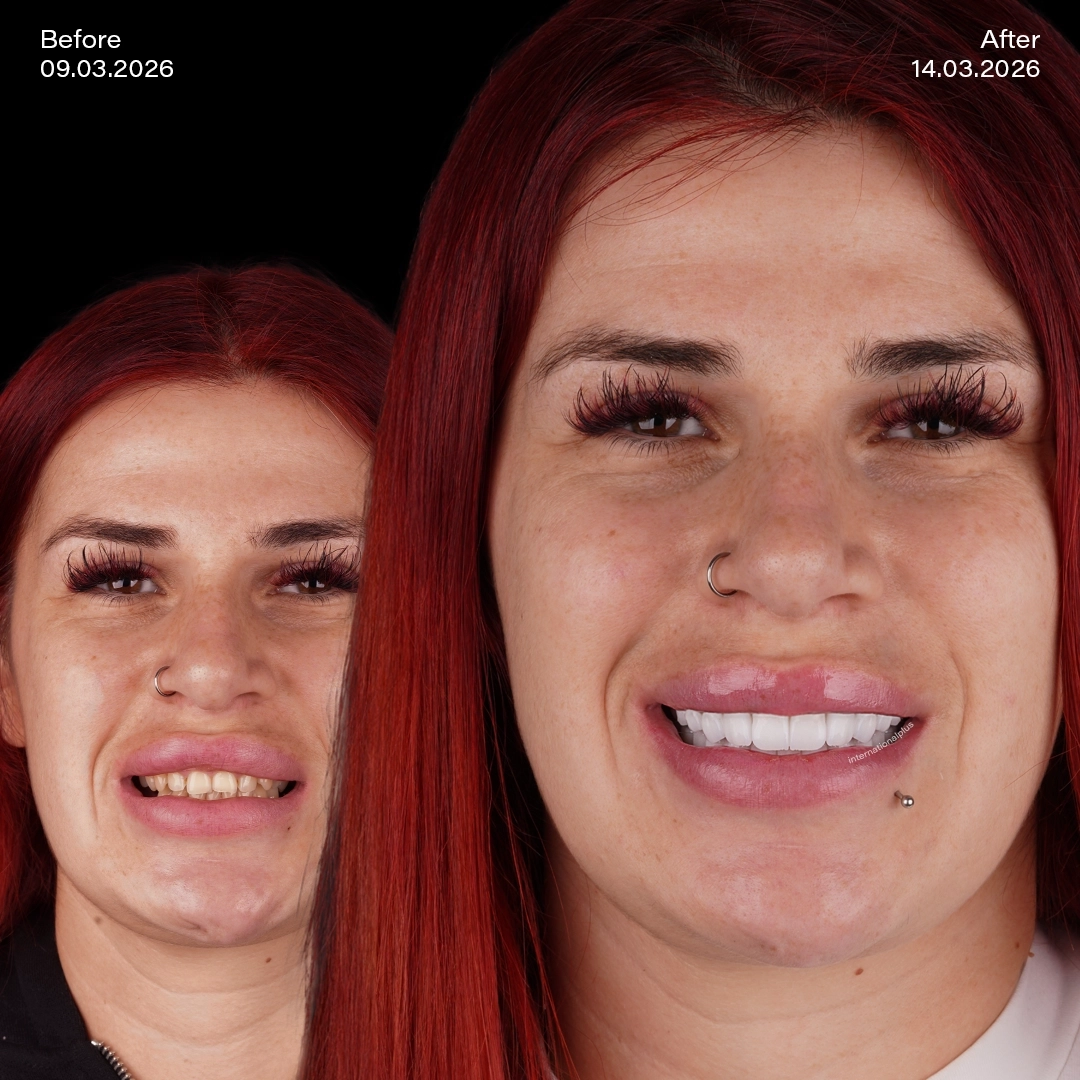
Martina finished treatment with a fixed, natural looking full mouth rehabilitation in shade 0M1, delivered on a foundation that had to be surgically rebuilt before it could carry a single tooth. This is what a case built on sinus lift dental implants can achieve: the closed sinus lift restored the bone the plan depended on, the Megagen implants anchored the arch and the staged PMMA trial let her confirm the look before it became permanent. A night guard protects the finished work against parafunctional load. We build each plan around one person’s anatomy and goals so individual results may vary.
This is the standard behind the outcome. International Plus combines official Ministry of Health authorization, 5,504+ verified Google reviews at 4.8/5 and more than 200,000 international patients treated since 2014. For patients like Martina, a surgery-led case sits within our broader dental implant treatment in Istanbul and All on 4 full arch restoration, planned in full before travel.
Considering a full mouth solution that needs bone rebuilding first? Book your free consultation
Frequently Asked Questions
What is a closed sinus lift and why was it needed?
A closed sinus lift or crestal sinus floor elevation, raises the sinus membrane through the implant channel and adds graft to gain vertical bone height in the upper back jaw. It was needed because that area did not have enough bone to hold an implant safely. Rebuilding the height first is what made predictable implant placement possible in this case.
Can dental implants be placed if there is not enough bone?
Often yes but only after the bone is rebuilt. Procedures such as a sinus lift, socket preservation at extraction and alveoplasty prepare the site so implants have a stable foundation. The exact approach is decided from CBCT imaging and a multidisciplinary review before any surgery is scheduled.
Why use a staged PMMA trial smile before the final teeth?
A PMMA trial smile is a temporary set of teeth in tooth-coloured acrylic worn before the definitive work is milled. It lets the patient and team confirm shape, length and bite and make adjustments so the final zirconia is approved in advance. This staged approach reduces surprises once the permanent teeth are delivered.
How long does surgical site preparation add to treatment?
It adds a healing interval, commonly around six months so grafted bone and integrating implants can mature before the final teeth are loaded. The precise timeline depends on how much bone had to be rebuilt and how each site heals. A staged plan trades extra time for a more stable long term result.
Reviewed by Dr. Berkay Işık
References
- Kadkhodazadeh M, et al. Survival rate of implants placed with transcrestal sinus floor elevation: a systematic review. Br J Oral Maxillofac Surg. 2024. PMID 39098575
- Díaz-Olivares LA, et al. Management of Schneiderian membrane perforations during maxillary sinus floor augmentation with implant survival outcomes. Int J Implant Dent. 2021. PMC8273047
- Barootchi S, et al. Alveolar ridge preservation: complications and cost-effectiveness. Periodontol 2000. 2023. PMID 36580417
- Al-Maawi S, et al. Efficacy of platelet-rich fibrin in promoting the healing of extraction sockets: a systematic review. Int J Implant Dent. 2021. PMC8684569
- Greenstein G, et al. Implant Insertion Torque: Its Role in Achieving Primary Stability of Restorable Dental Implants. Compend Contin Educ Dent. 2017. PMID 28156122
- Papaspyridakos P, et al. Full arch implant-supported monolithic zirconia fixed dental prostheses: an updated systematic review. J Prosthodont. 2025. PMID 39136214
- Jurado CA, et al. Esthetic Crown Lengthening and Gingival Contouring: a review. Medicina (Kaunas). 2022. PMC9608665
- Revilla-León M, et al. Facial scanning accuracy and its application in dentistry: a systematic review. J Prosthet Dent. 2022. PMID 33541817
Follow us on Social Media
internationalplusofficial
internationalplus
internationalplusdental
This content is written, reviewed, and approved by the International Plus Medical Review Board to ensure clinical accuracy and adherence to strict editorial standards. All medical information is regularly monitored, audited and updated in light of the latest scientific advancements.
However the information provided here is for general informational purposes only and cannot be used for self diagnosis or making individual health interpretations. Results of medical treatments depend on individual anatomy and the unique healing process of each patient. This information should not replace a personal consultation with a qualified healthcare professional. To understand the best options for your specific needs and to receive a personalized treatment plan, we invite you to book a free consultation with the expert medical team at International Plus.

Dr. Alper Çağlayan Sarraf directs the oral surgery unit at InternationalPlus Istanbul, focusing on demanding cases that draw patients from every corner of the world.