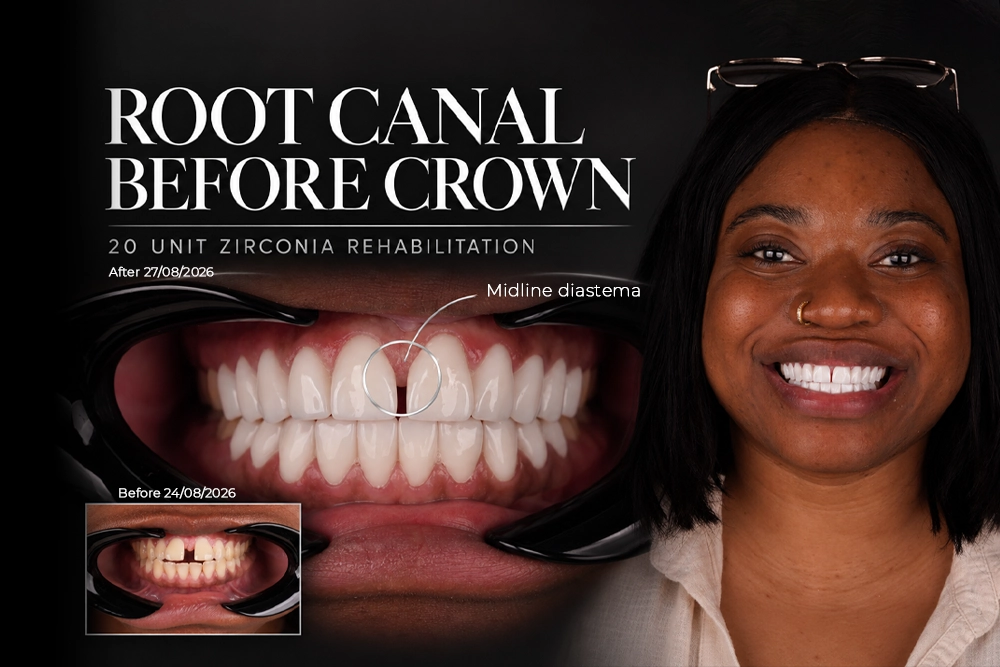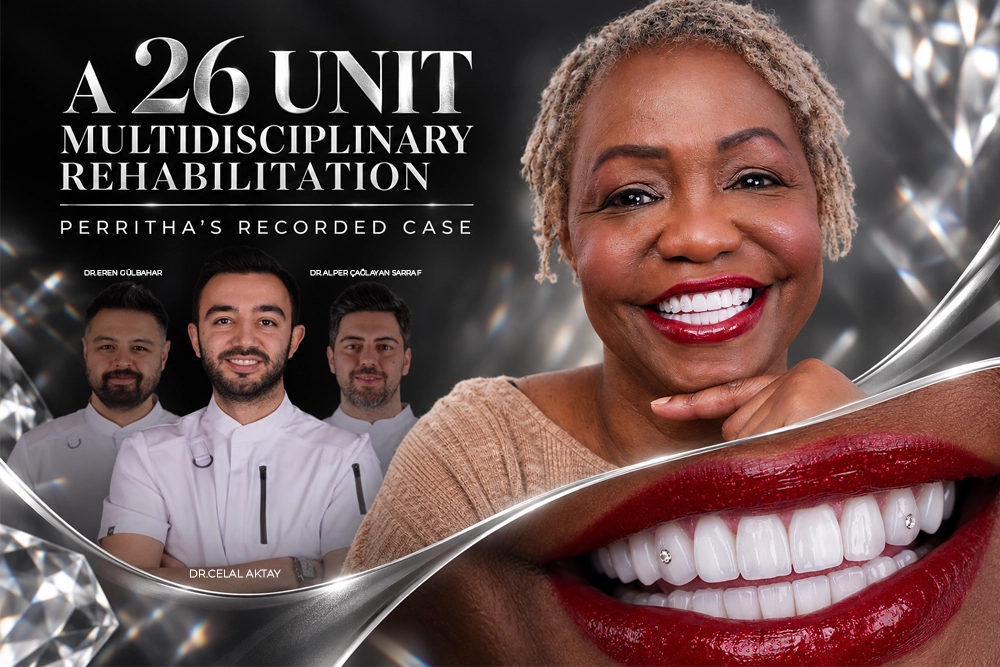
Perritha’s chart from 5 March 2026 holds one treatment plan that crosses four dental disciplines. Twenty six zirconium units plus nine root canal treatments at two difficulty levels head that page. Four fillings, two gingivectomy sites and a night guard complete it. The plan is best described as a full mouth zirconia with gingival recontouring, ordered so that periodontal surgery and endodontics closed before ceramic was milled. This case study follows that order at a clinic treating patients from 140+ countries.
Key Takeaways
- The challenge: One plan spanning four disciplines from endodontics through periodontal surgery to the definitive prosthetics with an aesthetic occlusion request written on the chart.
- The solution: 26 zirconium units, upper 6 to 6 with lower 7 to 7, five of them screw retained in shade OM1 using the PLUS 1 smile design form.
- Technical highlights: Two gingivectomy sites reset the gum level before preparation; nine root canals were logged as four type 2 plus five type 3.
- The outcome: A night guard for occlusal protection, alongside a patient supplied tooth diamond planned for the 13 to 23 segment. Individual results may vary.
What Did the Treatment Record List for This Case?
Perritha’s second session record, dated 5 March 2026, lists five procedure groups: 26 zirconium crown units, nine root canal treatments, four fillings, two gingivectomy sites plus a night guard. Shade OM1 and the PLUS 1 smile design form were assigned to our in house PLUS laboratory.
The unit arithmetic is exact. A unit is one crown position in an arch so an upper arch restored 6 to 6 gives 12 units and a lower arch restored 7 to 7 gives 14 units, totalling 26 units. Five of those 26 were marked screw retained on implants. Our Diagnostic Council, the multidisciplinary review that signs off every full mouth plan, fixed the discipline order on this chart: soft tissue surgery first, endodontics second, restorative cores third, ceramics last. The chart also carries a written aesthetic occlusion request from the patient, which is why the gum line was treated as a design surface rather than a fixed boundary.

Why Was Gingivectomy Planned Before the Crowns?
Gingivectomy is the surgical removal of excess gum tissue to expose more of the tooth. Two sites were marked on Perritha’s chart. Cutting the gum before preparation lets the prosthetic team place crown margins against a settled tissue level instead of chasing a line that will migrate after healing.
The clinical target is the gingival zenith, the highest point of the gum contour on each tooth, which controls how long or short a front tooth reads at conversational distance. Functional crown lengthening in the aesthetic zone is described in the literature as a joint periodontal and prosthodontic decision rather than a purely surgical one (Patel RM, et al., 2015). A randomised controlled trial comparing one stage and two stage crown lengthening for restorative purposes confirms that the timing of the surgical step changes the restorative result (González-Martín O, et al., 2020). In our practice the gingivectomy is completed at a separate visit before preparation so that gum disease treatment and periodontal care and the crown margin design never compete inside the same appointment.
Where Does Gingivectomy Stop and Bone Surgery Begin?
The limit is the supracrestal tissue attachment, formerly called biologic width: the band of connective tissue and junctional epithelium sitting between the gum margin and the bone crest. A crown margin driven into that band produces chronic inflammation. Gingivectomy removes tissue above the band and stops there.
Soft tissue removal works well where the gum covers sound tooth structure and the bone crest sits far enough below the planned margin but a case with the crest close to that margin needs osseous crown lengthening instead because cutting gum alone would invade the supracrestal attachment. The 2017 World Workshop consensus classifies violation of that attachment as an acquired condition with periodontal consequences (Jepsen S, et al., 2018). Perritha’s two gingivectomy sites were mapped against that limit before the scalpel touched tissue. Our smile makeover with 28 zirconia crowns case applied the same boundary rule to a wider anterior segment.
Planning a full mouth restoration with gum reshaping? Book your free consultation
How Was the Multi Stage Endodontic Work Sequenced?
Nine root canal treatments appear on Perritha’s chart at two complexity grades: four recorded as type 2 and five as type 3. Grading canals by difficulty before treatment lets the endodontic team allocate chair time and instrumentation to the harder molars rather than treating every tooth as equal work.
Case difficulty assessment is a recognised endodontic protocol and a retrospective study of assessment scoring found difficulty grade linked to treatment outcome (Almohaimede AA, et al., 2022). A type 3 canal on this scale carries curved or calcified anatomy that demands longer negotiation than a straight single canal. All nine were sealed before crown preparation reached those teeth. A meta analysis of indirect bonded restorations over root filled teeth reports that the definitive coronal restoration is decisive for long term prognosis (Mario D, et al., 2022). Four fillings rebuilt the remaining cores, giving microscope-assisted endodontic care a restored foundation to hand over to the prosthetic stage.
| Discipline | Recorded on the chart | Why it sits at this point in the order |
|—|—|—|
| Periodontal | Two gingivectomy sites | Gum level settles before margins are cut |
| Endodontics | Nine root canals, four type 2 and five type 3 | Canal systems sealed before ceramic covers them |
| Restorative | Four fillings | Cores rebuilt where decay left cavities |
| Prosthetic | 26 zirconium units, five screw retained | Final form seated on a stable foundation |
| Protection | Night guard | Night time load spread across the whole arch |
Bottom line: each discipline closes the door behind it so the next one never has to reopen finished work.
How Were the 26 Zirconium Units and the Five Screw Retained Units Built?
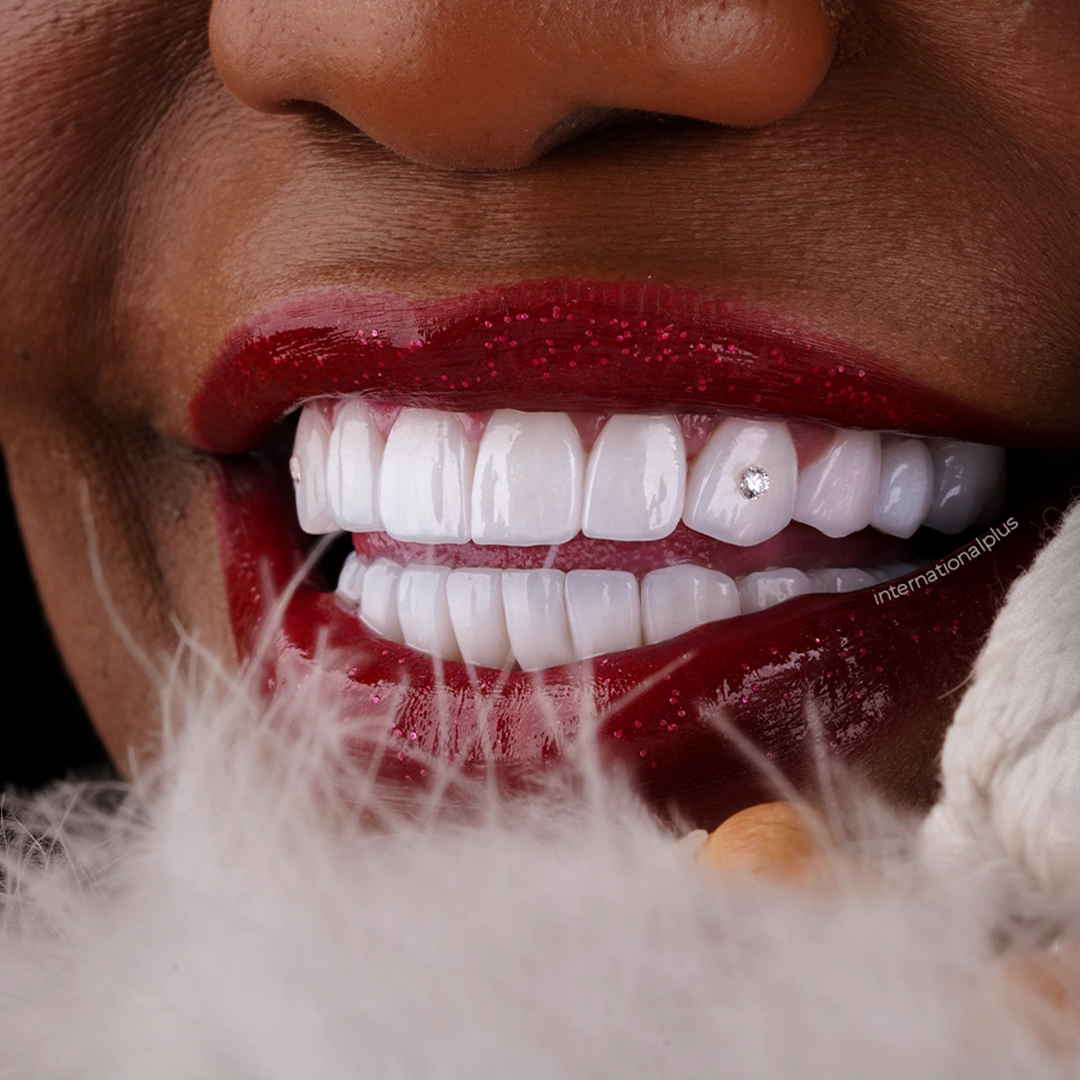
Twenty one of the 26 units were zirconium crowns on prepared natural teeth and five were screw retained on implants, meaning each of those five is held by a screw through the biting surface rather than by cement. Shade OM1 with the PLUS 1 form governed the aesthetic occlusion the patient requested.
Retrievability drove the retention choice on the implant borne units and a systematic review of screw versus cement retained reconstructions reports fewer biological complications for screw retention (Wittneben JG, et al., 2014). Our 27 unit screw retained zirconia rehabilitation sets out that reasoning in full. Long ceramic spans also need adequate prosthetic space and a material tolerating the load (AlTarawneh S, et al., 2021). Aesthetic occlusion here means the contact scheme was verified alongside tooth proportion rather than after it since the recontoured gum line had already changed the visible length of every anterior full ceramic crown restorations unit.
How Was the Patient Requested Tooth Diamond Integrated Into the Plan?
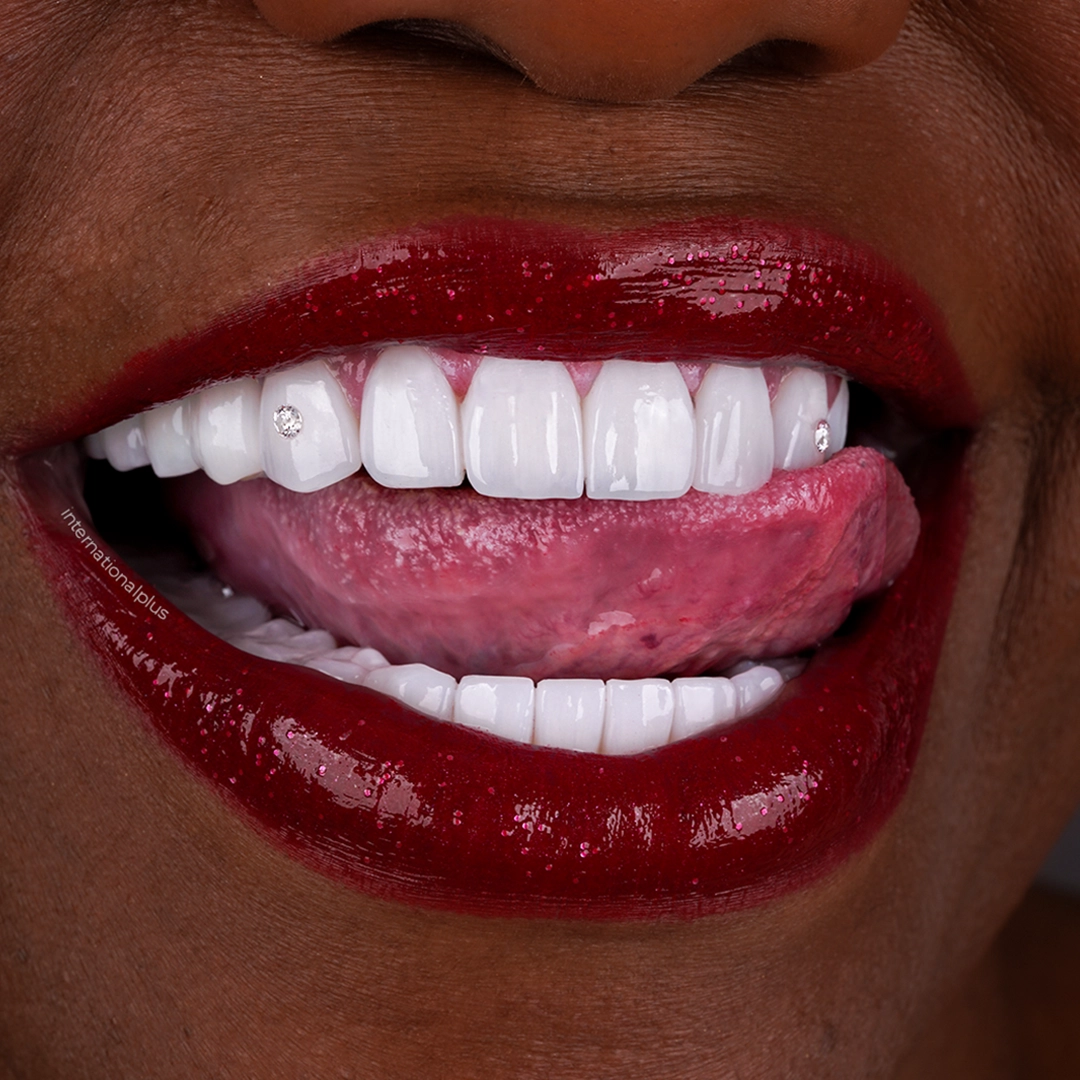
The chart records that Perritha would bring her own diamond for the 13 to 23 segment, the six upper front teeth from canine to canine. A tooth diamond is a small decorative stone bonded to an outer tooth surface. Placement was therefore handled as a design variable inside the prosthetic plan.
International Plus records this as a patient request, not as a clinical recommendation and makes no claim about its effect on tooth health. The technical consequence is straightforward: on a restored arch the bonding surface is zirconia rather than enamel so the site must be chosen where no opposing tooth contacts it during function and away from any screw access channel. Marking the position at the design stage lets the laboratory plan surface texture around the stone instead of adding it to a finished restoration. Patients considering a decorative addition are advised to discuss placement, later removal plus polishing of the surface with the treating team beforehand.
What the Full Mouth Zirconia With Gingival Recontouring Record Shows at Delivery
Perritha’s second session record closes with a night guard, a removable acrylic splint worn during sleep that absorbs clenching force before it reaches the ceramic. Zirconia neither wears nor flexes the way enamel does so occlusal protection is standard practice after a full mouth zirconia with gingival recontouring.
A 2026 systematic review of implant supported prostheses in patients with parafunctional habits lists occlusal splints among the strategies that reduce mechanical complications (Chawki I, et al., 2026). Nothing beyond the chart is claimed here: this is one patient under one set of recorded findings so individual results may vary. What the record does show is a repeatable order of work across four disciplines. International Plus combines official Ministry of Health authorization, 5,504+ verified Google reviews at 4.8/5 plus more than 200,000 international patients treated since 2014. Comparable sequencing appears in our full mouth reconstruction for severe bruxism and couple treated with full mouth zirconia crowns records.
Want your own multidisciplinary plan reviewed? Talk to our clinical coordination team
Frequently Asked Questions
What is gingivectomy in a full mouth restoration?
Gingivectomy is the surgical removal of excess gum tissue so more tooth surface becomes visible. In a full mouth restoration it resets the gum line before crown margins are prepared, which lets the laboratory design tooth proportions against a stable soft tissue level rather than a healing one.
Why does the gum line need to settle before crown preparation?
A crown margin cut against swollen or unhealed gum tissue ends up in the wrong position once that tissue matures. Reshaping first, then preparing at a later visit, keeps the finished margin at the intended level and reduces the risk of a visible line appearing later.
What is the difference between a type 2 and a type 3 root canal?
Difficulty grading describes canal anatomy rather than a different procedure. A lower grade covers straighter, easily negotiated canals while a higher grade covers curved, calcified or multi canal molars needing longer instrumentation time. Grading before treatment lets the endodontic team plan appointment length realistically.
Can gum reshaping be done at the same visit as tooth preparation?
Both approaches exist and the choice depends on how much tissue is removed and how close the bone crest sits. Where the reshaping is substantial, separating the two visits gives the tissue time to stabilise. A randomised trial has compared one stage and two stage protocols directly.
Is a tooth diamond suitable after full mouth crowns?
Placement on a restored arch differs from placement on enamel since the bonding surface is ceramic. Position must avoid opposing tooth contact and any screw access channel. Anyone considering a decorative addition should discuss placement, later removal plus surface polishing with the treating clinician first.
Reviewed by Dr. Celal Aktay
References
- Patel RM, et al. Functional crown lengthening surgery in the aesthetic zone: periodontic and prosthodontic considerations. Dent Update. 2015. PMID 26062277
- González-Martín O, et al. One versus two stage crown lengthening surgical procedure for aesthetic restorative purposes: a randomized controlled trial. J Clin Periodontol. 2020. PMID 32997836
- Jepsen S, et al. Periodontal manifestations of systemic diseases and developmental and acquired conditions: consensus report of workgroup 3 of the 2017 World Workshop. J Periodontol. 2018. PMID 29926943
- Almohaimede AA, et al. Significance of endodontic case difficulty assessment: a retrospective study. Int Dent J. 2022. PMC9485524
- Mario D, et al. The influence of indirect bonded restorations on clinical prognosis of endodontically treated teeth: a systematic review and meta-analysis. Dent Mater. 2022. PMID 35835608
- Wittneben JG, et al. Clinical performance of screw versus cement retained fixed implant-supported reconstructions: a systematic review. Int J Oral Maxillofac Implants. 2014. PMID 24660192
- AlTarawneh S, et al. Zirconia full arch implant prostheses: survival, complications and prosthetic space dimensions. Int J Oral Implantol (Berl). 2021. PMID 34006068
- Chawki I, et al. Particularities of the implant-supported prosthesis in patients with bruxism: systematic review of the literature. Pan Afr Med J. 2026. PMC13331755
Follow us on Social Media
internationalplusofficial
internationalplus
internationalplusdental
This content is written, reviewed, and approved by the International Plus Medical Review Board to ensure clinical accuracy and adherence to strict editorial standards. All medical information is regularly monitored, audited and updated in light of the latest scientific advancements.
However the information provided here is for general informational purposes only and cannot be used for self diagnosis or making individual health interpretations. Results of medical treatments depend on individual anatomy and the unique healing process of each patient. This information should not replace a personal consultation with a qualified healthcare professional. To understand the best options for your specific needs and to receive a personalized treatment plan, we invite you to book a free consultation with the expert medical team at International Plus.
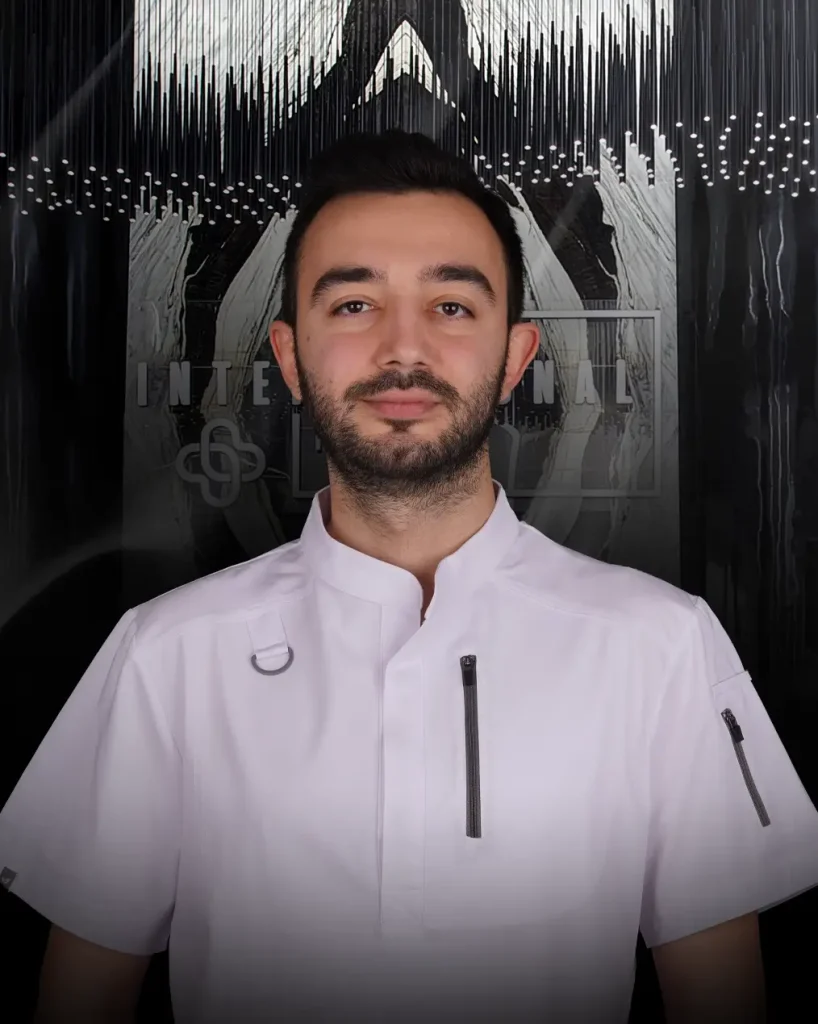
Dr. Celal Aktay delivers thorough, skillfully performed dental care with an emphasis on lasting results and patient satisfaction for travelers visiting InternationalPlus Istanbul. His systematic approach to case review ensures complete treatment planning that tackles every dimension of oral health rather than isolated issues.